

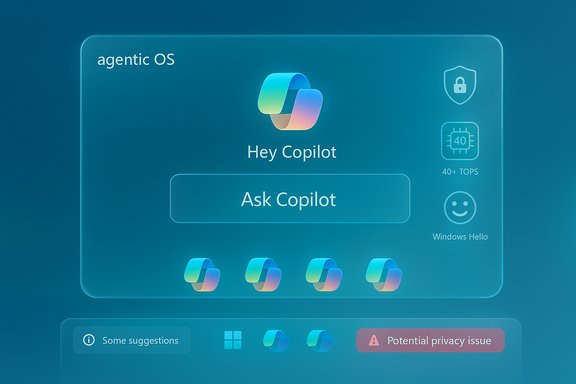
Microsoft’s latest AI push for Windows — framed in executive posts as Windows “evolving into an agentic OS” and showcased at Microsoft Ignite — touched off an unusually sharp, public backlash that exposed a widening gap between the company’s AI-first marketing and the everyday priorities of millions of Windows users. The row, which centered on aggressive Copilot branding, a controversial Recall feature, and an executive tone that many users called tone‑deaf, is more than a PR flub: it raises real questions about stability, privacy, value, and trust as AI moves from cloud experiments into the core of the operating system.
Google’s imbroglio over AI Overviews — which drew publisher complaints and regulatory scrutiny — is a clear parallel: AI features that reshuffle who captures value on the web can produce rapid, systemic backlash if value flows aren’t redistributed or if accuracy and opt‑out options are not provided. The current moment is therefore a market-wide stress test of how incumbents integrate AI without breaking critical trust relationships with users and partners.
Practical suggestions are straightforward: slow down where necessary, be transparent, default to privacy, publish reliability metrics, and give users straightforward, persistent control. If Microsoft can show measurable improvements — not just demos — and redesign messaging around consent and value rather than inevitability and hype, it can convert today’s distrust into tomorrow’s trusted capability. Until then, the company will continue to face vocal pushback from the user base it most needs to keep on board.
Source: The Hindu Why Microsoft’s AI is being criticised: Explained
 Background
How Microsoft framed the AI future for Windows
Over the past two years Microsoft moved decisively to make generative AI a platform-level differentiator. The company expanded its Copilot family across Microsoft 365, Edge, and Windows while building a hardware tier — Copilot+ PCs — positioned to run local inference workloads. At Microsoft Ignite the company presented a developer-facing stack (Windows AI Foundry, Model Context Protocol) and product features (Copilot Vision, Copilot Actions, taskbar agent integration) that together describe an operating system designed to host permissioned agents that can act on users’ behalf. This is the “agentic OS” concept executives promoted publicly.The immediate flashpoint
The controversy began when Windows and Devices president Pavan Davuluri used the phrase “Windows is evolving into an agentic OS” in a public post ahead of Ignite; the post drew an unusually large volume of negative replies, prompting Microsoft to limit responses and publicly acknowledge that the company “has a lot of work to do” on reliability and usability. The exchange then escalated when Microsoft AI CEO Mustafa Suleyman posted a short, incredulous reply to critics — invoking nostalgia (“Snake on a Nokia”) and saying he was “mind‑blown” that people were unimpressed — a tone many read as dismissive of practical, operational concerns.What Microsoft announced — the technical claims
Platform primitives and hardware
At Ignite Microsoft outlined several platform pieces intended to make agent-style experiences possible:- Model Context Protocol (MCP) and Windows AI Foundry for standardized agent interactions and context passing.
- On‑device runtimes for local inference, with Microsoft recommending Copilot+ PCs that include NPUs rated at roughly 40+ TOPS for richer local capabilities.
- Integration points across the taskbar, File Explorer, Outlook and other system surfaces — including “Ask Copilot” and Hey, Copilot voice activation on qualifying devices.
New user-facing features
Microsoft demoed and pushed features it sees as productivity multipliers:- Copilot Vision (multimodal understanding of images/video on screen).
- Copilot Actions (agents that can execute or automate system and app tasks).
- Recall (a searchable “photographic memory” for Copilot+ PCs that snapshots the desktop to allow later semantic search).
Why users reacted so strongly
1) Real-world performance vs. marketing demos
Multiple independent hands‑on reports and community reproductions found frequent mismatches between ad narratives and real-world results. Testers documented inconsistent vision recognition, hallucination-prone responses, and brittle automation behavior that often failed to reproduce scripted demos. Those failures matter: when an assistant is promoted as speeding a workflow and instead introduces errors or extra steps, frustration accumulates quickly and visibly.2) Perception of forced integration and loss of user control
Long-time Windows users and power users complained that AI elements feel pervasive rather than optional. Prompts, Copilot icons, and agent suggestions appear in many places; for some users, that looks a lot like forced AI baked into the OS experience rather than a discreet, opt-in productivity layer. That perception is amplified by bundling Copilot into paid tiers and by visible prompts pushing Microsoft services, which some interpret as monetization-first design.3) Privacy and security anxiety — Recall as a case study
The Recall feature crystallized concerns. Recall’s original design — taking frequent screenshots of desktop activity, indexing them, and making them searchable — triggered immediate alarm from security researchers and privacy advocates. Microsoft delayed and reworked Recall multiple times, and the company ultimately shifted the feature to be off by default and gated by opt‑in flows and Windows Hello authentication, while adding encryption to stored data. Still, the optics of an OS component that can capture large amounts of on-screen content remain deeply unsettling for many users and independent developers who built browser‑level protections (for example, Signal, Brave and AdGuard added measures to block Recall).4) Reliability and “fix the basics” sentiment
A recurring thread in user responses was simple: fix stability, update reliability, and preserve performance before layering new AI features. That argument is practical. Embedding heavy-weight, multimodal models and persistent agents into system surfaces changes resource demands, update cadence, and failure modes — and many users say Windows hasn’t proven it can keep the basics solid while doing this.5) Hallucinations and content integrity
AI hallucination — confidently wrong answers or invented facts — remains a core limitation of today’s large language models. Several users and reporters reported that Copilot-style assistants produced inaccurate or misleading outputs in real tasks, eroding trust when the assistant is positioned as a reliability multiplier. Independent analyses of AI summarization tools from major vendors have also shown factual errors and context loss, which feeds the credibility problem.Verifying the facts: what’s true, what changed, and what’s still unsettled
- The phrase “agentic OS” originated in public posts from Windows leadership and was widely reported in the lead-up to Microsoft Ignite; Microsoft staff later acknowledged a need to prioritize reliability and developer ergonomics.
- Mustafa Suleyman’s social post reacting to critics — the “Snake on a Nokia” line and the “mind‑blown” phrasing — is widely reported and attributable to his comments amid the Ignite timeframe. That post intensified the optics problem.
- The Recall feature was delayed, placed behind opt‑in gating for Copilot+ PCs, and adjusted to require Windows Hello and encryption for stored snapshots; independent reporting confirms Microsoft changed Recall’s default and added technical mitigations. However, the earlier period when files were accessible in plaintext and the surrounding security concerns are documented — and rightly flagged by researchers — so the product’s safety posture has evolved under real scrutiny. Readers should treat detailed claims about singular data-exposure incidents with caution unless confirmed by forensic reporting.
- Hardware guidance for Copilot+ devices — Microsoft’s public materials and Ignite communications recommended NPUs in the 40+ TOPS range for the most capable on‑device experiences; that figure appears consistently in Microsoft marketing for the Copilot+ class.
- Adoption friction: Dell’s COO Jeffrey Clarke reported an installed-base picture suggesting roughly 500 million devices capable of running Windows 11 have not upgraded, and another ~500 million are older and cannot — a number Dell provided on a recent earnings call and which was widely reported by outlets tracking PC migration. That stat helps explain why many users resist “forced” migration to an AI-first Windows on new hardware.
Strengths in Microsoft’s approach — why the vision has merit
- Clear platform ambition: Microsoft is explicit about treating AI as a platform primitive for Windows, not merely an app. That consistency allows hardware partners, enterprise IT, and independent developers to build toward a shared model (MCP, Foundry). A platform-level approach can accelerate useful integrations (e.g., contextual summarization across apps) when reliability improves.
- Hybrid compute model: Combining local inference on Copilot+ hardware with cloud capabilities gives Microsoft flexibility to optimize for privacy-sensitive or latency-sensitive tasks. On‑device inference is attractive for organizations that want to reduce data egress and for users who want faster responses for some features.
- Enterprise control primitives: Microsoft explicitly sells these features to enterprise customers with policy, tenant isolation, and admin controls in mind — a necessary condition if companies are to adopt agents for mission-critical workflows. If executed well, those controls will be decisive for enterprise uptake.
- Investment in tooling and developer surfaces: By providing APIs and protocols, Microsoft can enable third parties to build verified agents that operate within user-consented boundaries — a potential antidote to the “forced AI” critique if the company prioritizes robust consent and transparent permissions.
The most serious risks and what they mean for users
- Trust erosion from accuracy failures. Tasks that require precision — legal, medical, financial — cannot tolerate hallucinations. If Copilot-style agents make consequential errors, the result will be slower enterprise adoption and a longer trust-rebuilding period for consumer users. Independent testing already shows real-world gaps; product teams must prioritize accuracy and auditability.
- Privacy surface expansion. Features like Recall expand the attack surface: more local snapshots, search indices, and permissioned agent contexts mean more targets if implementation or configuration is weak. Even with encryption and Windows Hello gating, the very existence of a searchable index of desktop activity creates new threat models that need continuous, independent security review.
- Performance and device fragmentation. Embedding heavy models and always‑on components risks degrading battery life and responsiveness on older hardware. Microsoft’s Copilot+ hardware guidance implicitly acknowledges this, but the installed base is large and uneven; many users will be forced into tradeoffs or device refreshes they don’t want. Dell’s adoption numbers make this practical constraint obvious.
- Monetization optics and user consent. When an OS nudges users toward paid Copilot tiers or preloads services, the feature can look like upsell rather than utility. A history of in‑OS commercial prompts and bundled services heightens consumer skepticism. Without clear, persistent opt-outs and transparent billing/entitlement messaging, user resentment will persist.
- Ecosystem externalities (publishers, web content). The broader AI shift in search and content summarization — exemplified by Google’s AI Overviews and the legal fights that followed — demonstrates a systemic risk: when AI layers summarize the web’s work, publishers can lose traffic and revenue. Microsoft’s agentic web‑facing features may have similar, wide-reaching effects if not paired with fair content licensing and revenue-sharing mechanisms.
How Microsoft can (and must) respond — an evidence‑based roadmap
- Prioritize reliability metrics publicly.
- Release measurable accuracy, latency, and correctness benchmarks for Copilot features — including long‑conversation stability and multimodal vision tests — and publish regression timelines. Independent reviewers need benchable data to evaluate progress.
- Strengthen privacy-by-default and transparency.
- Make all agentic and indexing features off by default on all Windows SKUs, explain what is captured in human-readable terms during setup, and allow one-click, persistent global opt-outs that persist across feature updates. Documentation should include a clear, auditable description of where sensitive data is filtered (for example, private modes, specified apps).
- Open the security design to third‑party audit.
- Invite independent security researchers and regulators to audit Recall and similar components, publish red-team results and remediation steps, and maintain a public timeline of fixes.
- Reduce in‑OS commercial friction.
- Separate product UX and helpful hints from paywall nudges; ensure users understand which Copilot features are free, which require paid Microsoft 365 / Copilot licenses, and how to disable prompts and telemetry.
- Build enterprise-grade governance controls.
- For large customers, provide per‑tenant policy templates, exportable audit logs for agent activity, and enforcement primitives so admins can approve or block specific third‑party agents.
- Fund a third‑party verification program.
- A “Verified Agents” program that certifies agent behavior, security, and privacy controls could reduce distrust and help users choose trustworthy agents.
Where this fits in the broader industry picture
Microsoft’s experience is not unique, but it is distinct because Windows is a consumer-facing operating system used daily by a vast, heterogeneous population. AI companies focused solely on cloud models or conversational products (OpenAI, Anthropic) face different user expectations: their customers anticipate experimentation and novelty. By contrast, legacy platform vendors are measured against long-standing expectations of stability, control, and transparency.Google’s imbroglio over AI Overviews — which drew publisher complaints and regulatory scrutiny — is a clear parallel: AI features that reshuffle who captures value on the web can produce rapid, systemic backlash if value flows aren’t redistributed or if accuracy and opt‑out options are not provided. The current moment is therefore a market-wide stress test of how incumbents integrate AI without breaking critical trust relationships with users and partners.
Conclusion
Microsoft’s “agentic OS” vision is ambitious and potentially transformative: allowing trusted, permissioned agents to perform cross‑app tasks could deliver real productivity gains for businesses and skilled users. But the backlash that followed Davuluri’s and Suleyman’s public statements — amplified by widely shared testing and a high-profile privacy scare around Recall — is a clear sign that execution hasn’t kept pace with rhetoric. The problems are not merely cosmetic: they are about accuracy, security, consent, and the basic user contract that an operating system promises.Practical suggestions are straightforward: slow down where necessary, be transparent, default to privacy, publish reliability metrics, and give users straightforward, persistent control. If Microsoft can show measurable improvements — not just demos — and redesign messaging around consent and value rather than inevitability and hype, it can convert today’s distrust into tomorrow’s trusted capability. Until then, the company will continue to face vocal pushback from the user base it most needs to keep on board.
Quick reference (key verified points)
- “Agentic OS” phrasing and the social media backlash occurred in November around Microsoft Ignite; executives acknowledged user concerns.
- Recall was delayed, moved to opt‑in, and received security changes (Windows Hello gating, encryption) after independent criticism. Recent reporting confirms both the original weaknesses and the subsequent mitigations.
- Independent hands‑on testing showed Copilot features failing to reproduce some marketing scenarios; multiple outlets documented accuracy and consistency issues.
- Dell reported roughly 500 million devices capable of running Windows 11 remain un-upgraded — a structural adoption challenge that shapes how rapidly hardware-gated AI experiences can scale.
Source: The Hindu Why Microsoft’s AI is being criticised: Explained
