

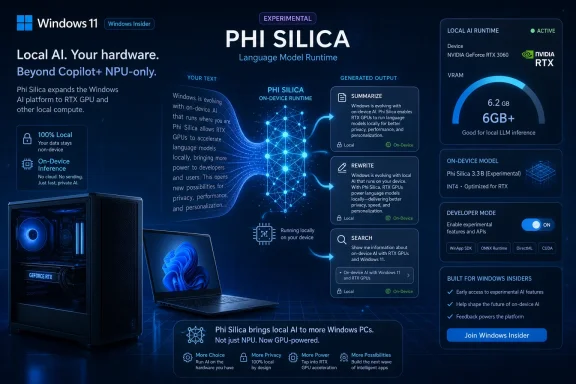
Microsoft’s June 2026 Windows App SDK experimental release lets developers run the Phi Silica language-model APIs on non-Copilot+ Windows 11 PCs with supported Nvidia RTX 30-series-or-newer GPUs, at least 6GB of VRAM, Developer Mode enabled, and a Windows Insider Experimental Channel build. That is not the same as turning every gaming desktop into a Copilot+ PC, but it is the clearest sign yet that Microsoft’s AI strategy on Windows is moving beyond the NPU-only story it sold in 2024. The company is not abandoning Copilot+ branding so much as admitting that the Windows AI runtime has to meet the installed base where it already lives. For developers, enthusiasts, and IT departments, the important shift is not marketing language; it is that local AI on Windows is starting to look like a platform capability rather than a laptop refresh incentive.
When Microsoft introduced Copilot+ PCs in 2024, the hardware line was clean by design: a qualifying machine needed a neural processing unit capable of more than 40 TOPS, along with modern memory and storage baselines. The message was easy to sell on a keynote slide. Buy the new class of Windows PCs, get the new AI experiences.
That clarity helped Microsoft, Qualcomm, AMD, Intel, and PC OEMs rally around a single upgrade narrative. It also created an awkward dividing line across the Windows ecosystem. A thin-and-light laptop with a new NPU could qualify for features that a far more expensive desktop workstation, gaming tower, or creator laptop could not, even if that older machine had a GPU capable of vastly more raw AI throughput.
The distinction made sense if the only question was battery life. NPUs are built to run sustained AI workloads efficiently, quietly, and without hammering the CPU or discrete GPU. That matters on a laptop sitting in a meeting, translating audio, summarizing text, or indexing recent activity in the background.
But Windows is not just a laptop operating system. It is also the platform of high-end desktops, gaming rigs, engineering workstations, home labs, and office machines with surprisingly capable graphics hardware. Locking local AI APIs to one kind of accelerator may have been a tidy launch strategy, but it was never a convincing long-term architecture for Windows.
That is a lot of friction, and it is clearly not aimed at ordinary users today. This is developer plumbing, not a consumer switch. The model is downloaded on demand through Windows Update, apps are expected to check readiness before calling into it, and the feature sits in the experimental branch precisely because Microsoft is still testing the shape of the platform.
Still, the technical move matters because it changes the premise. Phi Silica, Microsoft’s small local language model for Windows, was introduced as an NPU-optimized part of the Copilot+ developer story. Making it available on supported GPUs turns it into something closer to a Windows AI substrate: a common local model that apps can call without shipping their own model, managing their own inference stack, or depending entirely on cloud APIs.
That is the beginning of a more credible Windows AI platform. It says developers may eventually target capability classes rather than marketing badges. It says Microsoft understands that a runtime confined to the latest AI laptops will not generate the app ecosystem it needs.
That distinction matters because “Copilot+ feature” has become a fuzzy phrase. Some people use it to mean Microsoft’s branded Windows experiences, such as Recall, Click to Do, Cocreator, live captions translations, and AI-enhanced settings. Developers may use similar language to refer to the Windows AI APIs that expose local models and services. The GPU test appears focused on the language-model API layer, not on recreating the full Copilot+ shell experience.
For now, this is best understood as Microsoft testing a second execution path for one important part of the AI stack. Apps that want local text generation or summarization through Phi Silica may be able to run on a supported GPU. Apps that rely on other Windows AI components may still find themselves limited to Copilot+ hardware.
That is why the “Microsoft is killing Copilot+” framing overshoots the evidence. The company is not dismantling the badge. It is weakening the badge’s role as the sole gatekeeper for local AI development, which is more subtle and more consequential.
On a desktop PC, an RTX GPU is not a compromise for AI inference. It may be far more powerful than a laptop NPU in raw terms. The trade-off is that it can draw much more power, produce more heat, and compete with graphics or compute workloads the user actually bought the GPU to perform.
That trade-off is fine for many Windows users. A desktop plugged into the wall does not need the same power budget as a 14-inch laptop. A creator workstation that already runs local Stable Diffusion, Blender acceleration, or CUDA workloads is a natural host for local language-model inference. A gaming laptop on AC power may be a better AI test machine than an ultrabook with a modest NPU.
Microsoft’s 2024 Copilot+ pitch leaned heavily on efficiency because the first wave of machines needed a reason to exist. In 2026, the better argument is flexibility. If the same Windows AI API can use an NPU where efficiency matters and a GPU where availability or throughput matters, Microsoft has a stronger platform story than it had with a single hardware gate.
A platform API needs reach. If a developer adds local summarization, rewriting, semantic search, or offline assistance to a Windows app, that work becomes easier to justify when it can run on a meaningful share of machines. The moment Microsoft expands hardware coverage, the API looks less like a novelty for new laptops and more like a real dependency developers can plan around.
This is especially important because Microsoft is competing not only with macOS, but with the open-source AI ecosystem on Windows itself. Enthusiasts already run local models through Ollama, LM Studio, llama.cpp, ComfyUI, and vendor-specific stacks. Many of those tools are messy, powerful, fast-moving, and indifferent to whether a PC carries a Copilot+ sticker.
Microsoft’s advantage is not that it can beat every open-source tool on performance or model choice. Its advantage is integration. If Windows can provide a managed, shared, updateable, privacy-aware local AI component that apps can call consistently, developers get a simpler path and users get fewer duplicated runtimes. That only works if Microsoft stops treating the NPU badge as the whole story.
The AI feature set has also had a credibility problem. Recall, the most visible Copilot+ feature, became controversial almost immediately because of security and privacy concerns. Microsoft reworked it, delayed it, and repositioned it with stronger controls, but the episode damaged the idea that AI features alone would drive a PC upgrade wave.
Other features were useful but not category-defining. Live captions translation, Cocreator, studio effects, and local model APIs can be valuable, yet they do not necessarily make a two-year-old laptop feel obsolete. The gap between “interesting demo” and “must buy a new PC” remained wide.
GPU support is Microsoft’s tacit acknowledgment that AI adoption cannot depend entirely on hardware replacement. If Windows AI is going to matter, it has to spread through software channels as well as new-device channels. That does not make Copilot+ irrelevant, but it does make the badge less exclusive than Microsoft originally implied.
GPU support widens that promise. A developer building a note app, document tool, IDE helper, legal review utility, or local knowledge-base assistant can now imagine reaching users with powerful desktops and creator laptops, not just new Copilot+ machines. That matters for line-of-business apps, where the installed hardware fleet may be a mix of devices bought over several years.
But the current implementation is not yet smooth enough to become a mainstream production target. Experimental Channel builds are not appropriate for normal users. Developer Mode is a deliberate barrier. Driver requirements add another variable, and the first supported GPU class is Nvidia-only, with AMD support described as coming later.
The feature differences are also real. Microsoft notes that some NPU-side optimizations, including prompt compression and speculative decoding, are not currently available on GPU. That means developers cannot assume identical behavior or performance across NPU and GPU targets. The API may abstract the model, but it does not erase hardware differences.
A Windows-managed model also has governance appeal. If Microsoft handles model distribution through Windows Update and exposes AI components through system settings, admins can at least imagine policy controls, inventory, and lifecycle management. That is preferable to every department quietly installing its own model runner and plugin stack.
The problem is that experimental GPU support is not enterprise-ready today. Insider Experimental Channel builds are not deployment targets for production fleets. Developer Mode is often disabled by policy. Driver provenance matters, and organizations may not want users installing beta GPU drivers directly from vendors just to make a local language model work.
There is also the question of auditability. If apps can call local AI APIs, administrators will want to know which apps are doing it, what data is being processed, whether outputs are logged, whether models are removable, and how updates are approved. Microsoft has the ingredients for that story, but enterprises will need controls, documentation, and stable channel support before this becomes more than a lab curiosity.
That is unsurprising. Nvidia has the deepest consumer GPU AI ecosystem, and RTX 30-series hardware is common enough to matter while modern enough to offer the necessary acceleration features and memory. A 6GB VRAM floor also filters out low-end configurations that might technically run a model but deliver a poor experience.
The choice creates some awkward optics. Microsoft’s Copilot+ push was supposed to highlight NPUs across Qualcomm, AMD, and Intel silicon. The first meaningful non-NPU expansion gives Nvidia desktop and gaming hardware a privileged role. That is not necessarily favoritism; it may simply be where the engineering path is ready first.
But platform politics matter. AMD and Intel will not want Windows AI to become another developer surface where Nvidia arrives first and defines the baseline. If Microsoft wants Windows AI APIs to feel hardware-neutral, it will need to make good on broader GPU support quickly and communicate clearly how execution providers are selected, updated, and tested.
This is particularly true at the low end. Entry-level laptops are sensitive to memory and storage pricing, and Copilot+ requirements already pushed devices toward 16GB of RAM and modern SoCs. If affordable machines get squeezed, Microsoft cannot rely on a smooth transition where everyone naturally ends up with a qualifying NPU within a short cycle.
Desktop users are a separate problem. Many do not buy OEM PCs on laptop-like refresh schedules. They upgrade GPUs, add storage, stretch CPUs, and keep systems alive for years. A Windows AI strategy that ignores that behavior leaves some of the most technically engaged Windows users outside the fence.
GPU support is the obvious escape hatch. It lets Microsoft seed local AI capabilities into machines that already exist and already contain accelerators. It also gives the company a way to keep Windows 11 feeling modern without telling every user the answer is a new laptop.
That is a better idea than embedding AI features only in Microsoft’s own apps. If AI is genuinely useful on the PC, third-party software needs access to it. A writing app should not have to reinvent local text generation. A document manager should not have to ship its own OCR stack. A conferencing app should not have to build every enhancement from scratch.
The risk is fragmentation. If some APIs require NPUs, one runs on select Nvidia GPUs, another can use CPUs, and features behave differently depending on execution path, developers may hesitate. The Windows ecosystem has lived through hardware capability fragmentation before, and it usually produces cautious adoption rather than bold bets.
Microsoft’s job is to make the abstraction trustworthy without pretending all accelerators are the same. Apps need reliable capability checks, graceful fallback paths, clear performance expectations, and transparent model management. The experimental SDK is a start, but the developer story will only be compelling when it reaches stable channels and ordinary PCs.
But Microsoft does not get automatic trust here. Recall taught the company that “local” does not end the conversation. Users also care about what is collected, how it is stored, which apps can access it, how long it persists, whether it is encrypted, and how easy it is to disable.
Phi Silica on GPU is less controversial than Recall because it is an API for model inference, not a system that records user activity. Still, the same governance questions will follow every Windows AI component. If local models become shared system resources, users and admins will need clear controls for installation, removal, permissions, and data boundaries.
This is where Microsoft can turn a messy hardware pivot into a stronger story. The company should not sell GPU support as a way to make old PCs “Copilot+ enough.” It should sell Windows AI as a controlled local runtime that runs on the best available hardware under policies users can understand.
The badge can also remain useful for buyers who do not want to parse GPU models, VRAM, drivers, Insider builds, and API support tables. In retail, simplicity matters. A Copilot+ PC label tells buyers that Microsoft and the OEM intend the machine to support a defined set of AI experiences.
What changes is exclusivity. If Microsoft continues expanding Windows AI APIs to GPUs and CPUs where appropriate, Copilot+ becomes the premium, efficient, fully supported path rather than the only path. That is healthier for the platform, even if it blunts the marketing edge OEMs enjoyed in 2024.
There is precedent for this kind of softening. Windows features often debut with specific hardware before spreading through broader capability checks. The initial boundary creates focus; the eventual expansion creates scale. Copilot+ may be following that pattern, only under the glare of a much louder AI hype cycle.
Windows AI APIs are a bid to prevent that. By offering a system-managed model and hardware acceleration through Windows App SDK, Microsoft is trying to make the easiest path also the native path. That matters because defaults shape ecosystems. Developers use what is stable, documented, performant, and already present.
The GPU experiment strengthens that bid because it acknowledges developer reality. The Windows machines most likely to be used by AI-curious developers already have GPUs. The machines most likely to run heavy local experiments often are not Copilot+ laptops. If Microsoft wants developer mindshare, it cannot insist that everyone start with the newest NPU notebook.
The challenge is that developers have become wary of Windows platform promises that arrive slowly, change names, or remain confined to limited-access programs. Microsoft needs to show that Windows AI APIs will be stable, broadly available, and worth integrating for more than demo apps. GPU support is a good signal, but follow-through will matter more.
For enthusiasts, the development is still worth watching closely. It could bring Microsoft-supported local language features to existing gaming and creator PCs. For developers, it could enlarge the audience for Windows AI apps. For admins, it foreshadows policy decisions that will become unavoidable if local AI components become normal parts of Windows.
 Microsoft’s NPU Wall Was Always Too Neat to Last
When Microsoft introduced Copilot+ PCs in 2024, the hardware line was clean by design: a qualifying machine needed a neural processing unit capable of more than 40 TOPS, along with modern memory and storage baselines. The message was easy to sell on a keynote slide. Buy the new class of Windows PCs, get the new AI experiences.That clarity helped Microsoft, Qualcomm, AMD, Intel, and PC OEMs rally around a single upgrade narrative. It also created an awkward dividing line across the Windows ecosystem. A thin-and-light laptop with a new NPU could qualify for features that a far more expensive desktop workstation, gaming tower, or creator laptop could not, even if that older machine had a GPU capable of vastly more raw AI throughput.
The distinction made sense if the only question was battery life. NPUs are built to run sustained AI workloads efficiently, quietly, and without hammering the CPU or discrete GPU. That matters on a laptop sitting in a meeting, translating audio, summarizing text, or indexing recent activity in the background.
But Windows is not just a laptop operating system. It is also the platform of high-end desktops, gaming rigs, engineering workstations, home labs, and office machines with surprisingly capable graphics hardware. Locking local AI APIs to one kind of accelerator may have been a tidy launch strategy, but it was never a convincing long-term architecture for Windows.
The Experimental SDK Is Small, but the Signal Is Loud
The new change is narrow in its current form. Microsoft’s Windows App SDK 2.2.2 experimental release adds GPU support for Language Model APIs on non-Copilot+ PCs, beginning with Nvidia GeForce RTX 30-series and newer GPUs with at least 6GB of VRAM. The feature requires a Windows Insider Experimental Channel build, Developer Mode, and a recent vendor GPU driver rather than a generic driver delivered through Windows Update.That is a lot of friction, and it is clearly not aimed at ordinary users today. This is developer plumbing, not a consumer switch. The model is downloaded on demand through Windows Update, apps are expected to check readiness before calling into it, and the feature sits in the experimental branch precisely because Microsoft is still testing the shape of the platform.
Still, the technical move matters because it changes the premise. Phi Silica, Microsoft’s small local language model for Windows, was introduced as an NPU-optimized part of the Copilot+ developer story. Making it available on supported GPUs turns it into something closer to a Windows AI substrate: a common local model that apps can call without shipping their own model, managing their own inference stack, or depending entirely on cloud APIs.
That is the beginning of a more credible Windows AI platform. It says developers may eventually target capability classes rather than marketing badges. It says Microsoft understands that a runtime confined to the latest AI laptops will not generate the app ecosystem it needs.
This Is Not Recall for Your Gaming PC
The most important caveat is also the easiest to miss: GPU support for Phi Silica does not mean Microsoft is opening the entire Copilot+ feature set to every RTX desktop. The current support matrix still leaves most Windows AI APIs on the NPU side of the fence. OCR, imaging APIs, object erase, image description, and other Copilot+ experiences remain tied to NPU-equipped Copilot+ PCs in Microsoft’s documentation.That distinction matters because “Copilot+ feature” has become a fuzzy phrase. Some people use it to mean Microsoft’s branded Windows experiences, such as Recall, Click to Do, Cocreator, live captions translations, and AI-enhanced settings. Developers may use similar language to refer to the Windows AI APIs that expose local models and services. The GPU test appears focused on the language-model API layer, not on recreating the full Copilot+ shell experience.
For now, this is best understood as Microsoft testing a second execution path for one important part of the AI stack. Apps that want local text generation or summarization through Phi Silica may be able to run on a supported GPU. Apps that rely on other Windows AI components may still find themselves limited to Copilot+ hardware.
That is why the “Microsoft is killing Copilot+” framing overshoots the evidence. The company is not dismantling the badge. It is weakening the badge’s role as the sole gatekeeper for local AI development, which is more subtle and more consequential.
The GPU Was Never the Weak Option
There is a temptation to think of NPUs as “AI chips” and GPUs as gaming hardware drafted into AI work by accident. That gets the history backward. GPUs have been the dominant accelerator for modern machine learning for years, and Nvidia’s CUDA ecosystem is one reason the current AI boom exists in the form it does.On a desktop PC, an RTX GPU is not a compromise for AI inference. It may be far more powerful than a laptop NPU in raw terms. The trade-off is that it can draw much more power, produce more heat, and compete with graphics or compute workloads the user actually bought the GPU to perform.
That trade-off is fine for many Windows users. A desktop plugged into the wall does not need the same power budget as a 14-inch laptop. A creator workstation that already runs local Stable Diffusion, Blender acceleration, or CUDA workloads is a natural host for local language-model inference. A gaming laptop on AC power may be a better AI test machine than an ultrabook with a modest NPU.
Microsoft’s 2024 Copilot+ pitch leaned heavily on efficiency because the first wave of machines needed a reason to exist. In 2026, the better argument is flexibility. If the same Windows AI API can use an NPU where efficiency matters and a GPU where availability or throughput matters, Microsoft has a stronger platform story than it had with a single hardware gate.
The Installed Base Is the Platform Microsoft Cannot Ignore
The cold business logic is obvious: Windows developers will not build enthusiastically for APIs that run only on a small slice of the PC base. Copilot+ PCs have been on the market for two years, but Windows has decades of hardware diversity behind it. That installed base includes millions of RTX 30- and 40-series systems that are too capable to ignore.A platform API needs reach. If a developer adds local summarization, rewriting, semantic search, or offline assistance to a Windows app, that work becomes easier to justify when it can run on a meaningful share of machines. The moment Microsoft expands hardware coverage, the API looks less like a novelty for new laptops and more like a real dependency developers can plan around.
This is especially important because Microsoft is competing not only with macOS, but with the open-source AI ecosystem on Windows itself. Enthusiasts already run local models through Ollama, LM Studio, llama.cpp, ComfyUI, and vendor-specific stacks. Many of those tools are messy, powerful, fast-moving, and indifferent to whether a PC carries a Copilot+ sticker.
Microsoft’s advantage is not that it can beat every open-source tool on performance or model choice. Its advantage is integration. If Windows can provide a managed, shared, updateable, privacy-aware local AI component that apps can call consistently, developers get a simpler path and users get fewer duplicated runtimes. That only works if Microsoft stops treating the NPU badge as the whole story.
Copilot+ Branding Met the Reality of PC Buying
The original Copilot+ PC campaign assumed users would understand and value a new hardware category. Some did, especially buyers already in the market for premium laptops. But PC buying is rarely that clean. Many people purchase whatever is available at a given price when their old machine fails, when work refresh cycles arrive, or when a sale makes an upgrade tolerable.The AI feature set has also had a credibility problem. Recall, the most visible Copilot+ feature, became controversial almost immediately because of security and privacy concerns. Microsoft reworked it, delayed it, and repositioned it with stronger controls, but the episode damaged the idea that AI features alone would drive a PC upgrade wave.
Other features were useful but not category-defining. Live captions translation, Cocreator, studio effects, and local model APIs can be valuable, yet they do not necessarily make a two-year-old laptop feel obsolete. The gap between “interesting demo” and “must buy a new PC” remained wide.
GPU support is Microsoft’s tacit acknowledgment that AI adoption cannot depend entirely on hardware replacement. If Windows AI is going to matter, it has to spread through software channels as well as new-device channels. That does not make Copilot+ irrelevant, but it does make the badge less exclusive than Microsoft originally implied.
Developers Get a Better Story, but Not Yet a Clean One
For developers, the appeal of Windows AI APIs is straightforward: call a Microsoft-managed model rather than bundling one, licensing one, downloading one, or paying for cloud inference. A system-level model can reduce app size, simplify deployment, and create a more predictable baseline. It can also support offline and privacy-sensitive scenarios where cloud calls are inappropriate.GPU support widens that promise. A developer building a note app, document tool, IDE helper, legal review utility, or local knowledge-base assistant can now imagine reaching users with powerful desktops and creator laptops, not just new Copilot+ machines. That matters for line-of-business apps, where the installed hardware fleet may be a mix of devices bought over several years.
But the current implementation is not yet smooth enough to become a mainstream production target. Experimental Channel builds are not appropriate for normal users. Developer Mode is a deliberate barrier. Driver requirements add another variable, and the first supported GPU class is Nvidia-only, with AMD support described as coming later.
The feature differences are also real. Microsoft notes that some NPU-side optimizations, including prompt compression and speculative decoding, are not currently available on GPU. That means developers cannot assume identical behavior or performance across NPU and GPU targets. The API may abstract the model, but it does not erase hardware differences.
Enterprise IT Will See Promise Wrapped in Policy Risk
For IT administrators, the expansion of local AI APIs cuts both ways. On the positive side, local inference can reduce dependence on external AI services, preserve data on device, and avoid per-call cloud costs. That is attractive in regulated environments and in organizations still wary of sending business content to hosted AI systems.A Windows-managed model also has governance appeal. If Microsoft handles model distribution through Windows Update and exposes AI components through system settings, admins can at least imagine policy controls, inventory, and lifecycle management. That is preferable to every department quietly installing its own model runner and plugin stack.
The problem is that experimental GPU support is not enterprise-ready today. Insider Experimental Channel builds are not deployment targets for production fleets. Developer Mode is often disabled by policy. Driver provenance matters, and organizations may not want users installing beta GPU drivers directly from vendors just to make a local language model work.
There is also the question of auditability. If apps can call local AI APIs, administrators will want to know which apps are doing it, what data is being processed, whether outputs are logged, whether models are removable, and how updates are approved. Microsoft has the ingredients for that story, but enterprises will need controls, documentation, and stable channel support before this becomes more than a lab curiosity.
Nvidia Gets the First Seat at the Table
The initial hardware support is telling. Nvidia RTX 30-series and newer GPUs with at least 6GB of VRAM are the first targets, while AMD GPU support is listed as coming soon. Intel discrete GPU support is not the headline here, and integrated graphics are not the point of this first wave.That is unsurprising. Nvidia has the deepest consumer GPU AI ecosystem, and RTX 30-series hardware is common enough to matter while modern enough to offer the necessary acceleration features and memory. A 6GB VRAM floor also filters out low-end configurations that might technically run a model but deliver a poor experience.
The choice creates some awkward optics. Microsoft’s Copilot+ push was supposed to highlight NPUs across Qualcomm, AMD, and Intel silicon. The first meaningful non-NPU expansion gives Nvidia desktop and gaming hardware a privileged role. That is not necessarily favoritism; it may simply be where the engineering path is ready first.
But platform politics matter. AMD and Intel will not want Windows AI to become another developer surface where Nvidia arrives first and defines the baseline. If Microsoft wants Windows AI APIs to feel hardware-neutral, it will need to make good on broader GPU support quickly and communicate clearly how execution providers are selected, updated, and tested.
The AI PC Market Needed a Software Escape Hatch
Microsoft’s change also lands in a harsher PC market than the one Copilot+ launched into. AI demand has strained memory and storage supply chains, and the industry has been warning about higher component costs. As prices rise, the idea that users will casually refresh hardware for AI features becomes harder to sustain.This is particularly true at the low end. Entry-level laptops are sensitive to memory and storage pricing, and Copilot+ requirements already pushed devices toward 16GB of RAM and modern SoCs. If affordable machines get squeezed, Microsoft cannot rely on a smooth transition where everyone naturally ends up with a qualifying NPU within a short cycle.
Desktop users are a separate problem. Many do not buy OEM PCs on laptop-like refresh schedules. They upgrade GPUs, add storage, stretch CPUs, and keep systems alive for years. A Windows AI strategy that ignores that behavior leaves some of the most technically engaged Windows users outside the fence.
GPU support is the obvious escape hatch. It lets Microsoft seed local AI capabilities into machines that already exist and already contain accelerators. It also gives the company a way to keep Windows 11 feeling modern without telling every user the answer is a new laptop.
Local AI Is Becoming a Windows Runtime, Not a Feature Demo
The deeper shift is architectural. Microsoft has spent years trying to make Windows more than a shell and app launcher for cloud services. Windows AI APIs are an attempt to make local models part of the operating system’s developer contract, similar in spirit to how Windows exposes media, graphics, identity, notifications, and sensors.That is a better idea than embedding AI features only in Microsoft’s own apps. If AI is genuinely useful on the PC, third-party software needs access to it. A writing app should not have to reinvent local text generation. A document manager should not have to ship its own OCR stack. A conferencing app should not have to build every enhancement from scratch.
The risk is fragmentation. If some APIs require NPUs, one runs on select Nvidia GPUs, another can use CPUs, and features behave differently depending on execution path, developers may hesitate. The Windows ecosystem has lived through hardware capability fragmentation before, and it usually produces cautious adoption rather than bold bets.
Microsoft’s job is to make the abstraction trustworthy without pretending all accelerators are the same. Apps need reliable capability checks, graceful fallback paths, clear performance expectations, and transparent model management. The experimental SDK is a start, but the developer story will only be compelling when it reaches stable channels and ordinary PCs.
Privacy Is the Best Argument Microsoft Has, If It Earns It
The strongest case for local AI is privacy. If a model can summarize, rewrite, classify, or answer questions about a user’s content without sending that content to the cloud, Windows gains a meaningful differentiator. That argument resonates with individuals, enterprises, schools, governments, and anyone tired of pasting sensitive information into web tools with unclear retention policies.But Microsoft does not get automatic trust here. Recall taught the company that “local” does not end the conversation. Users also care about what is collected, how it is stored, which apps can access it, how long it persists, whether it is encrypted, and how easy it is to disable.
Phi Silica on GPU is less controversial than Recall because it is an API for model inference, not a system that records user activity. Still, the same governance questions will follow every Windows AI component. If local models become shared system resources, users and admins will need clear controls for installation, removal, permissions, and data boundaries.
This is where Microsoft can turn a messy hardware pivot into a stronger story. The company should not sell GPU support as a way to make old PCs “Copilot+ enough.” It should sell Windows AI as a controlled local runtime that runs on the best available hardware under policies users can understand.
The Copilot+ Badge Survives, but Its Meaning Changes
Copilot+ still has a role. A qualifying NPU provides predictable efficiency, consistent behavior, and a clean OEM-supported experience. For laptops, that remains important. Battery life, thermals, and acoustic comfort are not footnotes; they are the difference between a feature people leave on and a feature they disable.The badge can also remain useful for buyers who do not want to parse GPU models, VRAM, drivers, Insider builds, and API support tables. In retail, simplicity matters. A Copilot+ PC label tells buyers that Microsoft and the OEM intend the machine to support a defined set of AI experiences.
What changes is exclusivity. If Microsoft continues expanding Windows AI APIs to GPUs and CPUs where appropriate, Copilot+ becomes the premium, efficient, fully supported path rather than the only path. That is healthier for the platform, even if it blunts the marketing edge OEMs enjoyed in 2024.
There is precedent for this kind of softening. Windows features often debut with specific hardware before spreading through broader capability checks. The initial boundary creates focus; the eventual expansion creates scale. Copilot+ may be following that pattern, only under the glare of a much louder AI hype cycle.
The Real Fight Is Over Default AI Plumbing
Microsoft’s competition is not just Apple’s Neural Engine or Google’s cloud AI. It is the question of who owns the default AI plumbing on the PC. If developers turn first to Nvidia libraries, open-source runtimes, browser APIs, or cloud SDKs, Microsoft becomes just another app vendor on its own platform.Windows AI APIs are a bid to prevent that. By offering a system-managed model and hardware acceleration through Windows App SDK, Microsoft is trying to make the easiest path also the native path. That matters because defaults shape ecosystems. Developers use what is stable, documented, performant, and already present.
The GPU experiment strengthens that bid because it acknowledges developer reality. The Windows machines most likely to be used by AI-curious developers already have GPUs. The machines most likely to run heavy local experiments often are not Copilot+ laptops. If Microsoft wants developer mindshare, it cannot insist that everyone start with the newest NPU notebook.
The challenge is that developers have become wary of Windows platform promises that arrive slowly, change names, or remain confined to limited-access programs. Microsoft needs to show that Windows AI APIs will be stable, broadly available, and worth integrating for more than demo apps. GPU support is a good signal, but follow-through will matter more.
The New Windows AI Map Has Fewer Walls and More Footnotes
The practical readout for Windows users is simple: the direction is encouraging, but the present is experimental. Microsoft is widening the road beyond Copilot+ PCs, yet it has not opened every lane. Anyone expecting an RTX desktop to suddenly receive the full Copilot+ experience will be disappointed.For enthusiasts, the development is still worth watching closely. It could bring Microsoft-supported local language features to existing gaming and creator PCs. For developers, it could enlarge the audience for Windows AI apps. For admins, it foreshadows policy decisions that will become unavoidable if local AI components become normal parts of Windows.
- Microsoft’s current GPU expansion applies to the Phi Silica language-model APIs, not the complete set of Copilot+ Windows experiences.
- The first supported GPU class is Nvidia GeForce RTX 30-series and newer hardware with at least 6GB of VRAM.
- The feature currently requires Windows App SDK 2.2.2 experimental bits, a Windows Insider Experimental Channel build, Developer Mode, and a current vendor GPU driver.
- Copilot+ PCs still matter because their NPUs provide the efficient and officially supported path for many Windows AI APIs.
- The long-term significance is that Windows AI is beginning to move from a hardware badge toward a runtime that can target multiple accelerator types.
References
- Primary source: Tom's Hardware
Published: Sun, 14 Jun 2026 13:00:00 GMT
Microsoft is reportedly testing Copilot+ AI features with discrete GPUs instead of NPUs — a feature available on Windows App SDK with a Windows Insider Experimental Channel build and Developer Mode turned on | Tom's Hardware
Is this the beginning of the end for Copilot+ PCs?www.tomshardware.com - Related coverage: techradar.com
Microsoft is bringing AI features to more Windows 11 PCs — just in case you were under the impression that AI was being cut back | TechRadar
There's no need for an NPU for certain AI features now, as an Nvidia GPU will do the jobwww.techradar.com - Official source: support.microsoft.com
Windows Copilot+ AI components - Microsoft Support
 support.microsoft.com
- Official source: learn.microsoft.com
What are Windows AI APIs? | Microsoft Learn
The Windows AI APIs support a variety of AI-powered features through machine learning (ML) models that run locally on Copilot+ PCs.learn.microsoft.com - Related coverage: techspot.com
Microsoft is now letting Nvidia GPUs run local AI features that were locked to Copilot+ PCs | TechSpot
When Copilot+ PCs launched on June 18, 2024, the messaging was clear: dedicated AI hardware was essential. These machines were defined in part by their neural processing...www.techspot.com - Official source: microsoft.com
Shop High-Performance Laptops, Computers, PCs, and Tablets | Microsoft Windows
Shop high-performance laptops, PCs, and tablets built for multitasking, advanced AI capabilities, powerful graphics, and all-day performance. Explore premium, high-spec Windows devices.www.microsoft.com
- Related coverage: pcworld.com
Microsoft tests Windows AI features on RTX GPUs, not just NPUs | PCWorld
An experimental version of Microsoft's Windows App SDK, the foundation of many Windows AI capabilities, is being made available to PCs with GPU, not just NPUs. It's a signal that times are changing.www.pcworld.com - Official source: developer.microsoft.com
Windows AI | Microsoft Developer
A unified, reliable and secure platform supporting the AI developer lifecycle from model selection, fine-tuning, optimizing and deployment across CPU, GPU, NPU and cloud.developer.microsoft.com - Related coverage: windowscentral.com
"If it's this easy, why don't more Windows apps use a PC's NPU?" — Microsoft MVP demonstrates how he added meaningful AI to an app in just 10 minutes | Windows Central
It turns out that the NPU in your AI PC could be getting a lot more use, if only developers decided to take the (relatively simple) AI plunge.www.windowscentral.com - Official source: news.microsoft.com
- Related coverage: wiki.toku.us
