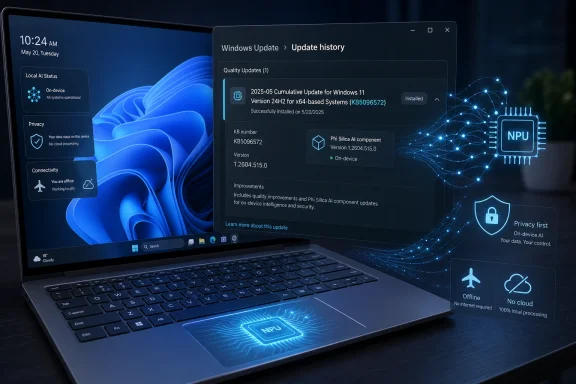
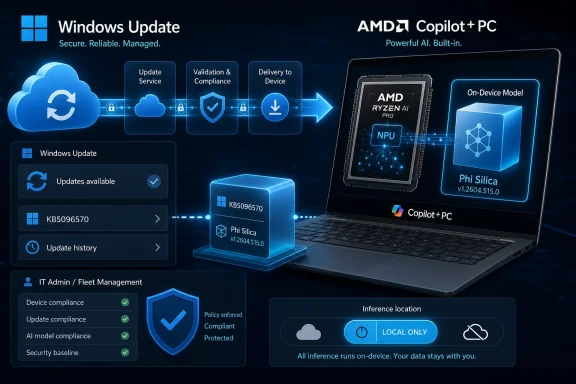
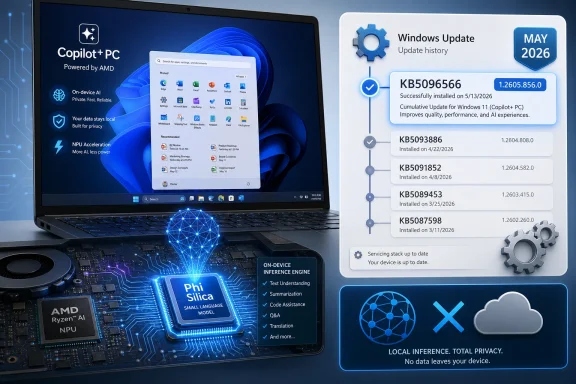
Microsoft has published KB5096570, a May 2026 Phi Silica AI component update that installs version 1.2604.515.0 on AMD-powered Copilot+ PCs running Windows 11 version 26H1, provided the device already has the latest cumulative update installed. The update is small in presentation but large in implication: Windows’ local AI stack is becoming an independently serviced platform, not merely a set of flashy shell features. For AMD Copilot+ systems, that means the language model underneath Windows features and third-party apps can change through Windows Update without waiting for a full OS release. The practical question for administrators is no longer whether AI is “in Windows,” but how often its local models will move under their feet.

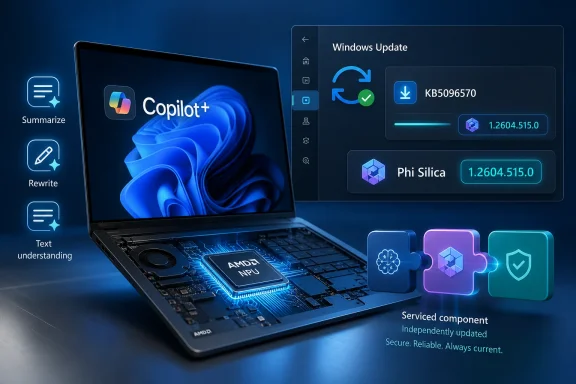
Futuristic laptop display shows Windows update KB5096570 with Copilot+ and AI component icons.Microsoft Turns the Model Into a Serviced Windows Component​

KB5096570 is not a cumulative update, not a driver package in the old sense, and not a Store app refresh. It is an AI component update for Phi Silica, Microsoft’s small language model tuned for local execution on Copilot+ PCs with AMD silicon. The version number, 1.2604.515.0, is the visible artifact of a bigger architectural shift: Windows now has AI components with their own release cadence, dependencies, and update history entries.
That matters because Phi Silica is not just a demo model sitting in a developer sample. Microsoft describes it as a Windows AI component used for on-device language intelligence across Windows features and apps. It supports tasks such as text understanding, summarization, rewriting, and short-form generation, and it is exposed to developers through Windows AI APIs.
The update applies to Windows 11 version 26H1, all editions, but only on Copilot+ PCs. That boundary is not a footnote. Microsoft is drawing a line between ordinary Windows PCs and machines that can run inbox AI workloads locally through a neural processing unit, or NPU.
For AMD-powered Copilot+ PCs, KB5096570 replaces the earlier KB5089864 update. The replacement chain suggests that Microsoft is treating Phi Silica like a maintained platform asset, not a one-time feature payload. For Windows enthusiasts, this is the kind of infrastructure detail that often says more than the marketing page.

The Quiet Update Is the Strategy​

The language in KB5096570 is spare: “improvements” for the Phi Silica AI component. Microsoft does not publish a detailed changelog explaining model behavior changes, latency adjustments, accuracy gains, moderation tweaks, or developer-facing compatibility notes. That silence is familiar to anyone who has watched Windows servicing evolve; it is also more consequential when the thing being serviced is a language model.
Traditional Windows updates change binaries, drivers, policy templates, and security mitigations. AI component updates can change behavior in subtler ways. A summarizer may become more concise. A rewrite operation may adopt a different tone. A local model may reject or transform prompts differently because content filtering behavior has changed. None of that necessarily breaks an API contract, but it can change what users and applications experience.
This is where Microsoft’s on-device AI pitch collides with the enterprise expectation of predictability. Local AI promises privacy and low latency because data can remain on the device. But if the local model is updated automatically through Windows Update, organizations need to understand how model drift will be communicated, tested, and controlled.
KB5096570 does not answer that entire governance question. It does, however, show the mechanism. AI on Windows is not waiting for annual feature drops; it is being fed through the same service machinery that already determines much of the Windows fleet experience.

Copilot+ PCs Are Becoming a Separate Windows Class​

The update is also a reminder that “Windows 11” is no longer a uniform target. A PC running Windows 11 without Copilot+ hardware may receive the same monthly security update as a Copilot+ system, but it will not necessarily have the same local AI substrate. Phi Silica depends on the Copilot+ class of hardware, especially the NPU.
That creates a new compatibility layer for developers. The old Windows question was usually about OS version, architecture, GPU capability, or optional framework availability. The new question is whether the device belongs to the Copilot+ class and has the right AI components installed. A developer can call Windows AI APIs only if the local platform can satisfy those calls.
Microsoft’s pitch is that developers should not have to package, optimize, and tune their own local language models for every machine. Windows supplies the model, routes execution through the hardware, and provides common APIs. In theory, that gives app makers a simpler path to offline AI features.
In practice, this also makes Microsoft the steward of a new runtime dependency. If a Windows app leans on Phi Silica for summarization or rewriting, it is relying not just on Windows 11, but on a serviced AI model whose version may differ by processor family, update state, region, and channel.

AMD Gets Its Own AI Servicing Lane​

The wording of KB5096570 is specific: this is for AMD-powered systems. That detail is not incidental. Copilot+ PCs have arrived across different silicon platforms, and Microsoft’s AI stack has to account for hardware-specific optimization paths. A model tuned for one NPU environment may require a different package, schedule, or validation process than the same capability on another platform.
This is the unglamorous side of the Copilot+ promise. Microsoft wants Windows AI APIs to look uniform to developers, but underneath that abstraction sits a matrix of silicon vendors, drivers, firmware, model packages, and operating system builds. KB5096570 is one tile in that matrix.
For users, the result should be boring if everything works. Windows Update downloads the component, installs it automatically, and the device reports “2026-05 Phi Silica version 1.2604.515.0 for AMD-powered systems (KB5096570)” in Update history. The best infrastructure disappears into the background.
For admins, though, boring is earned through visibility. Processor-specific AI packages introduce another category to inventory and validate. Fleet reporting needs to distinguish whether an AMD Copilot+ machine actually has the expected Phi Silica package, not merely whether it is on the right Windows build.

The Local AI Pitch Is Privacy, but the Operational Reality Is Control​

Microsoft’s central claim for Phi Silica is that it runs locally on the device’s NPU, delivering low-latency responses while keeping data local. That is a meaningful distinction from cloud-only AI features. A local summarizer or rewrite engine can be useful in restricted environments where sending text to an external service is undesirable or prohibited.
But privacy is not the same as control. A model that runs locally can still be opaque to the organization deploying it. Administrators may know that data is not leaving the device, yet still lack a clear account of how the model was trained, how it was evaluated, what changed between versions, and what failure modes are expected.
Microsoft has started to answer some of that through platform cards and responsible AI documentation, but KB articles like this one remain operational rather than explanatory. They tell you the package exists, where it applies, how it arrives, and how to confirm installation. They do not tell you whether the model’s practical behavior changed in ways that matter to your help desk, compliance team, or line-of-business app.
That gap is not unique to Microsoft. The entire industry is still learning how to communicate model updates in a way that is useful without drowning customers in evaluation jargon. Windows, however, has a special burden because it is the general-purpose client platform for enterprises, governments, schools, developers, and home users.

The Developer Story Is Powerful and Awkward​

For developers, Phi Silica is one of the more interesting parts of Microsoft’s AI strategy because it offers a local model without the usual deployment headache. A Windows app can use platform APIs for text generation, summarization, rewriting, and related language tasks. No cloud API key is required for the local execution path, and the model is optimized for supported Copilot+ hardware.
That is the powerful part. The awkward part is distribution. If an app depends on Phi Silica, it depends on hardware that is still a subset of the Windows installed base. It may need graceful fallback behavior for non-Copilot+ PCs, older Windows versions, unsupported regions, missing updates, or unavailable model packages.
This will shape the first wave of serious Windows AI apps. Developers will be tempted to add on-device AI features as enhancements rather than core requirements, at least until Copilot+ hardware becomes common enough to assume. A document editor might offer local rewrite on supported machines and cloud rewrite elsewhere. A notes app might expose summarization only when the Windows AI API reports availability.
That split could be frustrating, but it is also the normal early life of a platform capability. GPU acceleration, biometric authentication, HDR, and hardware-backed security all went through similar phases. The difference is that AI features are more visible to users and more difficult to characterize when they misbehave.

Windows Update Becomes the AI Supply Chain​

The most important sentence in the KB is the ordinary one: the update will be downloaded and installed automatically from Windows Update. That makes Windows Update part of the AI supply chain. It is no longer merely delivering fixes for the OS around AI features; it is delivering the AI component itself.
This has several consequences. First, the health of Windows Update directly affects the reliability of local AI features. A machine stuck behind update failures or deferred servicing policies may not have the expected model component. Second, update history becomes a diagnostic surface for AI behavior. If a user says a local rewrite feature changed this month, the installed Phi Silica version may be part of the investigation.
Third, Microsoft now has a channel for improving local AI outside the tempo of major Windows releases. That is strategically important. Model quality, safety behavior, hardware efficiency, and API reliability can improve over time, and Microsoft can ship those improvements to supported devices automatically.
The tradeoff is that organizations will need more mature policy around AI component updates. Some will accept automatic servicing as part of normal Windows hygiene. Others will want rings, validation windows, reporting, and perhaps rollback guidance. Microsoft’s challenge will be to make those controls visible enough for enterprise IT without turning every model refresh into a research-paper review.

Version 26H1 Signals a Faster Windows AI Track​

The prerequisite that devices must have the latest cumulative update for Windows 11 version 26H1 installed is also revealing. Windows 11 26H1 is the platform context for this update, and the AI component is being serviced in relation to that branch. Whether Microsoft ultimately makes 26H1 a broad consumer milestone or a targeted platform release, the naming reinforces that AI features are tightly coupled to current Windows builds.
That coupling is not surprising. Local AI depends on APIs, drivers, runtime plumbing, model packages, NPU scheduling, and security boundaries. Those pieces evolve together. A model update may require OS support, and an OS update may expect a newer model package.
For WindowsForum readers who track servicing, this is another reason to watch the distinction between feature updates, enablement packages, cumulative updates, Store-delivered components, and Windows Update-delivered AI components. Microsoft’s client platform has become modular, but modularity does not automatically mean simplicity.
The danger is that users may see “Windows 11” and assume feature parity. The reality is increasingly conditional. Which Windows 11? Which cumulative update? Which processor? Which AI component package? Which region? Which developer API availability state? That is the kind of complexity Windows veterans recognize immediately, even when it arrives under a new AI banner.

The Changelog Problem Will Not Stay Small​

KB5096570 is a modest update today because Microsoft frames it as an improvement package. But as Phi Silica becomes more important to Windows features and third-party apps, the lack of granular release notes will become harder to ignore. AI behavior is product behavior. If the model changes, the product changes.
That does not mean Microsoft needs to publish every internal benchmark or safety test. It does mean customers will eventually need meaningful categories of change. Did the update improve performance? Did it expand language capability? Did it alter content moderation? Did it fix a crash or availability issue? Did it change output formatting? Did it address a security concern?
The traditional “quality improvements” formulation is already frustrating in cumulative updates. For AI components, it risks being insufficient. A model update can affect workflows in ways that are difficult to reproduce and easy to dismiss as subjective. Better release notes would help users distinguish expected improvement from regression.
Microsoft has an opportunity here. If Windows is to become the mainstream local AI platform, its model servicing should be more transparent than the mobile-app style “bug fixes and performance improvements” that users have learned to distrust. The company does not need to reveal the secret sauce to give administrators and developers a usable map.

The Admin Job Expands From Patch Compliance to Model Awareness​

For IT departments, KB5096570 is the kind of update that should trigger a small but important process change. Patch compliance dashboards have traditionally focused on cumulative updates, security baselines, driver versions, firmware, and application inventory. AI component versions now deserve a line in that inventory for fleets that include Copilot+ PCs.
That does not mean every organization needs an emergency change board for Phi Silica 1.2604.515.0. It does mean that support teams should know where to look. The KB instructs users to verify installation through Settings, Windows Update, and Update history. In managed environments, administrators will want equivalent reporting through whatever device management stack they use.
The more strategic question is whether organizations allow local AI features at all, and under what conditions. Some will welcome on-device language features precisely because they avoid cloud data transfer. Others will be cautious because local generation still introduces risks around inappropriate output, data handling, user expectations, and compliance documentation.
The worst option is accidental adoption. If Copilot+ PCs enter the fleet as ordinary hardware refreshes, local AI capabilities may arrive before policy catches up. KB5096570 is a reminder that the capability is not hypothetical; it is being serviced now.

The Consumer Benefit Is Real, Even If the Plumbing Is Messy​

For everyday users with AMD-powered Copilot+ PCs, the update should simply make local AI features better. That is the promise of the component model. You buy a machine with an NPU, Windows supplies optimized AI building blocks, and improvements arrive over time without needing the user to understand model packaging.
There is a genuine upside here. Local summarization and rewriting can feel dramatically different from cloud features when latency is low and the experience is integrated. If Microsoft and developers use Phi Silica well, AI can become less like a chatbot you visit and more like a background capability inside normal Windows workflows.
The privacy argument is also stronger for local AI than for cloud-first assistants. Keeping data on the device reduces exposure and can make AI features acceptable in contexts where cloud processing would be a nonstarter. That does not eliminate every risk, but it changes the risk model.
The messy part is that consumers will rarely know which layer is responsible when something fails. Is the issue the app, the Windows AI API, the Phi Silica model package, the NPU driver, the Windows build, or a regional availability rule? Microsoft’s job is to hide that complexity. Windows history suggests it will not always succeed.
KB5096570 Shows the Fine Print of the Copilot+ Bet​

The practical reading of KB5096570 is simple: supported AMD Copilot+ PCs on Windows 11 26H1 get a newer Phi Silica package automatically, and users can confirm it in Update history. The strategic reading is more interesting: Microsoft is turning local AI into a serviced Windows platform layer, with all the benefits and governance headaches that implies.
  • KB5096570 installs Phi Silica version 1.2604.515.0 for AMD-powered Copilot+ PCs running Windows 11 version 26H1.
  • The update is delivered automatically through Windows Update and requires the latest cumulative update for Windows 11 26H1.
  • The package replaces KB5089864, indicating that Microsoft is maintaining Phi Silica through a regular component-update chain.
  • Phi Silica provides local language capabilities such as summarization, rewriting, text understanding, and short-form generation through Windows features and Windows AI APIs.
  • Administrators should treat AI component versions as part of device inventory for Copilot+ fleets, especially where app behavior or compliance depends on local AI.
  • Developers should design graceful fallbacks because Phi Silica availability depends on Copilot+ hardware, update state, platform support, and Microsoft’s Windows AI API requirements.
The update itself will pass quietly for most users, which is exactly how Microsoft wants this layer of Windows AI to work. But the quietness should not obscure the shift: models are becoming Windows components, component versions are becoming part of the support story, and the Copilot+ PC is becoming a platform with its own servicing reality. If Microsoft can pair that machinery with clearer release notes and better administrative controls, local AI on Windows may mature into something more useful than a branding exercise; if it cannot, the next wave of Windows troubleshooting may start with the question no help desk used to ask: which model version are you on?

References​

  1. Primary source: Microsoft Support
    Published: Tue, 26 May 2026 21:03:05 Z
 

Microsoft has released KB5096567, a Phi Silica AI component update to version 1.2605.856.0 for Intel-powered Copilot+ PCs running Windows 11 version 24H2 or 25H2, delivering the on-device small language model automatically through Windows Update after the latest cumulative update is installed. The important part is not that another KB number has appeared in Update history. It is that Microsoft is now treating local AI models as serviced Windows components, closer to drivers, inbox apps, and security platforms than optional developer toys. For Intel Copilot+ PC owners, this is the latest sign that the AI PC era will be patched, versioned, and governed through the same machinery that already defines modern Windows.

Futuristic laptop with a glowing digital brain and connected cybersecurity icons in blue light.Microsoft Turns the Local Model Into a Windows Component​

Phi Silica is Microsoft’s small language model for Windows, tuned to run locally on Copilot+ PCs using the Neural Processing Unit rather than sending every request to a cloud model. In practical terms, it is the language engine behind features that can summarize, rewrite, understand, and generate short text on the device.
KB5096567 applies specifically to Intel-powered Copilot+ PCs. Microsoft’s support article says the update targets Windows 11 version 24H2 and Windows 11 version 25H2, and that it replaces the earlier KB5090934 release. Once installed, users should see “2026-05 Phi Silica version 1.2605.856.0 for Intel-powered systems” in Windows Update history.
That sounds narrow, but it is structurally important. Windows is no longer just receiving operating system fixes and device drivers; it is receiving model updates as part of the platform. The model is not merely an app dependency tucked away inside a single Microsoft Store package. It is part of the Windows AI substrate.
This is exactly the kind of quiet servicing change that tends to look boring until it becomes the architecture. Microsoft does not need every user to know what Phi Silica is for the update to matter. If applications and inbox experiences rely on it, its version becomes part of the compatibility surface of Windows.

The Copilot+ PC Promise Depends on Updates Nobody Asked For​

The Copilot+ PC pitch has always had two halves. The first is visible: flashy features, image tools, Recall-style timelines, Click to Do actions, live captions, and generative assistance woven into the desktop. The second is less glamorous: a stack of models, APIs, runtimes, hardware execution paths, and policy controls that must work consistently across Qualcomm, Intel, and AMD hardware.
KB5096567 belongs to the second half. It is not a headline feature release. It is plumbing.
That plumbing matters because local AI is only useful if developers can rely on it. A Windows developer using the Windows AI APIs does not want to ship a separate model for every supported PC, manage hardware-specific acceleration, or explain to customers why a feature works on one Copilot+ PC but not another. Microsoft’s strategy is to make Windows itself the distribution channel for those capabilities.
That is why the distinction between a cloud model and an on-device component matters. In the cloud, Microsoft can update a model behind an API endpoint with minimal user awareness. On the PC, the model exists on the device, consumes local storage, executes on local silicon, and sits inside the user’s update and compliance environment. That makes servicing visible, even when the user never launches a “Phi Silica” app.

Intel Gets Its Turn in the AI PC Servicing Lane​

The Intel-specific nature of KB5096567 is not a footnote. Copilot+ PCs were initially defined in public imagination by Qualcomm’s Snapdragon X launch wave, but Microsoft’s long-term Windows AI ambitions require parity across processor vendors. Intel and AMD systems have to feel like first-class Copilot+ PCs, not delayed ports of an Arm-first experiment.
By publishing a separate Intel-powered Phi Silica update, Microsoft is acknowledging a reality sysadmins already understand: hardware abstraction has limits. The same user-facing AI feature may depend on different model packages, execution providers, NPU drivers, firmware assumptions, and performance tuning depending on the silicon underneath.
For buyers, that fragmentation can be invisible when everything works. For IT departments, it is another thing to inventory. Two laptops may both be “Copilot+ PCs,” both run Windows 11 24H2 or 25H2, and both expose the same broad Windows AI APIs, yet their AI component update histories may diverge by processor family.
This is not necessarily a bad thing. Hardware-specific optimization is the whole point of using the NPU. But it does mean the AI PC story is moving from marketing label to lifecycle management problem.

Phi Silica Is Small Because Windows Needs It Everywhere​

Phi Silica is a small language model, not a frontier-scale chatbot trying to replace the cloud. Its job is narrower and, in some ways, more strategically useful. It is designed for local text intelligence: summarization, rewriting, short-form generation, and structured transformations that can happen quickly without a round trip to a data center.
That limitation is part of the design. A model that runs on a client NPU has to care about latency, memory, thermals, battery life, and contention with everything else the PC is doing. It cannot behave like a cloud model with an effectively elastic pool of accelerators behind it.
Microsoft’s documentation also frames Phi Silica as a developer-facing platform piece. Through the Windows App SDK and Windows AI APIs, apps can call into local AI capabilities without shipping and optimizing their own model stack. That is a powerful proposition for developers who want AI-assisted text features but do not want to become model infrastructure companies.
The bet is that many useful AI experiences do not need a giant remote model. A mail app summarizing a thread, a note-taking tool rewriting a paragraph, or a business app turning rough text into a cleaner format may benefit more from speed, privacy, and offline availability than from the absolute strongest model available in the cloud.

Local AI Changes the Privacy Argument, But It Does Not End It​

Microsoft emphasizes that Phi Silica runs locally, and that matters. If a selected block of text can be summarized or rewritten on the device, it may avoid the privacy, compliance, and latency questions that come with sending user content to a remote service. For enterprises, regulated industries, and privacy-conscious users, that is not a trivial improvement.
But “local” should not be confused with “risk-free.” The model still receives prompts from applications or Windows features. It still produces outputs that may be inaccurate, biased, overconfident, or unsuitable for sensitive workflows. It still exists within an ecosystem of apps that may log, display, transmit, or misuse the content around it.
The security model therefore shifts rather than disappears. Instead of asking only whether data leaves the machine, administrators also have to ask which apps can invoke local AI, what text is being passed into prompts, how outputs are presented to users, and whether the organization has policies for AI-assisted content generation.
This is where Microsoft’s decision to route these capabilities through Windows APIs could become useful. A platform-level approach gives Redmond a chance to expose controls, document limitations, and provide a common behavior model. The alternative — every app bundling its own opaque model and runtime — would be worse for manageability.

Windows Update Becomes the Model Distribution Network​

The most consequential line in the KB article may be the simplest: the update is downloaded and installed automatically from Windows Update. That one sentence defines the operating model for Microsoft’s local AI future.
Automatic delivery means Microsoft can revise AI components without waiting for OEM images, app updates, or manual user action. It can replace previous releases, align model versions with Windows cumulative updates, and keep supported Copilot+ PCs on a known baseline. From Microsoft’s perspective, that is essential if Windows AI APIs are to be trusted by developers.
From an administrator’s perspective, it also raises familiar questions in a new domain. What changed in the model? Was behavior altered? Did performance improve? Did a moderation policy shift? Did prompts that previously worked now produce different results? Traditional KB articles often provide sparse details even for operating system changes; model updates may make that opacity more uncomfortable.
AI model updates are not like ordinary bug fixes. A driver either resolves a crash or it does not. A language model’s behavior is probabilistic and contextual. A change can improve one class of prompts while degrading another, or make outputs safer while making them less useful. That kind of change is hard to summarize in a standard support note.

The Prerequisite Is Also the Policy​

Microsoft says systems must have the latest cumulative update for Windows 11 24H2 or 25H2 installed before receiving KB5096567. That requirement is not surprising, but it is revealing. AI components are being tied to the monthly Windows servicing baseline.
This gives Microsoft leverage. If a business wants the latest local AI stack, it cannot indefinitely defer the underlying Windows cumulative updates. The model layer and the OS layer are moving together.
For consumers, that probably means fewer decisions. The update arrives, installs, and appears in history. For managed environments, it means AI readiness becomes another reason to maintain patch currency — or another reason to delay deployment until validation is complete.
There is a tension here that Microsoft has not fully resolved in public messaging. Copilot+ PC features are sold as product capabilities, but their reliability depends on a moving servicing train. Users buy hardware expecting stable features; Microsoft ships AI as a continuously updated platform. Those are not incompatible ideas, but they require trust.

Developers Are the Real Audience for This Update​

Most end users will not know Phi Silica by name. Developers will.
The Windows AI APIs are Microsoft’s attempt to give developers a supported path into on-device AI. Instead of requiring each application to bring its own model, runtime, hardware detection, and acceleration strategy, Microsoft wants developers to call Windows and let the platform handle the machinery. Phi Silica is one of the most important pieces of that story for language tasks.
That is why versioning matters. A developer building against local summarization or rewriting features needs to know whether the model is present, whether the PC qualifies, whether the APIs are available, and whether behavior is within expected bounds. If the model is updated through Windows Update, app developers inherit both the benefits and uncertainty of platform servicing.
The upside is obvious. Smaller app downloads, better battery behavior, hardware-specific optimization, and potentially more private AI workflows all become easier. The downside is that app behavior can depend on a component the developer does not ship and may not fully control.
This is not new in Windows development. Apps have always depended on system DLLs, frameworks, drivers, and optional features. But AI makes the dependency more visible because outputs are not deterministic in the same way a graphics API call or file picker is deterministic.

The Enterprise Question Is Not Whether AI Is Installed​

In enterprise Windows environments, the first instinct may be to ask whether KB5096567 should be blocked. That is understandable but incomplete. The more useful question is what local AI components are allowed to do once present.
If a Copilot+ PC is in scope for Windows 11 24H2 or 25H2 and receives automatic AI component updates, organizations need inventory and policy visibility. They need to know which devices have Intel, AMD, or Qualcomm AI component packages; which apps can use Windows AI APIs; and whether sensitive workflows are exposed to AI-generated transformation.
There is also a compliance angle. Local processing may help organizations that prohibit cloud AI handling of certain data. A legal department, hospital, defense contractor, or financial firm may be more willing to allow a local summarizer than a cloud chatbot. But “processed locally” is not the same as “approved for all data classes.”
The best enterprise posture is likely not blanket rejection or blind adoption. It is classification. Local AI summarization of public help-desk text may be fine. Local rewriting of confidential acquisition documents may require policy. AI-generated customer communications may need review regardless of where the model runs.

Microsoft’s KB Minimalism Meets AI’s Need for Transparency​

The KB5096567 article is brief. It identifies the component, version, supported Windows releases, prerequisite, replacement information, and update-history string. For a conventional support update, that might be enough.
For an AI model update, it feels thin.
Administrators and power users will want to know whether the update improves accuracy, expands supported prompts, changes moderation behavior, fixes performance issues, reduces NPU usage, or addresses a security concern. Microsoft does not provide that level of detail in the support article. It presents the update as a release, not a changelog.
That may be sustainable while these components are young and lightly used. It will be harder once third-party apps, enterprise workflows, and regulated processes depend on them. If local AI becomes a platform feature, model release notes will need to mature beyond version strings.
Microsoft is not alone here. The whole industry is still learning how to document model behavior changes. Cloud AI providers frequently publish broad release notes that are useful for marketing but thin for operational validation. Windows brings that same problem onto managed endpoints.

The AI PC Is Becoming Less Like a PC and More Like a Fleet​

For years, PC management meant tracking OS builds, firmware, drivers, applications, and security agents. The Copilot+ generation adds model packages to that list. That is a meaningful expansion of the endpoint.
The PC now has a local AI layer that may vary by processor vendor, Windows release, cumulative update level, region, feature availability, and developer access model. Users may experience it through friendly UI features, but administrators will experience it as another serviced dependency.
This is where Microsoft has an advantage and a burden. Windows Update is already one of the largest software distribution systems on the planet. If anyone can deliver model components to hundreds of millions of endpoints, it is Microsoft. But every additional component increases the need for trust, rollback clarity, documentation, and administrative control.
The company’s challenge is to make AI component servicing feel boring in the best possible way. The update should arrive, work, respect policy, expose enough information for validation, and avoid surprising the user. That is easy to say and difficult to execute, especially when the component is a language model whose behavior cannot be fully captured by a version number.

The Version String Tells a Bigger Story Than the KB Article​

Version 1.2605.856.0 looks like an internal build number, but it also signals cadence. Microsoft has been publishing AI component releases across 2025 and 2026, including updates for Phi Silica and image-related components. The pattern suggests that these models are not static payloads shipped once with a device.
That has consequences for how reviewers and buyers should think about Copilot+ PCs. The machine you buy is not merely defined by its launch-day AI features. It is defined by whether the silicon, drivers, Windows release, and AI component pipeline continue to receive improvements.
This may eventually become a competitive differentiator among processor vendors. If one platform receives better-tuned model updates, faster feature enablement, or more reliable NPU execution, the experience gap may show up in real applications rather than benchmark slides. Conversely, if updates are uneven, users may wonder why the Copilot+ badge does not guarantee identical behavior.
KB5096567 does not answer those questions. It simply shows the mechanism in motion.

The Practical Reading for Intel Copilot+ PC Owners​

For an Intel-powered Copilot+ PC on Windows 11 24H2 or 25H2, KB5096567 should be treated as a normal automatic Windows AI component update rather than a manual feature pack. If the device is current on cumulative updates, Windows Update should handle installation.
The main verification step is Update history. Microsoft says the installed update should appear under the May 2026 Phi Silica entry for Intel-powered systems. If it does not appear immediately, the usual Windows Update variables apply: rollout timing, device eligibility, cumulative update status, and management policy.
Users should not expect a new standalone app to appear. Phi Silica is a platform component. Its effects are more likely to surface through Windows features and applications that call local language capabilities.
For developers, the lesson is sharper. If your app depends on Phi Silica, treat component presence and capability detection as first-class logic. Do not assume every Windows 11 PC has the model. Do not even assume every Copilot+ PC is on the same AI component version at the same moment.

The May Phi Silica Update Draws the New Windows Map​

The concrete facts of KB5096567 are simple, but the direction of travel is not.
  • KB5096567 updates Phi Silica to version 1.2605.856.0 on Intel-powered Copilot+ PCs.
  • The update applies to Windows 11 version 24H2 and Windows 11 version 25H2, across supported editions.
  • The device must already have the latest cumulative update installed before the Phi Silica component update is delivered.
  • Windows Update installs the component automatically rather than requiring a separate manual download.
  • The update replaces the earlier KB5090934 Phi Silica release for Intel-powered systems.
  • Users can confirm installation in Settings by checking Windows Update history for the May 2026 Phi Silica entry.
That short list is the operational view. The strategic view is that Windows is becoming a model-servicing platform. AI is not just being added to apps; it is being added to the operating system’s maintenance contract.
Microsoft’s KB5096567 is a small update with a large implication: the future Windows endpoint will be judged not only by build numbers, drivers, and security patches, but by the quality and governance of the models quietly updated beneath the desktop. For Intel Copilot+ PC owners, Phi Silica 1.2605.856.0 is one more version string in Update history; for the Windows ecosystem, it is another brick in the argument that local AI will live or die by the discipline of ordinary servicing.

References​

  1. Primary source: Microsoft Support
    Published: Tue, 26 May 2026 21:02:59 Z
 

Last edited:
Microsoft has published KB5096572, a Windows Update-delivered Phi Silica AI component update to version 1.2604.515.0 for Intel-powered Copilot+ PCs running Windows 11 version 26H1 with the latest cumulative update installed. The dry phrasing hides a larger shift: Windows AI is becoming a serviced platform layer, not a one-time feature bundle. For Intel Copilot+ PC owners, this is less about a single small language model refresh than about Microsoft proving that local AI can be patched, versioned, audited, and made dependable enough for everyday Windows features and third-party apps.

Laptop screen shows Windows update history with AI/NPU and on-device privacy indicators.Microsoft Turns the Local Model Into a Windows Component​

The most important word in KB5096572 is not Phi, Silica, or even AI. It is “component.”
Microsoft is treating Phi Silica like part of Windows’ living substrate: updated through Windows Update, listed in Update history, tied to a specific Windows release, and dependent on the latest cumulative update. That is a very different model from the consumer AI story Microsoft has usually sold, where Copilot is a cloud service that changes somewhere behind the curtain and users simply discover that a button now behaves differently.
Phi Silica is meant to be local. It is Microsoft’s small language model for Copilot+ PCs, optimized to run on the neural processing unit rather than leaning on a remote datacenter for every inference. The promise is familiar by now: lower latency, more privacy, less dependence on network connectivity, and an operating system that can understand text without shipping every task to the cloud.
The update applies to Intel-powered systems, which matters because Copilot+ PCs have never been a single hardware story. Qualcomm opened the category with Snapdragon X systems, but Microsoft’s long-term Windows business depends on Intel and AMD machines carrying the same AI promises into the mainstream PC market. KB5096572 is a reminder that those promises now have to survive the messy reality of silicon-specific servicing.
This is where the mundane Windows Update packaging becomes strategically important. If Microsoft wants developers to build against Windows AI APIs, it cannot let the underlying model feel like a mystery blob that may or may not exist on a user’s machine. A versioned component in Update history is not glamorous, but it is the beginning of accountability.

The AI PC Pitch Finally Meets the Patch Tuesday World​

The first wave of Copilot+ PC marketing asked buyers to imagine a new class of computer: not merely faster, but more context-aware, more assistive, and less dependent on cloud round-trips. That story was always going to collide with the operational habits of Windows itself. Features that ship in Windows eventually need servicing channels, compatibility rules, rollback plans, and documentation that administrators can understand.
KB5096572 sits squarely in that collision. It is not a cumulative update for the whole OS. It is not a graphics driver. It is not an app update from the Microsoft Store. It is an AI component update, automatically downloaded and installed from Windows Update, visible under Update history for the machine’s processor type.
That distinction matters because AI models are not static software in the old sense. They can improve in quality, efficiency, safety behavior, prompt handling, and hardware scheduling without the visible surface of Windows changing much at all. A user may not see a new button after installing this update, but the local language intelligence available to Windows features and apps may behave differently.
That is both the opportunity and the discomfort. Windows users are accustomed to patches that fix bugs, close vulnerabilities, or add platform support. Model updates introduce a softer category of change: improved summarization, better rewriting, faster response, lower resource use, or fewer strange outputs. Those are real product changes, but they are harder to test than whether a printer still prints.
For IT departments, this is where the AI PC ceases to be a marketing category and becomes a management object. If local AI is part of the operating system, then AI behavior becomes part of Windows lifecycle management. The question is no longer whether a machine has an NPU; it is whether the right model, runtime, API layer, OS build, and policy posture are all aligned.

Intel Gets a Necessary Piece of the Copilot+ Parity Puzzle​

Microsoft’s Copilot+ rollout created an unusual hierarchy inside the Windows ecosystem. Snapdragon systems arrived first with the cleanest access to the new branding and feature set, while Intel and AMD hardware had to catch up through later silicon and staged feature availability. That was awkward for a platform whose identity has historically been built on hardware breadth.
An Intel-specific Phi Silica component update is therefore more than a footnote. It signals that Microsoft is continuing the painstaking work of making Copilot+ features behave consistently across architectures without pretending the underlying hardware is identical. Intel’s Core Ultra 200V-class systems bring capable NPUs into Windows laptops, but the software stack still has to know how to schedule, optimize, and update AI workloads for that silicon.
The NPU is not just a checkbox. Local language models are sensitive to memory movement, power budgets, driver behavior, and model optimization. A small language model can be “small” in cloud terms and still impose meaningful constraints on a thin laptop if the platform does not handle it efficiently. That is why these component updates matter more than their sparse support pages suggest.
For users, the practical effect should be boring in the best sense. Phi Silica-powered features should become faster, more reliable, or more consistent without requiring them to understand model packaging. For developers, the update strengthens the idea that Windows AI APIs can target a local capability maintained by Microsoft rather than a one-off demo environment.
But parity is not the same as sameness. Intel, AMD, and Qualcomm Copilot+ PCs may expose the same class of Windows AI experiences while still receiving different component packages at different times. That is a normal hardware ecosystem problem, but Microsoft will need to communicate it carefully. The more invisible the AI stack becomes, the more visible any inconsistency will feel when features arrive late or behave differently across machines.

Phi Silica Is Microsoft’s Bet That Small Models Belong Inside the OS​

Phi Silica is not trying to be the biggest model in the room. Its purpose is to make language intelligence cheap enough, fast enough, and local enough to become a Windows primitive. That is a more interesting ambition than chasing leaderboard glory.
A small language model embedded in the OS can do work that would be wasteful or invasive if every request required a cloud call. It can summarize short text, rewrite a sentence, interpret a command, assist with accessibility workflows, or help an app understand user intent without turning every interaction into a network event. The value is not that it replaces frontier-scale AI; it is that it makes modest AI tasks routine.
This is the same logic that made GPUs indispensable long before every user cared about shaders. Hardware acceleration becomes transformative when developers can assume it exists and build small conveniences around it. Microsoft wants the NPU to become that kind of ordinary resource, and Phi Silica is one of the ways it gets there.
The catch is that local AI only becomes ordinary if it is dependable. Developers will not build serious features around a model that is inconsistently available, poorly documented, or frozen at launch. Component updates like KB5096572 are Microsoft’s answer: the model is part of the platform, and the platform will service it.
There is a privacy argument here too, though it should not be overstated. Running a task locally can reduce exposure to cloud services, but local processing does not automatically settle every governance question. Organizations still need to know what data is being processed, where it is stored, how features are controlled, and whether outputs are logged or used by surrounding applications. “On-device” is a strong design choice, not a magic compliance stamp.

The Developer Story Depends on Boring Guarantees​

Microsoft’s Windows AI APIs are the real audience for Phi Silica updates. Built-in Windows features may be the showcase, but third-party developers are the multiplier. If Microsoft can persuade app makers that every modern Copilot+ PC includes a usable local language model, Windows gains an AI capability that macOS, ChromeOS, and Linux distributions must answer in their own ways.
The developer proposition is straightforward: instead of bundling a model, negotiating cloud inference costs, or building a custom ONNX pipeline, an app can call into Windows-provided AI capabilities. The operating system handles the local model and hardware acceleration. The app gets text generation or language assistance without becoming an AI infrastructure company.
That is compelling, especially for small utilities, productivity tools, enterprise line-of-business apps, and accessibility software. A note-taking app could summarize locally. A document tool could rewrite a paragraph without sending it to a vendor’s server. A helpdesk application could classify user-submitted text on the device. These are not science-fiction features; they are the kind of small automations that make software feel modern.
But developers are unforgiving about platform uncertainty. They need to know which Windows versions are supported, which devices qualify, what happens when the required model is missing, how errors are reported, and whether performance is predictable. A support article that says the update is present in Update history may sound trivial, but it gives developers and admins a concrete diagnostic point.
The limited-access nature of some Windows AI APIs also shows that Microsoft is still balancing ambition with caution. Local language models can generate undesirable output, consume resources, or create confusing user experiences if exposed recklessly. Microsoft wants adoption, but it also wants a controlled runway while the platform matures.

The Version Number Is a Clue to a Faster Windows Cadence​

Version 1.2604.515.0 will not mean much to most users. To Windows watchers, it is another sign that Microsoft is decomposing the OS into more independently serviced pieces. The modern Windows machine is less a single monolith than a collection of components, experience packs, Store apps, drivers, feature flags, and now AI models moving on related but distinct schedules.
That has advantages. Microsoft can improve an AI component without waiting for a full annual Windows release. It can target Intel-powered systems with the correct package. It can stage rollout through Windows Update and let devices report whether the component is installed.
It also complicates the mental model of Windows. Two PCs can both say they are running Windows 11 and still differ meaningfully in AI capability depending on processor, NPU, cumulative update level, component version, region, policy, and rollout status. For enthusiasts, that complexity is familiar. For normal users, it risks making Copilot+ feel less like a product and more like a set of conditions.
Windows 11 version 26H1 adds another wrinkle. Microsoft’s public Windows release naming has already trained users and admins to watch version numbers carefully, and any AI component tied to a specific release reinforces the idea that local AI is part of the forward Windows branch rather than an add-on for the installed base. Older PCs may get Copilot in the cloud, but the local AI platform belongs to newer hardware and newer OS builds.
That is the business model hiding in the architecture. Microsoft and its PC partners need reasons for users to refresh hardware. NPUs, local models, and Copilot+ branding provide that reason. Servicing Phi Silica through Windows Update turns the pitch into an ongoing platform commitment.

Users Will Notice the Absence Before They Notice the Model​

Most people will not open Update history looking for Phi Silica. They will notice whether a Windows feature appears, whether a rewrite suggestion responds quickly, whether an app can summarize offline, or whether a Copilot+ capability advertised on the box is actually available. The model is infrastructure, and infrastructure is usually invisible until it fails.
That creates a communications challenge for Microsoft. The company must explain enough for power users and admins to verify the stack, without making every consumer feel responsible for understanding AI component versions. “Check Update history” is useful, but only after someone already suspects a missing component.
The more important test is whether Windows can gracefully handle absence. If Phi Silica is not installed, out of date, or unavailable on a particular processor, features should degrade clearly. An app should not simply fail with vague AI runtime errors. A user should not have to search support pages to learn that their machine lacks the right NPU or OS release.
This is especially important because the phrase “AI PC” remains slippery in the market. Some systems have NPUs but do not meet Copilot+ requirements. Some have a Copilot key but not the full local AI feature set. Some users bought early Intel “AI PC” hardware before Microsoft’s Copilot+ floor hardened around higher NPU performance. The brand confusion is not academic; it affects expectations.
KB5096572 is specifically for Intel-powered Copilot+ PCs, not every Intel Windows laptop with AI-themed stickers. That boundary is healthy, but Microsoft and OEMs will need to keep drawing it plainly. Otherwise, component updates become one more place where buyers discover that “AI-ready” and “Copilot+ capable” were not the same promise.

Enterprise IT Will Treat Local AI Like a New Attack Surface​

For administrators, local AI components bring a mixed blessing. On-device processing can reduce cloud exposure and keep sensitive text on the machine. It can also introduce new software behaviors that need inventory, policy, monitoring, and risk assessment.
The first enterprise question is version control. If a business app uses Phi Silica through Windows AI APIs, the model version becomes part of the application’s runtime environment. A change in summarization quality or output style may be acceptable for a consumer note app but more consequential in regulated workflows. IT will want to know what changed and when.
The second question is policy. Organizations may want to enable local AI for accessibility and productivity while disabling specific experiences such as broad screen analysis, automatic content suggestions, or features that interact with sensitive applications. Microsoft has learned from the Recall backlash that “local” does not automatically equal trusted. Controls must be visible before deployment, not after controversy.
The third question is supportability. Helpdesks need clear ways to answer: Does the device qualify? Is the component installed? Is the cumulative update current? Is the NPU driver healthy? Is a policy blocking the API? The support article’s Update history instruction is a start, but mature enterprise adoption will require better tooling through management consoles, inventory providers, and event logs.
There is also the question of procurement. If local AI features become useful enough, organizations will begin specifying Copilot+ capability in refresh cycles. That gives Microsoft, Intel, AMD, Qualcomm, and OEMs a path to reenergize PC replacement. But enterprises will not buy on vibes forever. They will buy when local AI saves time, reduces cloud cost, improves privacy posture, or enables workflows that older PCs cannot reasonably perform.

The Privacy Pitch Is Strongest When Microsoft Does Less Talking​

Microsoft’s privacy argument for Phi Silica is simple: processing language tasks locally can keep data on the device. In an era when users have grown weary of cloud AI services ingesting prompts, documents, and context, that is a meaningful advantage. It is also one Microsoft should handle with restraint.
The company has already seen how quickly AI trust can collapse when a feature appears to overreach. Recall’s original unveiling triggered intense criticism because it made sweeping local capture feel like a surveillance feature, even though Microsoft emphasized on-device processing. The lesson was not that local AI is doomed. The lesson was that users care about agency, defaults, retention, and understandable controls.
Phi Silica is a better privacy story because it is a component rather than an all-seeing experience. A local language model that helps summarize, rewrite, or generate short text does not inherently require a persistent memory of everything the user has done. That narrower role makes the trust proposition easier.
Still, Microsoft should avoid implying that local inference settles every concern. An app can process sensitive data locally and still mishandle the output. A local model can be invoked by software the user does not fully understand. A feature can be privacy-preserving in architecture and still be intrusive in practice. The details matter.
The best version of Microsoft’s pitch is therefore operational, not theatrical. Let users see what is installed. Let admins control what is allowed. Let developers call documented APIs. Let the model run locally when that is the right tool. Trust will come less from slogans about privacy and more from predictable behavior over time.

The Copilot+ PC Needs More Updates Like This, Not Fewer​

KB5096572 is not the kind of update that sells a laptop by itself. Nobody walks into a store asking for Phi Silica version 1.2604.515.0. But platform credibility is built from precisely this sort of unglamorous work.
The early AI PC era has suffered from a mismatch between promise and daily utility. Consumers heard about transformative local AI, then found a handful of features, region limits, staged rollouts, and a Copilot experience that often still felt cloud-first. Enthusiasts understood the technical direction, but the mainstream value proposition remained hazy.
Servicing local models is how that gap starts to close. Every update that improves latency, reliability, hardware compatibility, or developer access makes the NPU less decorative. Every API that lets a normal app use local language intelligence gives Copilot+ PCs a reason to exist beyond branding.
The danger is that Microsoft repeats old Windows habits: shipping a platform, marketing it aggressively, then leaving developers to guess whether the user base is large and consistent enough to matter. If Phi Silica is to become a real Windows primitive, Microsoft must keep publishing updates, documenting requirements, and making the developer path boringly dependable.
Intel’s role is especially important because of scale. Qualcomm gave Microsoft a clean architectural showcase, but Intel remains central to the Windows PC market. If Intel Copilot+ machines feel second-class, the entire category feels fragmented. If they receive regular, visible AI component updates, the category starts to look durable.

The Update History Entry Is the Canary in the AI Stack​

For now, the most concrete thing users can do is check Windows Update history after installation. That is not exciting, but it is tangible. It tells a user or admin that the AI component exists on the machine and has been serviced.
This is also where Microsoft’s new AI stack becomes legible. Instead of treating AI as a magic cloud personality, Windows is exposing it as installable platform machinery. That may disappoint anyone expecting spectacle, but it should reassure people who have to support PCs for a living.
The practical picture is narrow but important:
  • KB5096572 updates the Phi Silica AI component to version 1.2604.515.0 on supported Intel-powered Copilot+ PCs.
  • The update targets Windows 11 version 26H1 systems that already have the latest cumulative update installed.
  • The package is delivered automatically through Windows Update rather than as a manual app download.
  • Users and administrators can verify installation through Settings, Windows Update, and Update history.
  • The update matters most where Windows features or third-party apps rely on local language processing through Windows AI APIs.
  • The broader signal is that Microsoft intends to service local AI models as part of the Windows platform lifecycle.
The smallness of the support article is almost the point. If Microsoft succeeds, AI component updates will become as routine as driver updates or servicing stack changes: occasionally noticed by administrators, mostly invisible to users, and essential to whether the platform keeps working.
Microsoft’s AI PC strategy will not be judged by whether Phi Silica gets a cleaner version number or a tidier support page. It will be judged by whether local AI becomes useful enough that users miss it on older machines and predictable enough that developers trust it in their apps. KB5096572 is a modest Intel-specific update, but it points toward the Windows Microsoft wants to build next: one where the model is no longer a novelty bolted onto the OS, but a serviced, hardware-aware layer beneath it.

References​

  1. Primary source: Microsoft Support
    Published: Tue, 26 May 2026 21:02:42 Z
  2. Official source: learn.microsoft.com
  3. Official source: microsoft.com
  4. Related coverage: pcworld.com
  5. Related coverage: windowscentral.com
  6. Related coverage: intel.com
 

Microsoft has published KB5096570, an automatic Windows Update package that installs Phi Silica AI component version 1.2604.515.0 on eligible AMD-powered Copilot+ PCs running Windows 11 version 26H1 after the latest cumulative update is already in place. The update is small in wording but large in implication: Microsoft is treating local AI models as serviced Windows components, not optional app features. That changes how administrators should think about patching, compliance, privacy, and the long tail of Windows hardware fragmentation. Phi Silica is no longer just a demo of on-device intelligence; it is becoming part of the Windows servicing machine.

Futuristic tech ad showing Windows Update and AMD Copilot+ PC with local AI inference on a laptop.Microsoft Turns the Local Model Into a Serviced Windows Part​

KB5096570 does not arrive with the drama of a feature update, a redesigned Start menu, or a security emergency. It is the kind of support article that looks procedural: a version number, a processor family, a Windows release requirement, and a note that Windows Update will handle the installation automatically. But that plainness is precisely the point.
Microsoft is signaling that its Windows AI stack will be maintained like the rest of the platform. Phi Silica, the company’s small language model for on-device language tasks, is not being treated as a one-time payload baked into a factory image. It has a component identity, a Knowledge Base entry, a version number, and a place in Update history.
That matters because the industry has spent the last two years talking about AI PCs mostly in terms of silicon and slogans. TOPS numbers, NPUs, Copilot branding, and launch-stage demos have dominated the conversation. KB5096570 is less flashy but more operationally important: it shows what happens after the laptop is sold.
For AMD-powered Copilot+ PCs, Phi Silica version 1.2604.515.0 is now part of that post-sale lifecycle. Microsoft says the update improves the Phi Silica AI component for Windows 11 version 26H1 and requires the latest cumulative update before installation. In other words, the AI layer is tied to the ordinary Windows maintenance chain, not floating above it.

Phi Silica Is Microsoft’s Bet That AI Should Run Close to the User​

Phi Silica is Microsoft’s on-device small language model for Windows AI features and apps. It is designed to run locally on Copilot+ PC hardware, using the neural processing unit rather than round-tripping every request to a cloud model. The goal is lower latency, less dependency on connectivity, and a stronger privacy story for certain classes of language processing.
That design choice is not merely technical. It is Microsoft’s answer to a tension at the center of consumer and enterprise AI adoption: users want smarter software, but organizations do not want every snippet of text, meeting fragment, or document excerpt shipped to a remote inference endpoint. Local models offer a middle path, even if they do not eliminate all governance questions.
Phi Silica is compact compared with frontier cloud models, but compact does not mean trivial. It can support text understanding, summarization, rewriting, and short-form generation. Developers can also reach it through Windows AI APIs, giving apps a way to perform language tasks locally without building or bundling their own model stack.
The obvious tradeoff is that local models are constrained by device hardware and Microsoft’s model packaging decisions. A small language model running on an NPU will not behave like a large hosted model with far more parameters and server-class resources. But for many Windows tasks, good enough, fast enough, and local enough may be the more important threshold.

The AMD-Specific Package Shows the AI PC Is Not One Platform Yet​

The most revealing word in KB5096570 may be “AMD.” Microsoft is not simply shipping one universal Phi Silica update for every Windows 11 device. It is publishing component updates scoped by processor family, Windows version, and Copilot+ eligibility.
That is sensible from an engineering perspective. NPUs differ. Driver stacks differ. Power-management behavior differs. The path from a language model to a responsive user-facing feature depends on firmware, silicon, runtime components, and OS plumbing working together. A model update that behaves well on one NPU platform may not be identical to what ships for another.
But it also exposes the complexity underneath the Copilot+ PC brand. Microsoft wants buyers to see a category: a modern Windows PC with enough local AI horsepower to unlock new features. Administrators, developers, and support teams see something messier: AMD systems, Intel systems, Qualcomm systems, different Windows branches, different component versions, and different update availability.
That fragmentation is not inherently fatal. Windows has always been a hardware ecosystem rather than a vertically controlled appliance. But AI components make the fragmentation more visible because model behavior is part of the user experience. When summarization quality, response speed, or feature availability varies by device class, the “same Windows” promise becomes harder to explain.
KB5096570 is therefore both reassuring and cautionary. It proves Microsoft is servicing AMD AI components directly. It also reminds us that the Windows AI platform is already a matrix of silicon-specific dependencies.

Windows 11 Version 26H1 Makes This More Complicated Than a Normal Patch​

The Windows version requirement is just as important as the processor requirement. KB5096570 applies to Windows 11 version 26H1, not the broad installed base of Windows 11 24H2 or 25H2 machines. That immediately narrows the audience and complicates the message.
Microsoft has positioned 26H1 as a targeted Windows release associated with specific new silicon rather than a conventional feature update for all existing PCs. That means many users who see “Windows 11” and “Phi Silica” in the same sentence may still never encounter this particular update. It is not a general-purpose AI patch for every AMD laptop.
For IT teams, that distinction matters. Inventory systems that simply record “Windows 11” are no longer detailed enough for understanding AI component exposure. Version, hardware class, processor family, NPU capability, and cumulative update level all affect whether a device can receive a package like KB5096570.
The prerequisite also says something about sequencing. Microsoft requires the latest cumulative update before the Phi Silica component update can be applied. That suggests the AI component expects the current OS servicing baseline, likely because the runtime, drivers, APIs, or policy hooks it depends on are being updated through the normal cumulative channel.
In practice, this makes local AI less like installing a Store app and more like maintaining a subsystem. The feature may appear to users as a rewrite button, a summary action, or an app capability. Underneath, it is chained to OS servicing discipline.

Automatic Installation Is Convenient Until Governance Enters the Room​

Microsoft says KB5096570 will be downloaded and installed automatically from Windows Update. For consumers, that is the right default. If a Copilot+ PC has an on-device AI component, most users will expect it to improve without manual hunting through support pages.
For enterprise administrators, automatic installation is more complicated. AI components sit at an awkward boundary between productivity enhancement, platform dependency, and governance concern. A model update can change quality, behavior, performance, and potentially the set of scenarios in which applications rely on local language processing.
This does not mean every Phi Silica update should be treated as a high-risk deployment. The support language for KB5096570 is modest, describing improvements rather than dramatic new capabilities. Still, the category deserves attention because model updates are not like printer driver fixes. They can alter outputs in ways that are harder to test deterministically.
Traditional patch validation asks whether the machine boots, whether applications launch, whether security baselines remain intact, and whether known workflows still work. AI validation adds fuzzier questions. Does summarization still preserve meaning? Does rewriting behave consistently with policy? Does a local model produce different results after a servicing event in a regulated workflow?
That is where Microsoft’s componentization is both helpful and incomplete. A KB number and version string give administrators something to track. But organizations will still need their own rules for when AI component changes require pilot testing, user communication, or documentation.

Update History Becomes the New AI Inventory Screen​

Microsoft’s instruction for verifying KB5096570 is simple: go to Settings, then Windows Update, then Update history. After installation, the update should appear there, depending on the processor type in the device. That is enough for a single user checking one machine.
It is not enough for a fleet. Enterprises will want this data in endpoint management tools, compliance reports, and support scripts. If Phi Silica becomes a dependency for Windows features and third-party applications, knowing whether version 1.2604.515.0 is present becomes more than trivia.
The broader point is that AI component versioning is about to become part of endpoint state. Administrators already track OS builds, Defender platform versions, browser versions, firmware levels, and driver packages. On Copilot+ PCs, they will increasingly track model and AI runtime components as well.
That raises a cultural issue for Windows support. Users may report that a summarization feature is missing, slow, or producing different results than a colleague’s machine. The answer may not be “reinstall the app.” It may be “check the Windows AI component version, the NPU driver, the cumulative update level, and whether the device is on the right Windows branch.”
That kind of troubleshooting is manageable, but only if Microsoft keeps the metadata visible and consistent. KB5096570 is a start because it gives the component a name and version. The next test is whether management tooling keeps pace with the new category.

The Privacy Pitch Is Strongest When the Servicing Story Is Boring​

The best argument for Phi Silica is not that it will outperform cloud models. It will not, at least not in general-purpose reasoning or long-form generation. Its advantage is locality.
For many everyday Windows tasks, local inference is the right architecture. A user asking for a rewrite of a paragraph, a summary of selected text, or a short generated snippet may not need a cloud-scale model. If the task can be performed on the device with acceptable quality, the privacy and latency benefits are obvious.
But privacy claims require operational trust. It is not enough to say that a model runs locally. Users and administrators need confidence that the component is updated predictably, documented clearly, and bounded by policy. A local model that changes silently and opaquely will still make security teams nervous.
This is why the dry mechanics of KB5096570 matter. The update’s existence as a Windows component package helps normalize the idea that local AI should be serviced, audited, and checked like other platform elements. That does not solve every privacy question, but it moves the conversation from marketing to maintenance.
There is also a security dimension. Any local component that processes user content and exposes developer-facing APIs becomes part of the attack surface in a broad sense. Microsoft does not describe KB5096570 as a security update, and there is no reason to treat it as one based on the published wording. But over time, model runtimes, API brokers, and AI integration layers will need the same maturity that Windows has built around browsers, scripting engines, and document parsers.

Developers Get a Platform, But Not a Free Abstraction​

For developers, Phi Silica is attractive because it promises local language capabilities without each app carrying its own model distribution problem. If Windows exposes a supported API for local summarization, rewriting, or language understanding, developers can build AI features that feel native to the device.
That is a powerful proposition. It lowers the barrier to adding AI-assisted workflows in productivity tools, note-taking apps, developer utilities, education software, and line-of-business applications. It also gives Microsoft a way to make Copilot+ PCs more useful beyond first-party demos.
The catch is that platform APIs inherit platform variability. A developer targeting Phi Silica must think about which Windows versions expose the right interfaces, which devices have compatible NPUs, and which model component versions are present. The moment an application relies on local AI, hardware eligibility becomes part of the app’s real-world behavior.
This is not new in computing. Graphics APIs, camera features, biometric hardware, and media acceleration have all forced developers to code against optional capabilities. What is new is the user expectation around AI. If an app says it can summarize, rewrite, or generate text, users may not understand why the feature behaves differently on two Windows 11 PCs bought in the same year.
Microsoft’s challenge is to make the developer abstraction stable while the hardware underneath remains diverse. KB5096570 does not answer that challenge by itself. It simply shows the servicing layer that will have to support it.

The Quiet Update Is Really About Microsoft Owning the AI Stack​

The most important strategic fact about Phi Silica is that it is Microsoft-developed. Windows is not merely providing hooks for third-party AI engines; it is shipping its own local language model as a system component. That gives Microsoft control over quality, integration, API behavior, and update cadence.
This is a familiar move. Microsoft has often turned once-separate capabilities into platform services when they became strategically important. Networking, browser components, media frameworks, security engines, and identity integrations all followed some version of this path. AI is now joining that list.
The benefit for users is coherence. If Microsoft controls the local model, the runtime, the OS integration, and the developer APIs, features can be more consistent than a patchwork of vendor-specific tools. The benefit for developers is a standard target. The benefit for Microsoft is obvious: Windows becomes the distribution channel for AI capability.
The risk is dependency. Once apps begin relying on Microsoft’s local model, changes in Microsoft’s servicing strategy ripple outward. If a component update improves performance, everyone benefits. If a regression appears, everyone inherits it. If availability is restricted to certain device classes, the ecosystem fragments around that boundary.
That is why KB5096570 deserves more attention than its short support text invites. It is a small update in the service of a very large platform strategy.

AMD’s Copilot+ Moment Moves From Launch Claims to Maintenance Reality​

AMD’s role in the Copilot+ PC story has always been about proving that x86 laptops can compete in the AI PC era without ceding the narrative to Arm. Ryzen AI systems brought NPUs into mainstream Windows machines, giving OEMs a path to sell AI-capable laptops with familiar compatibility expectations.
KB5096570 shows the second phase of that story. It is no longer enough to ship a machine with an NPU and a Copilot+ badge. The platform has to be maintained, and the AI component has to be tuned for the hardware it runs on.
That is particularly important for AMD systems because buyers often choose them for a mix of performance, battery life, integrated graphics, and enterprise familiarity. If local AI features become part of the value proposition, those features need to remain current across the device lifecycle. A stale AI component would weaken the promise of the hardware.
The update also suggests that Microsoft and silicon vendors are in a more continuous relationship than the old driver model implied. AI performance depends on models, runtimes, schedulers, firmware, and OS updates lining up correctly. The value is not contained in the chip alone.
For customers, the practical question is simple: does the device keep receiving the components that make its advertised AI features work well? KB5096570 is one answer for a specific AMD-powered 26H1 population.

The Support Article Says Little Because Microsoft Wants This to Feel Normal​

There is a kind of deliberate understatement in Microsoft’s support language. The company does not present KB5096570 as a landmark AI release. It says the update includes improvements, requires the latest cumulative update, installs automatically, and can be checked in Update history.
That restraint is probably intentional. Microsoft does not want every AI component update to become a news event. It wants these packages to be boring, routine, and trusted. The more AI becomes part of Windows, the less Microsoft can afford to frame every model update as a dramatic new feature drop.
But boring updates still need transparent documentation. “Improvements” is a broad word. It may cover performance tuning, reliability fixes, compatibility changes, quality adjustments, or servicing infrastructure. Without more detail, administrators can record that a version changed but not always explain what changed.
There is a balance to strike. Microsoft may not want to expose model internals or overwhelm users with technical notes. Still, enterprise customers will eventually ask for richer change information, especially if local AI features enter regulated workflows or business-critical applications.
The Windows ecosystem has seen this pattern before. Consumer-friendly update language tends to be terse. Enterprise reality demands specificity. AI components will push that tension harder because output behavior matters as much as binary health.

The Real Divide Is Between AI as Feature and AI as Infrastructure​

Most public discussion of Copilot+ PCs still treats AI as a set of visible features. Users ask whether a machine can summarize text, generate images, blur backgrounds, translate audio, or search memories. That is the feature view.
KB5096570 belongs to the infrastructure view. It is about how the platform carries, updates, and verifies the model components that make those features possible. This view is less exciting, but it is where Windows succeeds or fails as an AI operating system.
If AI remains a novelty layer, update details like this will matter only to enthusiasts. If AI becomes a normal part of Windows application behavior, these details will matter to everyone responsible for reliability. The local model becomes another dependency in the software supply chain.
That phrase may sound heavy for a small language model on a laptop, but it is accurate. The model has a version. It is distributed through a trusted channel. It affects application behavior. It depends on platform prerequisites. It is scoped to hardware. That is infrastructure.
Microsoft’s decision to service Phi Silica through Windows Update is therefore the right architectural move. The open question is whether the company can make the surrounding documentation, policy controls, and management visibility mature fast enough for enterprise adoption.

Windows Update Is Becoming a Model Delivery Network​

Windows Update has long delivered operating system fixes, drivers, Defender intelligence, firmware in some cases, and feature enablement packages. With Phi Silica updates, it is also becoming a delivery mechanism for local AI model components.
That is a major shift in what operating system servicing means. Models are not static code in the traditional sense. They embody behavior learned during training and adjusted through optimization. Updating them can improve quality, reduce failures, or change edge-case responses in ways that are not always captured by conventional release notes.
This does not make model updates unsafe. It makes them different. A driver either recognizes a device or it does not. A cumulative update either fixes a known issue or introduces a regression. A language model update can be more ambiguous: better in common cases, different in rare cases, and difficult to validate exhaustively.
For Windows, the answer cannot be to freeze AI components. Local models will need updates as Microsoft improves efficiency, quality, compatibility, and safety behavior. The answer is to give administrators the right level of visibility and control without turning every consumer laptop into a lab environment.
KB5096570 is a useful marker because it shows Microsoft is already moving down that road. The model delivery network is not theoretical. It is operating now, one scoped component package at a time.

A Small KB Number Draws the New Windows Map​

The concrete facts of KB5096570 are narrow, but they tell a broader story about where Windows is going.
  • KB5096570 installs Phi Silica AI component version 1.2604.515.0 on eligible AMD-powered Copilot+ PCs running Windows 11 version 26H1.
  • The update requires the latest cumulative update for Windows 11 version 26H1 before it can be installed.
  • Microsoft delivers the package automatically through Windows Update rather than asking users to download it manually.
  • Users can verify installation in Windows Update history, where the entry should appear according to the device’s processor type.
  • The update reinforces that Windows AI features will depend on serviced, hardware-aware components rather than one universal AI payload.
  • For administrators and developers, Phi Silica versioning is becoming part of the practical Windows support surface.
The immediate user impact may be modest: an eligible AMD Copilot+ PC receives an AI component update, and Windows records it in update history. The longer-term impact is more important. Microsoft is building a Windows in which local AI models are patched, versioned, and distributed like platform components, and that will reshape how users trust features, how developers target capabilities, and how IT teams define a fully updated PC.
KB5096570 will not be remembered as a blockbuster update, and that may be exactly what Microsoft wants. The future of Windows AI will not arrive only through keynote demos or branded Copilot moments; it will arrive through quiet component updates that make local models part of the operating system’s ordinary maintenance rhythm. For AMD-powered Copilot+ PCs on Windows 11 version 26H1, that future now has a version number, and the next test is whether Microsoft can make the servicing of AI feel as dependable as the servicing of Windows itself.

References​

  1. Primary source: Microsoft Support
    Published: Tue, 26 May 2026 21:03:05 Z
  2. Official source: learn.microsoft.com
  3. Related coverage: windowsforum.com
  4. Related coverage: windowscentral.com
  5. Related coverage: windowslatest.com
  6. Related coverage: techradar.com
 

Microsoft has published KB5096575, an automatic Windows Update package that moves the Phi Silica J32 AI component to version 1.2604.515.0 on Qualcomm-powered Copilot+ PCs running Windows 11 version 26H1 with the latest cumulative update installed. The update looks small because it is small in the old Windows-servicing sense: no flashy feature banner, no user-facing app, no grand promise of a new assistant. But it is also a useful marker of where Windows is going. Microsoft is turning local AI from a product demo into a serviced platform component, and that shift matters more than this individual build number.

Laptop shows Windows Update success for KB5096575 with AI processing and text tools UI in blue.Microsoft Moves AI From App Feature to Serviced Windows Plumbing​

The most interesting thing about KB5096575 is not that Phi Silica J32 has a new version. It is that Microsoft is treating a local language model as something Windows Update can deliver, track, and quietly revise like any other system component. For years, Windows intelligence meant cloud features bolted onto the OS: search suggestions, Copilot chat, Edge integrations, OneDrive-backed experiences. Phi Silica J32 points to a different model, where the machine itself carries a Microsoft-tuned language engine as part of its operating environment.
That is a subtle but important change in the Windows contract. A display driver update changes what your GPU can reliably do. A servicing stack update changes how the OS updates itself. An AI component update changes what Windows and apps can infer, summarize, rewrite, and generate locally. In other words, the operating system is no longer just brokering access to hardware and files; it is increasingly brokering access to machine intelligence.
Microsoft’s language around Phi Silica is careful. It is a small language model, not a general replacement for cloud-scale Copilot. It is optimized for the NPU, not the CPU or GPU. It is designed for short, local tasks rather than sprawling multi-step reasoning. That restraint is part engineering reality and part product positioning, but it also tells administrators what kind of feature this is supposed to be: a local accelerator for everyday text work, not a datacenter in a laptop shell.
The KB’s narrow scope reinforces that point. This update is for Qualcomm-powered systems, specifically the J32 variant of Phi Silica, and Microsoft says it applies to Windows 11 version 26H1. That makes it less a universal Windows update than a slice of the new hardware-specific AI stack. The future of Windows servicing may be less about one monolithic OS payload and more about fleets of models, runtimes, and execution providers tailored to silicon families.

Qualcomm Gets the First-Class Treatment Because the NPU Is the Product​

Qualcomm-powered Copilot+ PCs have been Microsoft’s preferred showcase for the local AI pitch since the first Snapdragon X machines arrived. That was not only because Qualcomm had a marketing story to tell, though it certainly did. It was because Copilot+ PCs needed a visible reason to exist beyond battery life and Arm compatibility. The NPU became the differentiator, and Phi Silica is one of the software pieces that makes the NPU feel like more than a spec-sheet trophy.
The J32 label matters because it signals that this is not merely “Phi Silica” in the abstract. It is a hardware-targeted build for Qualcomm systems. That is exactly what local AI requires if it is going to be useful rather than decorative. Models need to be quantized, tuned, scheduled, and integrated around the execution characteristics of the hardware beneath them. The same AI feature may look identical to a user while relying on very different under-the-hood components across Qualcomm, AMD, Intel, and future silicon.
That creates a familiar Windows tension. Users want Windows to be Windows, regardless of what chip is inside. Developers want APIs that hide hardware complexity. IT departments want predictable behavior across procurement cycles. But AI workloads are unusually sensitive to local hardware capabilities, and Microsoft cannot simply pretend every Windows 11 PC is equal. A machine with a modern NPU is in a different class from one without it.
This is why KB5096575 is both narrow and strategic. It does not help the vast installed base of conventional x64 PCs. It does not turn an older laptop into a Copilot+ device. It does, however, show Microsoft operationalizing the idea that AI PCs will receive AI component updates as part of normal servicing. For Qualcomm owners, that is a practical benefit. For everyone else, it is a preview of a more fragmented Windows feature landscape.

Windows 11 26H1 Looks Like a Hardware Branch, Not a Mass-Market Milestone​

The reference to Windows 11 version 26H1 is likely to confuse ordinary users, because Windows version names have trained people to expect broad feature releases. Here, 26H1 appears tied to new hardware support rather than a general upgrade wave for every current Windows 11 PC. That distinction is important. KB5096575 is not an invitation to go looking for 26H1 on existing systems; it is a servicing note for systems already on that branch.
Microsoft has been moving toward a more hardware-aware Windows cadence for years, even when it does not describe it that way. Modern Standby, Pluton, secured-core PCs, Arm64 emulation, DirectStorage, and NPU-backed features all blur the old assumption that an OS version alone tells you what a device can do. With Copilot+ PCs, that blur becomes explicit. The Windows version, the processor family, the NPU, the model package, and the app API surface all have to line up.
For IT pros, this creates a documentation problem as much as a deployment problem. “Windows 11” is no longer a sufficient answer when someone asks whether a feature is supported. Even “Windows 11 26H1” may not be enough if the feature depends on a Qualcomm-specific AI component. The support matrix now has more columns, and some of them are tied to model packages that update outside the traditional feature-release drama.
That may be unavoidable, but it is not harmless. Windows has always carried edition differences, regional differences, driver differences, and OEM differences. AI adds a new layer of capability drift. Two users may be on machines that look similar, both running Windows 11, both sold as premium laptops, yet only one has the local model variant a particular app expects. Microsoft’s best defense is a strong API contract that lets apps fail gracefully and explain requirements clearly.

Phi Silica Is Small by Design, and That Is the Point​

It is tempting to judge Phi Silica against the largest cloud language models and dismiss it as modest. That misses the assignment. A small language model running locally is not trying to win a benchmark contest against a datacenter-scale system. It is trying to provide useful language operations at low latency, with no round trip to a cloud service, and with data remaining on the device.
That design target fits a specific class of Windows tasks. Summarizing a short document, rewriting a paragraph, extracting intent from text, generating a concise draft, or helping an app turn unstructured content into a table does not always require a giant model. In many cases, the difference between “instant and local” and “smarter but remote” is more important than the difference between good and great prose. Users notice delay. Enterprises notice data movement. Developers notice whether an API can be called reliably without negotiating a cloud dependency.
Microsoft’s documentation frames Phi Silica as NPU-tuned and integrated through Windows AI APIs in the Windows App SDK. That is the right abstraction if the company wants adoption beyond its own inbox apps. Developers should not need to become Qualcomm NPU specialists to add a summarization button. They should be able to call a Windows API, handle availability checks, and let the OS manage the model and acceleration path.
The catch is that local AI still has limits that users rarely see in marketing copy. Prompt length, supported languages, regional availability, moderation behavior, and output quality can change by model version. A component update like 1.2604.515.0 may improve behavior without giving administrators a neat changelog of every altered response pattern. That is normal for AI systems, but it is less normal for Windows change management, where admins expect deterministic knobs and documented regressions.

The Privacy Pitch Is Real, but It Is Not a Free Pass​

On-device AI has an obvious privacy advantage: the text being processed does not have to leave the PC for the model to do its work. For regulated businesses, schools, law firms, health organizations, and government agencies, that is not a minor detail. The ability to summarize or rewrite local content without sending it to a third-party endpoint can make the difference between a prohibited feature and a deployable one.
But privacy is not the same thing as governance. Local processing reduces one category of risk while leaving others untouched. An app can still mishandle outputs. A user can still paste sensitive content into the wrong workflow. A model can still generate inaccurate or inappropriate text. Local AI also creates audit challenges because activity may happen on the endpoint rather than in a centralized cloud service with established logging and retention controls.
That is where Microsoft’s platform approach becomes a double-edged sword. If Phi Silica is exposed through standard Windows AI APIs, organizations can in theory build policy around a known system component rather than a patchwork of third-party SDKs. That is good. But if the model is automatically updated through Windows Update, organizations also need to understand how model changes are governed, validated, and documented. “It stayed on the device” is not the same as “it behaved consistently.”
Security teams will also care about the model supply chain. A local model serviced by Microsoft is arguably easier to trust than random model binaries embedded in individual apps. Central servicing can reduce duplication and improve patchability. Yet it also concentrates dependency. If a Windows AI component regresses, every app leaning on that component may inherit the problem at once.

Developers Get a Shortcut, but Not an Escape From Product Judgment​

For Windows developers, Phi Silica’s most attractive promise is that it makes local language features ordinary. Instead of shipping a model, choosing an inference stack, optimizing for hardware, and explaining to users why their fans spin up during summarization, an app can ask Windows for a capability. That is the dream: AI as a platform service, not an app-by-app science project.
That could matter for small developers more than for the giants. Microsoft Office, Adobe, and major browser vendors can afford cloud infrastructure, model partnerships, and specialized engineering teams. A niche note-taking app, legal utility, password manager, IDE extension, or offline field-service tool cannot always do that. If Windows supplies a local model with stable APIs, a long tail of software can add modest but useful AI features without becoming AI companies.
The danger is that developers treat availability as justification. Just because an app can summarize every text field does not mean it should. Windows already suffers from context-menu sprawl, notification fatigue, startup clutter, and “helpful” features that serve vendor ambition more than user need. Local AI could become another layer of noise if every app adds a rewrite button, a summary pane, and a generated suggestion stream simply because the API is there.
The better applications will be the ones that use Phi Silica narrowly. A mail client that summarizes long threads before a meeting has a defensible use case. A coding tool that rewrites bug reports into structured repro steps may save real time. A file manager that guesses meaning from filenames and snippets risks becoming creepy or wrong if not handled carefully. The model is the least interesting part of the product decision; the surrounding UX determines whether local AI feels useful or intrusive.

Administrators Need to Treat AI Components Like Drivers With Opinions​

KB5096575 lands in Update history, which is exactly where administrators should look to confirm whether the component is present. That sounds mundane, but it is operationally important. AI components are becoming inventory items. If a help desk ticket says an app’s local summarization feature fails on one Copilot+ PC but not another, the answer may be buried in Windows Update history rather than in the app itself.
The prerequisite is also notable: Microsoft says the device must have the latest cumulative update for Windows 11 version 26H1 installed. That means the AI component is not floating independently of the OS baseline. It depends on the servicing state of the machine. For managed environments, that creates another reason to keep cumulative updates current, even if the visible user-facing changes seem minor.
There is a practical deployment question here. Many organizations control driver updates, firmware updates, feature updates, Store app updates, and Microsoft 365 updates through different policies and processes. AI components do not fit neatly into the old buckets. They are not drivers, though they are hardware-linked. They are not ordinary apps, though apps depend on them. They are not security updates, though they may affect risk.
The right mental model may be drivers with opinions. Like drivers, these packages expose hardware capability to software. Unlike drivers, their behavior includes probabilistic outputs, content policies, language handling, and task-specific quality. That makes validation harder. An updated display driver either fixes flicker or introduces flicker. An updated language model may subtly change summaries in ways that are harder to detect until users complain.

The Automatic Update Is the Quietest Part of the Story​

Microsoft says the update will be downloaded and installed automatically from Windows Update. That is exactly what most consumers should want. Few people want to manually manage local AI model components, and even fewer will understand why a summarization feature depends on a model package with a version number like 1.2604.515.0. Automatic delivery is how this becomes invisible infrastructure.
For enterprises, automatic installation is more complicated. The whole point of managed Windows is to prevent surprise changes from landing in production before they are tested. Even if KB5096575 is benign, the category it represents deserves attention. When model updates become frequent, administrators will need policies that distinguish between security-sensitive fixes, quality improvements, feature expansions, and hardware enablement.
Microsoft has experience with this kind of ambiguity. Windows Update already carries drivers, firmware, Defender intelligence, .NET updates, dynamic updates, app packages, and feature enablement switches. The company has built an enormous servicing machine around components that users rarely see. AI model servicing can ride that machine, but it also inherits its trust issues. Windows admins remember updates that broke printing, VPNs, domain joins, BitLocker recovery flows, and Start menu behavior.
The stakes are different with AI components. A broken model may not blue-screen the system. It may merely produce worse summaries, fail to initialize, consume more power, or return content an app does not expect. Those failures are softer, but they can still matter. If local AI becomes embedded in workflows, soft failures become productivity incidents.

The Version Number Tells Us Less Than We Want​

Version 1.2604.515.0 is concrete enough to inventory but not descriptive enough to explain. Microsoft says the update includes improvements to the Phi Silica AI component for Windows 11 version 26H1. That is a familiar support-page phrase, and it is also frustratingly vague. Improvements to what? Accuracy? latency? memory use? supported prompts? moderation? reliability? installation logic? all of the above?
This opacity is not unique to Microsoft. AI vendors often avoid granular release notes because model behavior changes are difficult to summarize and can expose evaluation details. But Windows has a different audience from a consumer chatbot. Enterprise customers need to know what changed, especially if the component can influence documents, communications, accessibility features, or business workflows.
There is a middle ground Microsoft should aim for. It does not need to publish model weights, internal benchmarks, or adversarial test suites. It could, however, categorize changes more clearly: performance, reliability, quality, safety, language coverage, API compatibility, or regional behavior. Even broad categories would help admins decide how urgently to validate an update.
Without that clarity, the burden shifts to the field. Enthusiasts will benchmark. Developers will test prompts. Enterprises will trial on pilot rings. Support forums will collect anecdotal regressions and fixes. That community work is valuable, but it is not a substitute for vendor transparency. If AI is now Windows infrastructure, its servicing notes should mature beyond “includes improvements.”

Copilot+ PCs Are Becoming a Platform Boundary​

KB5096575 also underlines a strategic divide Microsoft has been reluctant to over-explain: Copilot+ PCs are not just faster PCs with a marketing badge. They are becoming a platform boundary inside Windows. Some APIs, features, and local models will simply not exist on older or non-qualifying machines. That boundary may be justified by hardware requirements, but users will experience it as fragmentation.
The old Windows promise was breadth. If you bought almost any PC, Windows software would mostly run. Performance varied, but compatibility was the anchor. Copilot+ shifts part of the value proposition from compatibility to capability. An app may run on every Windows 11 PC but expose its best features only on machines with the right NPU and model packages. That is normal in mobile ecosystems and gaming PCs. It is less culturally familiar for mainstream Windows productivity software.
This could accelerate hardware refresh cycles. If enough applications start depending on local AI APIs, businesses may view Copilot+ hardware as a productivity baseline rather than a premium option. Microsoft and OEMs would welcome that. Windows PC sales have needed a new replacement argument, and “your old laptop cannot run the local AI features” is a stronger pitch than thinner bezels or another hour of battery life.
It could also breed resentment. Many Windows users bought capable machines recently that do not meet Copilot+ requirements. Others have desktops with powerful GPUs but no qualifying NPU. If Microsoft’s own AI stack treats those systems as second-class for local features, the company will have to explain why. Technical reasons exist, but platform politics are rarely settled by technical reasons alone.

The Real Competition Is Not Just macOS or ChromeOS​

It is easy to frame Phi Silica as Microsoft’s answer to Apple Intelligence, Google’s Chromebook AI features, or whatever local model stack Linux enthusiasts assemble next. That comparison is useful but incomplete. Microsoft’s harder competition is the gravitational pull of the cloud. Developers already know how to call hosted models. Users already recognize chat interfaces. Enterprises already negotiate cloud AI contracts. Local Windows AI has to prove it is not merely private, but convenient and good enough.
Convenience is where Microsoft has a real advantage. If the model is already present, updated, hardware-accelerated, and exposed through supported APIs, developers get a lower-friction path than bundling models or managing inference runtimes. That is the platform play. Microsoft does not need every app to build a Copilot clone. It needs thousands of apps to use small local AI features until the capability feels native to Windows.
Quality is the harder part. Small local models can be extremely useful, but users have been trained by cloud systems that can handle broad prompts and large contexts. If Phi Silica-powered features feel too constrained, they will be dismissed as toy AI. If they are too free-form, they may disappoint or mislead. The sweet spot is guided tasks: summarize this, rewrite that, classify these notes, turn this text into structured output.
That is why the API surface matters more than the brand. “Phi Silica” may never become a household name, and it probably does not need to. The successful outcome is that Windows apps quietly gain reliable local language functions and users stop caring which model performed them. The model name is scaffolding. The experience is the building.

Microsoft’s Local AI Bet Still Needs Trust​

The company’s AI push has suffered from a trust gap, and not only because of privacy concerns around controversial features like Recall. Users are wary because AI has been marketed as inevitable before it has consistently been useful. Administrators are wary because Microsoft has a habit of enabling cloud-connected experiences faster than organizations can govern them. Developers are wary because platform bets can change direction when corporate strategy shifts.
Phi Silica is an opportunity to rebuild some of that trust precisely because it is modest. Local summarization and rewriting are not science fiction. They are understandable. They can be tested. They can be bounded. They can work offline. They can be exposed through normal app UI rather than a floating assistant that tries to mediate the whole computer.
But trust will depend on controls. Users should know when local AI is being used. Organizations should be able to inventory and manage the relevant components. Developers should receive clear availability and failure states. Microsoft should document regional limitations, content moderation behavior, and meaningful categories of change. The more AI becomes plumbing, the more the plumbing needs shutoff valves.
The automatic nature of KB5096575 is acceptable only if the management story keeps pace. Consumers can live with invisible improvements. Enterprises need rings, reporting, policy, rollback guidance, and clarity on whether a model update affects compliance posture. Microsoft does not have to solve all of that in a single KB article. It does have to recognize that AI component servicing is not just another background maintenance task.

The KB5096575 Lesson Is That the AI PC Is Finally Becoming Boring​

The most concrete lesson from KB5096575 is that Microsoft’s AI PC story is entering its maintenance phase. That sounds like an insult, but it is actually progress. New platforms become real when they stop being announced and start being patched. A serviced Phi Silica component is less glamorous than a keynote demo, but it is closer to how Windows actually becomes dependable.
There are several practical points worth taking from this update:
  • KB5096575 updates the Phi Silica J32 AI component to version 1.2604.515.0 for Qualcomm-powered systems running Windows 11 version 26H1.
  • The update is delivered automatically through Windows Update and can be verified in Settings under Windows Update history.
  • The prerequisite is the latest cumulative update for Windows 11 version 26H1, which makes the AI component part of the broader servicing baseline rather than a standalone feature drop.
  • Phi Silica J32 is aimed at local language tasks on Qualcomm Copilot+ PCs, including summarization, rewriting, text understanding, and short-form generation through Windows AI APIs.
  • The update highlights a growing split between ordinary Windows 11 compatibility and Copilot+ capability, especially where local AI depends on specific NPUs and model packages.
  • Administrators should begin treating AI components as inventory-worthy system dependencies, even when Microsoft describes their updates only as general improvements.
KB5096575 is not the update that will make skeptics love AI PCs, and it is not the update that will make every Windows developer rebuild around local models. Its importance is quieter: it shows Microsoft normalizing the idea that Windows includes hardware-tuned AI components that evolve through servicing. If the company can pair that machinery with better transparency, stronger controls, and genuinely useful app experiences, the AI PC may finally become less of a slogan and more of a platform.

References​

  1. Primary source: Microsoft Support
    Published: Tue, 26 May 2026 21:02:28 Z
  2. Official source: learn.microsoft.com
  3. Related coverage: windowsforum.com
  4. Related coverage: pcworld.com
  5. Related coverage: windowscentral.com
  6. Official source: microsoft.com
 

Attachments

  • windowsforum-kb5096575-update-phi-silica-j32-local-ai-component.webp
    windowsforum-kb5096575-update-phi-silica-j32-local-ai-component.webp
    277 KB · Views: 0
Microsoft’s KB5096576 is an automatic Windows Update package for Copilot+ PCs running Windows 11 version 26H1, updating the Image Transform AI component to version 1.2604.515.0 for on-device image editing and object-removal workloads. That sounds like a small servicing note, and in the old Windows world it would be. In the Copilot+ era, however, it is another sign that Microsoft is turning AI models into first-class Windows components, serviced separately, tracked separately, and increasingly expected to behave like drivers, codecs, and security definitions. The real story is not one image-editing update; it is the quiet normalization of model maintenance as part of the Windows platform.

Windows 11 laptop showing on-device “Image Transform” AI editing with Copilot+PC privacy features.Microsoft Turns the AI Model Into a Windows Component​

KB5096576 applies only to Copilot+ PCs, and that limitation matters. Microsoft is not shipping this component as a general-purpose Photos app plug-in or a cloud feature toggle for every Windows 11 machine. It is targeting the new class of PCs with neural processing units powerful enough to run local inference without turning every edit into a trip through a remote server.
The component in question, Image Transform, sits in the Windows AI stack and supports image editing and visual transformation across Windows features and apps. Microsoft describes its job in practical terms: it provides the machine-learning models and runtime needed to remove selected foreground objects and generate background content to fill the cleared area. In plainer English, this is the plumbing behind the kind of generative object removal users now expect from modern photo editors.
That framing is important because it separates the visible feature from the underlying capability. The user may experience this as “erase that person from the background” in an app. Windows sees it as a local AI component with a version number, update history entry, prerequisites, and a servicing channel.
This is the Windows model asserting itself over the AI model. Microsoft is not merely adding intelligence to apps; it is packaging inference capabilities as OS-maintained parts. That gives the company more control, but it also gives administrators a new category of moving part to track.

The Version Number Is the News​

The update installs Image Transform version 1.2604.515.0. That is not a consumer-friendly detail, but it is the detail that tells IT what Microsoft is building. AI features are no longer just branded experiences such as Cocreator, Restyle Image, Click to Do, or Recall-adjacent search. They are a chain of component versions underneath the shell.
The same version number has also appeared across other Windows AI components in Microsoft’s support material, suggesting coordinated servicing of the Copilot+ AI substrate rather than one-off app updates. That does not mean every component does the same job or lands on every device in the same way. It does mean Windows is developing an AI-component cadence that looks much more like platform maintenance than novelty feature delivery.
For enthusiasts, this is a useful breadcrumb trail. For administrators, it is an audit surface. If a feature behaves differently across two machines, the answer may no longer be only “different app version” or “different Windows build.” It may be “different AI component revision,” possibly gated by hardware, Windows release, cumulative update level, regional rollout, or silicon vendor.
This is where KB5096576 becomes more than another support page. Microsoft is documenting an AI model update in the same sober language it uses for ordinary Windows servicing. The banality is the point. AI is being absorbed into the maintenance machinery.

Copilot+ PCs Are Becoming the Test Bed for Local Windows AI​

Microsoft’s Copilot+ PC pitch has always depended on the NPU becoming useful enough to justify its presence. The company set the baseline at more than 40 TOPS of neural processing performance, but silicon specifications do not sell the everyday value of a PC. Features do.
Image Transform is one of the clearer examples of why Microsoft wants that local hardware. Object removal and background fill are latency-sensitive, image-heavy workloads that benefit from local acceleration. Nobody wants a basic edit to feel like uploading a document to a cloud service, waiting for moderation, and downloading the result.
Running locally also gives Microsoft a privacy argument it badly needs. The company can say image data stays on the device for this class of transformation, which is a cleaner message than “your content may be processed somewhere in our AI infrastructure.” After the controversy around Windows Recall and the broader skepticism toward AI features embedded at the OS level, local processing is not just a technical advantage. It is a trust strategy.
But local does not mean static. The component still updates through Windows Update, and the machine still depends on Microsoft’s model pipeline. The inference may happen on your desk, but the capability is still governed by Redmond’s servicing decisions.

Windows 11 Version 26H1 Gives the Update Its Real Shape​

KB5096576 is specifically described as an update for Windows 11 version 26H1, with the latest cumulative update required before installation. That prerequisite is easy to gloss over, but it reflects how Microsoft is tying AI component delivery to the wider Windows servicing baseline. The model update is not floating freely; it lands only when the OS is ready to host it.
This matters because Copilot+ PCs are already fragmented across Windows versions, processor families, feature waves, and staged rollouts. A user may own a qualifying machine and still not see the same AI behavior as another Copilot+ owner. The cumulative update requirement gives Microsoft a way to avoid deploying component updates onto unsupported or inconsistent OS foundations.
From a reliability perspective, that is sensible. These components depend on runtime interfaces, drivers, app integrations, and NPU execution paths. Shipping a newer model onto an older host can create subtle failures that are harder to diagnose than a missing DLL or broken driver.
From an administrator’s perspective, it creates a dependency chain. To know whether a Copilot+ feature is current, you need to check not only the app, not only Windows Update, and not only the OS build. You need to know whether the cumulative update is present and whether the AI component has actually installed.

Automatic Installation Is Convenient Until It Becomes Inventory​

Microsoft says the KB5096576 update will be downloaded and installed automatically from Windows Update. For consumers, that is the right default. Most users will never care which Image Transform version they have, and they should not have to.
For enterprises, automatic installation is more complicated. AI components affect user-visible behavior, generate content, process potentially sensitive material, and may have policy implications. Even if the images never leave the device, the organization still has to decide whether local generative editing is allowed, logged, governed, or disabled in certain roles.
The industry has spent decades learning to inventory operating systems, Office builds, browser versions, endpoint security engines, and firmware. AI model inventory is newer and murkier. A component update may improve quality, reduce latency, change output characteristics, fix safety behavior, or alter compatibility with apps that call into the Windows AI stack.
Microsoft’s update-history guidance is therefore more than a convenience. Telling users to check Settings, Windows Update, and Update history is the consumer-facing version of a larger administrative need: prove what model-bearing components are present on which devices. If Microsoft expects Windows AI to become a platform, it will need platform-grade observability.

The App Is No Longer the Boundary​

Historically, Windows users thought of photo editing as an app-level feature. Paint did one thing, Photos did another, third-party editors did something else, and the OS mostly stayed out of the creative pipeline. Copilot+ changes that boundary.
Image Transform works alongside other Windows AI components, including Image Processing and Image Creation. That suggests a layered pipeline: one component may understand or segment an image, another may transform it, another may generate new content. Apps can then expose those capabilities without each shipping an entire bespoke AI stack.
That is efficient, but it changes the competitive terrain. If Microsoft provides OS-level image transformation primitives, Windows apps can become thinner clients over shared local AI capabilities. Smaller developers may benefit from not having to build or license their own models. Larger developers may worry that Microsoft is moving the floor upward in a way that privileges native Windows experiences.
The old Windows API story was about files, windows, input, graphics, networking, and identity. The new one adds local intelligence as an operating-system service. Once that happens, the line between “Windows feature” and “app feature” starts to blur.

Privacy Is the Selling Point, Not the Whole Risk Model​

Microsoft’s claim that Image Transform runs locally on dedicated AI hardware and keeps image data on the device is meaningful. For many editing tasks, local inference is preferable to cloud processing. It reduces network exposure, can work with lower latency, and may allow users to edit private material without uploading it to an external service.
But privacy is not only about where inference happens. It is also about what applications can invoke the component, how user consent is presented, whether generated edits are labeled or recoverable, how temporary data is handled, and whether enterprise policy can restrict use. Local processing narrows one risk pathway while leaving others intact.
There is also the question of user expectation. When a Windows feature removes an object and fills in the background, it is generating plausible visual information. That may be harmless for vacation photos and product mockups, but it is less trivial in evidentiary, medical, journalistic, legal, or regulated contexts.
The platform needs controls that reflect those differences. A local model is not automatically an acceptable model. It is simply a model that runs closer to the user.

The Quiet Update Cadence May Be Microsoft’s Smartest AI Move​

Microsoft’s loudest AI announcements tend to attract the most skepticism. Recall became a flashpoint because it touched deep user anxieties about surveillance, retention, and control. Copilot branding, meanwhile, has often felt broader than the actual usefulness of the feature beneath it.
Component updates such as KB5096576 are quieter, and that may be their strength. They improve the machinery without demanding that users reorganize their workflows around a chatbot. Object removal, image enhancement, local description, and semantic search are the kinds of features that can become useful without becoming theatrical.
The danger is that quiet servicing also makes change less visible. If a model update improves background fill, most users will only notice that the feature seems better. If it worsens output, changes a workflow, or introduces an artifact, users may have no intuitive way to connect the problem to a background AI component update.
Windows Update has always carried this tension. Automatic servicing keeps machines safer and more consistent, but it can also make cause and effect difficult to trace. AI components add a new layer because their outputs are probabilistic. A driver either crashes or it does not; a generative model may simply become subtly different.

The Sysadmin Problem Is Not the Feature, It Is the Fleet​

On a single Copilot+ PC, KB5096576 is straightforward. Install the latest cumulative update, let Windows Update do its work, and verify the entry in update history. Across a fleet, the picture gets more interesting.
Organizations will need to know which Copilot+ devices are eligible, which Windows 11 releases they run, which cumulative updates are installed, which AI components are present, and whether policy allows the feature surface to be used. They will also need to understand how these updates appear in reporting tools and whether existing patch workflows treat them as first-class updates or as oddities outside the usual compliance dashboards.
There is an echo here of the early days of firmware and driver servicing through Windows Update. What began as convenience became an operational domain. Administrators learned that hardware-specific updates could fix serious problems or introduce new ones, and that “automatic” did not mean “irrelevant.”
AI component servicing is likely to follow the same path. At first, it will look like a curiosity for a narrow class of premium PCs. Then Copilot+ hardware will spread through refresh cycles, and the question will become mundane: are the local AI components current, compliant, and behaving as expected?

Microsoft Is Building a Modular AI Operating System One KB at a Time​

The interesting strategic move is modularity. Microsoft is not waiting for a monolithic annual Windows release to update every AI capability. It is splitting the system into components that can be revised as models, runtimes, and hardware support evolve.
That is the only practical way to keep local AI competitive. Models improve quickly, optimization techniques change, and silicon vendors expose new capabilities through drivers and execution providers. A fixed model baked into a Windows image would age badly.
The modular approach also lets Microsoft target devices more precisely. A component might apply only to Copilot+ PCs, only to Windows 11 version 26H1, or only after a cumulative update. Other components may differ for AMD, Intel, or Arm systems depending on NPU support and validation status.
This is not elegant from a messaging standpoint. Consumers do not want to parse which AI component applies to which machine. But it is realistic engineering. The Windows ecosystem is too broad for a single AI payload to fit every device equally.

The Support Page Says Little Because the Platform Says Plenty​

KB5096576 does not provide a dramatic changelog. It says the update includes improvements to the Image Transform AI component. That phrase is frustratingly vague, and Microsoft should do better if it wants professionals to trust AI servicing in managed environments.
The company does not need to publish model weights, proprietary evaluation data, or exploit-level detail. But administrators and power users would benefit from clearer categories of change. Was this update primarily about quality? Performance? Reliability? Safety? Compatibility? Hardware enablement? A one-word bucket would still be better than “improvements.”
The lack of detail is especially noticeable because generative features can change user output in visible ways. If object removal becomes cleaner around hair, glass, or shadows, that is a meaningful improvement. If it changes behavior around faces, text, logos, or sensitive imagery, that is also meaningful.
Microsoft’s support language remains too thin for the world it is entering. AI components are not just libraries. They encode behavior.

The Consumer Benefit Is Real, Even If the Branding Is Exhausting​

It is easy to roll one’s eyes at yet another Copilot+ component update, particularly after two years of AI branding saturating every Microsoft product surface. But local image transformation is one of the more defensible uses of this hardware. It is immediate, understandable, and practical.
Users edit images constantly: screenshots, receipts, family photos, marketplace listings, work documents, presentation assets, and social posts. Removing unwanted objects and reconstructing backgrounds used to require a dedicated editor or a cloud-backed service. Making that capability local and broadly available across Windows features is a genuine quality-of-life improvement.
The best AI features disappear into the task. They do not ask the user to chat, prompt-engineer, or subscribe to a worldview. They remove a distraction from a photo, describe an image to someone who cannot see it clearly, find a document by meaning rather than filename, or translate speech when the network is poor.
KB5096576 sits in that more plausible category. It is not the grand AI assistant future. It is a narrow capability made faster and more private by local hardware.

The 26H1 Detail Hints at a Faster Windows AI Cycle​

Windows 11 version 26H1 appearing in this support context is notable because it keeps AI servicing tied to the forward edge of Windows development. Microsoft has been moving toward a world where Windows features arrive continuously, but AI components intensify that pattern. The OS version is no longer merely a compatibility badge; it becomes part of the model-delivery contract.
That may frustrate users who want the same features on older PCs or older Windows releases. Microsoft’s answer is likely to be that local AI depends on modern hardware and current platform bits. There is truth in that, but it also creates a new form of Windows segmentation.
The PC market is already divided by CPU generation, TPM support, Windows 11 eligibility, and OEM driver quality. Copilot+ adds another axis: NPU capability and AI component eligibility. Over time, users may find that two Windows 11 PCs with similar everyday performance have very different feature lives.
Microsoft will argue that this is the natural result of new hardware acceleration. That is fair. But it also means buyers need to pay attention not just to RAM and storage, but to whether a machine belongs to the Windows AI servicing future or the conventional Windows maintenance track.

Where the Update Leaves Windows Users Right Now​

For now, KB5096576 is narrow and practical. It is not a reason to buy a new PC by itself, and it is not a sign that every Windows machine is suddenly running generative image models in the background. It is a component update for a defined class of devices.
The bigger implication is cumulative. Each of these updates makes the Copilot+ architecture more real. The platform becomes less about launch demos and more about maintained local capabilities that apps can depend on.
That is how operating-system shifts usually happen. Not through one keynote, but through boring update entries that slowly become infrastructure.

The KB5096576 Signal Buried in Windows Update​

KB5096576 is small enough to miss and specific enough to matter. If you manage, test, or simply care about Copilot+ PCs, the update is worth treating as another data point in Microsoft’s emerging AI servicing model rather than as a standalone photo-editing patch.
  • KB5096576 updates the Image Transform AI component for Copilot+ PCs to version 1.2604.515.0.
  • The update applies to Windows 11 version 26H1 and requires the latest cumulative update before installation.
  • The component supports local image transformation tasks such as object removal and generated background fill.
  • Microsoft is distributing the update automatically through Windows Update rather than as a manual app download.
  • Users can verify installation through Windows Update history in the Settings app.
  • The update reinforces that Windows AI features are becoming modular OS components with their own servicing trail.
The next phase of Windows AI will be judged less by how often Microsoft says “Copilot” and more by whether these componentized local models become dependable, governable, and useful enough that users stop thinking about them. KB5096576 is a modest update, but it points toward a Windows architecture in which AI is not a feature bolted onto the desktop; it is another maintained layer of the operating system, with all the promise and administrative burden that implies.

References​

  1. Primary source: Microsoft Support
    Published: Tue, 26 May 2026 21:02:51 Z
  2. Official source: microsoft.com
  3. Related coverage: windowsforum.com
  4. Related coverage: windowslatest.com
  5. Official source: learn.microsoft.com
  6. Related coverage: windowscentral.com
 

Microsoft’s KB5096573, published for Qualcomm-powered systems running Windows 11 version 26H1, delivers Phi Silica AI component version 1.2604.515.0 through Windows Update, automatically installing improvements for Microsoft’s on-device small language model after the latest cumulative update is already present. That sounds like routine servicing, but it is really a marker for where Windows is going. Microsoft is treating local AI models less like optional app features and more like platform components with their own release cadence, hardware targeting, and update history. For Copilot+ PCs, the operating system is no longer just updating drivers, security fixes, and inbox apps; it is updating the intelligence layer itself.

Promotional image showing a Windows Update history with “Phi Silica” AI component updates for local AI on a laptop.Microsoft Turns the Local Model Into a Serviced Windows Component​

KB5096573 is not a blockbuster update in the traditional Windows sense. It does not arrive with a dramatic Start menu redesign, a new taskbar behavior, or a long list of administrator-facing policy switches. Its visible payload is narrow: a Phi Silica component update for Qualcomm-powered systems on Windows 11 version 26H1.
That narrowness is the point. Microsoft has spent decades teaching users and IT departments to think of Windows Update as the pipe for operating system maintenance. Now the company is using the same mechanism to maintain on-device AI capabilities that may be called by Windows features and third-party applications.
Phi Silica is not merely a demo model tucked away for enthusiasts. It is Microsoft’s NPU-optimized local small language model for Copilot+ PCs, exposed through Windows AI APIs and positioned as a way for apps to perform language tasks without shipping prompts to the cloud. Summarization, rewriting, short text generation, and text understanding are not new ideas, but making them a serviced Windows capability changes the economics and governance of using them.
The update also reinforces a less glamorous truth about AI PCs: the models matter as much as the silicon. Qualcomm’s NPU provides the hardware lane, but Microsoft decides what gets shipped into that lane, how it is versioned, and when it changes. KB5096573 is a small release note attached to a much larger platform bet.

26H1 Is a Hardware Story Disguised as a Windows Version​

The Windows 11 version 26H1 requirement is more than housekeeping. Microsoft has increasingly tied the newest AI experiences to particular combinations of Windows builds, NPUs, and silicon platforms. That turns the operating system version into a hardware eligibility boundary, not just a feature-update label.
For years, Windows administrators could treat most version differences as deployment timing problems. If a feature was not available today, it might arrive later through an enablement package, a cumulative update, or a staged rollout. Copilot+ PCs complicate that mental model because some features depend on local acceleration, model packages, and device-specific optimization.
Qualcomm-powered systems sit at the center of this update because Microsoft and Qualcomm have been the most tightly coupled partners in the first phase of Copilot+ PC development. Snapdragon X-class machines were the opening act for Microsoft’s modern AI PC push, and Phi Silica has been one of the clearest examples of Microsoft tailoring Windows AI features to a local NPU.
That does not mean Intel and AMD are irrelevant to Windows AI. It means the AI stack is becoming fragmented in the way graphics, power management, and firmware already are. The Windows brand remains unified, but the actual capabilities of a given Windows device increasingly depend on what silicon is inside and which AI components Microsoft has prepared for it.
For users, this will feel arbitrary unless Microsoft explains it well. For administrators, it means asset inventory now needs to include not just Windows version and CPU architecture, but NPU capability, AI component state, and whether a device’s update channel actually receives the model packages an application expects.

The Privacy Pitch Depends on Boring Reliability​

Microsoft’s public argument for Phi Silica is easy to understand: keep language processing local, reduce latency, and avoid sending sensitive content to a remote model when the job can be handled on-device. That is an attractive pitch for regulated industries, privacy-conscious users, and developers tired of paying for every inference call. It is also a pitch that only works if the local model behaves predictably.
A cloud API can be updated behind the scenes, but developers generally expect the service provider to document capability changes, deprecations, safety behavior, and model transitions. Local AI inside Windows needs the same discipline. If Phi Silica is going to be a platform dependency, then version numbers such as 1.2604.515.0 are not trivia; they are part of the compatibility contract.
KB5096573 does not spell out a dramatic change in model behavior. Microsoft describes it as an update that includes improvements to the Phi Silica AI component. That vagueness is typical of many Windows component updates, but it becomes more consequential when the component generates or transforms language.
A file system update can be tested against known inputs and outputs. A language model is probabilistic, constrained by safety systems, and shaped by subtle changes in weights, prompts, runtime handling, and moderation. Even when an update is beneficial, it may change edge-case responses in ways that matter to applications built around repeatable local behavior.
This is where Microsoft’s platform ambition meets enterprise caution. Businesses may like the idea of offline summarization and local text handling, but they will want change control. If an internal app uses Phi Silica to summarize support tickets, rewrite customer responses, or classify documents, an AI component update is not just a patch; it is a behavioral change in a production dependency.

Developers Get a Platform, but Also a Moving Target​

The most interesting audience for KB5096573 may not be end users. It may be developers who have been waiting for Windows AI APIs to become stable enough to target seriously. Phi Silica gives them a local language model without asking them to bundle a model, manage an inference runtime, or require a network call for every small AI feature.
That is powerful. A note-taking app can summarize locally. A writing tool can rewrite a paragraph without sending it to a vendor cloud. A line-of-business app can extract intent from a short instruction on a locked-down corporate machine. The developer experience becomes closer to calling a platform API than building a miniature AI infrastructure stack.
But a platform API is only as good as its availability guarantees. If the app requires a Copilot+ PC, a supported NPU, a particular Windows App SDK path, and the right underlying AI component, developers must either build graceful fallback behavior or accept a small addressable market. KB5096573 is a reminder that “Windows 11” is no longer a sufficient compatibility statement.
The old Windows application model rewarded broad compatibility. The new AI model rewards opportunistic enhancement. The best apps will detect what is available, use Phi Silica when it is present, fall back to cloud models when appropriate, and remain useful when neither is available. The worst apps will simply fail or hide features behind opaque hardware messages.
Microsoft can help by making model readiness transparent. Users should not need to know the difference between a cumulative update, an AI component update, and a Windows App SDK prerequisite just to understand why a local summarization feature is missing. Developers should not need to write detective code to determine whether the promised platform is actually present.

Windows Update Is Becoming an AI Distribution System​

There is a practical reason Microsoft is using Windows Update for Phi Silica. AI components are large, hardware-sensitive, and likely to change more often than traditional OS features. Distributing them through the same trusted update channel avoids the chaos of each app downloading its own model and runtime.
That centralization has benefits. Microsoft can optimize for disk usage, power behavior, NPU scheduling, safety policy, and device compatibility. It can also patch model-related issues without waiting for every third-party developer to ship an app update. In theory, the result is cleaner than the current desktop AI mess, where every vendor wants to install a helper service, a background updater, and a private model cache.
The tradeoff is control. If Microsoft owns the local AI component pipeline, then Microsoft also controls the pace at which devices gain, lose, or change AI behavior. Windows Update becomes the gatekeeper not just for security posture, but for the machine’s cognitive surface area.
That is a heavy governance burden. Enterprises already wrestle with update rings, deferrals, driver validation, and application compatibility testing. AI components add another axis. A model update might not break an app in the conventional sense, but it could affect output quality, tone, safety refusals, latency, memory use, or battery life.
The natural response will be testing rings for AI features, just as organizations use testing rings for Windows patches. That sounds straightforward until one remembers that local AI value often comes from being embedded invisibly into workflows. Testing whether a model update changed “summarization quality” or “rewrite usefulness” is not as simple as checking whether a printer still works.

Qualcomm Gets the Early Advantage, but Microsoft Keeps the Leverage​

KB5096573 is explicitly for Qualcomm-powered systems, which gives Snapdragon-based Copilot+ PCs another moment in the spotlight. Qualcomm has benefited from being first in Microsoft’s AI PC rollout, and the company’s NPUs gave Microsoft a concrete target for local AI experiences when the Copilot+ brand launched. Phi Silica’s Qualcomm-specific servicing keeps that advantage visible.
But this should not be mistaken for Qualcomm owning the Windows AI layer. Microsoft’s strategy is to abstract the model and API surface above the silicon. The company wants developers to think in terms of Windows AI APIs, not Hexagon NPU details, even if Qualcomm optimization is currently central to the experience.
That is exactly how Microsoft has historically preferred to manage hardware transitions. It supports partner differentiation where necessary, then pulls developers toward a Windows-level abstraction. DirectX did this for graphics. Windows Hello did it for biometrics. The Windows AI APIs are trying to do it for local inference.
For Qualcomm, the upside is immediate relevance. For Microsoft, the upside is leverage over the entire AI PC category. If developers build to Microsoft’s local AI APIs, then chip vendors compete to run those APIs well rather than forcing developers to choose between silicon-specific stacks.
The risk is that early fragmentation becomes habit. If Qualcomm systems receive certain model updates before AMD or Intel systems, or if Windows versions diverge by hardware class, developers may learn to treat Windows AI as a compatibility matrix rather than a universal platform. That would slow adoption precisely when Microsoft needs developers to make Copilot+ hardware feel necessary.

The Small Language Model Is Not a Small Commitment​

Calling Phi Silica a small language model can make the technology sound modest. In parameter count and resource requirements, it is obviously smaller than the frontier models powering major cloud AI services. In platform significance, however, it is anything but small.
A local SLM changes where computation happens. It shifts some AI tasks from cloud subscriptions to device capabilities. It also changes user expectations: if a PC has an NPU and a built-in language model, people will begin to expect applications to feel more context-aware even when offline.
That expectation will pressure developers. Once a few Windows apps offer instant local rewriting, summarization, or command interpretation, those features may become table stakes. The first wave will look like convenience; the second wave will look like baseline UX.
There is also a security dimension. Local models reduce some data-exfiltration risks because prompts do not need to leave the device. But local AI does not magically eliminate risk. Sensitive data can still be mishandled by the calling app, stored insecurely, included in logs, or exposed through poorly designed workflows.
Administrators should therefore resist the temptation to classify local AI as automatically safe. The better framing is that local processing gives organizations more control over where data travels. It does not absolve them from auditing what apps do with that data before and after inference.

The Update History Entry Is the New Compatibility Clue​

Microsoft’s instruction for checking KB5096573 is ordinary: go to Settings, open Windows Update, and check Update history. That is useful for consumers and help desks, but it also hints at a broader problem. AI component state needs to be discoverable, reportable, and manageable at scale.
A single user can check update history manually. An enterprise fleet cannot. If local AI becomes part of application capability, IT teams will need inventory tools that can answer which devices have which AI components, which model versions, and which hardware-specific builds. Without that visibility, support teams will be stuck troubleshooting AI features with the same vague scripts once used for missing codecs or bad drivers.
This matters because AI failures are often ambiguous. If a local rewrite feature is slow, is the NPU unavailable? Is the component missing? Is the device on battery saver? Is the model version outdated? Is content moderation blocking the prompt? Is the app using the API correctly? The answer may not be obvious to the user or the help desk.
Microsoft has an opportunity here to avoid repeating the worst habits of Windows feature discovery. The company should expose AI component readiness in a way that is intelligible to users and scriptable for administrators. “This device supports Phi Silica version X and it is ready for apps” is the kind of statement Windows needs to make plainly.
Until then, KB articles such as this one will function as breadcrumbs. They tell us what changed, but not always enough about why it matters or how to operationalize it. For enthusiasts, that is annoying. For IT departments, it is a deployment risk.

The Bigger Battle Is Trust, Not TOPS​

The Copilot+ PC marketing cycle has leaned heavily on NPU performance, especially the now-familiar TOPS figure. That was inevitable; hardware needs numbers, and buyers need a way to compare machines. But KB5096573 shows that the more important battle may be trust in the software layer.
Users will not care how many trillion operations per second their laptop can perform if the AI features are inconsistent, unavailable, or confusingly limited by model state. Developers will not target Windows AI APIs if the installed base is too fragmented or the documentation cannot keep pace with servicing. Administrators will not enable sensitive local AI workflows if they cannot test, govern, and explain updates.
Microsoft’s advantage is that it owns the OS, the API surface, the update mechanism, and the first-party Windows experiences that can demonstrate the value of local AI. Its disadvantage is that Windows users have long memories. They have seen features arrive half-finished, settings migrate unpredictably, and updates change behavior with limited explanation.
That history raises the bar for AI servicing. Microsoft cannot treat local models as mysterious black boxes that improve because the release note says so. It needs to provide enough transparency for professionals to trust the cadence, even if it does not disclose every internal model detail.
This is especially true because AI output is personal in a way many OS features are not. A bad animation annoys users. A bad summary misleads them. A rewrite that changes nuance can create business risk. A local assistant that misunderstands intent can undermine confidence in the whole class of features.

The Fine Print Now Carries the Strategy​

KB5096573’s fine print is doing a lot of work. It says the update is automatic through Windows Update. It says the latest cumulative update for Windows 11 version 26H1 is required. It says the component is tied to Qualcomm-powered systems. None of those points is surprising individually, but together they map the future of Windows AI.
The future is not one giant Copilot button. It is a mesh of local models, cloud services, app APIs, hardware accelerators, and update channels. Some of it will be visible to users. Much of it will be invisible until something is missing, broken, slow, or unexpectedly better.
That makes the servicing model a central part of the product. Microsoft is not just selling an AI PC; it is promising that the AI PC will improve after purchase. KB5096573 is one of the small mechanisms by which that promise is supposed to become real.
The uncomfortable question is whether customers will experience those updates as improvement or churn. If local AI components evolve quietly and reliably, Windows will feel smarter without users needing to understand why. If they evolve opaquely, every AI feature will acquire the familiar Windows support haze: it works on one machine, not on another, and nobody is quite sure which update made the difference.

The Phi Silica Update Tells IT Where to Look Next​

KB5096573 is not the kind of update that demands panic, but it does deserve attention from anyone managing or developing for Copilot+ PCs. Its importance is less about one version number than about the pattern it represents. Microsoft is beginning to service local AI like a first-class Windows substrate.
The practical lessons are already visible:
  • Organizations should track AI component versions on Copilot+ PCs with the same seriousness they apply to drivers, firmware, and cumulative updates.
  • Developers should design Windows AI features to detect availability, degrade gracefully, and avoid assuming that every Windows 11 device has the same local model stack.
  • Privacy claims around Phi Silica are strongest when paired with clear app-level data handling, because local inference alone does not guarantee safe workflows.
  • Qualcomm-powered Copilot+ PCs remain a leading target for Microsoft’s local AI work, but that early advantage also highlights the risk of hardware-specific fragmentation.
  • Windows Update is becoming the delivery channel for model behavior, not merely operating system maintenance, and enterprises will need testing practices that reflect that shift.
The larger story is that Microsoft is quietly moving AI from the browser tab and the cloud endpoint into the maintenance rhythm of Windows itself. KB5096573 will not be remembered as a landmark release, and most users will never know it installed. But if Windows AI succeeds, it will be because hundreds of updates like this make local models feel dependable, governed, and ordinary — and if it fails, it will be because those same invisible updates make the platform feel unpredictable just when Microsoft needs users and administrators to trust it.

References​

  1. Primary source: Microsoft Support
    Published: Tue, 26 May 2026 21:02:46 Z
  2. Related coverage: qualcomm.com
  3. Official source: learn.microsoft.com
  4. Related coverage: windowscentral.com
  5. Official source: developer.microsoft.com
  6. Related coverage: windowsforum.com
 

Microsoft has released KB5096569, a May 2026 Windows Update package for AMD-powered Copilot+ PCs that updates the Windows 11 Image Processing AI component to version 1.2605.856.0 on supported 24H2 and 25H2 systems with the latest cumulative update installed. It is a small entry in Microsoft’s support catalog, but it says something larger about where Windows servicing is headed. The operating system is no longer just a monthly cumulative update plus drivers; it is becoming a stack of separately serviced AI components, each tied to silicon, feature gates, and Windows release cadence. For users, the update may arrive quietly, but for IT teams it is another reminder that “Windows 11” now means different things depending on the NPU inside the laptop.

AMD Ryzen laptop on-screen showing on-device AI image processing and Windows update KB5096569 details.Microsoft Is Turning AI Features Into Serviced Windows Components​

KB5096569 is not a flashy feature drop. Microsoft’s description frames it as an update to the Image Processing AI component for AMD-powered Copilot+ PCs, covering machine-learning models and runtime pieces used for tasks such as scaling, segmentation, foreground and background extraction, and visual analysis. That is deeply unglamorous language, but it is also the language of a platform being assembled beneath the surface.
The important phrase is not “image processing.” It is component update. Microsoft is increasingly treating AI capabilities in Windows as modular assets that can be updated outside the old mental model of a single monolithic Windows release. A Copilot+ PC is not merely a Windows 11 PC with a faster processor; it is a Windows 11 PC with a local inference substrate that Microsoft expects to keep tuning.
That is why KB5096569 applies only to Copilot+ PCs and only to AMD-powered systems. The same version number, 1.2605.856.0, has appeared across related Copilot+ AI component updates for other silicon families, but Microsoft still packages and labels these updates by platform. The user sees one Windows brand. Administrators see a matrix.
This is the quiet bargain of on-device AI. Microsoft wants users to experience fast image analysis, editing, accessibility, and enhancement workflows without thinking about model files or runtime dependencies. But to get there, the company has to service those model and runtime dependencies with the same seriousness it applies to drivers, security patches, and app frameworks.

The AMD Angle Matters Because Copilot+ Is No Longer Just a Qualcomm Story​

When Copilot+ PCs first arrived, the public story leaned heavily on Qualcomm’s Snapdragon X platform. That made sense: Arm-based Copilot+ hardware was first out of the gate, and Microsoft used those machines to sell the idea of local AI performance, long battery life, and a new generation of Windows experiences. But the PC market was never going to reorganize around one silicon vendor.
AMD and Intel have since moved into the Copilot+ lane, and KB5096569 is evidence of the less glamorous work required to make that shift real. It is one thing to say that Windows AI features support multiple architectures. It is another to maintain separate packages that know how to run image-related AI workloads against the hardware and software stack available on each platform.
AMD-powered Copilot+ PCs bring the NPU into a more conventional x86 Windows environment. For buyers and businesses that were wary of Arm application compatibility, that matters. An AMD Copilot+ system can look and behave like a familiar Windows laptop while still qualifying for the newer AI experiences Microsoft is building around dedicated neural processing hardware.
But that familiarity can obscure the operational difference. A non-Copilot+ AMD laptop and an AMD Copilot+ laptop may both run Windows 11 24H2 or 25H2, both receive cumulative updates, and both show the same broad Windows branding. Only one class is eligible for KB5096569, because only one class has the required local AI hardware and Copilot+ feature stack.

The Support Article Is Sparse Because the Real Product Is the Pipeline​

Microsoft’s support note for KB5096569 does not provide a long changelog. It says the update includes improvements to the Image Processing AI component for Windows 11 version 24H2 and Windows 11 version 25H2, requires the latest cumulative update, installs automatically from Windows Update, and replaces an earlier update, KB5090936. That is not much for anyone hoping to learn whether a specific image feature became faster, more accurate, or less buggy.
The absence of detail is frustrating, but it is also revealing. Microsoft is not presenting this as a user-facing feature announcement. It is presenting it as maintenance of an AI plumbing layer that other Windows features and apps consume.
That creates a transparency problem. If an image segmentation model changes behavior, a user may notice only that a background blur, object extraction, accessibility description, or AI editing operation works slightly differently. The update history entry will say “2026-05 Image Processing version 1.2605.856.0 for AMD-powered systems,” not “fixed edge detection around hair in Photos” or “improved foreground extraction in Click to Do.”
Traditional Windows updates already struggle with changelog clarity. AI component updates add a new ambiguity: the thing being updated may be probabilistic rather than deterministic. A patch can alter results without producing a simple before-and-after bug list. For a consumer, that may be acceptable. For a managed environment testing accessibility workflows, imaging pipelines, or user training materials, it is less comforting.

The Local-AI Promise Depends on a Servicing Model Users Never Asked For​

Microsoft’s pitch for these components is sensible. The Image Processing AI component runs on dedicated AI hardware, supports low-latency work, and keeps image data on the device. That is exactly the case Microsoft needs to make after years of cloud-first AI messaging and after privacy debates around features such as Recall.
On-device processing is valuable. It can reduce round trips to cloud services, improve responsiveness, preserve battery life when hardware acceleration works properly, and keep sensitive visual data away from remote servers. For image understanding in particular, local execution is not a luxury. Screenshots, photos, webcam frames, and document images can contain the most private material on a PC.
Yet local AI does not eliminate trust questions. It relocates them. Instead of asking whether an image was sent to a cloud endpoint, users and administrators must ask which local model processed it, which app invoked that model, which policy controls apply, and whether the component was updated consistently across the fleet.
KB5096569 sits precisely in that tension. It supports the privacy-friendly story that image data can be processed on device. It also expands the amount of opaque AI infrastructure installed and updated under Windows Update. The more Microsoft leans on local models, the more the Windows servicing layer becomes part of the AI trust boundary.

Windows Update Is Becoming the Delivery Channel for Model Behavior​

Windows Update has always carried more than security fixes. It delivers drivers, servicing stack updates, .NET updates, firmware in some cases, Store-adjacent components, and feature enablement packages. But AI model and runtime components raise the stakes because they shape user-facing behavior in ways that may not look like conventional software changes.
An image processing component can affect the quality of automatic enhancement. It can alter how a subject is separated from a background. It can influence visual analysis used by accessibility or productivity features. These are not merely performance optimizations; they are judgments encoded into models and inference pipelines.
That does not mean every AI component update is risky. Most are likely routine refinements: compatibility fixes, better runtime reliability, improved performance on specific NPUs, and alignment with newer Windows features. But the testing burden does not vanish because Microsoft uses the word “AI.” If anything, it grows because outputs may be harder to compare.
For IT departments, the phrase “downloaded and installed automatically from Windows Update” is doing a lot of work. In unmanaged consumer scenarios, automatic installation is the right default. In enterprises, it raises the familiar question of how much control organizations actually have over AI component drift when endpoints receive updates through Windows Update, Windows Update for Business, Autopatch, Intune policy, or vendor images.

The Prerequisite Is a Reminder That Feature Readiness Is Layered​

KB5096569 requires the latest cumulative update for Windows 11 version 24H2 or 25H2. That prerequisite matters because Copilot+ features are not enabled by hardware alone. They depend on a layered stack: Windows release, cumulative update level, device class, NPU capability, vendor-specific enablement, AI components, Store apps, and sometimes region or language rollout gates.
This is where users can get confused. A laptop may be sold as a Copilot+ PC, yet a particular feature may not appear until several pieces line up. Another machine may have an NPU but not meet Copilot+ requirements. A third may be on the right Windows version but missing a component update. The marketing term is simple; the servicing reality is not.
Microsoft’s Copilot+ baseline has generally centered on a high-performance NPU, 16GB of RAM, and modern Windows 11 builds capable of exposing the local AI feature set. But the practical experience is more conditional than the sticker suggests. Some features arrived first on Qualcomm systems and later expanded to AMD and Intel. Some are tied to specific Windows versions. Some depend on app updates.
KB5096569 therefore functions like a readiness checkpoint. If it appears in update history on an AMD-powered Copilot+ PC, the device has at least received this particular image-processing layer. If it does not appear, the explanation could be mundane: the device is not Copilot+, the latest cumulative update is missing, rollout has not reached the machine, or update management policy is blocking it.

The 24H2 and 25H2 Target Tells Us Microsoft Is Building Across Releases​

The update applies to Windows 11 version 24H2 and Windows 11 version 25H2. That dual targeting is notable because Microsoft’s AI work has become intertwined with Windows’ annual release rhythm and its continuous delivery habit. The company wants Windows 11 25H2 to carry forward the Copilot+ platform without making every AI capability wait for a once-a-year monolith.
That creates a split identity for Windows releases. The annual version number still matters for support lifecycle, enablement, and compatibility baselines. But more of the visible product is now delivered through cumulative updates, app updates, and component packages. Windows 11 24H2 and 25H2 may share AI component versions even when their broader OS versioning differs.
For enthusiasts, that can be exciting. It means features and improvements can land faster. For administrators, it can feel like chasing moving targets. A fleet inventory that says “Windows 11 24H2” is no longer enough to describe the user experience. The question becomes which AI components are present, at which versions, and on which silicon.
The same pattern is visible in Microsoft’s wider Copilot+ rollout. Click to Do, Recall, semantic Windows search, Photos features, Paint features, and AI-assisted settings experiences all sit at different points in the OS-app-component triangle. KB5096569 is one tile in that mosaic, but the mosaic is the story.

The Update History Entry Is Now an Admin Clue, Not a Consumer Destination​

Microsoft tells users to check Settings, Windows Update, and Update history to confirm whether KB5096569 is installed. After installation, the entry should identify the May 2026 Image Processing version 1.2605.856.0 package for AMD-powered systems. That is useful, but it is also a very Windows way of exposing a modern AI dependency.
Most consumers will never check this. They should not have to. If a Copilot+ feature works, the component stack is invisible; if it fails, update history becomes one of many diagnostic breadcrumbs.
For administrators and support desks, however, that breadcrumb matters. When a user says an AI image feature behaves differently on one AMD Copilot+ laptop than another, the update history entry becomes part of the triage path. Is the cumulative update current? Is KB5096569 installed? Is the corresponding app current? Is the device actually using the NPU? Has the OEM driver package changed?
The catch is that Microsoft has not yet made AI component inventory feel as mature as traditional Windows update inventory. Enterprises can manage what they can see, query, report, and correlate. If AI components become operationally important, IT teams will need clean ways to audit them at scale, not just tell users to click through Settings.

The Replacement of KB5090936 Shows the Stack Is Already Moving​

KB5096569 replaces KB5090936. That detail is easy to skim past, but it is one of the most important lines in the support note. The Image Processing AI component is not a static prerequisite installed once at purchase. It is already moving through successive revisions.
That is normal for software. It is also a useful antidote to the idea that Copilot+ features are finished capabilities baked into the machine. A Copilot+ PC is more like a console with a continuously updated runtime than a laptop with a fixed feature sheet. The hardware enables the class of experience; the software determines what the experience actually becomes.
The version number, 1.2605.856.0, suggests a May 2026 component generation aligned with other AI component updates. Microsoft appears to be keeping related AI packages in step across CPU vendors where possible, while still separating delivery by hardware platform. That is a reasonable engineering compromise, but it adds bookkeeping.
The question for Microsoft is how much of this bookkeeping should remain hidden. Hide too much, and power users and enterprises cannot diagnose problems. Expose too much, and ordinary users are confronted with a soup of AI components whose names sound interchangeable. Windows has lived this tension for decades with drivers. AI components are about to inherit it.

Image Processing Is the Quiet Layer Behind Flashier Copilot+ Demos​

Image Processing AI does not have the marketing shine of Recall, Click to Do, Cocreator, or Image Creator. But those marquee experiences rely on underlying capabilities such as recognizing visual elements, separating foreground from background, transforming image content, or preparing inputs for other models. The boring layer is often the layer that determines whether the flashy demo feels magical or brittle.
Consider foreground and background extraction. A user sees a clean cutout, a better blur, or a useful editing action. Underneath, the system has made a segmentation decision. If that decision improves, the feature feels more polished. If it gets worse around hair, glass, shadows, hands, or low-contrast objects, the feature feels cheap.
Scaling is similar. Users may not care which model or runtime performs the operation, but they care whether an image looks sharp, whether a game or app benefits from super resolution, or whether the process drains battery. Visual analysis also sits behind accessibility and productivity scenarios where local image understanding can reduce friction for users who rely on assistive workflows.
That is why component updates deserve attention even when the KB article reads like a placeholder. Microsoft’s AI story will be judged less by keynote demos than by cumulative competence. Each unremarkable package either strengthens or weakens the sense that Windows can run local AI reliably.

Privacy Messaging Gets Stronger, but Accountability Must Follow​

Microsoft emphasizes that the component keeps image data on the device. That is the right message for the current moment. Users have become more aware of where AI systems send their data, and enterprises are acutely sensitive to screenshots, documents, customer records, and internal images leaving managed hardware.
Local processing can reduce exposure, but it does not answer every governance question. If an app can invoke local image analysis, policy should determine when that is allowed. If a model changes, organizations may need to know whether regulated workflows are affected. If AI-generated or AI-assisted edits alter content, auditability may matter.
The privacy advantage of on-device AI is strongest when paired with clear controls. Microsoft has already had to be more explicit about controls around Recall, including default behavior and managed-device policy. Image processing may seem less controversial, but it still touches user content. The fact that data remains local should be the beginning of the conversation, not the end.
There is also a communications challenge. Microsoft tends to describe these components in broad, reassuring terms: fast, low-latency, private, AI-assisted. Those are benefits, not operational details. As AI becomes a platform dependency, administrators will press for the same kind of documentation they expect from security baselines and management policies.

AMD Copilot+ PCs Need Predictability More Than Hype​

AMD’s role in Copilot+ PCs is important because it gives buyers a route into Microsoft’s AI PC category without leaving the x86 software ecosystem. For businesses, that may be the most attractive path. The machine can run the familiar Windows application estate while still satisfying Microsoft’s new AI hardware baseline.
But that promise depends on predictability. If Copilot+ features arrive unevenly across Qualcomm, AMD, and Intel systems, buyers will learn to treat the badge with caution. If updates are automatic but poorly explained, support teams will struggle to separate expected rollout behavior from broken configuration. If AI features vary by region, language, app version, and silicon, the procurement conversation gets messy.
KB5096569 is not evidence of failure. In fact, it is evidence that Microsoft is maintaining the AMD side of the stack. The concern is that maintenance itself has become part of the product. A Copilot+ PC is only as coherent as the update pipeline that keeps its AI components aligned with Windows and with Microsoft’s apps.
That is where Microsoft has an opportunity. The company could turn these KB articles into genuinely useful release notes: what improved, which features might benefit, which known issues exist, which policies affect availability, and how enterprises can verify deployment. Even a modest increase in specificity would help.

The AI PC Era Is Bringing Back the Driver Problem in New Clothes​

Windows veterans have seen this movie before. Hardware-specific enablement creates power and complexity. GPU drivers, audio stacks, touchpad utilities, firmware updates, chipset packages, and OEM control panels have all shaped the Windows experience in ways the OS alone cannot fully abstract.
AI components are different in technology but familiar in management burden. They depend on silicon capabilities. They may be tuned per vendor. They interact with OS features and apps. They can improve performance dramatically when aligned and create confusing gaps when misaligned.
The difference is that Microsoft wants AI to feel like a core Windows capability, not an optional peripheral. That raises the bar. If a webcam effect fails, users may blame the app. If a Copilot+ image action fails, they will blame Windows. If a local AI model produces inconsistent results across two ostensibly similar laptops, they will blame the Copilot+ brand.
KB5096569 therefore belongs to a bigger transition. Microsoft is trying to abstract the NPU the way Windows abstracts the GPU, but the user-facing claims are broader. The company is not merely promising acceleration. It is promising intelligence, privacy, and a new interaction model. Those promises are harder to debug.

The May 2026 Package Is Small, but the Operational Lesson Is Not​

For most eligible systems, KB5096569 should simply arrive. There is no manual installer path highlighted in the support text, no elaborate setup, and no user action beyond staying current on cumulative updates. That is the right consumer posture. The less users have to think about AI runtimes, the better.
But WindowsForum readers should treat this as a signal. If you administer AMD Copilot+ PCs, this is now part of your update vocabulary. If you troubleshoot Copilot+ features, Update history matters. If you evaluate devices, the presence of the right AI component versions should become part of the baseline alongside BIOS, driver, and cumulative update levels.
The update also shows how quickly Windows’ AI substrate is becoming normalized. A year ago, many Copilot+ discussions were about whether the category would matter at all. Now the maintenance stream is already producing replacement packages and versioned AI components per silicon vendor. That is how platforms become real: not through launch-day spectacle, but through the recurring paperwork of servicing.
The danger is that Microsoft may underestimate how much explanation this new layer requires. Enthusiasts will dig through KBs. Enterprises will ask vendors. Ordinary users will not know what changed, only that a feature appeared, disappeared, improved, or behaved differently. If Microsoft wants trust, it needs to make the invisible stack legible without making it overwhelming.

What AMD Copilot+ Owners Should Notice in This Particular Update​

KB5096569 is not a reason to panic, postpone, or hunt for a standalone download. It is a routine but meaningful update in Microsoft’s broader shift toward componentized local AI on Windows. The practical reading is straightforward, even if the platform implications are not.
  • KB5096569 applies only to AMD-powered Copilot+ PCs, not to every AMD Windows 11 system.
  • The update moves the Image Processing AI component to version 1.2605.856.0 for Windows 11 version 24H2 and version 25H2.
  • The device must already have the latest cumulative update for its supported Windows 11 version before this component update applies.
  • The package installs automatically through Windows Update and should appear in Update history after installation.
  • The update replaces KB5090936, showing that Microsoft is already revising this AI component over time.
  • The component supports local image understanding and processing tasks used by Windows features and apps, including scaling, segmentation, foreground and background extraction, and visual analysis.
The larger lesson is that Copilot+ PCs are not a one-time hardware purchase so much as an ongoing software relationship between Windows, the NPU, Microsoft’s apps, and vendor-specific enablement. KB5096569 is one of the quieter artifacts of that relationship, but quiet does not mean insignificant. As Windows 11 moves deeper into local AI, the winners will be the systems that make these updates invisible when they work, visible when they must be audited, and boring enough that users can trust them.

References​

  1. Primary source: Microsoft Support
    Published: Tue, 26 May 2026 21:03:03 Z
  2. Related coverage: windowsforum.com
  3. Related coverage: deskmodder.de
  4. Related coverage: na.ingrammicro.com
  5. Official source: techcommunity.microsoft.com
  6. Official source: news.microsoft.com
 

Microsoft has published KB5096579, a May 2026 Image Processing AI component update that brings version 1.2604.515.0 to Qualcomm-powered Copilot+ PCs running Windows 11 version 26H1, with installation handled automatically through Windows Update after the latest 26H1 cumulative update is installed. The smallness of the support note is the story: Microsoft is treating local AI not as a marquee app feature, but as a serviced layer of Windows. That is good engineering, but it also makes the Windows AI stack harder for users and administrators to see, audit, and explain. KB5096579 is less a patch than a signal of how Windows will increasingly be maintained in the Copilot+ era.

Windows 11 Copilot PC demo shows NPU image processing with update status on a laptop display.Microsoft Turns Local AI Into Another Servicing Lane​

For years, Windows updates were easy to categorize, at least in theory. There were cumulative updates for the operating system, driver updates for hardware, Store updates for apps, and occasional feature enablement packages that changed what users could do. KB5096579 sits in a newer category that blurs those lines: an AI component update that is neither a conventional app update nor a full Windows feature release.
The component in question handles image understanding and image processing for Qualcomm-powered Copilot+ PCs. Microsoft describes its responsibilities in broad terms: scaling, segmentation, foreground and background extraction, and visual analysis. Those are not cosmetic chores. They are the underlying primitives that make features like background blur, image enhancement, object separation, accessibility assists, and AI-assisted editing feel instantaneous rather than like a cloud round trip.
The update applies to Windows 11 version 26H1, a release Microsoft has explicitly scoped to select new hardware rather than the broad Windows installed base. That matters because 26H1 is not the annual Windows feature update most people are waiting for. It is a platform release for new device designs, especially the next wave of Arm-based machines built around Qualcomm silicon.
This is Microsoft’s new Windows bargain. AI features are being packaged as modular components, updated through Windows Update, and targeted by processor family. The user sees a terse entry in update history. Underneath, Windows is quietly swapping out part of the machine-learning substrate that makes the PC feel “AI-capable.”

The Support Note Says Little Because the Architecture Says Plenty​

KB5096579 follows a familiar Microsoft support-page pattern: a concise description, a version number, a prerequisite, and a note that Windows Update will handle delivery automatically. There is no long changelog of visible features. There are no performance charts. There is no promise that a specific Photos button, Studio Effects toggle, or accessibility workflow will suddenly improve overnight.
That restraint is not accidental. Microsoft is not framing this as a consumer feature launch; it is framing it as component maintenance. The update “includes improvements” to the Image Processing AI component, which is support-page language for a package that may tune models, runtime behavior, compatibility, reliability, or hardware-specific execution without necessarily changing the UI.
For enthusiasts, this can feel unsatisfying. A version bump from an earlier build to 1.2604.515.0 is concrete, but the practical delta is opaque. The machine may segment hair more cleanly, upscale an image more consistently, consume less power during a visual effect, or avoid a crash in a background pipeline. Microsoft does not say.
For IT pros, that opacity is more than an annoyance. Windows administrators are used to mapping updates to risk: security fixes, known issues, application compatibility, driver regressions, and policy changes. AI component updates introduce a subtler class of change, where the behavior of a feature may shift because a local model or inference path changed, even when Windows itself appears unchanged.
That is the trade Microsoft has chosen. If AI is to become a native part of Windows, the models and runtimes must be serviceable. If they are serviceable, they will change. If they change automatically, the burden shifts to Microsoft to make those changes observable enough for enterprise trust.

Qualcomm Gets the Fast Lane, but Also the Narrow Lane​

The Qualcomm targeting in KB5096579 is not a footnote. It is the operating model. Copilot+ PCs depend on neural processing units, and those NPUs differ substantially across vendors. The same user-facing feature may require different model builds, execution providers, firmware assumptions, and power-management behavior on Qualcomm, AMD, Intel, or future Nvidia-based Windows hardware.
That means the Windows AI stack is becoming more like the graphics stack. There is a common platform above, but silicon-specific tuning below. A DirectX game may expose the same menu on every PC while relying on different driver branches underneath; Windows AI features increasingly follow the same pattern, only with machine-learning components instead of shader compilers and graphics drivers.
Qualcomm’s role is especially prominent because the first Copilot+ wave gave Windows on Arm a rare moment of first-class platform attention. Snapdragon X machines were not just alternative thin-and-light laptops; they were Microsoft’s launch vehicles for local AI branding. With 26H1, that relationship tightens further, because the release is scoped around new device innovation rather than broad upgrade availability.
But a fast lane is still a lane. Owners of existing non-26H1 systems should not read KB5096579 as a general Windows 11 update waiting to appear on every PC. It is for Qualcomm-powered systems running Windows 11 version 26H1, and Microsoft says the latest cumulative update for that release must already be installed. If the device is not in that lane, this package is not meant for it.
That specificity is both technically sensible and potentially confusing. Windows users are accustomed to version numbers like 23H2, 24H2, and 25H2 being broad milestones. 26H1 breaks that intuition. It is Windows 11, but it is not a general invitation to upgrade the installed base.

The NPU Is Becoming a Windows Dependency, Not a Marketing Sticker​

The industry sold the NPU as a performance-per-watt story: run AI locally, avoid the cloud, preserve battery life, and keep latency low. KB5096579 shows the less glamorous follow-up. Once the NPU is part of the Windows feature path, it must be serviced like any other platform dependency.
Image processing is the obvious place to start because the benefits are easy to demonstrate. Background separation can happen live on a video call. Super-resolution can improve an image without uploading it. Accessibility features can interpret visual content closer to where the user is working. A local model can make these experiences faster and more private than cloud-only alternatives.
But local does not mean static. Models are software artifacts. They have bugs, regressions, quality issues, memory footprints, and hardware-specific acceleration paths. If Microsoft wants Copilot+ features to improve after purchase, it needs a channel for refreshing those artifacts.
That is why the component model matters. Windows no longer has to wait for a yearly feature update to improve some AI behavior. Nor does Microsoft have to ship every AI adjustment inside a monolithic cumulative update. It can publish targeted AI component packages, route them through Windows Update, and keep the visible Windows version stable.
This is a major platform shift hiding in a tiny KB. The operating system is learning to update its perception layer independently from its shell. For users, that may simply mean features get better. For administrators, developers, and auditors, it means the definition of “what changed on this PC” is becoming more complicated.

Privacy Is the Selling Point, but Trust Requires More Than Local Execution​

Microsoft’s pitch for on-device image processing is straightforward: run the work locally, keep image data on the device, and deliver low-latency experiences using dedicated AI hardware. In a market still wary of cloud AI ingestion, that is the correct pitch. Users do not want every photo, screenshot, webcam frame, or document image shipped to a remote service merely to enable convenience features.
KB5096579 reinforces that story because the component is explicitly about local image understanding and processing. It belongs to the Copilot+ model of Windows features that run on the machine rather than depending entirely on Microsoft’s servers. For sensitive workflows, that distinction matters.
Still, “on-device” is not a magic word. Trust requires clarity about what data is processed, when it is processed, whether outputs are cached, which apps can call the capability, and what controls administrators have. A local model can be more privacy-preserving than a cloud service while still raising questions about indexing, inference, retention, and user consent.
The Image Processing component also sits close to categories of data people treat as personal: faces, backgrounds, documents, scenes, rooms, and objects. Even if nothing leaves the PC, users deserve predictable controls. Enterprise administrators, meanwhile, need policy surfaces that let them decide which AI features are enabled in regulated environments.
Microsoft has learned this lesson before. Windows features that are technically local can still become controversial if users do not understand what is being analyzed or stored. The more capable the local AI stack becomes, the more Microsoft will need to pair its engineering with legible governance.

The 26H1 Split Makes Servicing Cleaner and Messaging Messier​

Windows 11 version 26H1 is an unusual release because Microsoft has positioned it as specialized, preinstalled on select new devices, and not a broad feature update for existing PCs. That helps explain why KB5096579 is so narrowly scoped. Microsoft can tune AI components for the hardware that actually ships with that OS image instead of pretending every Windows 11 PC is equivalent.
From a servicing perspective, this is clean. A new Qualcomm platform, a specific Windows release, a dedicated AI component, and automatic delivery through Windows Update make for a controlled chain. Microsoft can move quickly without dragging the entire Windows ecosystem through a hardware-specific update.
From a messaging perspective, it is messy. A customer sees “Windows 11” and expects a common baseline. An enthusiast sees “26H1” and may assume it is the next public feature release. An admin sees a KB number and wants to know whether it matters for the fleet. In this case, the answer depends on a combination of OS version, processor family, cumulative update level, and Copilot+ hardware class.
That complexity is not going away. If anything, it will expand as AI components multiply across image processing, image transformation, semantic search, content extraction, small language models, and hardware execution providers. The Windows update history page may become the only visible place where ordinary users can tell that these pieces exist.
The risk is that Microsoft recreates the driver-fragmentation problem in a more abstract form. Instead of asking which GPU driver supports a game, users may ask which AI component version supports a feature. Instead of checking whether an app requires a certain Windows build, developers may need to check whether a specific on-device model or execution layer is present.

Developers Will Follow the Components, Not the Marketing Names​

For developers, the important part of KB5096579 is not the marketing phrase “Copilot+ PC.” It is the component version and hardware path. If Windows AI features are backed by serviced models and runtime components, then app behavior may depend on which component revision is installed, not merely whether the PC has an NPU.
That creates an incentive to build against capabilities rather than slogans. An app should not assume that every Copilot+ PC exposes identical image-processing quality or performance. It should query the platform, handle missing features gracefully, and expect model behavior to evolve over time.
This is not new in computing. Developers already handle GPU feature levels, codec availability, camera capabilities, and DirectML or ONNX runtime differences. AI components bring that pattern into higher-level user experiences. The difference is that model output is often probabilistic and qualitative, which makes compatibility harder to define.
If Microsoft does this well, developers get a stable abstraction: call the Windows capability, let the OS route work to the appropriate local component, and benefit from Microsoft’s updates. If Microsoft does it poorly, developers will face a matrix of Copilot+ branding, silicon vendors, OS releases, model versions, and inconsistent behavior.
KB5096579 does not answer which path Windows is on. It does, however, make clear that Microsoft is building the machinery for the first path. The component exists, it is versioned, it is delivered through Windows Update, and it is tied to a specific hardware class.

The Enterprise Problem Is Observability​

The automatic delivery model is convenient for consumers. The update downloads and installs from Windows Update, and the user can verify its presence in Settings by checking Windows Update history. That is acceptable for a single laptop on a kitchen table.
In an enterprise, “it appears in update history” is not enough. Administrators need inventory, reporting, deferral controls, rollback paths, compatibility notes, and a way to correlate component versions with incidents. If a camera effect breaks after an AI component update, or an accessibility workflow changes output quality, the help desk must be able to identify what changed.
Microsoft’s enterprise tooling can eventually absorb this category, but the support language needs to mature. “Includes improvements” is not a changelog. It is a placeholder. That may be fine for a minor quality update, but AI behavior can affect workflows in ways that are not obvious from a binary pass/fail test.
There is also the matter of validation. Many organizations certify Windows builds, drivers, and business applications before broad deployment. AI components complicate that process because they may affect apps that rely on Windows-provided image understanding or enhancement. A model-quality improvement for one scenario could be a regression for another.
This is where Microsoft’s modular strategy runs into enterprise caution. Faster component updates are good when they fix problems quickly. They are less welcome when they alter behavior without enough documentation to support change management.

The Update History Entry Becomes the New Receipt​

Microsoft tells users to confirm installation through Settings, Windows Update, and Update history. After installation, the relevant Image Processing update should appear there depending on the processor type in the device. This is the consumer-facing receipt for a component most people will never knowingly launch.
That receipt matters because the component itself is invisible. There is no “Image Processing AI” app to open. There is no obvious Start menu entry. The component lives below the features and apps that call it, and its value is experienced indirectly through speed, quality, reliability, or availability.
The update history model is familiar, but it may not scale well to AI components. A future Copilot+ PC could receive updates to image processing, image transformation, semantic analysis, content extraction, local language models, and execution providers, all with separate KB numbers and version lines. For power users, that is useful. For everyone else, it is noise.
Microsoft will need a better UX eventually. Windows already has device health, driver details, optional updates, Store app versions, and update history scattered across different surfaces. AI components are another layer. If they become central to the Windows experience, burying them in update history will feel increasingly inadequate.
The more honest design would show local AI capability status as a first-class system page: what components are installed, which apps use them, whether work runs locally, and what policies apply. KB5096579 does not demand that interface today, but it points directly toward the need for it.

This Is How AI Features Stop Being Features​

The most important implication of KB5096579 is that AI is moving from novelty to plumbing. When a capability becomes plumbing, it stops arriving as a single dramatic announcement. It arrives as a versioned component, a dependency, a prerequisite, a line in update history, and eventually a thing users notice only when it breaks.
That is how mature platforms work. Nobody celebrates a new color-management component unless their monitor stops looking wrong. Nobody reads every codec update unless playback fails. If Microsoft succeeds, image segmentation and visual analysis will fade into the background of Windows in the same way.
But the analogy has limits. AI components do not just decode fixed formats or render deterministic pixels. They interpret. They infer. They decide where a foreground ends and a background begins, whether an object is separable, how an image should be enhanced, and which visual features matter. That makes their behavior more consequential and sometimes more subjective than traditional system components.
This is why Microsoft’s minimalist KB style feels both understandable and insufficient. The company wants AI servicing to feel routine. Users and administrators still need enough information to know when routine servicing changes the behavior of their machines.
The industry is converging on this model anyway. Local AI needs regular updates because models improve, hardware paths mature, and power/performance tuning is never finished at launch. The alternative is worse: frozen AI features that age quickly and leave new silicon underused.

The Small KB That Reveals the Bigger Windows Roadmap​

KB5096579 is not a blockbuster update, and that is precisely why it is interesting. It shows Microsoft acting as if the AI substrate of Windows is now ordinary enough to patch quietly. The company is not waiting for a giant Windows release to service local image intelligence. It is pushing a targeted component to the machines that need it.
That tells us several things about where Windows is headed.
Windows will increasingly be differentiated by hardware capabilities that are serviced independently of the headline OS version. The old question “Which version of Windows are you running?” will remain relevant, but it will not be sufficient.
Copilot+ branding will become less important than the actual component stack beneath it. A PC’s usefulness for local AI will depend on NPU performance, supported models, runtime versions, and Microsoft’s willingness to keep that path updated.
Windows Update will carry more than fixes and features. It will carry model behavior, inference plumbing, and silicon-specific AI optimizations that shape everyday experiences without always announcing themselves loudly.
Enterprise management will need to catch up. AI component inventory and policy control will become part of normal endpoint governance, not an exotic concern for labs and early adopters.
Users will need clearer language. “On-device AI” is a reassuring phrase, but Windows must show when it is true, what is installed, and how local processing is controlled.
That is a lot to hang on one small support article, but platform shifts often look boring at the moment they become real. The flashy Copilot+ demos sell the laptop. The quiet KBs determine whether the laptop remains useful six months later.

The Practical Read for Qualcomm Copilot+ Owners​

For owners of eligible Qualcomm-powered Windows 11 26H1 systems, KB5096579 is a maintenance update rather than a feature hunt. It should arrive automatically through Windows Update once the latest cumulative update for 26H1 is installed, and it should be visible afterward in update history as the May 2026 Image Processing version 1.2604.515.0 package.
The practical checklist is short, but it is worth treating the update as part of the platform rather than an optional curiosity.
  • Make sure the device is actually running Windows 11 version 26H1, because this package is not a general-purpose Windows 11 update for older releases.
  • Install the latest cumulative update first, since Microsoft lists it as a prerequisite for the Image Processing AI component update.
  • Check Windows Update history after installation, because that is the clearest built-in confirmation that the component reached the device.
  • Do not expect a new app or obvious UI change, because the update services the underlying image-processing component used by Windows features and applications.
  • Watch image-related AI features after installation, especially camera effects, background extraction, scaling, and editing workflows, because those are the kinds of experiences most likely to reflect component-level changes.
For administrators, the same advice applies with more discipline. Inventory the component where possible, track the KB alongside cumulative updates, and be cautious about assuming that two Copilot+ PCs behave identically just because they share the same Windows brand.
Microsoft’s KB5096579 is easy to dismiss because it is quiet, narrow, and light on detail, but it is exactly the kind of update that will define the next phase of Windows: hardware-specific, AI-aware, locally executed, and serviced in pieces rather than delivered as a single annual spectacle. The promise is a PC that gets smarter and more capable without sending every task to the cloud; the challenge is making that intelligence transparent enough that users and IT departments can trust the machinery they can no longer easily see.

References​

  1. Primary source: Microsoft Support
    Published: Tue, 26 May 2026 21:02:53 Z
  2. Related coverage: windowscentral.com
  3. Official source: learn.microsoft.com
  4. Related coverage: windowsforum.com
  5. Related coverage: tomshardware.com
  6. Related coverage: techradar.com
 

Back
Top