

Microsoft’s short, public teaser that “Windows is evolving into an agentic OS” touched off a far louder conversation than the company intended: developers, power users and privacy advocates flooded social channels with criticism about Windows’ reliability, policing of user choice, and perceived bloat — and Microsoft’s Windows lead, Pavan Davuluri, replied that the team is listening and that “we want developers to choose Windows.” The exchange bluntly exposed a widening trust gap between Microsoft’s AI-first product narrative and the day-to-day expectations of the people who build on and depend on the platform.
Microsoft’s recent messaging frames Windows as a connective substrate for AI: an operating system that doesn’t just host applications, but coordinates them through persistent, permissioned agents able to act on behalf of users. The company has described this direction with the shorthand “agentic OS” and rolled out concrete engineering primitives — from the Model Context Protocol (MCP) and Windows AI Foundry to a branded Copilot+ PC tier built around powerful NPUs — to make the vision feasible. These platform changes are already visible in developer documentation and product pages. At the same time, Microsoft’s public communications bumped against longstanding, practical complaints: inconsistent UI polish, update regressions, increasing in‑OS nudges, and developer worries that Windows is becoming less of an open, controllable environment for builders. That friction made a short promotional sentence into a flashpoint; when Davuluri’s post accrued thousands of replies, the tone was overwhelmingly skeptical and often hostile. Microsoft’s follow-up — stressing feedback, developer importance, and a need to fix everyday reliability — read as an attempt to restore calm without abandoning the AI roadmap.
The current moment is a test of stewardship: whether Microsoft can execute an AI‑first roadmap while preserving the fundamentals that made Windows the platform of choice for millions — reliability, predictability, and developer control. The message from the community is clear and practical: show measurable improvements to the basics, make agentic features auditable and opt‑in, and protect developer ergonomics before evangelizing autonomy at the OS level. Pavan Davuluri’s “we want developers to choose Windows” line is the right sentiment; the company now needs measurable actions that demonstrate it.
Microsoft’s choice is stark but simple: build the agentic future users trust, or press on and risk accelerating defections that will shrink the very developer and enterprise base needed to sustain that future. The technology is arriving; the question is whether Microsoft will earn the permission to make agents a normal, trusted part of everyday Windows workflows.
Source: TweakTown After 'Agentic OS' backlash, Microsoft says it wants developers to choose Windows
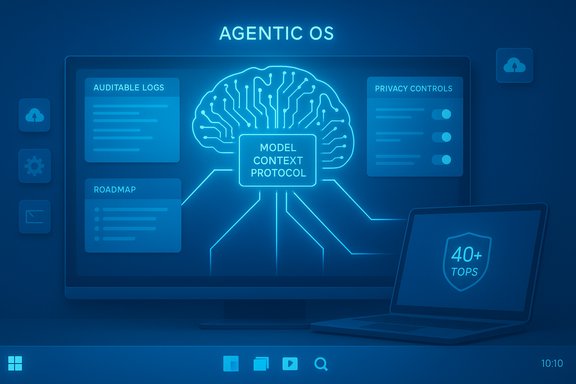 Background / Overview
Microsoft’s recent messaging frames Windows as a connective substrate for AI: an operating system that doesn’t just host applications, but coordinates them through persistent, permissioned agents able to act on behalf of users. The company has described this direction with the shorthand “agentic OS” and rolled out concrete engineering primitives — from the Model Context Protocol (MCP) and Windows AI Foundry to a branded Copilot+ PC tier built around powerful NPUs — to make the vision feasible. These platform changes are already visible in developer documentation and product pages. At the same time, Microsoft’s public communications bumped against longstanding, practical complaints: inconsistent UI polish, update regressions, increasing in‑OS nudges, and developer worries that Windows is becoming less of an open, controllable environment for builders. That friction made a short promotional sentence into a flashpoint; when Davuluri’s post accrued thousands of replies, the tone was overwhelmingly skeptical and often hostile. Microsoft’s follow-up — stressing feedback, developer importance, and a need to fix everyday reliability — read as an attempt to restore calm without abandoning the AI roadmap. What “agentic OS” actually means — the technical primer
The engineering pillars Microsoft is deploying
- Windows AI Foundry / Foundry Local — a runtime and toolchain that lets Windows manage local models, tools and on‑device inference while providing an API surface for apps to leverage models and agents. This is positioned as the local counterpart to Azure AI Foundry for cloud scale.
- Model Context Protocol (MCP) — an open protocol for agent-to-tool and agent-to-service interactions that exposes context and capabilities securely, enabling agents to call on local tools (file access, WSL, apps) or cloud services with explicit authorization. Microsoft has embedded MCP support across its AI platform stack.
- Copilot+ PC hardware tier — a device classification for PCs with neural processing units (NPUs) rated at 40+ TOPS, plus minimum memory and storage targets. Microsoft markets Copilot+ PCs as the devices that will deliver the richest low‑latency, private agent experiences (Recall, Cocreator, Live Captions, Click to Do, etc.. This specification appears across Microsoft’s Copilot+ pages and OEM partner materials.
What these primitives enable in practice
- Persistent cross‑app context and memory, so an agent can act with knowledge of open files, calendar context, and prior user instructions.
- Hybrid local/cloud inference: small or privacy‑sensitive tasks can run on‑device, heavy reasoning offloaded to cloud models.
- Tooling and APIs for third parties to register agents and build workflows that operate at the OS level rather than being isolated inside individual apps.
- Permissioning and audit surfaces — the theoretical guardrails required when software can take multi‑step actions autonomously.
Why the announcement provoked such a severe reaction
The reaction was not simply “AI panic.” It mapped to a set of concrete, repeated grievances:- Reliability and update hygiene. Users and admins described recent cumulative updates that regressed features or introduced breakages; frequent feature drops can amplify the perception that the baseline OS isn’t stable.
- Loss of control / power‑user friction. Long-time builders fret that an opinionated, agentic OS will reduce transparency and fine‑grained control — the very attributes that make Windows attractive for development, debugging and deep customization.
- Privacy and telemetry fears. Agentic features imply memory, context capture, and cross‑app bookkeeping. Without clear, auditable consent and retention rules, that looks like broadened telemetry by another name. Community commenters repeatedly demanded readable audit logs and conservative defaults.
- Perceptions of monetization and gating. The Copilot/Copilot+ narrative and in‑OS nudges to Microsoft 365 or OneDrive triggered suspicion that agentic automation could be another channel for upsell or to gate the best experiences behind premium hardware.
Microsoft’s public response: what was said, and what it actually commits to
Pavan Davuluri’s follow‑up reply to criticism — including a direct response to developer commentator Gergely Orosz — emphasized that the Windows team “take in a ton of feedback,” acknowledged pain points (reliability, performance, inconsistent dialogs, power‑user experiences), and stated the company’s desire that “we want developers to choose Windows.” He closed by saying words aren’t enough and it’s on the product teams “to continue improving and shipping.” Those lines are conciliatory and important, but they lack concrete timelines, metrics or new governance commitments. Independent reporting and thread aggregations picked up the exchange and reproduced the quotes. What the reply buys Microsoft in the short term is tone‑level dampening: leadership publicly recognized the complaints and signaled attention. What it does not (yet) provide is verifiable evidence of changed priorities: no published remediation roadmap, no guaranteed moratorium on high‑risk UX churn, and no immediate shift in defaults for agentic features. That gap is precisely what many technical audiences are asking Microsoft to close.Cross‑checked technical verifications (what we can say with confidence)
- Microsoft uses the term Copilot+ PC and documents a 40+ TOPS NPU guideline for machines intended to host the richest on‑device agent experiences. This appears on Microsoft’s official Copilot+ pages and in product blog posts describing OEM hardware. These pages define the Copilot+ experiences and list the Wave 1 and Wave 2 features targeted to those systems.
- Windows AI Foundry (also surfaced as Azure AI Foundry in cloud contexts) is an active Microsoft effort that provides both cloud and local tooling for model management, local inference and agent orchestration; Microsoft’s developer blog posts and Foundry documentation describe Foundry Local and how it integrates with MCP. These are published developer materials, not rumor.
- Model Context Protocol (MCP) is a real, open protocol that Microsoft is supporting and embedding across its agent stack; it’s discussed in Microsoft developer and blog posts as the mechanism to safely expose tools and data to agents under explicit authorization. MCP has broader industry momentum and a steering committee that includes Microsoft and GitHub.
- Pavan Davuluri’s X post that used “agentic OS” and his subsequent replies are a documented public exchange and were widely reported by major outlets; the exact language he used about listening to feedback and wanting developers to choose Windows is available in multiple news reports reproducing his comments.
Strengths of Microsoft’s agentic OS strategy
- Platform advantage and integration. Windows sits in front of a vast installed base of productivity apps, device drivers and enterprise management tooling. Embedding agentic primitives at the OS level can deliver cross‑app automation experiences that are hard to replicate purely in userland apps. If executed well, that can yield real productivity gains for knowledge workers.
- Hardware + software co‑design. Copilot+ PCs and the NPU strategy create an integrated hardware tier that allows low‑latency, private inference that enterprises and privacy‑sensitive users can prefer to cloud‑only solutions. This vertical alignment has precedent — when silicon and OS teams coordinate you can build genuinely new classes of features.
- Developer tooling alignment. By standardizing agent-to-tool protocols (MCP) and investing in Foundry tooling, Microsoft is creating a developer surface that could scale third‑party agent ecosystems with secure permissioning and discoverable capabilities — if those APIs are stable and well‑supported.
Risks, trade‑offs and where Microsoft must prove itself
- Trust deficit and sequence risk. Pushing agentic features before demonstrably restoring reliability and UX consistency risks alienating the very audiences (developers, admins, professionals) that Microsoft needs for platform health. The sequence matters: AI capabilities built atop a shaky baseline magnify existing problems.
- Defaults, telemetry and privacy. Agentic agents require state to be useful. Without conservative, well‑documented defaults and auditable logs, features that “remember” user context will be perceived as hidden telemetry. The burden of proof for consent and retention must be explicit and demonstrable.
- Hardware stratification and fragmentation. Gating the best experiences to Copilot+ hardware with a 40+ TOPS NPU could create a two‑tier Windows experience: “AI‑rich” devices with premium hardware and “legacy” devices without. That risks fragmenting developer expectations and increasing platform testing surface.
- Monetization optics. If Copilot features become channels for upselling Microsoft 365 or cloud services, perception will harden that agentic features are commercial levers rather than productivity investment. Microsoft must separate technical capability from paid feature lists in clear, transparent ways.
- Enterprise governance complexity. IT organizations demand deterministic configuration and predictable update behavior. Agentic automation embedded into the OS raises new policy needs: audit trails for agent actions, revocation and rollback mechanisms, and MDM/GPO controls that are comprehensive and testable.
A constructive checklist: how Microsoft could repair trust while keeping the roadmap
These are pragmatic, sequential items that would materially reduce community friction if implemented and communicated clearly.- Publish a measurable remediation roadmap that ties stability goals (bug counts, rollback frequency, UX consistency metrics) to concrete timelines and releases.
- Make agentic behaviors opt‑in by default; ship conservative defaults for Recall, persistent memory and screen capture, with a single privacy dashboard for all agentic features.
- Expose auditable logs and a developer/admin playground for agent actions so that IT can verify behavior before rollout.
- Publish a compatibility and stability guarantee for developer APIs — a versioned compatibility promise that avoids breaking developer toolchains across updates.
- Institute a “Power User” or “Professional Mode” profile with minimal nudges, conservative telemetry and preserved legacy affordances for developers and admins.
- Make Controlled Feature Rollout status visible to enterprise customers and Insiders, and provide test VHD images for QA teams.
- Commission independent privacy and security audits of agentic components and publish remediation plans.
What developers, IT teams and power users should do today
- Use controlled channels: run Canary/Beta/Dev on non‑critical machines; keep production deployments on stable branches and manage feature rollout through WSUS/Intune.
- Harden policies: establish group policies and MDM locks for any agentic features until you’ve validated audit trails and opt‑out mechanisms.
- Capture reproducible bugs: the Feedback Hub is useful, but collective, reproducible issue reports with logs and repro steps get prioritized faster.
- Test Copilot+ features in sandboxed environments before granting enterprise deployment approval — validate both behavior and privacy settings.
Longer‑term consequences for the Windows ecosystem
- If Microsoft successfully pairs measured engineering discipline with its agentic vision, Windows could become a unique orchestrator for productivity workflows — integrating voice, vision and local models across apps in ways no single app can. That would re‑centre Windows as a platform advantage rather than a collection of apps.
- If Microsoft fails to address stability, telemetry transparency, and developer assurances, the response could be structural: widening adoption of macOS and Linux among developers and a harder-to-reverse decline in platform goodwill. There are already signals of community migration interest after Windows 10’s end of support and the agentic messaging, which Microsoft must take seriously.
Final analysis: bold strategy, precarious execution
Microsoft’s ambition to make Windows “agentic” is strategically sensible: modern productivity expectations are shifting toward assistants that reduce friction and automate multi‑step work. The company has put concrete plumbing in place — MCP, Foundry, hardware guidance for Copilot+ — that makes the vision technically plausible. But strategy alone doesn’t win hearts; execution and sequencing do.The current moment is a test of stewardship: whether Microsoft can execute an AI‑first roadmap while preserving the fundamentals that made Windows the platform of choice for millions — reliability, predictability, and developer control. The message from the community is clear and practical: show measurable improvements to the basics, make agentic features auditable and opt‑in, and protect developer ergonomics before evangelizing autonomy at the OS level. Pavan Davuluri’s “we want developers to choose Windows” line is the right sentiment; the company now needs measurable actions that demonstrate it.
Microsoft’s choice is stark but simple: build the agentic future users trust, or press on and risk accelerating defections that will shrink the very developer and enterprise base needed to sustain that future. The technology is arriving; the question is whether Microsoft will earn the permission to make agents a normal, trusted part of everyday Windows workflows.
Source: TweakTown After 'Agentic OS' backlash, Microsoft says it wants developers to choose Windows
