

A Windows Phone-inspired Android interface concept is making the rounds after Concept Phones highlighted a set of Figma mock-ups that apply Microsoft’s Fluent design language to a modern handset. It is not a Microsoft product, Android skin, launcher, or announced partnership—just a design study—but it makes a credible case for the visual direction Microsoft left behind.
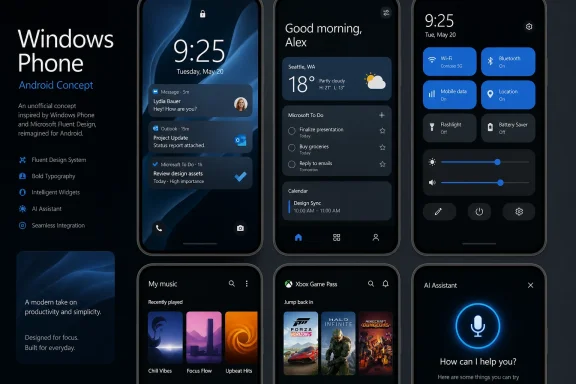
The mock-ups replace the conventional Android app-grid-first approach with oversized typography, roomy cards, rounded widgets, and restrained iconography. The lock screen uses floating notification cards and compact media controls; the home screen foregrounds weather, Microsoft To Do-style tasks, music, and gaming information rather than rows of static shortcuts.
The concept does not attempt a literal rebuild of Windows Phone 8 or its Live Tiles. Instead, it treats Android widgets as the successor to that idea: glanceable information remains visible, but the layout is less rigid than a screen made from fixed squares.
Concept Phones points to Windows 11-style elements throughout, particularly in Quick Settings. Large blue toggles, thin sliders, a compact media player, and broadly spaced controls resemble Microsoft’s current PC design language more than stock Android, Samsung’s One UI, or Xiaomi’s HyperOS. The Settings mock-up follows the same path, with colorful section icons, a prominent account area, and a dark, layered background.
There is also an assistant screen with a glowing microphone treatment that recalls Cortana. In this version, though, the assistant is presented as a contemporary AI interface rather than a revival of Microsoft’s discontinued voice service.
That is easier to imagine today than a new Microsoft phone platform. Microsoft ended Windows Phone 8.1 support on July 11, 2017, and Windows 10 Mobile reached end of support on January 14, 2020. The company’s mobile strategy since then has centered on Android apps and services, including Microsoft 365, Outlook, Edge, Phone Link, and its work with Android hardware partners.
A concept UI also sidesteps the expensive parts of shipping a real platform: OEM adoption, carrier certification, long-term updates, regional support, accessibility validation, and the inevitable compromises required by Android’s system-level APIs. A polished Figma frame does not establish that the notification model, widgets, theming, battery controls, or third-party apps would work as cleanly in production.
Still, as reported by Concept Phones, the mock-ups show that the Windows Phone design legacy has room to evolve beyond replicas and launcher themes. For Windows enthusiasts, it is a reminder that Microsoft’s mobile UI was distinctive even when its ecosystem was not competitive enough.
For now, there is nothing to install, buy, or test; the design remains an unofficial concept.
The mock-ups replace the conventional Android app-grid-first approach with oversized typography, roomy cards, rounded widgets, and restrained iconography. The lock screen uses floating notification cards and compact media controls; the home screen foregrounds weather, Microsoft To Do-style tasks, music, and gaming information rather than rows of static shortcuts.
 Fluent, not a Live Tiles revival
The concept does not attempt a literal rebuild of Windows Phone 8 or its Live Tiles. Instead, it treats Android widgets as the successor to that idea: glanceable information remains visible, but the layout is less rigid than a screen made from fixed squares.Concept Phones points to Windows 11-style elements throughout, particularly in Quick Settings. Large blue toggles, thin sliders, a compact media player, and broadly spaced controls resemble Microsoft’s current PC design language more than stock Android, Samsung’s One UI, or Xiaomi’s HyperOS. The Settings mock-up follows the same path, with colorful section icons, a prominent account area, and a dark, layered background.
There is also an assistant screen with a glowing microphone treatment that recalls Cortana. In this version, though, the assistant is presented as a contemporary AI interface rather than a revival of Microsoft’s discontinued voice service.
The practical appeal is Android underneath
The strongest part of the idea is not nostalgia. A Fluent-inspired shell built on Android would avoid the app availability problem that undermined Windows Phone. Users could retain Android’s application catalogue and device support while getting a more opinionated, productivity-oriented interface.That is easier to imagine today than a new Microsoft phone platform. Microsoft ended Windows Phone 8.1 support on July 11, 2017, and Windows 10 Mobile reached end of support on January 14, 2020. The company’s mobile strategy since then has centered on Android apps and services, including Microsoft 365, Outlook, Edge, Phone Link, and its work with Android hardware partners.
A concept UI also sidesteps the expensive parts of shipping a real platform: OEM adoption, carrier certification, long-term updates, regional support, accessibility validation, and the inevitable compromises required by Android’s system-level APIs. A polished Figma frame does not establish that the notification model, widgets, theming, battery controls, or third-party apps would work as cleanly in production.
Still, as reported by Concept Phones, the mock-ups show that the Windows Phone design legacy has room to evolve beyond replicas and launcher themes. For Windows enthusiasts, it is a reminder that Microsoft’s mobile UI was distinctive even when its ecosystem was not competitive enough.
For now, there is nothing to install, buy, or test; the design remains an unofficial concept.
References
- Primary source: Concept Phones
Published: 2026-07-15T17:55:10+00:00
Microsoft's Lost Mobile Future? This Windows Phone-Inspired Android UI Concept Feels Fresh
Phone Renders Leaks Concepts and Designswww.concept-phones.com
- Official source: learn.microsoft.com
Windows Phone 8.1 - Microsoft Lifecycle | Microsoft Learn
Windows Phone 8.1 follows the Fixed Lifecycle Policy.learn.microsoft.com - Official source: support.microsoft.com
What does it mean if Windows isn't supported? | Microsoft Support
Learn what it means if you have an older version of Windows that's no longer supported.support.microsoft.com - Official source: download.microsoft.com
