

Microsoft has confirmed a Windows driver-publishing change that will let new graphics drivers use a simpler Hardware ID plus Computer Hardware ID targeting model, with rollout work beginning in 2026 and broader enforcement expected from late 2026 into early 2027. The practical promise is straightforward: Windows Update should get better at not replacing a newer, user-installed GPU driver with an older but higher-ranked package from Microsoft’s distribution channel. That sounds like plumbing, because it is. But for anyone who has watched a game-ready NVIDIA, AMD, or Intel graphics driver mysteriously revert after an update scan, plumbing is exactly where the leak has been.
The announcement matters because Windows driver reliability has always lived in the uneasy space between convenience and control. Microsoft wants Windows Update to be the safe default for billions of devices, OEMs want predictable servicing for their exact hardware combinations, and power users want the driver they deliberately installed to stay installed. This change is Microsoft admitting, in the careful language of driver policy, that the old targeting model has been too blunt for modern graphics hardware.
The mistake would be to read this as a new graphics driver architecture. It is not. Microsoft is not replacing the Windows Display Driver Model, rewriting the graphics stack, or suddenly taking over NVIDIA’s and AMD’s release pipelines.
What is changing is the map Windows Update uses to decide which driver package applies to which machine. For graphics drivers published through the Windows Hardware Compatibility Program, Microsoft is moving from a more complex four-part hardware identification targeting scheme toward a two-part Hardware ID model combined with Computer Hardware IDs where appropriate.
That may sound like a reduction in precision, but Microsoft’s argument is the opposite. The older model could make a driver appear like the best match because of how the Plug and Play ranking system interpreted the hardware identifier. In practice, that could mean Windows Update offering, and sometimes installing, a driver that was technically applicable but operationally worse for the device sitting in front of the user.
The new approach leans more heavily on CHIDs, which describe the computer model or hardware configuration, rather than only the component. That matters for GPUs because the same graphics silicon can appear in desktops, laptops, workstations, docking configurations, and OEM-tuned thermal envelopes. A driver that is “right” for a PCI device ID can still be wrong for a specific laptop build.
This is the quiet distinction at the heart of the policy change. Microsoft is not saying Windows Update needs fewer rules. It is saying the rules need to identify the system with more care, instead of treating the graphics adapter as if it existed in isolation.
From Microsoft’s perspective, that answer may have been internally consistent. Windows Update does not merely sort drivers by release date or by what a vendor’s control panel says is newest. It ranks drivers based on applicability, signing, targeting, and metadata that are supposed to protect users from installing the wrong package.
The problem is that “best-ranked” is not always “best for the user’s intent.” A driver can win the ranking contest because it matches a hardware identifier more specifically, even if it is older than the driver currently installed. That is how a system can end up moving backward without the user having asked to move backward.
This distinction explains why the issue has been so stubborn. It was not merely a bug where Windows Update forgot to compare version numbers. It was a policy and targeting problem, one embedded in the way drivers are submitted, published, matched, and delivered.
That also explains the timeline. Microsoft cannot simply flip a client-side switch on Wednesday and solve every graphics driver downgrade on Thursday. The company has to change how future drivers are published through the hardware program, how partners target them, and how enforcement is staged without breaking existing distribution agreements.
Computer Hardware IDs are Microsoft’s way of describing that recipe. They are generated from system information such as manufacturer, product family, SKU, BIOS details, baseboard data, and other SMBIOS fields. In Windows Update targeting, CHIDs can narrow driver applicability before normal Plug and Play ranking decides what happens next.
That is especially relevant for notebooks. A mobile GPU may share branding with a desktop part, but the laptop vendor may have tuned power states, display switching, panel behavior, hybrid graphics, firmware interactions, or thermal policies. A generic driver can work perfectly well for some systems and still trip over an OEM-specific edge case on another.
The new graphics driver publishing policy tries to make that distinction more deliberate. By allowing display drivers for new devices to use two-part Hardware IDs combined with CHIDs, Microsoft gives vendors a cleaner way to say: this driver is for this class of GPU, but only when it appears in this kind of computer.
That is a more realistic model of the Windows ecosystem. It also moves responsibility closer to the companies that know the machine. GPU vendors know the chip. OEMs know the platform. Microsoft knows the update pipeline. The new policy tries to make those boundaries less leaky.
This is a familiar Windows servicing compromise. Microsoft is trying to improve the system without invalidating the entire installed base of driver metadata already flowing through Windows Update. That is sensible from a compatibility standpoint, but it also means the benefits will arrive unevenly.
New devices and newly published graphics drivers should be the first to benefit. Older hardware may see improvement only as vendors publish new packages under the updated rules, assuming they do so at all. Systems that are already prone to receiving a mismatched driver may continue to need old-fashioned administrative controls for some time.
This is where the difference between “confirmed” and “fixed” matters. Microsoft has confirmed a policy change. It has not made every Windows 11 PC immune to driver downgrades as of May 2026.
For enterprise administrators, that nuance is not academic. Fleet policies, driver rings, Windows Autopatch settings, OEM update utilities, and Intune approvals will still matter. A better targeting model reduces the number of bad offers, but it does not eliminate the need for deployment governance.
That is the other side of the same philosophy. Better targeting tries to prevent the wrong driver from landing. Cloud rollback tries to recover when a bad driver lands anyway.
The old model put too much burden on the unlucky endpoint. If a driver caused crashes, boot failures, display glitches, or device instability, the user or administrator often had to uninstall, roll back, hide, block, or wait. At scale, that is a brutal operational model. In consumer land, it becomes forum archaeology: find the right Device Manager path, use the old hide-update troubleshooter, disable driver updates, or reinstall the vendor package yet again.
Microsoft’s cloud-based recovery idea points to a more centralized response. If telemetry shows that a driver is unhealthy, Microsoft can stop or reverse distribution and move affected systems to a known-good version. That is not a substitute for vendor testing, but it is a recognition that the Windows ecosystem is too large for purely manual recovery.
The risk, of course, is that more central control makes trust more important. Users who already feel Windows Update has been too aggressive with drivers may not immediately cheer for a cloud service with more authority over rollback decisions. Microsoft’s challenge is to prove that the system intervenes only when it should, and that it reduces surprises rather than creating new ones.
Graphics drivers are not just for games. They affect Teams and Zoom performance, browser GPU acceleration, hardware video decode, CAD applications, medical imaging, financial workstations, multi-monitor setups, docking stations, and remote work scenarios. A bad or mismatched driver can look like an application problem, a monitor problem, a dock problem, or a Windows problem.
Driver downgrades are particularly irritating in managed environments because they undermine change control. An administrator may certify a driver version for a hardware model, only for Windows Update to offer something else based on a ranking rule that does not reflect the organization’s testing. Even when policy controls exist, the interaction among OEM tools, Windows Update, optional drivers, Autopatch, and manual installs can be messy.
The CHID-based approach gives Microsoft and hardware partners a better foundation for fleet-aware targeting. A driver intended for one OEM’s configuration should be less likely to bleed into another. A package meant for a specific laptop family should be easier to distinguish from a broadly applicable GPU driver.
That will not remove the need for rings. It should, however, reduce the number of cases where administrators are forced to fight Windows Update over an obviously unsuitable package. In enterprise terms, this is not glamour. It is fewer avoidable incidents.
That slowness frustrates users because the bug feels simple from the outside. If a newer NVIDIA driver is installed, why would Windows install an older one? If a user deliberately chose a vendor driver, why not respect that choice? If a downgrade causes problems, why not block it globally?
The answer is that Windows Update is not a single-user preference engine. It is an automated distribution system designed for enormous variation. It must handle clean installs, missing drivers, generic fallback drivers, security fixes, OEM-specific packages, dynamic updates during OS upgrades, optional drivers, and automatic servicing.
That scale is why a targeting-policy correction takes months rather than days. Microsoft has to avoid fixing one class of mismatch by starving another class of systems of drivers. A too-broad rule causes downgrades; a too-narrow rule leaves devices unsupported. The art is in the middle.
The timeline also signals that this is not just a client update for Windows 11 version 25H2 or a single cumulative update. It is a publishing-policy transition. The benefits will accumulate as hardware partners adopt the new method and Microsoft enforces it.
Drivers are powerful software. Kernel-mode drivers, in particular, sit close enough to the operating system to cause crashes, bypass protections, or become security liabilities. Microsoft’s long-term direction is obvious: fewer ancient trust exceptions, more telemetry-informed rollout, more certification pressure, and more centralized control over what Windows loads by default.
For users, this creates a tradeoff. A stricter driver ecosystem can be safer and more stable, especially for mainstream PCs. But it can also feel less flexible, particularly for tinkerers, niche hardware owners, and professionals who depend on a vendor’s newest package before it appears in Windows Update.
The GPU downgrade fix sits at the intersection of those tensions. Microsoft is not surrendering driver control back to users. It is trying to make its own control plane more accurate.
That is why the change is best read as a credibility repair. Windows Update cannot be the trusted path for driver delivery if it repeatedly appears to make nonsensical choices. Fixing the targeting model is a way for Microsoft to say: the platform can be more automatic without being more careless.
But the more interesting cases may be less visible. A laptop that stops flickering after an OEM graphics update. A workstation that needs a certified driver branch. A creator system that depends on a fix for hardware encoding. A handheld PC whose graphics stack is tuned around power and display behavior. These are not fringe scenarios anymore.
Modern Windows graphics is a platform dependency. The GPU accelerates the desktop, browser rendering, video calls, media playback, AI workloads, creative applications, and increasingly even parts of the developer workflow. Treating the graphics driver as a generic component update undersells how deeply it shapes the user experience.
That is why a targeting-policy change can matter more than it sounds. If the right driver stays installed, everything above it becomes less mysterious. If the wrong driver lands, users blame whatever broke first, not the ranking logic that delivered it.
The best driver update is often the one nobody notices. Microsoft’s goal here is to make the quiet path more common.
Consumer users often respond by disabling driver delivery through Windows Update altogether. That can work, but it is a blunt instrument. It may prevent an unwanted GPU downgrade, while also blocking useful fixes for other devices.
Power users may prefer vendor tools, clean installations, rollback through Device Manager, or hiding specific updates. Enterprises may use rings, manual approval workflows, Windows Update for Business policies, Intune, Autopatch, or OEM management utilities. Each approach has a place, but each adds process around a problem that should ideally be solved upstream.
Microsoft’s change does not make those tools obsolete. It makes them less likely to be needed for this specific class of graphics mismatch. That is a narrower claim than many users would like, but it is also a more credible one.
The practical advice for now is boring and correct: do not dismantle your current driver-management strategy just because Microsoft has announced a better targeting model. Watch how the policy rolls out, especially on the hardware models that have caused trouble before.
That is not inherently bad. In a world of billions of machines, telemetry-based rollout and rollback can prevent small mistakes from becoming global outages. A driver that crashes a small percentage of devices can be paused before it reaches everyone. A bad deployment can be reversed faster than a vendor might ship a replacement.
But the model only works if Microsoft is transparent enough for administrators and predictable enough for users. Driver changes are not like app updates. They can affect boot, display output, networking, storage, input, and security. When they go wrong, the user may not have a working screen on which to read the explanation.
This is why the GPU targeting fix should be welcomed without being overpraised. It addresses a real defect in the delivery model. It also deepens the assumption that Microsoft’s cloud and policy systems should decide more of what happens to drivers after Windows is installed.
That assumption is the future of Windows servicing. The fight is not over whether the cloud participates. It is over whether the cloud makes better decisions than the old local machinery did.
That makes this a hard improvement to celebrate. Successful infrastructure disappears. Nobody writes forum posts titled “Windows Update Correctly Left My Driver Alone.” The complaints vanish before the praise appears.
Still, there are concrete markers worth watching as the policy moves from announcement to enforcement:
Microsoft has spent years asking Windows users to trust automatic servicing; with GPU drivers, that trust has too often been undermined by updates that felt arbitrary from the user’s side of the screen. The new HWID-and-CHID publishing approach is not a cure for every driver headache, and its staged rollout means patience is still required. But it is a meaningful admission that driver quality is not only about the code inside the package — it is also about whether Windows knows where that package belongs. If Microsoft and its hardware partners execute well, the best sign of success will be a quieter Windows Update, one that finally understands that sometimes the smartest driver decision is to leave the better driver alone.
Source: Neowin Microsoft confirms Windows 11 to finally have a much-requested GPU driver improvement
The announcement matters because Windows driver reliability has always lived in the uneasy space between convenience and control. Microsoft wants Windows Update to be the safe default for billions of devices, OEMs want predictable servicing for their exact hardware combinations, and power users want the driver they deliberately installed to stay installed. This change is Microsoft admitting, in the careful language of driver policy, that the old targeting model has been too blunt for modern graphics hardware.
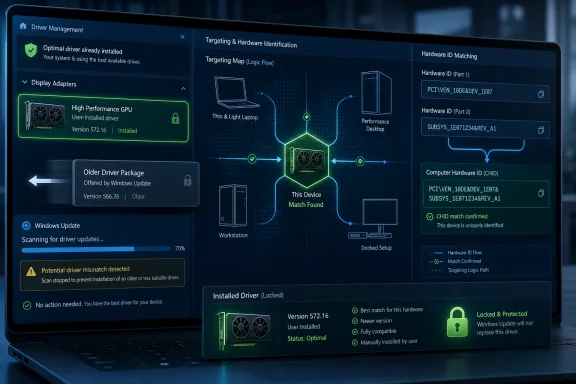 Microsoft Is Fixing the Map, Not the Driver
The mistake would be to read this as a new graphics driver architecture. It is not. Microsoft is not replacing the Windows Display Driver Model, rewriting the graphics stack, or suddenly taking over NVIDIA’s and AMD’s release pipelines.What is changing is the map Windows Update uses to decide which driver package applies to which machine. For graphics drivers published through the Windows Hardware Compatibility Program, Microsoft is moving from a more complex four-part hardware identification targeting scheme toward a two-part Hardware ID model combined with Computer Hardware IDs where appropriate.
That may sound like a reduction in precision, but Microsoft’s argument is the opposite. The older model could make a driver appear like the best match because of how the Plug and Play ranking system interpreted the hardware identifier. In practice, that could mean Windows Update offering, and sometimes installing, a driver that was technically applicable but operationally worse for the device sitting in front of the user.
The new approach leans more heavily on CHIDs, which describe the computer model or hardware configuration, rather than only the component. That matters for GPUs because the same graphics silicon can appear in desktops, laptops, workstations, docking configurations, and OEM-tuned thermal envelopes. A driver that is “right” for a PCI device ID can still be wrong for a specific laptop build.
This is the quiet distinction at the heart of the policy change. Microsoft is not saying Windows Update needs fewer rules. It is saying the rules need to identify the system with more care, instead of treating the graphics adapter as if it existed in isolation.
The GPU Driver Downgrade Problem Was Never Just an Enthusiast Complaint
For years, driver downgrades have been a recurring frustration in Windows communities because they feel like the operating system ignoring the user. A gamer installs a new driver to fix a specific title. A creator updates for a CUDA, OpenCL, or video encoding fix. A laptop owner installs the OEM-recommended package to resolve sleep or brightness issues. Then Windows Update arrives with a different answer.From Microsoft’s perspective, that answer may have been internally consistent. Windows Update does not merely sort drivers by release date or by what a vendor’s control panel says is newest. It ranks drivers based on applicability, signing, targeting, and metadata that are supposed to protect users from installing the wrong package.
The problem is that “best-ranked” is not always “best for the user’s intent.” A driver can win the ranking contest because it matches a hardware identifier more specifically, even if it is older than the driver currently installed. That is how a system can end up moving backward without the user having asked to move backward.
This distinction explains why the issue has been so stubborn. It was not merely a bug where Windows Update forgot to compare version numbers. It was a policy and targeting problem, one embedded in the way drivers are submitted, published, matched, and delivered.
That also explains the timeline. Microsoft cannot simply flip a client-side switch on Wednesday and solve every graphics driver downgrade on Thursday. The company has to change how future drivers are published through the hardware program, how partners target them, and how enforcement is staged without breaking existing distribution agreements.
The CHID Shift Reflects the Reality of Modern PCs
The PC market no longer fits the old mental model of interchangeable parts attached to a generic Windows installation. That model still exists in the DIY desktop world, but Windows Update has to serve everything from handheld gaming PCs and thin-and-light laptops to enterprise fleets and AI workstations. In that world, the graphics driver is often part of a larger system recipe.Computer Hardware IDs are Microsoft’s way of describing that recipe. They are generated from system information such as manufacturer, product family, SKU, BIOS details, baseboard data, and other SMBIOS fields. In Windows Update targeting, CHIDs can narrow driver applicability before normal Plug and Play ranking decides what happens next.
That is especially relevant for notebooks. A mobile GPU may share branding with a desktop part, but the laptop vendor may have tuned power states, display switching, panel behavior, hybrid graphics, firmware interactions, or thermal policies. A generic driver can work perfectly well for some systems and still trip over an OEM-specific edge case on another.
The new graphics driver publishing policy tries to make that distinction more deliberate. By allowing display drivers for new devices to use two-part Hardware IDs combined with CHIDs, Microsoft gives vendors a cleaner way to say: this driver is for this class of GPU, but only when it appears in this kind of computer.
That is a more realistic model of the Windows ecosystem. It also moves responsibility closer to the companies that know the machine. GPU vendors know the chip. OEMs know the platform. Microsoft knows the update pipeline. The new policy tries to make those boundaries less leaky.
Existing Drivers Will Keep Living Under the Old Rules
The catch is important: Microsoft says the policy is focused on future driver publishing. Existing drivers are not automatically reclassified under the new framework. That means users should not expect every old downgrade scenario to vanish overnight.This is a familiar Windows servicing compromise. Microsoft is trying to improve the system without invalidating the entire installed base of driver metadata already flowing through Windows Update. That is sensible from a compatibility standpoint, but it also means the benefits will arrive unevenly.
New devices and newly published graphics drivers should be the first to benefit. Older hardware may see improvement only as vendors publish new packages under the updated rules, assuming they do so at all. Systems that are already prone to receiving a mismatched driver may continue to need old-fashioned administrative controls for some time.
This is where the difference between “confirmed” and “fixed” matters. Microsoft has confirmed a policy change. It has not made every Windows 11 PC immune to driver downgrades as of May 2026.
For enterprise administrators, that nuance is not academic. Fleet policies, driver rings, Windows Autopatch settings, OEM update utilities, and Intune approvals will still matter. A better targeting model reduces the number of bad offers, but it does not eliminate the need for deployment governance.
Windows Update Is Becoming More Assertive About Driver Quality
The graphics targeting change is part of a broader driver-quality push. Microsoft has also been moving toward cloud-assisted rollback mechanisms, including Cloud-Initiated Driver Recovery, which is designed to let Microsoft pull systems back from a faulty driver delivered through Windows Update without waiting for every user or hardware vendor to intervene manually.That is the other side of the same philosophy. Better targeting tries to prevent the wrong driver from landing. Cloud rollback tries to recover when a bad driver lands anyway.
The old model put too much burden on the unlucky endpoint. If a driver caused crashes, boot failures, display glitches, or device instability, the user or administrator often had to uninstall, roll back, hide, block, or wait. At scale, that is a brutal operational model. In consumer land, it becomes forum archaeology: find the right Device Manager path, use the old hide-update troubleshooter, disable driver updates, or reinstall the vendor package yet again.
Microsoft’s cloud-based recovery idea points to a more centralized response. If telemetry shows that a driver is unhealthy, Microsoft can stop or reverse distribution and move affected systems to a known-good version. That is not a substitute for vendor testing, but it is a recognition that the Windows ecosystem is too large for purely manual recovery.
The risk, of course, is that more central control makes trust more important. Users who already feel Windows Update has been too aggressive with drivers may not immediately cheer for a cloud service with more authority over rollback decisions. Microsoft’s challenge is to prove that the system intervenes only when it should, and that it reduces surprises rather than creating new ones.
The Enterprise Angle Is Less Glamorous and More Important
Enthusiasts notice GPU driver downgrades because a game stutters, a control panel changes, or a benchmark result drops. Enterprises notice driver problems because thousands of machines can become tickets. That makes this policy change more consequential for IT than the gaming framing suggests.Graphics drivers are not just for games. They affect Teams and Zoom performance, browser GPU acceleration, hardware video decode, CAD applications, medical imaging, financial workstations, multi-monitor setups, docking stations, and remote work scenarios. A bad or mismatched driver can look like an application problem, a monitor problem, a dock problem, or a Windows problem.
Driver downgrades are particularly irritating in managed environments because they undermine change control. An administrator may certify a driver version for a hardware model, only for Windows Update to offer something else based on a ranking rule that does not reflect the organization’s testing. Even when policy controls exist, the interaction among OEM tools, Windows Update, optional drivers, Autopatch, and manual installs can be messy.
The CHID-based approach gives Microsoft and hardware partners a better foundation for fleet-aware targeting. A driver intended for one OEM’s configuration should be less likely to bleed into another. A package meant for a specific laptop family should be easier to distinguish from a broadly applicable GPU driver.
That will not remove the need for rings. It should, however, reduce the number of cases where administrators are forced to fight Windows Update over an obviously unsuitable package. In enterprise terms, this is not glamour. It is fewer avoidable incidents.
The Timing Shows How Slowly Windows Plumbing Really Moves
Microsoft’s stated window, stretching from pilot activity in 2026 toward broader enforcement in late 2026 and early 2027, is a reminder that Windows servicing changes are ecosystem negotiations. The operating system is only one piece. Hardware vendors, OEMs, Partner Center workflows, signing rules, telemetry systems, and Windows Update metadata all have to line up.That slowness frustrates users because the bug feels simple from the outside. If a newer NVIDIA driver is installed, why would Windows install an older one? If a user deliberately chose a vendor driver, why not respect that choice? If a downgrade causes problems, why not block it globally?
The answer is that Windows Update is not a single-user preference engine. It is an automated distribution system designed for enormous variation. It must handle clean installs, missing drivers, generic fallback drivers, security fixes, OEM-specific packages, dynamic updates during OS upgrades, optional drivers, and automatic servicing.
That scale is why a targeting-policy correction takes months rather than days. Microsoft has to avoid fixing one class of mismatch by starving another class of systems of drivers. A too-broad rule causes downgrades; a too-narrow rule leaves devices unsupported. The art is in the middle.
The timeline also signals that this is not just a client update for Windows 11 version 25H2 or a single cumulative update. It is a publishing-policy transition. The benefits will accumulate as hardware partners adopt the new method and Microsoft enforces it.
Microsoft Is Also Tightening the Driver Trust Boundary
The graphics targeting change lands during a broader period of driver-policy tightening. Microsoft has been pushing more drivers through the Windows Hardware Compatibility Program, limiting old signing paths, refining publishing restrictions, and emphasizing safer distribution through Windows Update. That larger context matters.Drivers are powerful software. Kernel-mode drivers, in particular, sit close enough to the operating system to cause crashes, bypass protections, or become security liabilities. Microsoft’s long-term direction is obvious: fewer ancient trust exceptions, more telemetry-informed rollout, more certification pressure, and more centralized control over what Windows loads by default.
For users, this creates a tradeoff. A stricter driver ecosystem can be safer and more stable, especially for mainstream PCs. But it can also feel less flexible, particularly for tinkerers, niche hardware owners, and professionals who depend on a vendor’s newest package before it appears in Windows Update.
The GPU downgrade fix sits at the intersection of those tensions. Microsoft is not surrendering driver control back to users. It is trying to make its own control plane more accurate.
That is why the change is best read as a credibility repair. Windows Update cannot be the trusted path for driver delivery if it repeatedly appears to make nonsensical choices. Fixing the targeting model is a way for Microsoft to say: the platform can be more automatic without being more careless.
Gamers Will Benefit, But They Are Not the Whole Story
Gaming will be the most visible beneficiary because GPU driver versions are part of gaming culture. New releases arrive with support for specific titles, bug fixes, performance improvements, and sometimes urgent workarounds. When Windows Update overwrites one of those drivers, the user notices immediately.But the more interesting cases may be less visible. A laptop that stops flickering after an OEM graphics update. A workstation that needs a certified driver branch. A creator system that depends on a fix for hardware encoding. A handheld PC whose graphics stack is tuned around power and display behavior. These are not fringe scenarios anymore.
Modern Windows graphics is a platform dependency. The GPU accelerates the desktop, browser rendering, video calls, media playback, AI workloads, creative applications, and increasingly even parts of the developer workflow. Treating the graphics driver as a generic component update undersells how deeply it shapes the user experience.
That is why a targeting-policy change can matter more than it sounds. If the right driver stays installed, everything above it becomes less mysterious. If the wrong driver lands, users blame whatever broke first, not the ranking logic that delivered it.
The best driver update is often the one nobody notices. Microsoft’s goal here is to make the quiet path more common.
The Old Workarounds Will Not Disappear Immediately
Until the new policy is fully reflected in the driver catalog, users and administrators will still rely on existing controls. Windows provides ways to manage driver updates, and enterprise tools provide more. But none of them are as satisfying as the operating system simply not offering the wrong driver in the first place.Consumer users often respond by disabling driver delivery through Windows Update altogether. That can work, but it is a blunt instrument. It may prevent an unwanted GPU downgrade, while also blocking useful fixes for other devices.
Power users may prefer vendor tools, clean installations, rollback through Device Manager, or hiding specific updates. Enterprises may use rings, manual approval workflows, Windows Update for Business policies, Intune, Autopatch, or OEM management utilities. Each approach has a place, but each adds process around a problem that should ideally be solved upstream.
Microsoft’s change does not make those tools obsolete. It makes them less likely to be needed for this specific class of graphics mismatch. That is a narrower claim than many users would like, but it is also a more credible one.
The practical advice for now is boring and correct: do not dismantle your current driver-management strategy just because Microsoft has announced a better targeting model. Watch how the policy rolls out, especially on the hardware models that have caused trouble before.
The Driver Stack Is Becoming a Cloud-Governed System
The deeper story is that Windows drivers are becoming less like static packages and more like a cloud-governed service. Microsoft already controls the update channel, metadata, gradual rollout, flighting, and approval processes. With more precise targeting and cloud-initiated recovery, it is adding more feedback and correction loops.That is not inherently bad. In a world of billions of machines, telemetry-based rollout and rollback can prevent small mistakes from becoming global outages. A driver that crashes a small percentage of devices can be paused before it reaches everyone. A bad deployment can be reversed faster than a vendor might ship a replacement.
But the model only works if Microsoft is transparent enough for administrators and predictable enough for users. Driver changes are not like app updates. They can affect boot, display output, networking, storage, input, and security. When they go wrong, the user may not have a working screen on which to read the explanation.
This is why the GPU targeting fix should be welcomed without being overpraised. It addresses a real defect in the delivery model. It also deepens the assumption that Microsoft’s cloud and policy systems should decide more of what happens to drivers after Windows is installed.
That assumption is the future of Windows servicing. The fight is not over whether the cloud participates. It is over whether the cloud makes better decisions than the old local machinery did.
The Real Test Will Be the Next Driver Windows Does Not Install
The most important evidence will not be a blog post or a policy document. It will be absence. A user installs a newer GPU driver, Windows Update scans, and nothing foolish happens. An OEM-specific graphics package stays on the intended laptop family. A desktop with a generic GPU driver does not get pulled backward by a better-ranked but older package.That makes this a hard improvement to celebrate. Successful infrastructure disappears. Nobody writes forum posts titled “Windows Update Correctly Left My Driver Alone.” The complaints vanish before the praise appears.
Still, there are concrete markers worth watching as the policy moves from announcement to enforcement:
- New graphics drivers published under the updated model should be less likely to override newer user-installed packages merely because of ranking quirks.
- OEM-specific systems should benefit most when vendors use CHIDs accurately and keep their SMBIOS data clean.
- Existing driver packages may continue to behave under the old rules until vendors republish or replace them.
- Enterprise administrators should keep using deployment rings and approval policies while the transition plays out.
- Cloud-based driver rollback may reduce the blast radius of bad updates, but it will not replace careful driver testing.
- The late-2026 to early-2027 enforcement window means this is a staged ecosystem change, not an immediate Windows 11 hotfix.
Microsoft has spent years asking Windows users to trust automatic servicing; with GPU drivers, that trust has too often been undermined by updates that felt arbitrary from the user’s side of the screen. The new HWID-and-CHID publishing approach is not a cure for every driver headache, and its staged rollout means patience is still required. But it is a meaningful admission that driver quality is not only about the code inside the package — it is also about whether Windows knows where that package belongs. If Microsoft and its hardware partners execute well, the best sign of success will be a quieter Windows Update, one that finally understands that sometimes the smartest driver decision is to leave the better driver alone.
Source: Neowin Microsoft confirms Windows 11 to finally have a much-requested GPU driver improvement
