
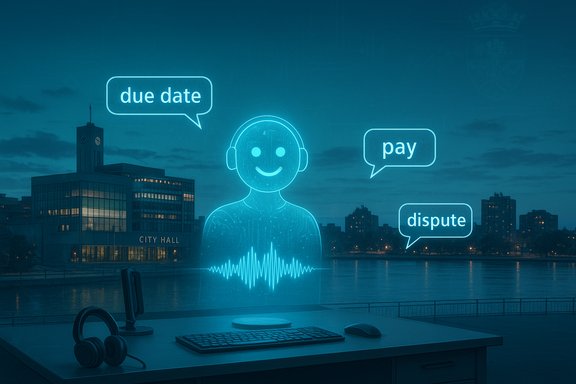
The City of Windsor has quietly approved a six‑month pilot that will route routine calls about speeding tickets and other Provincial Offences Act matters to a voice‑enabled AI chatbot — a move the city frames as a cost‑saving, service‑accessibility measure that will free front‑line staff for “higher‑value” work, but one that has already triggered union concern and broader questions about accuracy, governance and long‑term workforce impacts. Early city estimates presented to council say the bot would handle roughly 30% of the POA clerks’ call load (about 0.7 FTE of time freed at an estimated $57,600 annualized cost savings that the city expects to recoup within 10 months); those figures are reported in local coverage but remain subject to validation and council review.
Municipalities across Canada are experimenting with AI assistants to reduce repetitive transactional work, shorten wait times and extend service hours without adding staff. Cities from Kelowna to Kitchener — and transit systems like Saskatoon Transit — have publicly reported real operational gains after deploying chatbots, search assistants or predictive‑maintenance AI, though outcomes vary by scope, governance and measurement. These pilots often pursue the same promise: automate high‑volume, low‑risk interactions and redeploy human expertise to complex, judgment‑driven tasks. Windsor’s pilot sits inside this wider municipal trend but lands squarely at the most sensitive intersection of public service delivery: the justice‑adjacent world of fines, court schedules and legal processes. That context raises unique stakes. Answers provided to a person calling about an offence can influence behaviour (pay or dispute a ticket), timelines and sometimes legal exposure. For that reason, the design, accuracy and governance of any POA chatbot deserve more scrutiny than a typical “FAQ” bot handling recreation schedules or garbage collections.
The city’s headline numbers — 30% of calls, 0.7 FTE freed, $57,600 annualized cost and a 10‑month payback — are useful planning signals but require transparent baseline data and independent verification. The CRA’s recent Auditor‑General findings are a blunt reminder: automation can compound errors if underlying content and governance are weak; a chatbot that is only “better than a poor human baseline” is still an unacceptable outcome for legally consequential services. If Windsor, or any municipality, wants to do this right, it must pair smart procurement and tight technical controls with public reporting and a genuine workforce transition plan — not after the pilot, but before it scales. The technology can extend access and improve efficiency, but only under a governance framework that treats accuracy, privacy and staff livelihoods as operational requirements — not optional extras.
Source: CBC https://www.cbc.ca/news/canada/windsor/ai-artificial-intelligence-chat-bot-windsor-9.7023033
 Background / Overview
Municipalities across Canada are experimenting with AI assistants to reduce repetitive transactional work, shorten wait times and extend service hours without adding staff. Cities from Kelowna to Kitchener — and transit systems like Saskatoon Transit — have publicly reported real operational gains after deploying chatbots, search assistants or predictive‑maintenance AI, though outcomes vary by scope, governance and measurement. These pilots often pursue the same promise: automate high‑volume, low‑risk interactions and redeploy human expertise to complex, judgment‑driven tasks. Windsor’s pilot sits inside this wider municipal trend but lands squarely at the most sensitive intersection of public service delivery: the justice‑adjacent world of fines, court schedules and legal processes. That context raises unique stakes. Answers provided to a person calling about an offence can influence behaviour (pay or dispute a ticket), timelines and sometimes legal exposure. For that reason, the design, accuracy and governance of any POA chatbot deserve more scrutiny than a typical “FAQ” bot handling recreation schedules or garbage collections.What Windsor’s pilot promises
Scope and technical pitch
- A six‑month voice‑enabled AI chatbot will be added as an initial contact point for callers to the Provincial Offences Administration (POA) office.
- The chatbot is intended to handle routine, high‑volume questions — payment options, due dates, court dates, instructions on how to dispute a ticket — at any hour of the day.
- City administration frames the tool as a front‑line support that reduces call volume for clerks so they can spend their shifts on more complex tasks. The pilot will be evaluated for cost savings, service improvement and possible changes to staffing models after the trial period.
Financial and staffing claims reported
According to the materials referenced in local reporting, the city estimates:- The routine calls the chatbot would address amount to roughly 30% of the five clerks’ tasks, which the report equates to about 1.4 FTE overall.
- The pilot is expected to free up 0.7 FTE worth of time, with an annualized cost equivalent of $57,600, and the city projects this investment would be recouped within 10 months through redeployment to “higher‑value” work.
Why Windsor’s pilot matters (and why it’s not just a technology story)
This is a municipal administration making a consequential decision about:- Citizen service channels — shifting phone traffic to an automated voice layer changes how and when residents interact with government.
- Employee work design — how daily responsibilities are reorganized, how “higher‑value” work is defined, and whether freed hours become new outcomes or translate into headcount changes later.
- Public trust and legal risk — errors in POA guidance can have financial or procedural consequences for residents, so accuracy and audit trails matter.
Lessons from other municipalities: proven gains and cautionary counterexamples
Windsor’s pilot is best read against the practical experiences of peers. These case studies show how similar projects can both succeed and fail depending on governance, measurement and operational design.Kelowna: deliberate, award‑winning rollouts for transactional services
Kelowna has deployed multiple topic‑specific chatbots since 2020 — for building permits, revenue, landfill and other services — and has reported significant call deflection and usage metrics. The city publicly documents that its chatbots handled large volumes of queries and that voice and web bots resolved many interactions without staff transfer, freeing employees for more complex tasks. Kelowna has paired its bots with fallbacks (clear escalation to human staff) and transparency measures that inform users when AI is used. Those design choices and transparent reporting helped Kelowna earn industry recognition and appear to limit public backlash. Key takeaways from Kelowna:- Use narrow, well‑scoped bots (specific topics) rather than a single omniscient assistant.
- Provide an obvious, low‑friction path to human assistance.
- Publish usage metrics and explanations about how the bot sources its answers.
Kitchener: local‑first solutions and web search augmentation
Kitchener’s recent partnership with a local startup shows another practical approach: prioritize site‑specific search and retrieval rather than a generic chatbot that answers from the open web. By anchoring the assistant to municipal documents and the city’s own content, the city reduces hallucination risk and delivers context‑aware responses. Local vendor partnerships can also preserve economic benefits within the community.Saskatoon + Preteckt: AI for operations, not citizen legal queries
Saskatoon’s award for AI‑powered predictive transit maintenance — a collaboration with Preteckt — highlights a different municipal AI use case: operational analytics and predictive maintenance. Those applications generally carry lower legal risk than providing advice about offences and can deliver measurable savings in downtime and parts costs. The success here underscores that not all municipal AI is the same — systems that support internal operations and technicians have different risk profiles and governance needs than public‑facing legal assistants.Where AI delivers value — and where it creates new liabilities
AI can deliver predictable, practical benefits for municipalities:- 24/7 availability for routine questions, improving service accessibility for shift workers or residents outside office hours.
- Faster first responses and consistent answers for standard inquiries.
- Reduced staff time spent on rote interactions, allowing humans to focus on exceptions, escalations and complex casework.
1) Accuracy and "hallucination" risk
Generative or retrieval‑augmented systems can confidently provide wrong answers. When advice touches fines, court dates, or payment windows, an incorrect answer can impose financial penalties or create procedural harm. The CRA example (below) is a cautionary tale: bots can be less bad than staff in some metrics, yet still be wrong at unacceptable rates. Municipal pilots must measure answer accuracy against authoritative sources and expose provenance for every response.2) Auditability and records management
Municipal outputs are often government records. If an AI assistant advises a resident and that advice is later contested, the municipality must be able to produce the prompt, the AI’s response, and the source documents used. This requires logging, retention policies and FOI readiness that account for AI‑generated text. Without those provisions, chat transcripts may complicate, rather than simplify, governance.3) Data protection and privacy
Voice bots process audio, which may include personal data. If the vendor or hosted model uses caller audio or prompts for model improvement, municipal data protection obligations may be triggered. Public sector procurement needs explicit non‑training clauses, data‑flow maps and encrypted transport with clear data residency commitments.4) Workforce transition and morale
Even if a pilot stipulates “no job losses” during the trial, that guarantee is temporary. Municipal leaders must pair pilots with a workforce plan: reskilling programs, redeployment frameworks, and transparent criteria for how freed time will be measured and used. Without that, pilots become vectors of distrust and demoralization.The Auditor General’s warning: CRA’s chatbot accuracy as a cautionary example
A recent Auditor General review of the Canada Revenue Agency’s contact‑centre operations found alarming accuracy problems in both human agents and the agency’s chatbot. The AG’s testing found that live agents answered general individual‑tax questions correctly only about 17% of the time over a sampled period, while the CRA’s scripted chatbot “Charlie” provided accurate answers in roughly one‑third of test questions. Those findings have been widely reported and used as an example that automation is not a substitute for careful content curation, training and governance. Municipalities should take the CRA’s experience seriously: a public‑facing bot that is wrong one time in three is not acceptable when legal or financial consequences are in play. The AG’s report also highlights a governance truth: poor accuracy in human agents can make automated tools seem comparatively better, but that does not absolve the municipality from ensuring the AI’s answers meet a high standard of accuracy before deployment at scale. The right approach is to improve both the bot and the human processes that review and escalate answers.Governance, procurement and technical safeguards Windsor should require (best‑practice checklist)
When a city puts a chatbot in front of legal‑adjacent services, the following safeguards are essential:- Proof‑of‑Value baseline: define pre‑pilot KPIs (call volumes, average handle time, first‑contact resolution rates, accuracy benchmarks, number of escalations) and publish the methodology.
- Accuracy thresholds and go/no‑go gates: set minimum acceptable accuracy (e.g., ≥95% for factually determinative answers) and require a documented review before broad rollout.
- Human‑in‑the‑loop design: for any response affecting rights or payments, require human confirmation or offer immediate transfer to a clerk without friction.
- Provenance and auditable logs: every AI response must include metadata — which documents or policies were referenced and a unique traceable transcript — retained under municipal recordkeeping rules.
- Data handling contract terms: prohibit vendor use of municipal prompts or audio for model training, require explicit data residency and deletion clauses, and include audit rights.
- Fallback, escalation and signage: automatically escalate complex or low‑confidence queries and make it clear to callers when they are speaking with AI and how to reach a human.
- Transparency and public reporting: publish periodic pilot results and independent audits to build trust and allow external scrutiny.
- Workforce partnership: negotiate explicit workforce transition safeguards with unions (retraining credits, redeployment guarantees, or reassignment clauses) before moving beyond pilot.
Practical design patterns that reduce risk
- Focus on narrow tasks first (dates, payment methods, opening hours), not interpretive legal advice.
- Anchor the assistant to a curated local knowledge base (bylaws, POA forms, municipal instructions) rather than relying on broad web‑trained models.
- Keep confidence scoring visible: if the model’s confidence is below a threshold, the bot should say “I’m not sure — would you like me to transfer you to a clerk?”.
- Use hybrid models: retrieval‑augmented generation where the bot returns a snippet plus a direct link/reference to the official policy or form it used to answer.
- Run parallel A/B evaluation: compare bot answers and human answers on the same sample of questions and publish the delta.
The political and human angle: managing expectations and trust
Automation can be framed as “support” or “replacement.” Windsor’s administration has publicly emphasized the former, but the messaging alone will not satisfy unions or anxious staff. The city should take these steps to maintain trust:- Publish the pilot’s scope and explicitly state whether work hours freed will be redeployed, reskilled, or subject to future efficiency‑driven staffing reviews.
- Commit to joint evaluation with employee representatives and an independent third party measuring outcomes.
- Offer public education explaining how the bot works, its limits, and how residents can reach a human.
- Tie any long‑term staffing decisions to demonstrated, auditable results — not vendor promises or internal optimism.
What Windsor needs to publish and measure during and after the pilot
A minimal, credible public evaluation should include:- Baseline figures (call volume, average wait time, first‑contact resolution, staff time spent on routine queries) for at least 3–6 months pre‑pilot.
- Detailed vendor contract terms (data residency, non‑training clauses, liability and indemnity).
- Sampling methodology for accuracy testing (how many questions, which question types, blind evaluation by legal staff).
- Accessibility and language support statistics (are non‑English or low‑literacy callers equitably served?.
- A clear workforce plan co‑approved with the union, including retraining budgets and concrete redeployment targets.
Conclusion
Windsor’s POA chatbot pilot exemplifies the fork in the road facing many municipal governments: use AI to support and amplify human work, or allow short‑term efficiency promises to become long‑term staff reductions and degraded public service. The technical and fiscal case for chatbots is plausible — other cities have achieved real call deflection and operational gains — but Windsor’s context (legal‑adjacent services, fines and courts) raises the bar for accuracy, auditability and worker protections.The city’s headline numbers — 30% of calls, 0.7 FTE freed, $57,600 annualized cost and a 10‑month payback — are useful planning signals but require transparent baseline data and independent verification. The CRA’s recent Auditor‑General findings are a blunt reminder: automation can compound errors if underlying content and governance are weak; a chatbot that is only “better than a poor human baseline” is still an unacceptable outcome for legally consequential services. If Windsor, or any municipality, wants to do this right, it must pair smart procurement and tight technical controls with public reporting and a genuine workforce transition plan — not after the pilot, but before it scales. The technology can extend access and improve efficiency, but only under a governance framework that treats accuracy, privacy and staff livelihoods as operational requirements — not optional extras.
Source: CBC https://www.cbc.ca/news/canada/windsor/ai-artificial-intelligence-chat-bot-windsor-9.7023033
