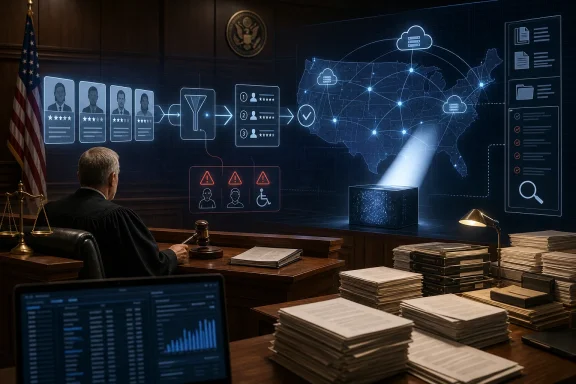
 The Workday Case Turns AI From Feature Into Legal Infrastructure
For years, enterprise software vendors have sold automation as a clean efficiency story. Human resources platforms promised to organize applicant flows, score candidates, surface matches, and reduce the administrative burden on recruiters drowning in résumés. The pitch was not that the machine was hiring people; it was that the machine was making hiring more manageable.
The Workday lawsuit attacks that distinction. Derek Mobley and other plaintiffs allege that Workday’s screening and recommendation tools caused discriminatory outcomes for applicants, including people over 40, Black applicants, disabled applicants, and others protected by anti-discrimination laws. Their argument is not merely that employers used software badly. It is that the software itself may have functioned as an active participant in the hiring process.
That is why this case matters beyond Workday. If a vendor builds, tunes, markets, and operates systems that rank or filter job seekers, courts may be less willing to accept the comforting fiction that liability stops at the customer’s login screen. In the older enterprise software model, a vendor provided a database, workflow, and interface. In the AI model, the vendor may also provide judgment-like outputs that materially affect who gets seen, who gets ignored, and who gets rejected.
Workday has denied wrongdoing, and the case remains far from a final judgment. But the procedural posture is already significant. A judge allowing claims to proceed means the plaintiffs have cleared another gate in a system where many technology-liability theories die early, before discovery exposes how the product actually works.
California Becomes the Courtroom for a National Hiring Machine
The immediate fight highlighted by the latest reporting centers on California’s Fair Employment and Housing Act and whether claims under that law can reach alleged conduct affecting applicants across the United States. Workday argued that California law should not regulate hiring decisions involving out-of-state employers and applicants. Plaintiffs countered that Workday’s relevant conduct was sufficiently tied to California, where the company is based and where product development and decision-making allegedly occurred.
That jurisdictional battle is not a technicality. It is the shape of modern SaaS litigation. A cloud vendor can build a model in one state, host services across distributed infrastructure, sell subscriptions nationwide, and influence employment workflows for companies that never think of themselves as operating in California. The legal system, built around older assumptions about place and conduct, is now being asked to map accountability onto software that behaves like a national nervous system.
For administrators, this is familiar in a different register. A policy configured in one tenant, one identity provider, or one management console can affect thousands of endpoints across geographies. The point of SaaS is centralization. The risk of SaaS is also centralization.
Workday’s position is understandable from a business standpoint. If California employment law can attach to vendor-side conduct and generate nationwide claims, large platform companies face broader exposure than they would under a state-by-state reading. But the plaintiffs’ argument is equally intuitive: if the disputed AI system was designed, maintained, or governed by a California-based vendor, the vendor should not be able to fragment responsibility across every customer and every rejected applicant.
The Vendor Defense Looks Weaker When the Software Recommends
The most important conceptual shift in this litigation is the idea that a vendor may act as an employer’s agent. That word sounds dry, but it is doing enormous work. If a software provider is merely selling a neutral tool, the employer remains the obvious defendant. If the provider is acting on behalf of employers in screening, ranking, recommending, or filtering candidates, the legal analysis changes.
This is where AI breaks the old procurement script. Traditional applicant-tracking systems stored information and routed forms. AI-enhanced hiring products may evaluate patterns, infer fit, prioritize candidates, and suppress others from attention. Even if a human recruiter ultimately clicks the final button, the software can define the field of candidates the human ever sees.
That matters because discrimination law has long recognized that facially neutral practices can have unlawful effects. The doctrine of disparate impact exists precisely because bias is not always a smoking-gun memo or a manager saying the quiet part out loud. A selection device can produce exclusionary outcomes even when no one intended to discriminate.
The Workday case asks whether algorithmic selection devices should be treated like other selection devices. That is a far less radical proposition than some AI vendors would prefer the public to believe. Employers have long had to validate tests, scoring systems, and hiring criteria. The novelty is not the accountability principle. The novelty is that the selection mechanism now lives inside a proprietary cloud platform whose logic may be opaque even to the customer paying for it.
The Black Box Is Becoming a Discovery Target
The lawsuit has also exposed the practical mess of proving algorithmic discrimination. Plaintiffs need evidence about how the tools worked, what data they used, what recommendations they generated, and whether outcomes differed by protected class. Vendors, meanwhile, are likely to argue that some materials are confidential, privileged, technically complex, or outside their control because customer data belongs to customers.
That tension is where the AI governance debate stops being a conference keynote and becomes litigation plumbing. Bias testing, model documentation, audit logs, customer configuration records, and applicant-flow data are not abstract ethics artifacts. They are the evidence trail.
One recent discovery dispute reportedly dealt with limits on access to Workday’s bias-testing data and customer applicant data. That is a preview of the next decade of enterprise AI litigation. Plaintiffs will ask for the data necessary to test the machine. Vendors will resist disclosure on privilege, trade secret, privacy, and contractual grounds. Courts will have to decide how much opacity the law can tolerate when automated systems help allocate economic opportunity.
For IT leaders, the lesson is blunt: if your organization cannot explain how an AI-enabled workflow makes or influences decisions, you may not be able to defend it later. “The vendor handles that” is not a governance program. It is a sentence that sounds worse under oath than it does in a procurement meeting.
Hiring AI Is Not Like Spellcheck
Enterprise vendors often describe AI features as productivity enhancements, and in many contexts that framing is fair. A writing assistant that summarizes a meeting or suggests a formula in a spreadsheet may create risks, but those risks are usually bounded. Hiring tools operate in a different moral and legal category because they affect access to income, health insurance, career progression, and social mobility.
That does not mean AI should be banned from recruiting. It does mean the industry’s habit of treating every AI feature as one more toggle in an admin center is becoming untenable. A résumé parser, ranking model, or candidate recommender is not equivalent to a dark-mode switch. It is part of a selection system.
The distinction matters for WindowsForum readers because modern IT estates increasingly blur business applications, identity systems, analytics platforms, and AI services. A hiring workflow may touch a browser, an endpoint, single sign-on, document storage, email, HRIS records, Teams messages, background-check integrations, and data exports. The legal risk may originate in HR, but the evidence and controls live partly in IT.
That is the underappreciated operational problem. AI governance is often assigned to legal, compliance, or “responsible AI” committees, while the actual configuration power sits with platform administrators. If a tool can score, filter, recommend, or suppress people, the IT organization needs to know where that capability is enabled, who can change it, what logs exist, and how long those logs survive.
The Case Lands in a Market Already Selling Trust
Workday is not an obscure AI startup. It is one of the dominant enterprise HR and finance platforms, deeply embedded in large organizations that have spent years consolidating people data into cloud suites. That makes the case especially consequential. When litigation targets a major incumbent, the ripple travels through procurement checklists, renewal negotiations, product roadmaps, and board-level risk discussions.
The broader HR technology market has spent the past few years attaching AI to nearly every stage of the employment funnel. Vendors promise better matching, faster screening, reduced recruiter workload, improved candidate experience, and more data-driven decisions. Those promises are attractive because hiring is expensive, noisy, and often painfully inefficient.
But “data-driven” is not the same as fair. A model trained on historical employment patterns can reproduce old exclusions under new mathematical packaging. A system optimized for speed may penalize nontraditional résumés. A tool that infers similarity to past successful employees may encode the demographics of past opportunity.
The market’s answer has been to sell trust alongside automation. Vendors publish responsible-AI principles, promise governance controls, and emphasize human oversight. Those materials may help, but courts will care more about product behavior than marketing language. If the system materially shapes who advances, a slide deck about ethics will not substitute for validation evidence.
Human Oversight Is Not a Magic Eraser
One of the most common defenses of AI-enabled hiring systems is that humans remain in the loop. That phrase has become the industry’s favorite talisman. It suggests that the algorithm only advises, while a person retains responsibility.
The problem is that human oversight can be real, superficial, or meaningless depending on workflow design. If the system ranks thousands of applicants and recruiters only review the top slice, the model has already shaped the decision. If the interface nudges attention toward “recommended” candidates, human discretion may become confirmation rather than review.
Anyone who has administered enterprise software understands this dynamic. Defaults matter. Sort order matters. Alerts matter. Labels matter. A field that appears above the fold gets treated differently from one buried behind a tab. Software does not need to make the final decision to exert power.
This is why the Workday case is not only about algorithms. It is about interfaces, workflows, and institutional reliance. A recommender system that changes the order of candidates may be as consequential as one that rejects them outright. The legal system is beginning to wrestle with that reality.
Windows Shops Should Read This as a Governance Warning
Although the lawsuit concerns Workday, the practical lesson applies across the Microsoft-heavy environments many WindowsForum readers manage. Most enterprises now run a stack of cloud identity, endpoint management, collaboration, security analytics, data platforms, and SaaS business applications. AI features are being inserted across that stack at a pace faster than most change-control boards were designed to handle.
The immediate temptation is to treat HR AI as HR’s problem. That is a mistake. IT owns access, logging, retention, integration, data movement, and often the administrative permissions that determine what features are enabled. Security teams may own data loss prevention and audit trails. Enterprise architects may own integration patterns. Procurement may own vendor questionnaires but depend on technical teams to know what to ask.
The Workday litigation should push organizations to inventory AI-enabled decision systems with the same seriousness they bring to privileged access. Not every AI feature deserves the same scrutiny. But systems affecting employment, credit, housing, education, healthcare, insurance, security enforcement, or disciplinary actions belong in a higher-risk bucket.
That inventory should be concrete, not aspirational. Organizations need to know which products use automated scoring or ranking, whether customers can disable those features, what protected-class testing has been done, what logs can be exported, what contractual rights exist to obtain vendor documentation, and whether internal users understand the limits of the tool.
The Compliance Burden Moves Upstream
For years, compliance in enterprise software often happened after deployment. Legal reviewed terms, procurement handled data-processing agreements, security ran a questionnaire, and the business owner accepted residual risk. AI selection systems make that sequence look backwards.
The key questions need to be asked before adoption. What is the model optimizing for? What data trained it? Can the vendor explain feature importance or decision logic? Has the system been validated for the specific use case? Does the customer receive audit results? Can the customer test outcomes across protected groups? What happens when the model changes?
Those questions are uncomfortable because they collide with how SaaS products are sold. Vendors want scalable, standardized offerings. Customers want configurable systems but may not have the expertise to validate algorithmic behavior. Both sides may prefer ambiguity until a lawsuit forces precision.
The Workday case increases the pressure to resolve that ambiguity in contracts. Customers will want representations about bias testing, audit rights, model-change notices, data retention, explainability, and indemnity. Vendors will resist promises they cannot operationalize across diverse customer configurations. The resulting negotiations will be tedious, expensive, and necessary.
The Plaintiff Still Has to Prove the Machine Did Harm
It is important not to overstate what has happened. A case surviving dismissal or proceeding as a collective or class-style action is not a finding of liability. The plaintiffs still must prove their claims. Workday will have opportunities to contest causation, class scope, statistical evidence, product characterization, customer responsibility, and the actual operation of its tools.
That distinction matters because AI panic can be as misleading as AI hype. Not every rejected applicant was rejected by an algorithm. Not every automated tool is discriminatory. Not every disparity is legally actionable. A serious account of the case must leave room for Workday’s defense and for the possibility that plaintiffs may fail to prove some or all of their allegations.
But procedural rulings shape markets even before final judgments. They signal what courts are willing to entertain, what discovery may uncover, and what theories plaintiffs’ lawyers may bring next. Vendors and customers do not wait for Supreme Court clarity before updating risk models. They react when litigation survives long enough to become expensive.
That is the real pressure point. Even if Workday ultimately prevails, the case is already changing the enterprise AI conversation. The question is no longer whether AI hiring tools can be challenged under existing discrimination laws. The question is how far those challenges can reach and what evidence will be required.
The AI Boom Meets the Old Civil Rights Machine
One reason this case is so important is that it does not depend on a brand-new AI statute. The claims are rooted in familiar anti-discrimination law. That should unsettle vendors that assumed regulation would lag far behind deployment.
Existing civil rights frameworks were built for selection systems long before generative AI and machine learning became boardroom obsessions. Employers could not simply outsource a discriminatory test to a consultant and declare themselves clean. The same logic may apply to software providers when their products perform analogous functions.
That continuity cuts through much of the mystique around AI. The law does not need to understand every neural-network parameter to ask whether a selection mechanism disproportionately screens out protected groups and whether the practice is justified. Courts may struggle with technical evidence, but the core fairness inquiry is not new.
The technology industry often talks as though AI creates unprecedented categories that require fresh legal invention. Sometimes it does. But in hiring, the older lesson is more powerful: if a system helps decide who gets opportunity, it enters a heavily regulated space. Calling the system AI does not move that space outside the law.
Enterprise Buyers Will Demand More Than Responsible-AI Slogans
The vendor response to this wave of scrutiny will likely be a new layer of documentation and assurances. Expect more model cards, audit summaries, compliance dashboards, and contractual language around high-risk AI use. Some of it will be useful. Some of it will be theater.
Enterprise buyers need to distinguish between artifacts that support accountability and artifacts that merely decorate a sales process. A responsible-AI policy is not the same as evidence that a hiring model performs fairly across protected groups. A human-oversight statement is not the same as workflow analysis showing that humans meaningfully review candidates rather than rubber-stamping algorithmic rankings.
This is where technically literate procurement becomes essential. Buyers should ask not just whether a vendor has tested for bias, but whether the testing matches the customer’s use case. They should ask how often models are updated, whether customer-specific configurations affect fairness, and whether audit results are available in a form that legal and technical teams can actually use.
They should also ask what happens when the vendor says no. If a provider will not disclose enough to let a customer assess legal risk, that refusal should be treated as a risk signal. Trade secrets are real, but so is the customer’s exposure when automated systems touch regulated decisions.
Applicants Are Learning That the Platform Is Part of the Employer
The applicant experience is one reason this case resonates so widely. Job seekers often encounter Workday not as a back-office vendor but as the face of the application process. They create accounts, upload résumés, answer questions, and then often hear nothing. To the applicant, the distinction between employer and platform can feel academic.
That perception matters. When people are rejected repeatedly through the same platform across different employers, they may suspect a common mechanism even if the actual explanation is more complicated. The Mobley lawsuit channels that suspicion into a legal theory: that a shared AI-enabled system may have produced shared discriminatory effects.
The difficulty is that applicants usually lack visibility. They may not know whether an employer used automated ranking, knockout questions, AI recommendations, recruiter review, or some combination. They may not know whether a rejection came from a human, a rule, a model, or a stale requisition. The opacity of modern hiring breeds both legitimate concern and speculative blame.
A healthier system would provide more transparency without overwhelming applicants or exposing proprietary details. At minimum, organizations should be able to explain whether automated tools materially influenced a hiring decision and how applicants can request accommodation or review. The industry has resisted that level of transparency because opacity is convenient. Litigation may make it less convenient.
The Ruling Also Challenges the “Neutral Platform” Myth
Large enterprise platforms like to occupy a strategic ambiguity. They are deeply embedded enough to claim transformational value, but neutral enough to avoid responsibility for outcomes. They are intelligent when selling, configurable when blamed, and merely infrastructural when sued.
The Workday litigation pressures that ambiguity. If a vendor markets AI tools as improving hiring decisions, it becomes harder to argue that those tools are legally inert. If the system recommends candidates, ranks applicants, or influences who advances, the vendor is not simply renting storage.
This does not mean every SaaS provider becomes liable for every customer decision. That would be unworkable. Customers configure systems, define roles, write job requirements, choose workflows, and make final employment decisions. Responsibility in a distributed software ecosystem is necessarily shared.
But shared responsibility is not no responsibility. Cloud security taught the industry that lesson years ago. Providers secure the cloud; customers secure what they put in it. AI governance may develop a similar model, with vendors responsible for model design, documentation, validation, and platform controls, while customers remain responsible for use, configuration, monitoring, and decision policies.
The Compliance Center of Gravity Shifts Toward Evidence
The next phase of AI governance will be less about principles and more about proof. Organizations will need records showing why a tool was adopted, how it was assessed, what controls were applied, and how outcomes were monitored. That evidence must be understandable to lawyers, auditors, regulators, and technical reviewers.
For Windows and enterprise IT teams, that means AI risk management needs to plug into existing operational disciplines. Change management should track when AI decision features are enabled. Identity governance should limit who can change scoring or ranking settings. Logging and retention policies should preserve relevant records. Data governance should document what applicant information flows into models and downstream systems.
This is not glamorous work. It is the same unromantic discipline that makes incident response possible after a breach. Nobody enjoys building log retention policies until the day the logs are needed. AI discrimination disputes will follow the same pattern.
The organizations best positioned for this era will not be the ones with the most elaborate AI manifestos. They will be the ones that can reconstruct what happened, explain why it happened, and show that someone tested whether the system produced unfair outcomes.
The Courtroom Lesson Hidden Inside the Admin Console
The immediate news is a legal setback for Workday, but the practical message is broader and more operational. AI hiring tools are becoming auditable systems of consequence, not magic productivity widgets. That changes the standard of care for everyone who buys, deploys, configures, or relies on them.
- Organizations should treat AI-enabled hiring, promotion, and screening tools as high-risk systems that require documented review before deployment.
- IT teams should inventory where automated scoring, ranking, recommendation, or filtering appears across SaaS platforms, not just inside obvious AI products.
- Procurement teams should demand audit rights, bias-testing information, model-change notice, and usable documentation before signing or renewing contracts.
- Legal and compliance teams should not rely on “human in the loop” language unless the actual workflow shows meaningful human review.
- Vendors should expect courts and customers to examine whether their products merely store data or actively shape regulated decisions.
- Applicants should understand that the ruling keeps allegations alive but does not establish that Workday or any employer has been found liable.
The Workday case is a warning that enterprise AI will not be judged only by what vendors say it is designed to do. It will be judged by how it behaves in the workflows where money, opportunity, and rights are on the line.
The next stage of AI in the workplace will be less about dazzling demos and more about accountable systems that can survive discovery, audit, and public scrutiny. If vendors want their tools to influence hiring decisions, they will have to accept that influence creates obligations. And if employers want the efficiency of automated screening, they will have to build the governance muscle to prove that efficiency did not come at the expense of fairness.