

The Enterprise AI Race Moves From Chat Windows to Workflows
For the past two years, enterprise AI has often been sold as a new surface: a copilot pane, a search bar, a chat window, a prompt box. That was useful enough to prove demand, but it left many companies with an awkward problem. Employees still had to know where the data lived, which system owned the process, and when to leave the AI assistant and return to the application of record.
The Workday-Google Cloud partnership is a sign that the market is moving past that first phase. The pitch now is not “ask AI a question” but “let an AI agent complete a bounded business task inside the systems employees already use.” In HR and finance, that distinction matters because the work is rarely just informational. A time-off question may lead to a request. An expense-policy question may lead to an approval path. A payroll inquiry may expose data that should never be casually summarized outside the right permissions model.
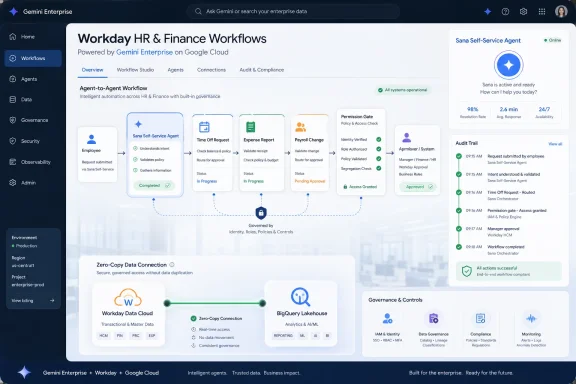
That is why this announcement lands differently from a generic model partnership. Workday is not simply saying that Gemini can answer questions about Workday. It is saying that Sana can live inside Gemini Enterprise, use Gemini as its default model layer for Workday scenarios, and operate under Workday’s governance structure while connecting into Google Cloud’s broader agent platform.
The strategic message is blunt: enterprise AI becomes valuable when it stops behaving like a clever overlay and starts behaving like workflow infrastructure.
Workday Wants Sana to Be the Front Door, Not a Feature
Workday’s Sana push reflects a broader repositioning of the company. Historically, Workday’s center of gravity was the system of record for people and money: human capital management, payroll, finance, planning, and related enterprise processes. With Sana, Workday is trying to make the user experience less like navigating a business application and more like delegating intent to a governed agent.
That sounds like marketing language until one considers how many employees use HR and finance systems only occasionally. Most workers do not want to learn the structure of an HCM suite. They want to know how many vacation days they have, whether a benefit applies, how to submit an expense, why a payslip looks different, or who still needs to approve something. The closer that interaction happens to email, chat, documents, calendars, or an enterprise assistant, the more likely employees are to use it correctly.
Embedding Sana Self-Service Agent in Gemini Enterprise is designed to attack that friction. Employees working in Google’s enterprise AI environment can interact with Workday processes without treating Workday as a separate destination. If the integration performs as described, the employee experience becomes less about logging in and navigating menus, and more about asking, confirming, and acting.
For Workday, this is also a defensive move. Microsoft has been pushing Copilot deeper into Microsoft 365 and business applications. ServiceNow is turning workflow automation into an AI-native story. Salesforce is making Agentforce a central platform narrative. SAP and Oracle are not going to concede HR and finance to anyone. Workday cannot afford to let AI assistants from other vendors become the primary interface to Workday data while Workday itself remains the back-end ledger.
Sana, then, is not merely an AI add-on. It is Workday’s attempt to preserve control over the business context even when the interaction layer moves elsewhere.
Google Cloud Gets the Enterprise Process Depth It Needs
Google Cloud’s side of the bargain is just as important. Gemini Enterprise needs more than models, orchestration tooling, and a polished assistant interface. It needs credible, high-value business processes that justify becoming a daily enterprise workspace.
HR and finance are exactly the kinds of domains that make an AI platform sticky. They are repetitive, policy-heavy, permission-sensitive, and widely used across departments. They also generate huge volumes of questions that do not necessarily require human HR or finance staff if the answers can be delivered safely and accurately.
By bringing Workday’s Sana agent into Gemini Enterprise, Google Cloud gets a stronger answer to a question that has followed every enterprise AI platform: what will employees actually do with this every day? General-purpose AI productivity is useful, but business buyers increasingly want measurable process improvements. Reducing HR ticket volume, speeding finance approvals, improving self-service analytics, and shortening routine administrative cycles are the kinds of outcomes CIOs can defend in budget meetings.
This also helps Google Cloud compete with Microsoft in a more concrete way. Microsoft’s advantage is distribution through Windows, Office, Teams, Entra, Dynamics, and the broader Microsoft 365 estate. Google Cloud cannot simply out-distribute Microsoft in the average enterprise desktop environment. It has to win by making Gemini Enterprise attractive as an agentic work hub for specific business functions and partner ecosystems.
Workday gives Google Cloud a serious enterprise anchor. It brings data, processes, and buyer relationships that are hard to replicate with generic AI tooling alone.
Governance Is the Product Nobody Wants Until It Is Missing
The most consequential part of the announcement may be the least glamorous: Workday’s Agent System of Record. The phrase sounds like enterprise software naming at its most self-serious, but the concept points to the central problem of agentic AI in production. Once agents can do things rather than merely say things, companies need a way to know which agent acted, under whose authority, against which data, with what approval chain, and with what audit trail.
That is not optional in HR and finance. These systems contain salaries, performance data, banking details, tax information, headcount plans, budgets, invoices, and organizational changes. An AI agent that can summarize a policy is one risk profile. An AI agent that can initiate a workflow, recommend an action, or hand a task to another agent is another risk category entirely.
Workday’s claim is that its Agent System of Record can provide the governance layer for first-party and third-party agents operating across these environments. In practical terms, that means identity, permissions, business rules, policy enforcement, and auditability become part of the agent architecture rather than an afterthought bolted on by each implementation team.
That is also where the competitive moat may form. Models will improve and commoditize. Interfaces will converge. The long-term lock-in may come from the control plane that decides what agents are allowed to know and do. If Workday can convince enterprises that ASOR is the safe way to manage agents touching people and money data, it has a stronger platform story than “we added AI to HR.”
The hard part will be proving that governance survives real-world complexity. Large enterprises do not run tidy software estates. They have multiple clouds, regional compliance requirements, legacy integrations, mergers, contractors, subsidiaries, unionized workforces, and exceptions layered on exceptions. An agent governance system has to handle the mess without becoming so restrictive that users route around it.
Zero-Copy Data Is a Trust Argument as Much as a Performance Argument
The partnership also includes zero-copy data integration between Workday Data Cloud and Google Cloud Lakehouse through BigQuery. The phrase zero-copy can sound like database plumbing, but it addresses a real enterprise anxiety: every duplicated data set becomes another place to secure, govern, reconcile, and eventually explain.
In HR and finance, copying data into analytics environments has always created a trade-off. Business teams want timely insight, while security and compliance teams worry about sensitive records moving into yet another repository. A zero-copy model attempts to reduce that tension by allowing analytics access without physically duplicating or moving the underlying Workday data into a separate store.
The benefits are obvious if the architecture works cleanly. Finance and HR leaders can ask more sophisticated questions across operational and analytical systems. Data teams can avoid building brittle extract-and-load pipelines for every use case. Security teams can point to fewer uncontrolled copies of sensitive data. Business users may get closer to real-time analytics without waiting for yesterday’s batch jobs to finish.
But zero-copy should not be treated as magic. It reduces certain risks; it does not abolish governance. Access still has to be controlled, queries still have to be authorized, semantic definitions still have to be consistent, and audit logs still have to be useful when something goes wrong. The value lies in shrinking the attack surface and simplifying the data architecture, not in pretending that sensitive information becomes harmless because it stayed in place.
The deeper point is that Workday and Google Cloud are trying to make data integration part of the agent story. Agents that cannot reach trusted data are glorified help pages. Agents that reach data without governance are compliance incidents waiting to happen. The competitive space lies between those extremes.
Multi-Agent Orchestration Is the New Integration Layer
The announcement’s references to Agent-to-Agent, Agent-to-UI, and Model Context Protocol interoperability fit into a larger industry movement. Enterprise vendors are preparing for a world where no single agent does everything. Instead, specialized agents will hand work to one another across application boundaries, with shared context and controlled authority.
That is the theory. In practice, multi-agent orchestration could either become the next enterprise architecture breakthrough or the next integration swamp. Anyone who has lived through service-oriented architecture, robotic process automation, iPaaS sprawl, and API governance knows how quickly elegant diagrams become operational debt.
Still, the direction is logical. HR and finance processes rarely live in one system. A hiring workflow can involve headcount planning, budget approval, job posting, candidate management, background checks, identity provisioning, equipment ordering, and onboarding. A finance exception can involve procurement, expense policy, manager approval, payment systems, and compliance review. If agents are going to automate meaningful work, they must cross those boundaries.
Workday and Google Cloud are positioning their partnership as a standards-friendly way to do that. The emphasis on interoperability is intended to reassure buyers that they are not investing in a closed agent cul-de-sac. It also signals that both vendors understand a political truth of enterprise IT: customers may standardize strategically, but they rarely consolidate completely.
The risk is that “open” becomes a branding exercise while the most useful capabilities remain tightly optimized for each vendor’s own ecosystem. That has happened before in cloud, identity, collaboration, and analytics. Enterprise buyers should watch not only whether protocols are supported, but whether agents from different vendors can perform useful work together without expensive custom glue.
Microsoft’s Shadow Hangs Over the Deal
Even though this is a Workday and Google Cloud announcement, Microsoft is inevitably in the frame. Workday announced Sana Self-Service Agent availability in Microsoft 365 Copilot earlier in May 2026, which makes the Google Cloud expansion look less like an exclusive alliance and more like a deliberate multi-surface strategy.
That is sensible. Workday’s customers live in mixed productivity environments. Some are Microsoft-first, some are Google-first, and many are hybrid in ways that frustrate neat vendor narratives. Workday wants Sana to follow the employee rather than force the employee into a single vendor’s preferred assistant.
But the Google partnership has a different flavor because Gemini becomes the default AI model for Sana for Workday. That gives Google Cloud a deeper role in the Workday AI stack than merely hosting an integration point. It suggests a closer alignment around reasoning, multilingual capabilities, multimodal features, and future agent behavior.
For Microsoft, the pressure is not that Workday has abandoned Copilot. It has not. The pressure is that Workday is refusing to let Microsoft own the entire agent interface to HR and finance. If the next generation of enterprise software is mediated by AI assistants, then every application vendor must decide whether to become a subordinate data source, a peer agent, or an orchestration layer in its own right.
Workday’s answer appears to be: all of the above, but with Workday governance attached.
Early Adopters Matter, but Outcomes Matter More
The mention of Accenture and Alphabet as early users gives the announcement credibility, but enterprise technology history is littered with marquee customer quotes that did not translate into broad adoption. The real test will be whether deployments produce measurable operational improvements.
For HR, the obvious targets are service tickets, response times, onboarding friction, benefits questions, and routine employee self-service. For finance, the targets include expense handling, approval bottlenecks, policy interpretation, close-related workflows, and analytics access for non-specialists. These are not exotic use cases, but that is precisely why they matter. Enterprise AI does not need to begin by replacing complex judgment; it can start by reducing the drag of repetitive administrative work.
Accenture’s involvement is notable because global systems integrators often shape how enterprise platforms become real deployments. They create implementation patterns, migration playbooks, governance templates, and industry-specific packages. If the Workday-Google Cloud agent model becomes a services motion, it could spread faster than a product announcement alone would suggest.
Alphabet’s presence is more politically interesting. As Google’s parent company, Alphabet is an obvious showcase environment, but also one with enough complexity to be meaningful. If Google cannot make Gemini Enterprise and Workday agents function well inside its own corporate orbit, the external pitch becomes harder to sustain.
Still, buyers should demand numbers, not logos. A successful pilot should eventually show fewer HR cases, faster workflow completion, lower error rates, higher self-service adoption, or better analytics usage. Without that, agentic AI remains a productivity story told in future tense.
The Model Choice Is Strategic, but the Workflow Choice Is Decisive
Gemini becoming the default AI model for Sana for Workday is a meaningful win for Google Cloud, but model selection is only part of the story. In enterprise software, the model is the engine, not the vehicle. The durable value comes from context, permissions, process knowledge, data quality, and the user’s trust that the system will not invent its way through a regulated workflow.
This is where Workday has an advantage over horizontal AI vendors. It understands the objects and processes inside HR and finance: workers, managers, cost centers, compensation, absence, expenses, approvals, suppliers, invoices, plans, and policies. A general model can reason across language, but it needs that structured business context to act reliably.
Google’s advantage is scale and AI infrastructure. Gemini models, Google Cloud’s data stack, BigQuery, agent tooling, and enterprise AI platform ambitions give Workday more reach than it would have building everything alone. The partnership is a recognition that neither side has the complete stack in isolation. Workday owns deeply trusted business workflows; Google Cloud wants to own the intelligent enterprise layer around them.
The danger for both is overpromising autonomy. HR and finance are full of edge cases where the right answer depends on policy nuance, jurisdiction, employee classification, union rules, local law, or management discretion. The most successful early agents will likely be constrained agents: answer this, draft that, route this, check status, prepare a recommendation, trigger a pre-approved workflow. The fantasy of fully autonomous enterprise administration will have to wait.
The Buyer’s Problem Is No Longer Whether AI Works
For enterprise IT leaders, the practical question has shifted. It is no longer whether AI can summarize a policy or answer a benefits question. It can. The harder question is whether the organization can deploy AI in a way that respects identity, permissions, auditability, data residency, retention rules, and operational accountability.
That makes this partnership relevant beyond Workday and Google Cloud customers. It illustrates the new buying criteria for enterprise AI platforms. Buyers will increasingly evaluate agent ecosystems the way they evaluate identity providers, integration platforms, and core business systems. The questions will be architectural, not just experiential.
Can the agent act under delegated authority rather than vague system authority? Can the organization trace why an action occurred? Can the agent distinguish between a manager, an employee, an HR partner, a finance controller, and a contractor? Can it respect regional data constraints? Can it hand off work to another agent without leaking context? Can it fail safely?
These are not edge considerations. They are the difference between an AI pilot and a production system. Workday and Google Cloud are trying to present their partnership as production-ready because it speaks to these issues directly: embedded agents, governed access, zero-copy data, interoperability, and model capability.
That is the right vocabulary. Execution will determine whether it is the right product.
Platform Consolidation Is Coming Wearing an AI Badge
The Workday-Google Cloud announcement also reflects a broader consolidation wave in enterprise software. AI is becoming the justification for platform bundling, deeper partnerships, and tighter ecosystems. Vendors are not merely adding features; they are trying to become the place where work is coordinated.
This should make buyers both interested and cautious. Consolidated platforms can reduce integration burden and improve governance. They can also increase lock-in, narrow architectural choices, and shift bargaining power toward the vendor that controls the agent layer.
The agent interface is especially powerful because it can hide complexity. That is wonderful for users and dangerous for procurement. If employees stop opening individual applications and start asking an assistant to get things done, the assistant becomes the new distribution point. The vendor that owns that layer can influence which systems are used, which workflows are recommended, and which data becomes visible.
Workday appears to understand this risk from the application vendor side. If Gemini Enterprise, Microsoft 365 Copilot, or another horizontal assistant becomes the dominant workplace interface, Workday needs Sana and ASOR to keep Workday’s logic present in the interaction. Google Cloud understands the same dynamic from the platform side. It needs enterprise applications like Workday to make Gemini Enterprise indispensable.
The result is an alliance shaped by mutual need, not mere enthusiasm for AI.
HR and Finance Are the Stress Test for Agentic AI
It is tempting to see HR and finance as back-office domains that are ripe for automation because they contain repetitive processes. That is true, but incomplete. They are also politically sensitive domains where errors can damage trust quickly.
A wrong answer about a software setting is annoying. A wrong answer about pay, benefits, time off, reimbursement, or employment status can become personal. A finance mistake can create audit exposure, budget confusion, or compliance problems. That raises the bar for AI adoption.
This is why embedded agents in HR and finance need a different standard than consumer chatbots or lightweight productivity assistants. They need to know when not to answer, when to escalate, when to cite policy, when to ask for confirmation, and when an action requires human approval. They need to respect the difference between helping an employee understand a process and making a decision that affects that employee.
The Workday-Google Cloud partnership implicitly acknowledges that. Its emphasis on governance, security, and interoperability is not decorative. It is the price of entry for AI in systems where the blast radius of a mistake is larger than a bad meeting summary.
If the companies can make agents useful without making them reckless, HR and finance may become the proving ground for enterprise AI’s second act.
The Real Test Will Be the Monday-Morning Workflow
The announcement is strongest when judged as architecture and weakest where all AI announcements are weak: proof at scale. The industry has moved from “look what the model can do” to “look what the workflow can absorb.” That is a healthier phase, but also a less forgiving one.
The near-term test will not be whether Sana can answer polished demo questions inside Gemini Enterprise. It will be whether ordinary employees use it on Monday morning for messy, mundane tasks. It will be whether HR teams trust it enough to deflect tickets. It will be whether finance teams let it touch approvals. It will be whether security teams can audit it without building a parallel bureaucracy around it.
There is also a cultural adoption problem. Employees may like AI for drafting and search but hesitate when it initiates actions involving pay, benefits, or expenses. Managers may welcome faster approvals but distrust opaque recommendations. HR and finance professionals may fear automation narratives even when the tools are aimed at reducing repetitive work rather than replacing judgment.
That means the winning deployments will likely be gradual. The agent will start as a guided self-service layer, then move into task completion, then into orchestration across systems, and only later into more autonomous recommendations. Enterprises that skip those trust-building steps may discover that “agentic” is not a deployment strategy.
The Calendar Now Belongs to the Integrators
The rest of 2026 will matter because Workday has indicated that more agents are coming, and Google Cloud is still building the broader Gemini Enterprise agent ecosystem. The announcement is therefore not a final product state but a marker in a platform race.
Systems integrators, implementation partners, and enterprise architects will shape what happens next. They will decide whether Workday-Google Cloud agents become standardized deployment patterns or bespoke science projects. They will translate vendor capabilities into industry workflows, regional compliance models, and change-management plans.
This is also where smaller competitors and adjacent vendors will feel pressure. If Workday and Google Cloud can offer governed HR and finance agents inside a major enterprise AI platform, point solutions will need a sharper story. They may compete on specialization, speed, or domain depth, but they will struggle if buyers prioritize integrated governance and platform reach.
At the same time, the market is not guaranteed to collapse into one winner. Many enterprises will run Microsoft, Google, Workday, Salesforce, ServiceNow, SAP, Oracle, and custom agents simultaneously. The real prize may not be monopoly control, but trusted orchestration across a fragmented software estate.
That is why the interoperability claims deserve close scrutiny. The future enterprise agent stack will be judged less by what it can do in a single-vendor demo and more by how well it behaves in the tangled reality of corporate IT.
The Fine Print CIOs Should Read Before the Demo
For all the ambition, buyers should resist treating this as a plug-and-play revolution. The integration may reduce friction, but it does not eliminate the work of governance design, process mapping, data stewardship, security review, and user training.
The most successful customers will likely begin with bounded use cases where the value is clear and the risk is manageable. They will define what the agent may answer, what it may initiate, what requires confirmation, and what must be escalated. They will measure outcomes before expanding autonomy.
They will also need to decide who owns the agent lifecycle. Is it HR operations, finance transformation, IT, security, data governance, or a new AI governance office? If an agent gives a wrong answer based on stale policy, who fixes the source? If an agent triggers the wrong workflow, who investigates? If an employee challenges an action, what audit trail is available?
These questions are not reasons to avoid the technology. They are reasons to take it seriously. Agentic AI in enterprise systems is not a feature rollout. It is a change in how authority moves through software.
The Workday-Google Deal Draws the New Enterprise AI Map
The concrete lessons from this partnership are less about brand alignment and more about where enterprise AI is headed. Workday and Google Cloud are trying to turn agents into governed participants in daily work, not optional assistants parked beside it.
- Workday’s Sana Self-Service Agent moving into Gemini Enterprise shows that the next interface for HR and finance may be a cross-application AI workspace rather than the application itself.
- Gemini becoming the default AI model for Sana for Workday gives Google Cloud a deeper role in Workday’s AI strategy while giving Workday access to a broader model and platform stack.
- Workday’s Agent System of Record is the most important governance claim in the announcement because agent authority, auditability, and permissioning will determine whether enterprises move beyond pilots.
- Zero-copy integration between Workday Data Cloud and Google Cloud Lakehouse is aimed at reducing data duplication while making HR and finance analytics more accessible and timely.
- Multi-agent interoperability will matter only if it works across messy enterprise estates, not merely inside carefully managed partner demos.
- Buyers should judge the partnership by measurable workflow outcomes, including lower ticket volumes, faster approvals, safer self-service, and clearer audit trails.
The Workday-Google Cloud partnership is best understood as a bet that enterprise AI will disappear into the workflow rather than sit above it, and that the winners will be the vendors that combine model power with governance, data access, and process authority. If that bet is right, the next phase of AI adoption will look less like employees chatting with a bot and more like business systems quietly negotiating work on their behalf. The opportunity is enormous, but so is the burden of proof: in HR and finance, an agent is only as valuable as the trust it earns when the demo ends and the real work begins.
References
- Workday and Google Cloud Bet on Embedded AI Agents to Redefine Enterprise HR and Finance Workflows The Futurum Group · 2026-06-06T01:50:18.471208