

Workload identity federation for AI agents is the use of short-lived, claims-based identity tokens to let software agents authenticate across cloud, application, and tool boundaries without storing static secrets, while preserving the agent’s identity, its runtime context, and the user or workload it represents. The idea is not new; the urgency is. What changed is that agents do not behave like predictable jobs in a pipeline. They wander through tools, APIs, tenants, and data stores in ways that make the old service-account bargain look dangerously under-specified.
For years, workload identity federation was one of the cleaner answers to a grubby cloud problem: how do you let software authenticate without handing it a password that lives forever? CI/CD systems, Kubernetes pods, serverless functions, and cloud-hosted applications all needed access to something outside themselves. The old answer was an API key, client secret, access token, or service-account credential tucked into an environment variable, vault, deployment manifest, or build system.
That answer scaled badly. Secrets were copied, cached, logged, committed, forgotten, and over-permissioned. Even when organizations had decent secret-management programs, the operational burden of provisioning, rotating, revoking, and auditing credentials for thousands of non-human identities became its own security tax.
Workload identity federation replaced much of that with a more sensible exchange. A workload proves who it is using a token issued by the platform where it runs. A target system validates that token against a preconfigured trust relationship. If the claims match policy, the target system issues a short-lived credential with scoped permissions.
In ordinary cloud infrastructure, this is now a mature pattern. AWS, Google Cloud, and Microsoft Azure all support variants of it. GitHub Actions can authenticate into cloud providers without a stored cloud key. Kubernetes workloads can use projected service-account tokens. Azure workloads can use federated credentials. GCP workloads can use workload identity pools. The core move is the same: do not distribute a secret when the runtime can present a verifiable identity instead.
That was a major security improvement, but it solved a narrower problem than many teams now assume. Traditional WIF was designed around a workload with a known job, a known trust boundary, and a reasonably stable set of permissions. AI agents break that neatness.
An AI agent is different because its path is often discovered at runtime. It may read a document, decide it needs to query a CRM record, summarize the result in Slack, create a GitHub issue, update a ticketing system, and then call an internal MCP server to retrieve more context. Each step may involve a different trust domain, a different authorization model, and a different owner.
That is why the phrase workload identity federation for agents matters. The agent is still a workload, but it is also a decision-making intermediary. It may be acting under its own operational authority, on behalf of a human user, under the policy constraints of a tenant, and inside a cloud runtime that has its own identity model.
Static credentials are especially poor in this setting. A single API key cannot express which user prompted the action, which agent performed it, which tool was invoked, what scope was needed, or whether the action was appropriate in that moment. It can only say that whoever holds the key may do whatever the key permits.
That is the wrong abstraction for agentic systems. The question is no longer merely “is this workload allowed to access this resource?” It becomes “is this specific agent, running in this specific context, representing this specific principal, allowed to request this specific downstream capability right now?”
Traditional WIF gives organizations the first half of that sentence. Agent identity systems are emerging to handle the rest.
But AI agents rarely stop at the first hop. The first hop may only get the agent into the organization’s identity layer. From there, it may need access to Salesforce, GitHub, Slack, Microsoft Graph, internal APIs, cloud storage, vector databases, or MCP servers. Each downstream system has its own credential scheme, its own OAuth implementation, its own audit model, and its own understanding of delegated access.
This is where traditional WIF reaches its limit. It can establish that the agent is a real workload. It does not, by itself, create a durable identity record for the agent, broker downstream credentials, combine agent identity with user delegation, or produce a coherent audit chain across every tool invocation.
The distinction is subtle but important. WIF is a mechanism. Agent identity is an operating model.
A mechanism can exchange one token for another. An operating model has to answer harder questions: who owns this agent, what can it do, which user delegated authority to it, which tenant policy applies, how long should access last, and what happens when the agent is decommissioned?
Agents inherit that problem and add autonomy. They do not merely hold credentials for a predefined task. They may choose which tool to call, decide when to call it, and combine data from multiple systems in ways the developer did not enumerate line by line.
That does not mean agents are magic or beyond governance. It means the governance model has to be closer to runtime policy than deployment-time provisioning. A credential issued to an agent should be narrow, short-lived, and tied to a set of verifiable claims. If the agent needs a different capability later, it should request a different credential later.
This is the security logic behind agentic WIF. The agent should not carry a backpack full of permanent keys just in case it needs them. It should arrive at each boundary with a cryptographic identity and ask for the minimum authority required to cross.
The challenge is that many enterprise environments are not built this way yet. They have identity providers for humans, IAM roles for cloud workloads, OAuth apps for SaaS integrations, and secret vaults for everything else. Agents cut across all of those categories.
If a user asks an agent to fetch a document from SharePoint or update a CRM field, the agent’s credential should not simply represent the agent. It should also represent the user’s entitlement. If Alice is not allowed to see Bob’s payroll file, an agent acting for Alice should not be able to retrieve it merely because the agent’s backend service account has broad access.
This sounds obvious, but many early agent integrations risk recreating the classic “god token behind the chatbot” pattern. The front end authenticates the user, the backend runs as a privileged app, and the agent retrieves whatever the backend can access. The user experience looks personalized; the authorization model is not.
Agent-aware federation tries to close that gap by combining multiple identities in the authorization decision. The runtime identity says which workload is making the request. The agent identity says which agent is acting. The user context says who delegated the task. The policy engine decides what credential, if any, should be issued.
This is where OAuth token exchange and on-behalf-of patterns become more than protocol trivia. They are the machinery needed to avoid collapsing every agent action into a single overpowered application identity. In a well-designed system, the agent does not impersonate everyone and everything. It receives constrained authority derived from policy.
AWS has Amazon Bedrock AgentCore Identity, positioned as identity and credential management for agents and automated workloads. It includes concepts such as workload identities, credential providers, token storage, and support for accessing AWS and third-party services on behalf of users. In AWS’s framing, the agent needs a managed identity directory and a credential-management plane, not just an IAM role.
Microsoft is building around Entra Agent ID and Azure AI Foundry. The significance is not merely that an agent can call a tool. It is that Microsoft wants agents to become first-class identity objects governed with familiar enterprise controls such as Conditional Access, lifecycle management, and role-based access. For Microsoft shops, that is a natural extension of the Entra universe.
Google has been developing Agent Identity concepts around Google Cloud and Vertex AI, tying agent identities into IAM-style principals and managed runtimes. Google’s documentation makes the same broad point in a different dialect: agents need identities that can be distinguished from ordinary workloads and governed according to who invokes them and what they access.
These are welcome developments. They show that the industry has moved past the idea that agents can safely live behind shared service accounts. But they also reveal the next architectural fight. Every hyperscaler wants agent identity to be native to its own platform. Enterprises, meanwhile, rarely run neatly inside one platform.
The result is a familiar cloud-era tension. Native identity services are powerful when the workload, data, tools, and users all live in the same ecosystem. They become harder to reason about when an agent built in one framework runs in another cloud, calls a third-party SaaS tool, retrieves user context from a separate identity provider, and writes logs to yet another system.
An agent-aware identity platform has to accept a workload proof from the runtime, validate it, bind it to an agent record, evaluate policy, issue a short-lived platform token, and then exchange or broker credentials for downstream systems. That downstream credential might be an OAuth token for a SaaS provider, a scoped API credential for an internal service, or a token for an MCP server.
This is a more ambitious role than classic federation. The identity layer becomes a traffic controller for authority. It decides which credentials exist, for how long, under whose delegation, and with what scopes.
For administrators, that changes the audit story. Instead of seeing a shared API key access a service, they should be able to see that a particular agent instance, running under a particular workload identity, acting for a particular user or tenant, requested a particular downstream credential and used it for a particular operation.
That is the difference between visibility and forensic fog. If agents are going to make changes in production systems, retrieve sensitive records, or trigger business workflows, the audit trail cannot stop at “the automation account did it.”
Credential brokering also reduces the blast radius of inevitable mistakes. If a token is short-lived and scoped to a single action or tool, leakage is less catastrophic. If access is derived from runtime claims and user context, revocation can happen at the policy or identity-record level rather than through emergency secret rotation across every deployment.
Descope’s model is to let agents federate into its identity platform using cloud-issued OIDC tokens, then receive scoped access tokens and downstream credentials through policy-governed exchanges. The platform supports AWS, Azure, and Google Cloud tokens, associates workload claims with agentic identity records, and uses those records for audit and authorization decisions.
In practice, the pattern looks like this: an agent runs in a cloud environment with a platform identity; it obtains an OIDC token from that environment; it presents the token to Descope using a JWT bearer grant; Descope validates the issuer and claims; Descope issues a scoped token; and the agent uses that token to request access to protected APIs, MCP servers, or downstream SaaS services.
The important part is not the brand name on the token endpoint. It is the decoupling. A cloud-neutral identity layer can, at least in theory, let organizations apply one agent identity model across Azure AI Foundry, Vertex AI, Bedrock AgentCore, Kubernetes, serverless workloads, and standalone agent frameworks.
That matters because agent sprawl is likely to look a lot like SaaS sprawl and service-principal sprawl before it. Individual teams will adopt tools quickly. Some agents will be sanctioned. Others will be experimental. A few will quietly become business-critical. If identity is bolted on per platform, security teams may discover the inventory problem only after the permissions problem has already arrived.
Microsoft’s advantage is obvious: Entra ID is already the control plane for many enterprise identities. If agent identities become visible and governable inside Entra, administrators get a familiar place to apply policy, monitor activity, and assign responsibility. That is not a small thing.
The risk is equally obvious. Many organizations already struggle with app registrations, enterprise applications, service principals, consent grants, privileged roles, and stale automation accounts. Adding agents as another class of identity will not simplify that landscape unless Microsoft and customers treat them as first-class governed objects rather than decorative metadata attached to applications.
Windows administrators should pay particular attention to on-behalf-of flows. The security difference between an agent accessing Microsoft 365 data as itself and an agent accessing data under the user’s delegated rights is enormous. The former can become a backdoor around information barriers. The latter can preserve least privilege, assuming the implementation is careful and the policies are real.
The same applies to hybrid environments. An agent that reads from Microsoft 365, writes to ServiceNow, calls a GitHub API, and triggers an Azure Function is already outside a single-vendor authorization story. Even if Entra governs the user, some other system may broker the GitHub credential, store the SaaS refresh token, or log the tool call.
If every MCP server is protected by a static token shared among agents, the enterprise has recreated the worst version of bot security. If every agent gets broad access because fine-grained issuance is too hard, the result is only marginally better. The tool layer needs identity-aware access, not just network reachability and a bearer token.
Agentic WIF gives MCP deployments a better foundation. A server can require a short-lived token minted for a specific agent and context. A policy engine can decide whether the agent may call that tool for that user. The audit trail can record the actual principal chain instead of a generic integration account.
This will become more important as agents move from read-only assistants to write-capable operators. Retrieval is already sensitive, but mutation is where sloppy identity becomes operational risk. An agent that can open tickets is useful. An agent that can close incidents, rotate keys, change firewall rules, merge pull requests, or approve expense workflows needs stronger guardrails.
The valuable properties come from the combination: short lifetime, scoped authority, verifiable claims, delegated context, policy evaluation, and auditable identity records. Remove any one of those and the model weakens.
This is also why organizations should not confuse vaulting with federation. A secret vault can reduce accidental exposure, but it does not eliminate the existence of static credentials. It also does not automatically solve user delegation or agent-specific policy. Vaults remain useful, especially for systems that cannot participate in modern token exchange, but they are not the same as an identity-native design.
Likewise, cloud IAM alone is not enough when the agent’s work leaves the cloud. An IAM role can establish that the workload is allowed to run and access certain cloud resources. It cannot automatically express that the agent is acting for a particular human in a third-party SaaS application with tenant-specific restrictions.
Which agents exist? Who owns them? Which users can invoke them? Which tools can they call? Which credentials can they broker? Which downstream systems have they accessed? Which policies limited their scopes? Which agents are dormant, orphaned, or overprivileged?
Those are governance questions, not just authentication questions. They require inventory, ownership, lifecycle management, logging, and review. They also require a cultural shift: agents must be treated less like features and more like identities.
That shift will be uncomfortable. Developers want agents to be easy to build and deploy. Security teams want agents to be constrained and observable. Business units want agents to connect to everything that makes them useful. The identity layer is where those pressures collide.
A good federation model will not eliminate that conflict, but it can make the trade-offs explicit. Instead of handing an agent a permanent Salesforce token because it might need customer records someday, the platform can issue a narrowly scoped credential when a specific task demands it. Instead of letting a shared backend account blur every action, the system can preserve the chain of authority.
If an agent is compromised, can administrators revoke its identity without breaking unrelated workloads? If a user loses access to a data set, do agent-mediated actions immediately reflect that change? If a cloud workload is redeployed into a different namespace or tenant, does the identity platform distinguish it from the old one? If a downstream token leaks, is it short-lived enough and narrow enough to limit damage?
These are not theoretical concerns. Agent systems are complex, and complexity produces misconfiguration. The more autonomous the agent, the more important it is that each credential be treated as a momentary grant rather than a durable entitlement.
This is where per-agent identity records matter. A token expires, but the identity record remains. That record gives security teams something to review, suspend, investigate, and govern. Without it, the enterprise is left chasing ephemeral runtime events across logs that may not agree on what the agent was.
The same logic applies to tenant boundaries. Multi-tenant SaaS applications, managed service providers, and internal platforms serving multiple business units need policy decisions that account for tenant context. An agent identity without tenant-aware authorization is only half a control.
The good news is that the technical building blocks are better this time. OIDC, JWT bearer grants, OAuth token exchange, workload federation, SPIFFE-style workload identity, and cloud-native identity services all provide a stronger foundation than the API-key culture they are replacing.
The bad news is that the incentives have not changed. Teams under pressure to ship agent features will take the shortest path to a working integration. If that path is a static token with broad rights, many will take it. If the secure path is too hard, too vendor-specific, or too poorly documented, agent identity debt will accumulate quickly.
That is why agentic WIF should be treated as architecture, not polish. It belongs in the first design review, not the post-launch security backlog. Once agents are already embedded in workflows and customers rely on them, replacing their credential model becomes much harder.
Workload identity federation for AI agents is ultimately a recognition that autonomy without identity is just automation with a larger blast radius. The cloud industry already learned that static secrets are a poor foundation for modern workloads; agents make that lesson harder to ignore and more expensive to postpone. The next phase will be messy, split between hyperscaler-native systems and cloud-neutral brokers, but the direction is clear: agents that act across systems will need identities that travel with them, policies that constrain them, and audit trails that outlive them.
 The Secretless Future Arrived Before the Agentic One
For years, workload identity federation was one of the cleaner answers to a grubby cloud problem: how do you let software authenticate without handing it a password that lives forever? CI/CD systems, Kubernetes pods, serverless functions, and cloud-hosted applications all needed access to something outside themselves. The old answer was an API key, client secret, access token, or service-account credential tucked into an environment variable, vault, deployment manifest, or build system.That answer scaled badly. Secrets were copied, cached, logged, committed, forgotten, and over-permissioned. Even when organizations had decent secret-management programs, the operational burden of provisioning, rotating, revoking, and auditing credentials for thousands of non-human identities became its own security tax.
Workload identity federation replaced much of that with a more sensible exchange. A workload proves who it is using a token issued by the platform where it runs. A target system validates that token against a preconfigured trust relationship. If the claims match policy, the target system issues a short-lived credential with scoped permissions.
In ordinary cloud infrastructure, this is now a mature pattern. AWS, Google Cloud, and Microsoft Azure all support variants of it. GitHub Actions can authenticate into cloud providers without a stored cloud key. Kubernetes workloads can use projected service-account tokens. Azure workloads can use federated credentials. GCP workloads can use workload identity pools. The core move is the same: do not distribute a secret when the runtime can present a verifiable identity instead.
That was a major security improvement, but it solved a narrower problem than many teams now assume. Traditional WIF was designed around a workload with a known job, a known trust boundary, and a reasonably stable set of permissions. AI agents break that neatness.
Agents Turn Authentication Into a Moving Target
A conventional workload usually knows what it is going to do before it starts. A build runner pushes an artifact. A pod reads from a bucket. A function writes to a queue. The identity architecture can be designed around that predictable path.An AI agent is different because its path is often discovered at runtime. It may read a document, decide it needs to query a CRM record, summarize the result in Slack, create a GitHub issue, update a ticketing system, and then call an internal MCP server to retrieve more context. Each step may involve a different trust domain, a different authorization model, and a different owner.
That is why the phrase workload identity federation for agents matters. The agent is still a workload, but it is also a decision-making intermediary. It may be acting under its own operational authority, on behalf of a human user, under the policy constraints of a tenant, and inside a cloud runtime that has its own identity model.
Static credentials are especially poor in this setting. A single API key cannot express which user prompted the action, which agent performed it, which tool was invoked, what scope was needed, or whether the action was appropriate in that moment. It can only say that whoever holds the key may do whatever the key permits.
That is the wrong abstraction for agentic systems. The question is no longer merely “is this workload allowed to access this resource?” It becomes “is this specific agent, running in this specific context, representing this specific principal, allowed to request this specific downstream capability right now?”
Traditional WIF gives organizations the first half of that sentence. Agent identity systems are emerging to handle the rest.
The First Hop Is No Longer the Whole Journey
Cloud-native WIF handles the first hop elegantly. An agent running in AWS, Azure, or Google Cloud can prove that it is a legitimate workload in that environment. The runtime can issue an OIDC token. An external identity platform can validate the issuer, audience, subject, namespace, service account, tenant, or other claims. A short-lived token can then be minted.But AI agents rarely stop at the first hop. The first hop may only get the agent into the organization’s identity layer. From there, it may need access to Salesforce, GitHub, Slack, Microsoft Graph, internal APIs, cloud storage, vector databases, or MCP servers. Each downstream system has its own credential scheme, its own OAuth implementation, its own audit model, and its own understanding of delegated access.
This is where traditional WIF reaches its limit. It can establish that the agent is a real workload. It does not, by itself, create a durable identity record for the agent, broker downstream credentials, combine agent identity with user delegation, or produce a coherent audit chain across every tool invocation.
The distinction is subtle but important. WIF is a mechanism. Agent identity is an operating model.
A mechanism can exchange one token for another. An operating model has to answer harder questions: who owns this agent, what can it do, which user delegated authority to it, which tenant policy applies, how long should access last, and what happens when the agent is decommissioned?
Non-Human Identity Was Already Hard; Agents Make It Stranger
Security teams have spent years learning that non-human identities are often more dangerous than human accounts. They are numerous, poorly inventoried, rarely reviewed, and frequently overprivileged. Service principals, app registrations, CI/CD runners, bots, integration accounts, and machine users tend to accumulate access because nobody wants to break production automation.Agents inherit that problem and add autonomy. They do not merely hold credentials for a predefined task. They may choose which tool to call, decide when to call it, and combine data from multiple systems in ways the developer did not enumerate line by line.
That does not mean agents are magic or beyond governance. It means the governance model has to be closer to runtime policy than deployment-time provisioning. A credential issued to an agent should be narrow, short-lived, and tied to a set of verifiable claims. If the agent needs a different capability later, it should request a different credential later.
This is the security logic behind agentic WIF. The agent should not carry a backpack full of permanent keys just in case it needs them. It should arrive at each boundary with a cryptographic identity and ask for the minimum authority required to cross.
The challenge is that many enterprise environments are not built this way yet. They have identity providers for humans, IAM roles for cloud workloads, OAuth apps for SaaS integrations, and secret vaults for everything else. Agents cut across all of those categories.
Delegation Is the Hard Part Everyone Wants to Wave Away
The most important difference between an ordinary workload and an AI agent is not that the agent uses a large language model. It is that the agent often acts for someone. That creates a delegation problem.If a user asks an agent to fetch a document from SharePoint or update a CRM field, the agent’s credential should not simply represent the agent. It should also represent the user’s entitlement. If Alice is not allowed to see Bob’s payroll file, an agent acting for Alice should not be able to retrieve it merely because the agent’s backend service account has broad access.
This sounds obvious, but many early agent integrations risk recreating the classic “god token behind the chatbot” pattern. The front end authenticates the user, the backend runs as a privileged app, and the agent retrieves whatever the backend can access. The user experience looks personalized; the authorization model is not.
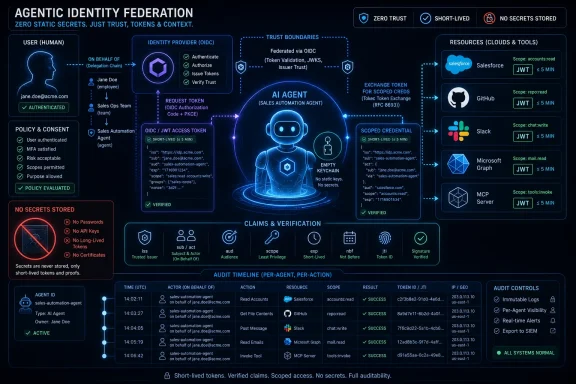
Agent-aware federation tries to close that gap by combining multiple identities in the authorization decision. The runtime identity says which workload is making the request. The agent identity says which agent is acting. The user context says who delegated the task. The policy engine decides what credential, if any, should be issued.
This is where OAuth token exchange and on-behalf-of patterns become more than protocol trivia. They are the machinery needed to avoid collapsing every agent action into a single overpowered application identity. In a well-designed system, the agent does not impersonate everyone and everything. It receives constrained authority derived from policy.
The Cloud Vendors Are Building Agent Identity Silos
The major cloud providers have noticed the gap. AWS, Microsoft, and Google are each moving beyond basic workload federation toward dedicated agent identity services.AWS has Amazon Bedrock AgentCore Identity, positioned as identity and credential management for agents and automated workloads. It includes concepts such as workload identities, credential providers, token storage, and support for accessing AWS and third-party services on behalf of users. In AWS’s framing, the agent needs a managed identity directory and a credential-management plane, not just an IAM role.
Microsoft is building around Entra Agent ID and Azure AI Foundry. The significance is not merely that an agent can call a tool. It is that Microsoft wants agents to become first-class identity objects governed with familiar enterprise controls such as Conditional Access, lifecycle management, and role-based access. For Microsoft shops, that is a natural extension of the Entra universe.
Google has been developing Agent Identity concepts around Google Cloud and Vertex AI, tying agent identities into IAM-style principals and managed runtimes. Google’s documentation makes the same broad point in a different dialect: agents need identities that can be distinguished from ordinary workloads and governed according to who invokes them and what they access.
These are welcome developments. They show that the industry has moved past the idea that agents can safely live behind shared service accounts. But they also reveal the next architectural fight. Every hyperscaler wants agent identity to be native to its own platform. Enterprises, meanwhile, rarely run neatly inside one platform.
The result is a familiar cloud-era tension. Native identity services are powerful when the workload, data, tools, and users all live in the same ecosystem. They become harder to reason about when an agent built in one framework runs in another cloud, calls a third-party SaaS tool, retrieves user context from a separate identity provider, and writes logs to yet another system.
The Real Product Category Is Credential Brokering
The interesting layer is not just “agent identity.” It is credential brokering.An agent-aware identity platform has to accept a workload proof from the runtime, validate it, bind it to an agent record, evaluate policy, issue a short-lived platform token, and then exchange or broker credentials for downstream systems. That downstream credential might be an OAuth token for a SaaS provider, a scoped API credential for an internal service, or a token for an MCP server.
This is a more ambitious role than classic federation. The identity layer becomes a traffic controller for authority. It decides which credentials exist, for how long, under whose delegation, and with what scopes.
For administrators, that changes the audit story. Instead of seeing a shared API key access a service, they should be able to see that a particular agent instance, running under a particular workload identity, acting for a particular user or tenant, requested a particular downstream credential and used it for a particular operation.
That is the difference between visibility and forensic fog. If agents are going to make changes in production systems, retrieve sensitive records, or trigger business workflows, the audit trail cannot stop at “the automation account did it.”
Credential brokering also reduces the blast radius of inevitable mistakes. If a token is short-lived and scoped to a single action or tool, leakage is less catastrophic. If access is derived from runtime claims and user context, revocation can happen at the policy or identity-record level rather than through emergency secret rotation across every deployment.
Descope’s Pitch Shows Where the Market Is Going
The Descope post that prompted this discussion is vendor-authored, and it naturally steers toward Descope’s Agentic Identity Hub as the cloud-neutral answer. That positioning should be read as positioning, but the underlying architectural argument is sound.Descope’s model is to let agents federate into its identity platform using cloud-issued OIDC tokens, then receive scoped access tokens and downstream credentials through policy-governed exchanges. The platform supports AWS, Azure, and Google Cloud tokens, associates workload claims with agentic identity records, and uses those records for audit and authorization decisions.
In practice, the pattern looks like this: an agent runs in a cloud environment with a platform identity; it obtains an OIDC token from that environment; it presents the token to Descope using a JWT bearer grant; Descope validates the issuer and claims; Descope issues a scoped token; and the agent uses that token to request access to protected APIs, MCP servers, or downstream SaaS services.
The important part is not the brand name on the token endpoint. It is the decoupling. A cloud-neutral identity layer can, at least in theory, let organizations apply one agent identity model across Azure AI Foundry, Vertex AI, Bedrock AgentCore, Kubernetes, serverless workloads, and standalone agent frameworks.
That matters because agent sprawl is likely to look a lot like SaaS sprawl and service-principal sprawl before it. Individual teams will adopt tools quickly. Some agents will be sanctioned. Others will be experimental. A few will quietly become business-critical. If identity is bolted on per platform, security teams may discover the inventory problem only after the permissions problem has already arrived.
Windows Shops Should Recognize the Pattern
For WindowsForum readers, this may sound abstract until it lands in the Microsoft estate. It will not stay abstract for long. Copilot Studio agents, Azure AI Foundry agents, Microsoft Graph connectors, SharePoint content, Teams workflows, Power Platform automations, and line-of-business APIs all sit directly in the blast zone of agent identity design.Microsoft’s advantage is obvious: Entra ID is already the control plane for many enterprise identities. If agent identities become visible and governable inside Entra, administrators get a familiar place to apply policy, monitor activity, and assign responsibility. That is not a small thing.
The risk is equally obvious. Many organizations already struggle with app registrations, enterprise applications, service principals, consent grants, privileged roles, and stale automation accounts. Adding agents as another class of identity will not simplify that landscape unless Microsoft and customers treat them as first-class governed objects rather than decorative metadata attached to applications.
Windows administrators should pay particular attention to on-behalf-of flows. The security difference between an agent accessing Microsoft 365 data as itself and an agent accessing data under the user’s delegated rights is enormous. The former can become a backdoor around information barriers. The latter can preserve least privilege, assuming the implementation is careful and the policies are real.
The same applies to hybrid environments. An agent that reads from Microsoft 365, writes to ServiceNow, calls a GitHub API, and triggers an Azure Function is already outside a single-vendor authorization story. Even if Entra governs the user, some other system may broker the GitHub credential, store the SaaS refresh token, or log the tool call.
MCP Makes the Identity Problem More Urgent
The rise of MCP servers and tool-calling interfaces sharpens the issue. Agents are increasingly expected to discover tools and call them as part of a task. Those tools may expose sensitive capabilities: database queries, ticket updates, file retrieval, code execution, infrastructure changes, or business approvals.If every MCP server is protected by a static token shared among agents, the enterprise has recreated the worst version of bot security. If every agent gets broad access because fine-grained issuance is too hard, the result is only marginally better. The tool layer needs identity-aware access, not just network reachability and a bearer token.
Agentic WIF gives MCP deployments a better foundation. A server can require a short-lived token minted for a specific agent and context. A policy engine can decide whether the agent may call that tool for that user. The audit trail can record the actual principal chain instead of a generic integration account.
This will become more important as agents move from read-only assistants to write-capable operators. Retrieval is already sensitive, but mutation is where sloppy identity becomes operational risk. An agent that can open tickets is useful. An agent that can close incidents, rotate keys, change firewall rules, merge pull requests, or approve expense workflows needs stronger guardrails.
Short-Lived Credentials Are Necessary but Not Sufficient
It is tempting to summarize WIF as “short-lived tokens instead of secrets.” That is true, but incomplete. A short-lived overprivileged token can still do serious damage. A short-lived token with no user context can still violate access policy. A short-lived token with no durable audit record can still leave investigators guessing.The valuable properties come from the combination: short lifetime, scoped authority, verifiable claims, delegated context, policy evaluation, and auditable identity records. Remove any one of those and the model weakens.
This is also why organizations should not confuse vaulting with federation. A secret vault can reduce accidental exposure, but it does not eliminate the existence of static credentials. It also does not automatically solve user delegation or agent-specific policy. Vaults remain useful, especially for systems that cannot participate in modern token exchange, but they are not the same as an identity-native design.
Likewise, cloud IAM alone is not enough when the agent’s work leaves the cloud. An IAM role can establish that the workload is allowed to run and access certain cloud resources. It cannot automatically express that the agent is acting for a particular human in a third-party SaaS application with tenant-specific restrictions.
The Governance Model Has to Follow the Agent
The best agent identity systems will not be judged by how elegantly they mint tokens. They will be judged by whether administrators can answer basic operational questions.Which agents exist? Who owns them? Which users can invoke them? Which tools can they call? Which credentials can they broker? Which downstream systems have they accessed? Which policies limited their scopes? Which agents are dormant, orphaned, or overprivileged?
Those are governance questions, not just authentication questions. They require inventory, ownership, lifecycle management, logging, and review. They also require a cultural shift: agents must be treated less like features and more like identities.
That shift will be uncomfortable. Developers want agents to be easy to build and deploy. Security teams want agents to be constrained and observable. Business units want agents to connect to everything that makes them useful. The identity layer is where those pressures collide.
A good federation model will not eliminate that conflict, but it can make the trade-offs explicit. Instead of handing an agent a permanent Salesforce token because it might need customer records someday, the platform can issue a narrowly scoped credential when a specific task demands it. Instead of letting a shared backend account blur every action, the system can preserve the chain of authority.
The Practical Test Is Failure
The real test of agentic WIF is not the happy-path demo. It is what happens when something goes wrong.If an agent is compromised, can administrators revoke its identity without breaking unrelated workloads? If a user loses access to a data set, do agent-mediated actions immediately reflect that change? If a cloud workload is redeployed into a different namespace or tenant, does the identity platform distinguish it from the old one? If a downstream token leaks, is it short-lived enough and narrow enough to limit damage?
These are not theoretical concerns. Agent systems are complex, and complexity produces misconfiguration. The more autonomous the agent, the more important it is that each credential be treated as a momentary grant rather than a durable entitlement.
This is where per-agent identity records matter. A token expires, but the identity record remains. That record gives security teams something to review, suspend, investigate, and govern. Without it, the enterprise is left chasing ephemeral runtime events across logs that may not agree on what the agent was.
The same logic applies to tenant boundaries. Multi-tenant SaaS applications, managed service providers, and internal platforms serving multiple business units need policy decisions that account for tenant context. An agent identity without tenant-aware authorization is only half a control.
The Next Identity Mess Is Avoidable, but Only Barely
The industry has a habit of discovering identity problems after adoption has already raced ahead. Cloud keys sprawled before IAM hygiene matured. OAuth app consent exploded before many tenants had serious review processes. Service principals multiplied before lifecycle ownership became routine. Agents are now entering the same danger zone.The good news is that the technical building blocks are better this time. OIDC, JWT bearer grants, OAuth token exchange, workload federation, SPIFFE-style workload identity, and cloud-native identity services all provide a stronger foundation than the API-key culture they are replacing.
The bad news is that the incentives have not changed. Teams under pressure to ship agent features will take the shortest path to a working integration. If that path is a static token with broad rights, many will take it. If the secure path is too hard, too vendor-specific, or too poorly documented, agent identity debt will accumulate quickly.
That is why agentic WIF should be treated as architecture, not polish. It belongs in the first design review, not the post-launch security backlog. Once agents are already embedded in workflows and customers rely on them, replacing their credential model becomes much harder.
The Agent Identity Checklist That Actually Belongs in the Design Review
Before deploying agents that call real tools or touch real enterprise data, teams should be able to state their identity model plainly. If the answer depends on a shared secret, a privileged backend account, or a hand-waved “the app handles it,” the design is not ready for production.- Each agent should have a distinct identity record that survives beyond any single token or runtime instance.
- Each credential issued to an agent should be short-lived, scoped, and tied to verifiable workload claims.
- Each user-delegated action should preserve the user’s entitlements rather than relying on a broad service account.
- Each downstream tool call should be logged with enough context to reconstruct the agent, workload, user, tenant, and policy decision.
- Each cloud-native agent identity service should be evaluated for how well it works outside its home ecosystem.
- Each static secret removed from an agent workflow should be treated as a reduction in blast radius, not merely an implementation detail.
Workload identity federation for AI agents is ultimately a recognition that autonomy without identity is just automation with a larger blast radius. The cloud industry already learned that static secrets are a poor foundation for modern workloads; agents make that lesson harder to ignore and more expensive to postpone. The next phase will be messy, split between hyperscaler-native systems and cloud-neutral brokers, but the direction is clear: agents that act across systems will need identities that travel with them, policies that constrain them, and audit trails that outlive them.
References
- Primary source: Security Boulevard
Published: 2026-06-23T02:02:43.102841
What Is Workload Identity Federation for AI Agents? - Security Boulevard
An amazing postsecurityboulevard.com - Official source: learn.microsoft.com
Agent identity concepts in Microsoft Foundry - Microsoft Foundry | Microsoft Learn
Learn how agent identities and agent identity blueprints work in Microsoft Foundry, including RBAC, authentication for tools, and governance.learn.microsoft.com - Official source: docs.cloud.google.com
Identities for workloads | Identity and Access Management (IAM) | Google Cloud Documentation
Configure Google Cloud workload identities: Identity and Access Management (IAM), Workload Identity Federation, and service accounts.docs.cloud.google.com
- Related coverage: docs.aws.amazon.com
Provide identity and credential management for agent applications with Amazon Bedrock AgentCore Identity - Amazon Bedrock AgentCore
Amazon Bedrock AgentCore Identity is an identity and credential management service designed specifically for AI agents and automated workloads. It provides secure authentication, authorization, and credential management capabilities that enable agents and tools to access AWS resources and...docs.aws.amazon.com
- Official source: microsoft.com
Secure Agent Access with Microsoft Entra | Microsoft Security
Take control of AI agent sprawl by managing, protecting, and governing agents with secure access for agents from Microsoft Entra.www.microsoft.com
- Related coverage: descope.com
Build Identity-Aware Agents With Google Vertex AI, ADK & Descope
Add Descope to Vertex AI Agent Engine and Google ADK: a cloud-neutral agent directory, issuance-time policy, credential vault, and CIBA approvals for AI agents.www.descope.com
- Related coverage: aws.amazon.com
Introducing Amazon Bedrock AgentCore Identity: Securing agentic AI at scale | Artificial Intelligence
In this post, we explore Amazon Bedrock AgentCore Identity, a comprehensive identity and access management service purpose-built for AI agents that enables secure access to AWS resources and third-party tools. The service provides robust identity management features including agent identity...aws.amazon.com - Related coverage: techradar.com
'What if the AI agent you just deployed was secretly working against you?': Vertex AI 'double agent' flaw exposes customer data and Google's internal code | TechRadar
Misconfigured AI agents can lead to data disclosurewww.techradar.com - Related coverage: itpro.com
Microsoft opens up Entra Agent ID preview with new AI features | IT Pro
Microsoft Entra Agent ID aims to help manage influx of AI agents using existing toolswww.itpro.com
