

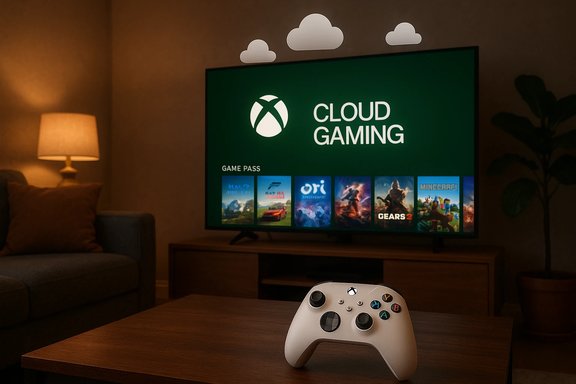
Microsoft and Hisense quietly opened another path to console‑less Xbox play on January 5, 2026, announcing the Xbox app will arrive on select Hisense and V homeOS‑powered smart TVs later this year — a move that extends Xbox Cloud Gaming to millions more living rooms and gives budget‑conscious players a new way to access Game Pass titles without buying a console.
Background / Overview
Microsoft’s official Xbox Wire post confirms a partnership with V (formerly VIDAA) to bring the Xbox app to “select Hisense and V homeOS‑powered Smart TVs” in 2026. The company says subscribers across the reworked Game Pass tiers — Essential, Premium, and Ultimate — will be able to stream “hundreds of games” from the Game Pass catalog using Xbox Cloud Gaming through the TV app, and that further rollout details will arrive in the months ahead. This announcement isn’t a one‑off: it follows Microsoft’s broader push over 2024–2025 to get Xbox Cloud Gaming onto TVs and low‑cost streaming devices, including earlier deals with Samsung, LG and Fire TV platforms. The service’s new emphasis on improved streaming quality — notably up to 1440p for qualifying Ultimate subscribers — underpins Microsoft’s argument that cloud play can now deliver a visually convincing, console‑style experience to devices that are far cheaper than a standalone Xbox console. Industry outlets picked up the story immediately: GameSpot and GamesBeat ran same‑day coverage describing the deal as another step in Microsoft’s strategy to turn every screen into a potential Xbox, while other outlets framed the move against the backdrop of higher console and subscription prices introduced in 2025.Why this matters: the economics behind the move
In plain terms, the Hisense partnership is about user acquisition and accessibility. Three market pressures make this a logical, even necessary, play for Microsoft:- Rising hardware costs for consoles and PCs — manufacturers flagged price pressure throughout 2025, and major outlets reported repeated Xbox console price increases in multiple markets. That makes a cloud‑first, subscription model more compelling for price‑sensitive players.
- The Game Pass product rework (Essential / Premium / Ultimate) broadened cloud access across tiers, creating a larger addressable base for TV integrations to reach. Microsoft positioned Ultimate as the premium tier with the best clouds and day‑one releases, and Essential/Premium as lower‑cost options that still include unlimited cloud play.
- Smart TV makers need services to differentiate hardware; Xbox Cloud Gaming gives Hisense a recurring‑value proposition to sell TVs with: buy the set once, subscribe later. For Microsoft, TV integrations extend trial paths into subscriptions and potential long‑term revenue. Independent coverage framed this as a mutually beneficial OEM/OEM partnership.
What Microsoft actually promised (and what they didn't)
Microsoft’s public announcement is clear in one area and deliberately light on specifics in others.What Microsoft confirmed:
- The Xbox app is coming to select Hisense and V homeOS TV models during 2026.
- Game Pass subscribers on Essential, Premium, and Ultimate will be eligible to stream titles via Xbox Cloud Gaming on those TVs.
- Microsoft will share more details about the TV experience — including exact device support and availability windows — in the coming months.
- A detailed model list of supported Hisense/V homeOS televisions and whether older sets will receive an OTA update. Coverage from Microsoft and Hisense typically follows a phased certification approach, so expect OEM‑specific lists later.
- Hard limits on resolution or bitrate by Game Pass tier within the context of the TV app announcement itself. The company’s October 2025 Game Pass update defined Ultimate as receiving the highest streaming quality (up to 1440p), but Microsoft’s Hisense announcement did not publish a separate tiered quality table for TVs. That leaves nuance on quality caps and device support to follow‑up posts and device certification notes.
Technical reality check: quality, bandwidth, and practical limits
Cloud gaming headline numbers sound attractive — but real experience depends on several technical factors. Microsoft’s Game Pass overhaul and the Xbox Cloud Gaming updates in late 2025 introduced higher‑quality streams and a user‑selectable resolution feature, but the rollout is subject to per‑title and per‑device gates. Here’s what is verifiable today.- Ultimate’s quality uplift: Microsoft publicly described up to 1440p streams for select games and devices as part of the Ultimate experience; independent testing and reporting confirmed that 1440p sessions can peak at higher bitrates (reported peaks near 27 Mbps), which materially reduces compression artifacts versus older streams.
- Lower tiers and resolution: Microsoft’s Game Pass announcement confirms unlimited cloud gaming for Essential and Premium but did not officially publish fixed resolution caps in the same post. Third‑party reporting and TV implementations indicate that many non‑Ultimate users will get HD/FHD streams on capable hardware, but availability may vary by device and title. Multiple outlets and device guides show that streaming can be set to Auto or manually adjusted across options like 720p, 1080p and, for Ultimate, 1440p on supported endpoints — but those on‑screen options are often device‑dependent. Because Microsoft hasn’t published a single universal table mapping tier → max resolution for all device types, be cautious about assuming fixed caps on every TV and region.
- Bandwidth and data use: Practical guidance remains consistent across Microsoft posts and testing communities — plan on at least 20 Mbps for steady 1080p, and sustained mid‑20s Mbps or higher for reliable 1440p. Data usage scales quickly: community measurements and manufacturer pages estimate roughly several GB per hour at 1080p and multiple GBs more at 1440p. If you’re on a metered home connection, streaming for hours will consume meaningful data.
- Latency and game types: Cloud play’s Achilles’ heel is latency; even well‑tuned streaming introduces measurable input delay compared with local console or PC play. This matters most in fast competitive shooters, fighting games, and rhythm titles. For RPGs, strategy games and single‑player platformers, cloud play is nearly indistinguishable for many players. Microsoft’s presence of regional Azure capacity and the company’s “shortest wait times” promise for Ultimate help, but last‑mile routing and household Wi‑Fi quality are decisive factors.
The evidence on resolution by tier — verify before you assume
Multiple independent reports corroborate that Ultimate is the tier that unlocks the new 1440p streams for qualifying titles and devices. The Verge’s coverage of the October Game Pass relaunch quotes Microsoft staff saying the best streaming quality (up to 1440p) is available to Ultimate subscribers, and device menus observed on some TV apps show selectable options tied to subscription status. At the same time, device‑specific documentation and TV app screenshots (as reported by third‑party outlets and community guides) demonstrate that Essential/Premium users can still receive 720p–1080p streams — and in some cases, a manual toggle to 1080p High Quality appears to be selectable for non‑Ultimate tiers on certain TVs. Those implementation details appear to be driven by the TV app firmware and Microsoft’s app certification process, not one universal product rule. Because Microsoft has not published exhaustive tier → resolution matrices for every TV platform, any claim that “Essential = 720p, Premium = 1080p, Ultimate = 1440p” should be treated as likely in many cases but not universally guaranteed. Trust the device’s Xbox app settings and official Xbox Wire follow‑ups for final confirmation.Which Hisense / V homeOS TVs will support the app?
Microsoft’s January announcement uses the phrase “select Hisense and V homeOS‑powered Smart TVs” and explicitly defers the certified model list to later communications. That means:- Expect a staged roll‑out that initially covers higher‑end Hisense sets and recent V homeOS models, with older or budget tiers possibly excluded or receiving an OTA update later.
- Historically, TV OEM rollouts (Samsung, LG) followed a certification path: Microsoft provides an app binary and TV vendors validate controller support, DRM, and performance on specific panels and SoCs before publishing the app in the TV store. The same pattern will very likely apply to Hisense.
How to prepare your home TV for the Xbox app
If you’re considering using a Hisense TV as your Xbox replacement, do the following now so you’re ready when the app drops:- Upgrade your network:
- Use wired Ethernet for the TV where possible. If Wi‑Fi is unavoidable, use 5 GHz or Wi‑Fi 6 and keep the router close to the TV. Aim for a stable connection with low jitter.
- Check bandwidth:
- Run a speed test from the same network and device you’ll game on. Target 20–35 Mbps for consistent 1080p and higher for 1440p sessions.
- Use a compatible controller:
- The Xbox Wireless Controller via Bluetooth or an officially supported pad gives the cleanest pairing and lowest perceived latency. Many TVs support standard Bluetooth controllers, but pairing and latency vary by model.
- Monitor data caps:
- If your ISP meters usage, expect multiple gigabytes per hour depending on resolution — budget accordingly.
- Test with xbox.com/play:
- The web portal remains the easiest place to trial the stream on a browser or a provisional device before relying on the TV app.
Consumer trade‑offs and limitations
Cloud gaming on a TV is compelling, but not a universal replacement for owning a console or gaming PC. Key trade‑offs:- Ownership vs. access: Game Pass is subscription access. Titles can rotate out of the library, and cloud availability for purchased games is still gated by licensing and publisher approvals. The “stream your own game” feature exists, but it remains subject to per‑title restrictions and regional rollout nuances.
- Latency remains a real constraint: If you prioritize competitive multiplayer responsiveness, local hardware typically wins. Cloud play is rapidly improving, but for high‑skill twitch titles the difference is still noticeable.
- Quality variability: Not every game or TV will get the same max resolution or bitrate. Title builds, anti‑cheat constraints, device decoders, and regional server capacity all affect image quality and stability. Expect a phased, per‑title expansion of the new HQ streams.
- Ongoing costs: While the TV‑plus‑subscription route reduces upfront hardware spend, subscription prices rose materially in 2025 and 2026 — Microsoft’s Ultimate tier is now positioned as a premium offering at a higher monthly price (and the company raised console prices in many markets last year). Do the math: if you game heavily long‑term, hardware plus occasional purchases may outpace a multi‑year subscription depending on play habits.
Strategic and industry implications
For OEMs: TV makers now compete on software ecosystems as much as display specs. Pre‑bundled access to services with recurring revenue (Game Pass) is a commercial lever for Hisense to differentiate sets at marginal cost.For Microsoft: TVs widen the funnel for Game Pass signups. TV owners who try the service are an addressable group for subscription upgrades — especially if the TV exposes a smooth onboarding path with controller bundles and trial promotions. Public coverage suggests Microsoft expects TV integrations to scale user acquisition rather than replace its hardware business. For the market: wider stream availability accelerates the console‑less play narrative. It also pressures network providers and retailers to consider bundling high‑speed plans and subscription trials as part of TV sales strategies.
Strengths, potential risks, and red flags
Strengths- Low entry cost for consumers who already own a smart TV.
- Closed loop for Microsoft: streaming converts hardware owners into recurring subscription customers.
- Technical progress: 1440p streams and higher bitrates demonstrably improve the visual parity of streamed games.
- Network dependence and data caps remain the single biggest barrier to a uniformly good TV streaming experience.
- Per‑title and per‑device gating could frustrate users who expect uniform quality across the Game Pass catalog.
- Pricing friction: Game Pass price increases and higher console prices change the consumer math — some users will still prefer owning hardware despite the upfront cost.
- Exact model eligibility and the final resolution caps per tier on Hisense TVs are not yet published; anyone weighing a TV purchase on the promise of full 1440p cloud play should wait for the official list and device notes. Treat those claims as pending until Microsoft and Hisense publish complete compatibility matrices.
Bottom line and practical verdict
Microsoft’s move to put an Xbox app on Hisense and V homeOS TVs is a predictable expansion of the cloud‑first strategy and a meaningful convenience win for players without ready access to consoles or powerful PCs. It strengthens the proposition that you can “play Xbox” without an Xbox box — so long as your home network, device, and subscription align.For price‑sensitive players who already have a modern smart TV and a decent internet connection, the Hisense Xbox app will be a fast, low‑cost entry to Game Pass’s library. For competitive or latency‑sensitive gamers, local hardware still holds the edge.
The partnership is notable both for its accessibility and its timing: it follows an industry squeeze on hardware prices and Microsoft’s reworked Game Pass tiers that aim to monetize access more aggressively. That combination makes cloud TV integrations a growth vector worth watching, but not an immediate replacement for local ownership in every use case.
How to stay informed and what to expect next
- Watch Xbox Wire and Microsoft’s official social channels for the certified Hisense model list and the rollout schedule.
- Expect device‑specific release notes from Hisense outlining which V homeOS versions and TV models will host the Xbox app.
- When the app is available, check the Xbox app Settings → Audio & Video on your TV for resolution options and the “User Selected Resolution” control to manually set quality if your network can support it. Community guides and device reviews will help interpret those menus and expected data usage.
For now, the headline is simple: if you’ve been waiting for an affordable way to access Xbox games on a living‑room screen, Hisense’s upcoming Xbox app is another path forward — promising a console‑like library for less cash, but carrying the familiar caveats of cloud gaming’s dependence on bandwidth, server capacity, and per‑title support.
Source: Windows Central https://www.windowscentral.com/gami...sense-and-v-homeos-powered-smart-tvs-in-2026/
