

Microsoft has pulled back from plans to put Copilot for Gaming directly on Xbox consoles after Xbox CEO Asha Sharma said on June 4, 2026, that console players were not enthusiastic about the chatbot-style assistant and that the feature did not solve a clear player problem. The reversal is small in product terms but large in symbolism. For a company that has spent the last two years putting Copilot badges on nearly every surface it owns, Xbox is now offering a rare admission: not every screen needs an AI companion, and not every customer wants one.
That matters because Xbox is not abandoning artificial intelligence. It is narrowing the target. The new pitch is not “talk to your console,” but “make games run better, help developers work faster, and remove friction players already feel.” In gaming, that distinction may be the difference between a useful AI strategy and another corporate feature looking for a reason to exist.
Microsoft’s Copilot strategy has always made more intuitive sense in Office than in Halo. A spreadsheet worker stuck on a formula, an Outlook user drowning in mail, or a developer trying to explain an unfamiliar codebase has an obvious reason to ask a chatbot for help. The value proposition is direct: save time, summarize complexity, automate a task.
A console is different. The person on the couch has already chosen a full-screen activity designed to absorb attention, not split it. A gaming session is not a productivity workflow interrupted by inconvenience; it is the thing the player came to do. The more Microsoft described Copilot for Gaming as an in-session assistant, the more it risked feeling like a second interface laid over an experience that players already expect to be seamless.
That is why Sharma’s reported explanation lands harder than a normal product cancellation. “Our console players aren’t excited about that” is not a technical critique. It is a market critique. Players did not reject AI because it was too primitive, too expensive, or too early. They rejected the premise that a conversational assistant belonged in the middle of console play.
The gaming industry has spent decades teaching users that immersion is precious. The best interface is often the one that disappears. A chatbot, even a helpful one, is visible by design. It asks to be consulted, summoned, listened to, corrected, or dismissed. For a console player, that can feel less like assistance and more like another notification layer fighting for oxygen.
The problem is that this use case already has many incumbents. Players have YouTube, Discord, wikis, guides, Twitch clips, forums, search engines, Steam discussions, in-game hints, accessibility options, and friends. On console, they also have a phone within reach. Copilot needed to be better than those alternatives not in a laboratory demo, but at the exact moment a player is frustrated, impatient, and unwilling to wrestle with a bad answer.
That is a high bar. A gaming assistant that gives vague advice is useless. One that spoils a story beat is worse than useless. One that misunderstands a live game state becomes a joke. One that interrupts pacing becomes a nuisance. The feature could only win if it was accurate, context-aware, fast, controllable, and respectful of the player’s intent.
Microsoft’s stated vision leaned on the right nouns: context, personalization, recommendations, guidance. But gamers have become fluent in the gap between product language and lived experience. “AI sidekick” sounds impressive at a showcase. It sounds less compelling when the likely first questions are whether it hallucinates, whether it reads gameplay data, whether it records voice, whether it monetizes attention, and whether it can simply be turned off.
Console players have a different bargain with the machine. They buy into a curated appliance model: pick up the controller, sit down, launch the game, and expect the system to get out of the way. The console dashboard has become more crowded over the years, but the emotional contract remains simplicity. Adding an AI assistant to that environment was always going to be judged not by novelty but by intrusion.
That makes Sharma’s decision notable because it recognizes a difference Microsoft has sometimes blurred. “Xbox” is now a brand spanning consoles, PC, cloud, mobile apps, handheld PCs, subscriptions, storefronts, and first-party publishing. But the console is still a distinct cultural object. Its users do not necessarily want every feature that makes sense elsewhere in the ecosystem.
The failed assumption was that because Microsoft has Copilot, Xbox should have Copilot too. The better assumption is that Xbox should have AI only where it makes the game, the store, the network, or the development pipeline measurably better. That sounds obvious, but in the current AI cycle, obvious restraint has been in short supply.
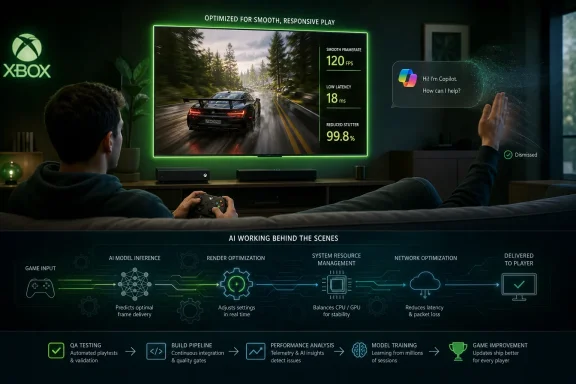
That is where Xbox appears to be turning. Sharma’s framing suggests Microsoft still sees AI as central to gaming, but not necessarily as a personality. This is a meaningful pivot. A visible AI assistant must earn trust every time it speaks. An invisible AI optimization layer earns trust by making the game feel better.
Graphics is the obvious battlefield. Nvidia has already trained the market to understand AI upscaling as a performance technology rather than a gimmick. AMD, Intel, Sony, and Microsoft all have incentives to squeeze more visual quality out of constrained hardware. If AI can help Xbox deliver higher perceived resolution, steadier frame rates, or better power efficiency, players will not complain that the feature lacks a cute name.
Development tooling may matter even more. Modern games are too large, too expensive, and too slow to produce. Studios need better automation for testing, build analysis, asset workflows, crash triage, accessibility checks, localization, and compatibility. If Microsoft can give internal and external developers AI tools that reduce drudgery without flattening creative work into algorithmic mush, Xbox gains leverage where it actually needs it: getting more good games into players’ hands.
Xbox is different because the customer base is unusually sensitive to perceived corporate misalignment. Console players remember Kinect. They remember dashboard ads. They remember TV-first messaging. They remember always-online anxiety. They remember platform promises that aged badly. This is an audience that can smell an executive mandate dressed up as a feature.
That history made Copilot for Gaming vulnerable from the start. Microsoft could say “assistant,” but many players heard “surveillance,” “upsell,” “overlay,” or “AI slop.” Some of that reaction is reflexive and unfair; not every AI feature is a content mill in disguise. But skepticism is rational when a company with Microsoft’s scale introduces a new layer that could touch play history, identity, recommendations, voice input, and commerce.
By stepping back, Xbox is doing something rare: conceding that distribution power is not the same as demand. Microsoft can ship a feature to millions of devices. It cannot make players want it. In the long run, that recognition may be healthier for Xbox than a stubborn rollout followed by months of backlash and quiet deprecation.
Instead, this decision gives Sharma a cleaner opening argument. Killing or de-prioritizing a feature associated with Microsoft’s corporate AI obsession signals that Xbox may be willing to say no to Redmond orthodoxy when the gaming use case is weak. That does not make the strategy automatically player-first. It does, however, show an awareness that the Xbox brand cannot be repaired through buzzwords.
There is also a management lesson here. Leaders often inherit projects that made sense under the last strategic mood. The question is whether they let those projects continue because they have internal sponsors, sunk costs, and slide-deck momentum, or whether they ask the harder question: would anyone miss this if it never launched? For console Copilot, Sharma’s answer appears to be no.
That is not a small thing inside a company like Microsoft. Copilot is not a side project; it is one of the company’s defining platform bets. Saying that a Copilot-branded feature does not belong on Xbox consoles is a boundary-setting act. It suggests the gaming division wants AI to justify itself in gaming terms, not merely in Microsoft terms.
Players will still care whether AI affects game quality. They will care if studios use generative tools to replace craft with volume. They will care if AI-driven recommendations make storefronts feel manipulative. They will care if automated moderation is opaque, if matchmaking becomes inscrutable, or if personalization turns into a funnel for engagement rather than enjoyment.
Developers will care from the other side. AI tools can reduce repetitive work, but they can also become productivity surveillance systems. They can help small teams punch above their weight, but they can also create pressure to ship more with fewer people. They can generate useful prototypes, but they can also flood pipelines with assets that need human cleanup. “Behind the scenes” does not automatically mean harmless.
This is where Microsoft will need a clearer doctrine. AI that improves frame rates is easy to defend. AI that helps QA reproduce rare bugs is easy to defend. AI that auto-generates quest text, voice lines, or art direction at scale will be judged much more harshly, especially in an industry already bruised by layoffs and ballooning production costs.
The phrase “solving a problem” is useful, but it is not enough. The next question is whose problem gets solved. A player problem, a developer problem, a publisher margin problem, and a platform engagement problem are not the same thing. Xbox will earn trust only if it can show that its AI investments improve the experience rather than merely optimize the business.
Gaming is especially hostile terrain for that kind of feature creep. Players value agency. They also value difficulty, discovery, surprise, mastery, and community knowledge. A tool that helps one player through a boss fight may be welcome; a system that feels like it is mediating play through a corporate assistant may be rejected on principle.
There is a version of this technology that could still work. An opt-in helper for accessibility, onboarding, parental support, co-op coordination, or game discovery might have a future. A tightly scoped assistant that answers specific questions without spoiling content could be useful. A developer-approved hint system with player-controlled depth could reduce frustration without cheapening accomplishment.
But the branding matters. “Copilot” carries Microsoft’s enterprise AI baggage. It evokes work, documents, meetings, and productivity. The word may be powerful in a business suite, but it is awkward in a living room where the point is not to co-pilot a task but to inhabit a world. Xbox may eventually bring AI assistance back under another form, but the lesson should be clear: the feature must feel native to play, not imported from Office.
AI remains deeply relevant to games. It is already present in animation systems, content tools, anti-cheat work, moderation, rendering, testing, bot behavior, accessibility, and analytics. The next decade of gaming will almost certainly involve more machine learning, not less. The question is whether companies use it to make games better or to make platforms noisier.
For Xbox, the immediate win is avoiding a self-inflicted wound. The console business does not need another divisive dashboard feature. It needs hardware clarity, a stronger first-party release cadence, better PC integration, a healthier Game Pass value story, improved store discovery, and confidence that the brand still knows what a console is for. Copilot on the console was never going to solve those problems.
That is why the decision feels less like a defeat for AI than a course correction for Xbox. The company is not saying machines cannot help. It is saying the assistant should not be the product. In a market tired of AI being treated as destiny, that may be the most player-friendly AI message Microsoft has delivered yet.
That matters because Xbox is not abandoning artificial intelligence. It is narrowing the target. The new pitch is not “talk to your console,” but “make games run better, help developers work faster, and remove friction players already feel.” In gaming, that distinction may be the difference between a useful AI strategy and another corporate feature looking for a reason to exist.
 Xbox Learns That the Living Room Is Not a Productivity Surface
Microsoft’s Copilot strategy has always made more intuitive sense in Office than in Halo. A spreadsheet worker stuck on a formula, an Outlook user drowning in mail, or a developer trying to explain an unfamiliar codebase has an obvious reason to ask a chatbot for help. The value proposition is direct: save time, summarize complexity, automate a task.A console is different. The person on the couch has already chosen a full-screen activity designed to absorb attention, not split it. A gaming session is not a productivity workflow interrupted by inconvenience; it is the thing the player came to do. The more Microsoft described Copilot for Gaming as an in-session assistant, the more it risked feeling like a second interface laid over an experience that players already expect to be seamless.
That is why Sharma’s reported explanation lands harder than a normal product cancellation. “Our console players aren’t excited about that” is not a technical critique. It is a market critique. Players did not reject AI because it was too primitive, too expensive, or too early. They rejected the premise that a conversational assistant belonged in the middle of console play.
The gaming industry has spent decades teaching users that immersion is precious. The best interface is often the one that disappears. A chatbot, even a helpful one, is visible by design. It asks to be consulted, summoned, listened to, corrected, or dismissed. For a console player, that can feel less like assistance and more like another notification layer fighting for oxygen.
Copilot for Gaming Was a Plausible Demo With an Unclear Job
The original idea behind Copilot for Gaming was not absurd. Microsoft described a helper that could offer guidance, recommendations, tips, session context, and personalized support. In theory, that could save players from alt-tabbing to a browser, searching Reddit, watching a ten-minute walkthrough for a thirty-second puzzle, or abandoning a game because the next step is unclear.The problem is that this use case already has many incumbents. Players have YouTube, Discord, wikis, guides, Twitch clips, forums, search engines, Steam discussions, in-game hints, accessibility options, and friends. On console, they also have a phone within reach. Copilot needed to be better than those alternatives not in a laboratory demo, but at the exact moment a player is frustrated, impatient, and unwilling to wrestle with a bad answer.
That is a high bar. A gaming assistant that gives vague advice is useless. One that spoils a story beat is worse than useless. One that misunderstands a live game state becomes a joke. One that interrupts pacing becomes a nuisance. The feature could only win if it was accurate, context-aware, fast, controllable, and respectful of the player’s intent.
Microsoft’s stated vision leaned on the right nouns: context, personalization, recommendations, guidance. But gamers have become fluent in the gap between product language and lived experience. “AI sidekick” sounds impressive at a showcase. It sounds less compelling when the likely first questions are whether it hallucinates, whether it reads gameplay data, whether it records voice, whether it monetizes attention, and whether it can simply be turned off.
The Console Audience Was Always the Hardest Sell
It is tempting to describe this as a broad anti-AI moment, but the sharper point is platform-specific. PC players are accustomed to overlays, launchers, mods, browsers, chat clients, performance monitors, and secondary screens. A Copilot panel in Game Bar may be one more tool in an already messy toolbox. Mobile users also live in a world of assistants, notifications, and app-mediated interactions.Console players have a different bargain with the machine. They buy into a curated appliance model: pick up the controller, sit down, launch the game, and expect the system to get out of the way. The console dashboard has become more crowded over the years, but the emotional contract remains simplicity. Adding an AI assistant to that environment was always going to be judged not by novelty but by intrusion.
That makes Sharma’s decision notable because it recognizes a difference Microsoft has sometimes blurred. “Xbox” is now a brand spanning consoles, PC, cloud, mobile apps, handheld PCs, subscriptions, storefronts, and first-party publishing. But the console is still a distinct cultural object. Its users do not necessarily want every feature that makes sense elsewhere in the ecosystem.
The failed assumption was that because Microsoft has Copilot, Xbox should have Copilot too. The better assumption is that Xbox should have AI only where it makes the game, the store, the network, or the development pipeline measurably better. That sounds obvious, but in the current AI cycle, obvious restraint has been in short supply.
The Real AI Opportunity Is Below the Waterline
The most persuasive version of AI in gaming is not a chatbot sitting beside the player. It is a set of systems the player may never consciously notice. If AI can improve upscaling, smooth frame pacing, reduce stutter, accelerate testing, localize dialogue, improve matchmaking, surface better recommendations, or help developers optimize across hardware targets, the player does not need to “use AI.” The player simply gets a better result.That is where Xbox appears to be turning. Sharma’s framing suggests Microsoft still sees AI as central to gaming, but not necessarily as a personality. This is a meaningful pivot. A visible AI assistant must earn trust every time it speaks. An invisible AI optimization layer earns trust by making the game feel better.
Graphics is the obvious battlefield. Nvidia has already trained the market to understand AI upscaling as a performance technology rather than a gimmick. AMD, Intel, Sony, and Microsoft all have incentives to squeeze more visual quality out of constrained hardware. If AI can help Xbox deliver higher perceived resolution, steadier frame rates, or better power efficiency, players will not complain that the feature lacks a cute name.
Development tooling may matter even more. Modern games are too large, too expensive, and too slow to produce. Studios need better automation for testing, build analysis, asset workflows, crash triage, accessibility checks, localization, and compatibility. If Microsoft can give internal and external developers AI tools that reduce drudgery without flattening creative work into algorithmic mush, Xbox gains leverage where it actually needs it: getting more good games into players’ hands.
Microsoft’s Broader AI Push Finally Meets a Boundary
The Copilot-for-everything era has been defined by a peculiar corporate confidence. Microsoft has placed AI into Windows, Edge, Bing, Microsoft 365, GitHub, security products, developer tools, and enterprise services with the conviction that the interface layer itself is being rebuilt. In many markets, that bet is understandable. In some, it is already useful. In others, it has felt like the software equivalent of putting a smart speaker in every room and calling the house renovated.Xbox is different because the customer base is unusually sensitive to perceived corporate misalignment. Console players remember Kinect. They remember dashboard ads. They remember TV-first messaging. They remember always-online anxiety. They remember platform promises that aged badly. This is an audience that can smell an executive mandate dressed up as a feature.
That history made Copilot for Gaming vulnerable from the start. Microsoft could say “assistant,” but many players heard “surveillance,” “upsell,” “overlay,” or “AI slop.” Some of that reaction is reflexive and unfair; not every AI feature is a content mill in disguise. But skepticism is rational when a company with Microsoft’s scale introduces a new layer that could touch play history, identity, recommendations, voice input, and commerce.
By stepping back, Xbox is doing something rare: conceding that distribution power is not the same as demand. Microsoft can ship a feature to millions of devices. It cannot make players want it. In the long run, that recognition may be healthier for Xbox than a stubborn rollout followed by months of backlash and quiet deprecation.
Asha Sharma’s First Big Lesson Is That Gamers Reward Restraint
Sharma’s position carries an unusual tension. Her background makes her a credible steward of AI-driven product systems, but that same background made some Xbox fans nervous when she took the top job. If the new Xbox era looked like a mandate to turn gaming into a Copilot showcase, the backlash would have been immediate and predictable.Instead, this decision gives Sharma a cleaner opening argument. Killing or de-prioritizing a feature associated with Microsoft’s corporate AI obsession signals that Xbox may be willing to say no to Redmond orthodoxy when the gaming use case is weak. That does not make the strategy automatically player-first. It does, however, show an awareness that the Xbox brand cannot be repaired through buzzwords.
There is also a management lesson here. Leaders often inherit projects that made sense under the last strategic mood. The question is whether they let those projects continue because they have internal sponsors, sunk costs, and slide-deck momentum, or whether they ask the harder question: would anyone miss this if it never launched? For console Copilot, Sharma’s answer appears to be no.
That is not a small thing inside a company like Microsoft. Copilot is not a side project; it is one of the company’s defining platform bets. Saying that a Copilot-branded feature does not belong on Xbox consoles is a boundary-setting act. It suggests the gaming division wants AI to justify itself in gaming terms, not merely in Microsoft terms.
The Risks Move From the Dashboard to the Development Pipeline
The cancellation of console Copilot does not end the debate. It moves it. If AI becomes less visible to players and more embedded in development, infrastructure, and personalization, the questions become subtler and arguably more important.Players will still care whether AI affects game quality. They will care if studios use generative tools to replace craft with volume. They will care if AI-driven recommendations make storefronts feel manipulative. They will care if automated moderation is opaque, if matchmaking becomes inscrutable, or if personalization turns into a funnel for engagement rather than enjoyment.
Developers will care from the other side. AI tools can reduce repetitive work, but they can also become productivity surveillance systems. They can help small teams punch above their weight, but they can also create pressure to ship more with fewer people. They can generate useful prototypes, but they can also flood pipelines with assets that need human cleanup. “Behind the scenes” does not automatically mean harmless.
This is where Microsoft will need a clearer doctrine. AI that improves frame rates is easy to defend. AI that helps QA reproduce rare bugs is easy to defend. AI that auto-generates quest text, voice lines, or art direction at scale will be judged much more harshly, especially in an industry already bruised by layoffs and ballooning production costs.
The phrase “solving a problem” is useful, but it is not enough. The next question is whose problem gets solved. A player problem, a developer problem, a publisher margin problem, and a platform engagement problem are not the same thing. Xbox will earn trust only if it can show that its AI investments improve the experience rather than merely optimize the business.
The Failure Was Timing, Trust, and the Wrong Kind of Visibility
Copilot for Gaming arrived at a difficult cultural moment. The first wave of AI enthusiasm has given way to a more discriminating phase. Users have seen impressive demos, but they have also seen hallucinations, unwanted integrations, privacy concerns, degraded search results, synthetic content spam, and features that seem designed to satisfy investors more than customers.Gaming is especially hostile terrain for that kind of feature creep. Players value agency. They also value difficulty, discovery, surprise, mastery, and community knowledge. A tool that helps one player through a boss fight may be welcome; a system that feels like it is mediating play through a corporate assistant may be rejected on principle.
There is a version of this technology that could still work. An opt-in helper for accessibility, onboarding, parental support, co-op coordination, or game discovery might have a future. A tightly scoped assistant that answers specific questions without spoiling content could be useful. A developer-approved hint system with player-controlled depth could reduce frustration without cheapening accomplishment.
But the branding matters. “Copilot” carries Microsoft’s enterprise AI baggage. It evokes work, documents, meetings, and productivity. The word may be powerful in a business suite, but it is awkward in a living room where the point is not to co-pilot a task but to inhabit a world. Xbox may eventually bring AI assistance back under another form, but the lesson should be clear: the feature must feel native to play, not imported from Office.
The Industry Should Read This as a Warning, Not a Retreat
Other gaming companies should resist the easy interpretation that Microsoft tried AI in gaming and players said no. The more precise lesson is that players said no to a visible assistant whose value was not obvious enough to justify its presence. That is a narrower conclusion, but a more useful one.AI remains deeply relevant to games. It is already present in animation systems, content tools, anti-cheat work, moderation, rendering, testing, bot behavior, accessibility, and analytics. The next decade of gaming will almost certainly involve more machine learning, not less. The question is whether companies use it to make games better or to make platforms noisier.
For Xbox, the immediate win is avoiding a self-inflicted wound. The console business does not need another divisive dashboard feature. It needs hardware clarity, a stronger first-party release cadence, better PC integration, a healthier Game Pass value story, improved store discovery, and confidence that the brand still knows what a console is for. Copilot on the console was never going to solve those problems.
That is why the decision feels less like a defeat for AI than a course correction for Xbox. The company is not saying machines cannot help. It is saying the assistant should not be the product. In a market tired of AI being treated as destiny, that may be the most player-friendly AI message Microsoft has delivered yet.
The Useful Lesson Hidden Inside a Cancelled Assistant
The practical reading for WindowsForum readers is straightforward: this is not the end of AI in Xbox, but it is likely the end of one particularly visible version of it. Expect Microsoft to keep investing in AI where it touches performance, tools, discovery, and services. Expect the company to be more cautious about putting a chatbot directly in the path of console play.- Microsoft is moving away from a console-facing Copilot for Gaming because Xbox leadership says players were not enthusiastic about the idea.
- Gaming Copilot’s strongest remaining use cases are likely on PC, mobile, handhelds, and support surfaces where overlays and assistant-style interactions feel less alien.
- Xbox’s more durable AI strategy will probably focus on rendering, optimization, development workflows, testing, recommendations, and platform friction.
- The decision suggests Sharma’s Xbox is willing to reject AI features that do not solve a clear gaming problem, even when they align with Microsoft’s broader Copilot branding.
- The next controversy will not be whether Xbox uses AI, but whether that AI improves games for players and developers or merely automates costs and engagement targets.
References
- Primary source: thewincentral.com
Published: 2026-06-06T09:20:21.815257
Xbox Drops Copilot for Gaming as Players Show Little Interest - WinCentral
Xbox is shifting AI efforts toward game performance and graphics after players showed little interest in Copilot for Gaming. - Read in AI News on WinCentral thewincentral.com
- Related coverage: windowscentral.com
Xbox's CEO just defined her mission: "My mandate is not 30% accountability margins, it’s to be the number one." | Windows Central
It seems the historically high profit margins no longer apply to the new XBOX CEO, Asha Sharma.www.windowscentral.com - Related coverage: tomshardware.com
Xbox announces 'Copilot for Gaming' AI assistant — early access coming to Xbox mobile app, more details to come at GDC 2025 | Tom's Hardware
Microsoft turns Copilot into an actual copilotwww.tomshardware.com - Related coverage: news.xbox.com
Xbox June Update: Copilot for Gaming Available for Testing on Mobile, Aggregated Gaming Library, and More - XBOX Wire
Exciting Xbox updates this month! Copilot for Gaming now in early preview on mobile, new Aggregated Gaming Library & Publisher Channels on the Xbox PC app, plus enhanced console features!news.xbox.com - Related coverage: techspot.com
Microsoft kills Gaming Copilot for Xbox consoles and mobile | TechSpot
It was only two months ago at GDC 2026 when Sonali Yadav, Xbox's Gaming AI partner group product manager, said Gaming Copilot would be coming to current-gen...www.techspot.com - Related coverage: videogameschronicle.com
‘Our console players aren’t excited about that’: Xbox CEO Asha Sharma says it ditched Copilot because it didn’t solve a problem | VGC
AI tools like neural rendering are still “a great opportunity”…www.videogameschronicle.com
- Related coverage: tomsguide.com
Xbox CEO just scrapped Copilot AI for consoles — and I couldn't be happier | Tom's Guide
Xbox CEO Asha Sharma just announced that development for Microsoft Copilot AI on consoles has been abandonedwww.tomsguide.com - Related coverage: windowsforum.com
Xbox Kills Copilot for Consoles: Players Weren’t Excited, Sharma Says | Windows Forum
Xbox CEO Asha Sharma said at Bloomberg Live on June 4, 2026, that Microsoft killed Copilot for Xbox consoles because console players were not excited by the...windowsforum.com - Related coverage: gamespot.com
Copilot Is Kaput On Xbox Consoles - GameSpot
Microsoft is canning the controversial AI assistant's console version as part of its Xbox restructuring.www.gamespot.com - Related coverage: games.gg
Xbox CEO confirms Copilot is dead on console and mobile | GAMES.GG
Xbox CEO Asha Sharma confirms Microsoft is ending Copilot development on console and winding it down on mobile as Xbox refocuses its AI strategy.games.gg - Related coverage: gamesradar.com
"Don't judge the resume, judge the K\/D": Ex Activision Blizzard exec defends new Xbox CEO with absolutely zero gaming experience, says "it IS learnable" | GamesRadar+
I hope you'll give Asha that opportunity to load in, learn, and show what she can dowww.gamesradar.com - Related coverage: pcgamer.com
'Our presence on PC isn't strong enough,' Xbox bosses admit | PC Gamer
At the same time, the "Microsoft Gaming" name adopted in 2022 has been dropped, and it's all back to Xbox again.www.pcgamer.com
