

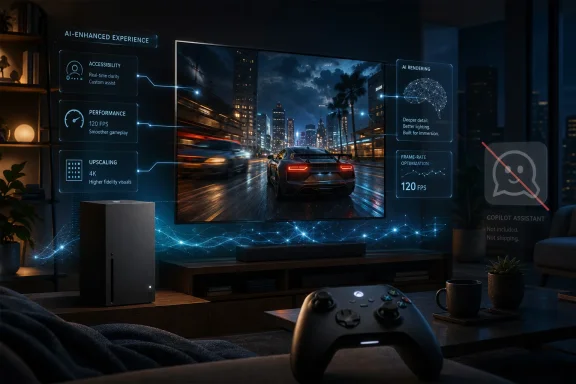
Xbox CEO Asha Sharma has said Microsoft stopped developing Copilot for Xbox consoles in 2026 because console players were not interested in the experience and because the feature did not solve a clear gaming problem. That answer matters because it cuts against Microsoft’s broader corporate instinct to put Copilot everywhere. It also gives Xbox, a brand that has spent years blurring its own hardware identity, a rare moment of product discipline. The company is not rejecting AI; it is admitting that AI as a feature and AI as a solution are not the same thing.
For the last two years, Microsoft’s AI story has often sounded less like product strategy than weather: Copilot is coming, and everyone should prepare accordingly. It came to Windows, Microsoft 365, Edge, GitHub, security tools, developer workflows, and eventually the Xbox conversation. The logic was simple enough from Redmond’s altitude: if Copilot is the new interface layer for computing, then gaming should not be exempt.
But consoles are not general-purpose productivity machines, no matter how many apps they can run. A console is a controlled environment built around immediacy, immersion, and muscle memory. The best console features disappear into the flow; the worst ones ask the player to stop, read, authorize, respond, configure, or listen when they came to play.
That is why Sharma’s explanation lands harder than the usual “we’re always evaluating priorities” corporate fog. She did not merely say the schedule changed. She said Xbox console players were not excited about that experience, and that if Microsoft ships AI for gaming, it needs to solve a problem.
That sounds obvious. It is not how the AI boom has usually behaved.
The difficulty is that gaming help is not a generic knowledge task. It is contextual, time-sensitive, spoiler-sensitive, platform-sensitive, and often dependent on what the player has already done in a mutable world state. A bad answer in Word is annoying. A bad answer in a boss fight is dead air. A clumsy answer in a mystery game can ruin the thing the player paid to uncover.
The console version had an even narrower target to hit. If the assistant interrupts the game, it is intrusive. If it requires the player to pause, dictate, wait, and parse a response, it competes with a web search, a YouTube walkthrough, a Discord friend, or simply trying again. If it offers shallow tips, players will dismiss it as noise. If it offers deep guidance, developers and players will worry about spoilers, balance, and authorship.
The feature therefore needed to be uncannily good from day one. “Interesting” was not enough. “On-brand for Microsoft” was not enough. “AI-driven sidekick” was not enough.
That does not make her anti-AI. Her comments point in the opposite direction. Sharma talked approvingly about neural rendering, upscaling, and AI systems that could reduce device footprint while improving graphics. In other words, she distinguished between AI that sits in front of the player and AI that works underneath the experience.
That distinction is the whole story. Console players may not want a chatbot perched beside a game, but they will happily accept better frame rates, cleaner image reconstruction, smarter compression, faster development tools, more responsive matchmaking, and accessibility features that actually help. Nobody objects to machine learning when it makes the thing they already wanted work better. They object when it feels like a corporate initiative wearing a gamer headset.
Sharma’s “it was an Xbox decision” line is also important. Microsoft CEO Satya Nadella has been explicit about Copilot as a company-wide strategic layer. For Xbox to carve out an exception suggests either real autonomy or a belated recognition that gaming cannot be managed like another Office surface.
What they do not accept is friction that arrives without payoff. The console bargain is brutally clear. The user gives up some flexibility compared with a PC in exchange for a machine that behaves predictably. Anything that makes the console feel more like a notification platform, a smart speaker, or a productivity dashboard has to justify itself.
Copilot for console faced a trust deficit before it even launched. Microsoft has trained Windows users to expect AI surfaces to appear as much because they serve Microsoft’s roadmap as because they serve the user’s immediate need. Xbox players, meanwhile, have spent years watching the brand redefine itself from console platform to subscription service to cloud endpoint to “everything is an Xbox” ecosystem. Into that anxiety, an AI companion did not read as help. It read as another sign that the console was no longer the center of the story.
That perception may be unfair in parts, but product strategy has to deal with perception as a real constraint. A feature that needs enthusiasm cannot launch into a room full of suspicion and expect adoption to fix the narrative.
Microsoft has every reason to care about that. Xbox hardware has to compete not only with PlayStation, but with PCs, handhelds, cloud devices, and televisions that increasingly blur the boundaries of where games run. If AI can help a lower-power box produce better images, reduce storage bloat, improve latency, or make development cheaper, that is a strategic advantage.
This is where the Copilot brand may have been a liability. “Copilot” now carries baggage. It implies a conversational agent, an assistant, a pane, a button, a subscription tier, a prompt box. But some of the most important AI work in gaming will not look like Copilot at all. It will look like a game holding 60 frames per second more reliably, a handheld lasting longer on battery, or an accessibility system describing visual chaos to a player who needs it.
The irony is that the strongest AI argument for Xbox may require Microsoft to stop talking about AI as the product.
AI could be useful there. It could help automate repetitive development tasks, test more configurations, identify performance regressions, improve localization workflows, generate internal documentation, and help studios deal with increasingly complex content pipelines. These are not glamorous features for a showcase trailer, but they solve real problems.
The risk, of course, is that “AI for developers” can become its own euphemism for fewer workers, rougher creative processes, or lower-quality content. Players are already sensitive to the smell of algorithmic filler. If Xbox leans into AI as a production tool, it will need to show that the result is better games, not cheaper sludge.
That is the tightrope Sharma now walks. Killing console Copilot buys credibility only if Xbox spends that credibility on useful changes. If the company merely moves AI from the front end to the back office and then ships thinner experiences, players will notice.
Xbox cannot afford to behave that way. The console business is more emotionally loaded than Windows. People do not merely use a console; they buy into a library, a controller, a social graph, a set of rituals, and a promise that their machine will remain a good place to play. When that promise feels subordinated to a corporate mandate, the backlash is sharper.
That is why this cancellation has symbolic weight beyond Copilot itself. It is a case where Microsoft apparently looked at a cross-company strategic priority and allowed a product team to say: not here, not like this.
If that becomes a pattern, it would mark a healthier Microsoft. If it remains a one-off, it will be remembered as a brief moment of restraint before the next assistant arrives with a friendlier name.
In that context, Sharma’s move is smart but insufficient. Saying no to an unwanted AI assistant is easier than articulating what the Xbox console is for in 2026 and beyond. If the answer is simply “one endpoint among many,” console players will hear demotion. If the answer is “the best living-room Xbox experience,” Microsoft has to prove that with exclusive features, performance, reliability, and a library strategy that does not make the box feel optional.
Copilot failed the problem test. Now the console itself has to pass it.
That means the next Xbox pitch cannot be a slogan. It has to be material. Players will want to see why buying Xbox hardware gives them a better experience than using a PC, a handheld, a TV app, or a PlayStation that increasingly receives Microsoft-published games. AI may support that answer, but it cannot substitute for it.
For WindowsForum readers, the lesson extends beyond Xbox. Microsoft’s AI push is not going away, and neither is Copilot as a corporate brand. But the Xbox reversal shows that even inside Microsoft, product fit can still beat platform orthodoxy.
 Xbox Finally Found a Place Where Copilot Could Not Win by Default
For the last two years, Microsoft’s AI story has often sounded less like product strategy than weather: Copilot is coming, and everyone should prepare accordingly. It came to Windows, Microsoft 365, Edge, GitHub, security tools, developer workflows, and eventually the Xbox conversation. The logic was simple enough from Redmond’s altitude: if Copilot is the new interface layer for computing, then gaming should not be exempt.But consoles are not general-purpose productivity machines, no matter how many apps they can run. A console is a controlled environment built around immediacy, immersion, and muscle memory. The best console features disappear into the flow; the worst ones ask the player to stop, read, authorize, respond, configure, or listen when they came to play.
That is why Sharma’s explanation lands harder than the usual “we’re always evaluating priorities” corporate fog. She did not merely say the schedule changed. She said Xbox console players were not excited about that experience, and that if Microsoft ships AI for gaming, it needs to solve a problem.
That sounds obvious. It is not how the AI boom has usually behaved.
The Sidekick Pitch Was Always Stronger in a Demo Than on a Couch
Microsoft’s original pitch for Copilot in gaming had a familiar shape: an AI companion that could recommend games, help players return to an old save, coach them through difficult moments, and surface relevant information without a trip to a search engine or wiki. On paper, that is not absurd. Anyone who has returned to a 90-hour RPG after six months knows the feeling of staring at a quest log as if it were written by a previous civilization.The difficulty is that gaming help is not a generic knowledge task. It is contextual, time-sensitive, spoiler-sensitive, platform-sensitive, and often dependent on what the player has already done in a mutable world state. A bad answer in Word is annoying. A bad answer in a boss fight is dead air. A clumsy answer in a mystery game can ruin the thing the player paid to uncover.
The console version had an even narrower target to hit. If the assistant interrupts the game, it is intrusive. If it requires the player to pause, dictate, wait, and parse a response, it competes with a web search, a YouTube walkthrough, a Discord friend, or simply trying again. If it offers shallow tips, players will dismiss it as noise. If it offers deep guidance, developers and players will worry about spoilers, balance, and authorship.
The feature therefore needed to be uncannily good from day one. “Interesting” was not enough. “On-brand for Microsoft” was not enough. “AI-driven sidekick” was not enough.
Sharma’s First Big AI Call Was to Say No
The politics of the decision are almost as interesting as the product decision. Sharma arrived at Xbox from Microsoft’s CoreAI world, which made many players assume she would accelerate, not restrain, AI features inside the platform. Instead, one of her first defining moves was to wind down Copilot on mobile and stop console development.That does not make her anti-AI. Her comments point in the opposite direction. Sharma talked approvingly about neural rendering, upscaling, and AI systems that could reduce device footprint while improving graphics. In other words, she distinguished between AI that sits in front of the player and AI that works underneath the experience.
That distinction is the whole story. Console players may not want a chatbot perched beside a game, but they will happily accept better frame rates, cleaner image reconstruction, smarter compression, faster development tools, more responsive matchmaking, and accessibility features that actually help. Nobody objects to machine learning when it makes the thing they already wanted work better. They object when it feels like a corporate initiative wearing a gamer headset.
Sharma’s “it was an Xbox decision” line is also important. Microsoft CEO Satya Nadella has been explicit about Copilot as a company-wide strategic layer. For Xbox to carve out an exception suggests either real autonomy or a belated recognition that gaming cannot be managed like another Office surface.
Console Players Are Not Anti-Technology; They Are Anti-Friction
The easiest misread is to frame this as gamers rejecting AI because they are hostile to change. That is too convenient. Console players have accepted enormous technical shifts when the benefit was obvious: SSD-based loading, quick resume, variable refresh rate, cloud saves, cross-play, spatial audio, dynamic resolution, and increasingly sophisticated reconstruction techniques.What they do not accept is friction that arrives without payoff. The console bargain is brutally clear. The user gives up some flexibility compared with a PC in exchange for a machine that behaves predictably. Anything that makes the console feel more like a notification platform, a smart speaker, or a productivity dashboard has to justify itself.
Copilot for console faced a trust deficit before it even launched. Microsoft has trained Windows users to expect AI surfaces to appear as much because they serve Microsoft’s roadmap as because they serve the user’s immediate need. Xbox players, meanwhile, have spent years watching the brand redefine itself from console platform to subscription service to cloud endpoint to “everything is an Xbox” ecosystem. Into that anxiety, an AI companion did not read as help. It read as another sign that the console was no longer the center of the story.
That perception may be unfair in parts, but product strategy has to deal with perception as a real constraint. A feature that needs enthusiasm cannot launch into a room full of suspicion and expect adoption to fix the narrative.
The Better AI Story Is Invisible
Sharma’s comments about neural rendering point to the more plausible future for AI on Xbox. The next generation of game hardware will be defined less by raw silicon jumps and more by how intelligently systems can generate, reconstruct, stream, compress, and schedule work. Nvidia’s DLSS has already made the case on PC: players may argue about artifacts and implementation quality, but the appeal of higher apparent resolution and better performance is self-evident.Microsoft has every reason to care about that. Xbox hardware has to compete not only with PlayStation, but with PCs, handhelds, cloud devices, and televisions that increasingly blur the boundaries of where games run. If AI can help a lower-power box produce better images, reduce storage bloat, improve latency, or make development cheaper, that is a strategic advantage.
This is where the Copilot brand may have been a liability. “Copilot” now carries baggage. It implies a conversational agent, an assistant, a pane, a button, a subscription tier, a prompt box. But some of the most important AI work in gaming will not look like Copilot at all. It will look like a game holding 60 frames per second more reliably, a handheld lasting longer on battery, or an accessibility system describing visual chaos to a player who needs it.
The irony is that the strongest AI argument for Xbox may require Microsoft to stop talking about AI as the product.
Developers Needed Tools More Than Players Needed a Companion
There is another audience in this decision: developers. Sharma has said Xbox is re-evaluating its approach to exclusivity, windowing, and AI. That triad matters because Xbox’s biggest problems are not limited to consumer-facing features. They include developer economics, porting complexity, content cadence, hardware constraints, certification workflows, and the challenge of making Game Pass, console sales, PC releases, and rival-platform launches coexist without confusing everyone.AI could be useful there. It could help automate repetitive development tasks, test more configurations, identify performance regressions, improve localization workflows, generate internal documentation, and help studios deal with increasingly complex content pipelines. These are not glamorous features for a showcase trailer, but they solve real problems.
The risk, of course, is that “AI for developers” can become its own euphemism for fewer workers, rougher creative processes, or lower-quality content. Players are already sensitive to the smell of algorithmic filler. If Xbox leans into AI as a production tool, it will need to show that the result is better games, not cheaper sludge.
That is the tightrope Sharma now walks. Killing console Copilot buys credibility only if Xbox spends that credibility on useful changes. If the company merely moves AI from the front end to the back office and then ships thinner experiences, players will notice.
This Is Also a Reversal of Microsoft’s Worst Platform Habit
Microsoft’s worst platform habit is not ambition. It is bundling ambition into places where users did not ask for it, then treating resistance as a communications problem. Windows users have seen this with account prompts, Edge nudges, Teams integrations, widgets, ads, backup nags, and AI buttons that arrive before the value proposition is settled.Xbox cannot afford to behave that way. The console business is more emotionally loaded than Windows. People do not merely use a console; they buy into a library, a controller, a social graph, a set of rituals, and a promise that their machine will remain a good place to play. When that promise feels subordinated to a corporate mandate, the backlash is sharper.
That is why this cancellation has symbolic weight beyond Copilot itself. It is a case where Microsoft apparently looked at a cross-company strategic priority and allowed a product team to say: not here, not like this.
If that becomes a pattern, it would mark a healthier Microsoft. If it remains a one-off, it will be remembered as a brief moment of restraint before the next assistant arrives with a friendlier name.
The Xbox Brand Still Has a Bigger Identity Problem
The Copilot reversal does not solve Xbox’s larger dilemma. The brand is still trying to reconcile hardware loyalty with platform ubiquity. It wants console players to feel valued while also expanding to PC, cloud, mobile, and rival consoles. It wants Game Pass to remain central without letting the subscription define every purchasing decision. It wants to promise future hardware while telling players that almost any screen can be an Xbox.In that context, Sharma’s move is smart but insufficient. Saying no to an unwanted AI assistant is easier than articulating what the Xbox console is for in 2026 and beyond. If the answer is simply “one endpoint among many,” console players will hear demotion. If the answer is “the best living-room Xbox experience,” Microsoft has to prove that with exclusive features, performance, reliability, and a library strategy that does not make the box feel optional.
Copilot failed the problem test. Now the console itself has to pass it.
That means the next Xbox pitch cannot be a slogan. It has to be material. Players will want to see why buying Xbox hardware gives them a better experience than using a PC, a handheld, a TV app, or a PlayStation that increasingly receives Microsoft-published games. AI may support that answer, but it cannot substitute for it.
The Retreat From Copilot Gives Xbox a Cleaner Test
The most concrete reading of Sharma’s decision is that Xbox is narrowing its AI ambitions around usefulness. That is the right filter, and it gives players and administrators a simple way to judge what comes next. If a feature improves performance, accessibility, preservation, discovery, moderation, or development quality, it deserves a hearing. If it merely adds a conversational layer because the rest of Microsoft has one, it should stay in the lab.For WindowsForum readers, the lesson extends beyond Xbox. Microsoft’s AI push is not going away, and neither is Copilot as a corporate brand. But the Xbox reversal shows that even inside Microsoft, product fit can still beat platform orthodoxy.
The Console Copilot That Never Shipped Leaves a Useful Paper Trail
The practical takeaways are narrower than the online argument, but they are also more durable. Xbox did not swear off AI. It backed away from a specific assistant experience that lacked demand on consoles.- Microsoft has stopped developing Gaming Copilot for Xbox consoles and is winding down the mobile version, according to Sharma’s public comments.
- Sharma framed the decision as a product-fit call, saying console players were not excited by the assistant experience.
- Xbox is still interested in AI where it improves gaming fundamentals, especially areas such as neural rendering and upscaling.
- The decision suggests Xbox may have more room to diverge from Microsoft’s company-wide Copilot push than many players assumed.
- The next test is whether Microsoft applies the same “solve a problem” standard to subscriptions, hardware strategy, storefront design, and cross-platform publishing.
References
- Primary source: Video Games Chronicle
Published: Fri, 05 Jun 2026 09:24:17 GMT
‘Our console players aren’t excited about that’: Xbox CEO Asha Sharma says it ditched Copilot because it didn’t solve a problem | VGC
AI tools like neural rendering are still “a great opportunity”…www.videogameschronicle.com - Related coverage: windowscentral.com
Xbox games chief confirms Microsoft will show its titles are coming to PS5, other platforms at the Xbox Games Showcase — Xbox's CEO responds to controversy [UPDATED] | Windows Central
Microsoft will broadcast multiplatform availability during the Xbox Games Showcase, frustrating fans.www.windowscentral.com - Related coverage: bloomberg.com
- Related coverage: tomshardware.com
Xbox announces 'Copilot for Gaming' AI assistant — early access coming to Xbox mobile app, more details to come at GDC 2025 | Tom's Hardware
Microsoft turns Copilot into an actual copilotwww.tomshardware.com - Related coverage: news.xbox.com
Your Personal Gaming Sidekick Awaits: Gaming Copilot (Beta) is Coming to Windows PC and Xbox on Mobile - XBOX Wire
Gaming Copilot – which provides recommendations, help, insights, and more – is officially coming to Windows PC and Xbox on mobile in October.news.xbox.com - Related coverage: gamespot.com
Gaming Copilot AI Assistant Is Coming To Current-Gen Xbox Consoles This Year - GameSpot
The chatbot assistant has been in a beta state on PC and mobile.www.gamespot.com
- Related coverage: gematsu.com
Microsoft Gaming CEO Phil Spencer retires, Xbox president Sarah Bond resigns [Update] - Gematsu
Microsoft Gaming CEO Phil Spencer will retire effective February 23, and Xbox president and chief operating officer Sarah Bond has resigned…www.gematsu.com - Related coverage: techcrunch.com
Xbox debuts a new AI-powered gaming companion for mobile users | TechCrunch
Ahead of the Game Developers Conference (GDC), Xbox revealed on Thursday that it’s experimenting with an AI-powered gaming sidekick. "Copilot for Gaming," Xbox's "Copilot for Gaming" is a voice-activated assistant that can answer game-related questions and act as a sidekicktechcrunch.com - Related coverage: gadgets360.com
Microsoft’s Gaming Copilot AI Assistant is Coming to Current-Generation Xbox Consoles in 2026: Report | Technology News
Microsoft is reportedly planning to expand its Gaming Copilot AI assistant to the current generation consoles this year.www.gadgets360.com - Related coverage: gamesradar.com
Xbox just revealed Gaming Copilot is coming to "current-generation consoles" later this year | GamesRadar+
We will continue to bring it to more services that players are playingwww.gamesradar.com - Related coverage: pcgamer.com
New Xbox boss promises no 'soulless AI slop' after moving over from Microsoft's CoreAI products division | PC Gamer
"We will not chase short-term efficiency or flood our ecosystem with soulless AI slop," said Asha Sharma, the new CEO of Microsoft Gaming.www.pcgamer.com
