In a single, blunt turn of phrase — “The Xbox Is Now a PC. Every PC Is Now an Xbox” — the idea that Microsoft’s console and Windows strategies are merging stopped being industry rumor and started being a platform-level project that developers, OEMs, and players must reckon with. The line between living-room simplicity and PC openness has been blurring for years; at GDC 2026 Microsoft accelerated that convergence with three concrete moves: a rebrand and mass rollout of a controller‑first “Xbox Mode” for Windows 11 beginning in April, a new slate of DirectX and tooling features (notably Advanced Shader Delivery) to eliminate first‑run shader pain and smooth cross‑target builds, and Project Helix — a next‑generation Xbox platform explicitly positioned to “play your Xbox and PC games.” Those announcements reframe the Xbox brand not merely as a console family but as an entire Windows‑rooted gaming posture, and the implications are wide ranging for gamers, developers, and PC makers alike. rview
Microsoft’s push to collapse the distinction between console and PC has been incremental and strategic. Over the last several years, the company has layered Xbox services into Windows — Game Pass on PC, Play Anywhere cross-buy titles, and an evolving Xbox PC app that now aggregates games across third‑party launchers. That groundwork created the practical possibility of a single platform experience that could boot into a controller‑first shell while retaining Windows’ flexibility underneath.
What changed at GDC 2026 is that Microsoft moved this work from experimentation to rollout. The company formalized the Full Screen Experience (FSE) that debuted on partner handhelds into a system posture called Xbox Mode, scheduled to appear on eligible Windows 11 devices in a staged rollout beginning in April 2026. Microsoft also announced a suite of developer‑facing DirectX innovations (including Advanced Shader Delivery) and sketched the roadmap for Project Helix, its next console platform built around a custom AMD semi‑custom SoC — a device Microsoft says will “lead in performance and play your Xbox and PC games.” Those public signals are a coordinated strategy: align developer tooling, OS features, and hardware so that a single build can scale between PC and console realities.
Key headline attributes:
Why this matters:
Practical features of the aggregated Xbox PC app:
But adoption costs money and priority:
However, OEMs must also manage driver support, power profiles, and certification for Xbox Mode and for Project Helix compatibility. The pace of driver maturity — especially for newer features like FSR Next or path tracing on the GPU — will shape the rate of adoption.
That said, Microsoft’s current approach is aggregative rather than exclusive — the Xbox PC app launches third‑party clients and shows titles installed from them — which is materially different from a closed, exclusive storefront. The nuance will matter in any regulatory evaluation.
If Microsoft executes:
The pragmatic reader should treat April 2026 as a milestone rather than a destination: Xbox Mode’s rollout will be the test case for n operationalize this convergence. Project Helix remains a multi‑year story with developer alpha hardware expected in 2027 — an important signal, but not a retail launch guarantee. For now, the era of “console vs PC” is clearly over; the competitive question is whether a hybrid, Windows‑anchored platform delivers the best of both worlds, or the worst compromises of each.
But ambition does not guarantee success. The plan depends on software and silicon partners, anti‑cheat and middleware vendors, OEMs, and most importantly, developers adopting the new workflows. The early months of deployment — starting with Xbox Mode’s staged rollout in April 2026 and continuing through alpha Project Helix dev kits in 2027 — will determine whether Microsoft’s hybrid vision becomes the new default for gaming or remains a contentious, optional layer on top of Windows.
Readers should expect incremental improvement in the short term and substantive platform shifts over the next 18–36 months. For now, the most accurate headline is this: Microsoft has reshaped the conversation — Xbox is no longer simply a console family. It’s an operating posture for Windows that promises the simplicity of a living‑room experience and the flexibility of a PC, and whether that promise materializes will depend on execution across software, drivers, silicon, and ecosystem trust.
Source: Gizmodo The Xbox Is Now a PC. Every PC Is Now an Xbox
Microsoft’s push to collapse the distinction between console and PC has been incremental and strategic. Over the last several years, the company has layered Xbox services into Windows — Game Pass on PC, Play Anywhere cross-buy titles, and an evolving Xbox PC app that now aggregates games across third‑party launchers. That groundwork created the practical possibility of a single platform experience that could boot into a controller‑first shell while retaining Windows’ flexibility underneath.
What changed at GDC 2026 is that Microsoft moved this work from experimentation to rollout. The company formalized the Full Screen Experience (FSE) that debuted on partner handhelds into a system posture called Xbox Mode, scheduled to appear on eligible Windows 11 devices in a staged rollout beginning in April 2026. Microsoft also announced a suite of developer‑facing DirectX innovations (including Advanced Shader Delivery) and sketched the roadmap for Project Helix, its next console platform built around a custom AMD semi‑custom SoC — a device Microsoft says will “lead in performance and play your Xbox and PC games.” Those public signals are a coordinated strategy: align developer tooling, OS features, and hardware so that a single build can scale between PC and console realities.
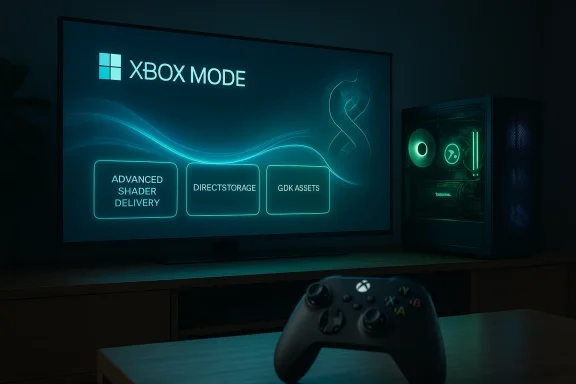 What Microsoft announced at GDC 2026
Xbox Mode (the new Full Screen Experience)
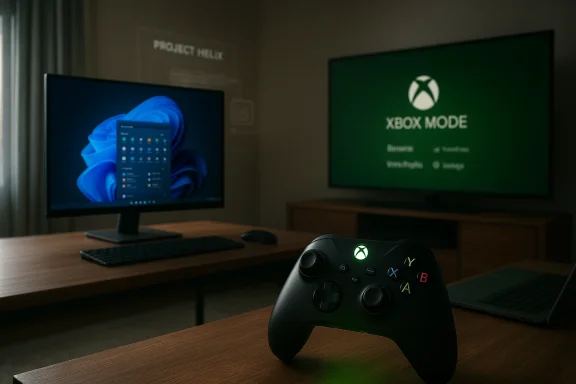
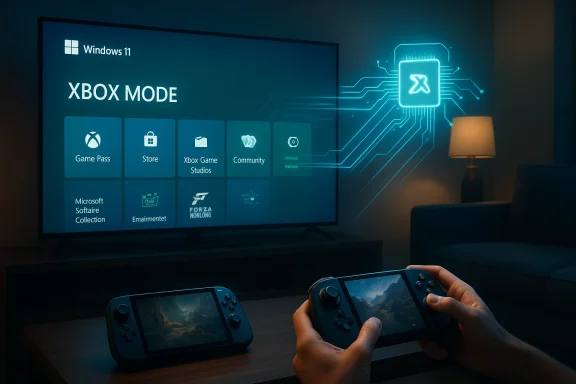
At its most visible, Microsoft announced that the Xbox Full Screen Experience — the controller‑first, simplified, full‑screen shell first seen on hardware like the ROG Xbox Ally handhelds — will be rebranded as Xbox Mode and rolled out to Windows 11 PCs starting in April 2026. Xbox Mode is a session posture layered on top of Windows that boots into the Xbox PC app, reduces desktop noise, and prioritizes controller navigation and quick game launch. Microsoft is positioning this as a “living‑room friendly” UX for laptops, desktops, tablets, and handhelds alike.Key headline attributes:
- Controller‑first navigation and a full‑screen launcher.
- Boots into the Xbox PC app and trims background desktop overhead.
- A staged, region‑by‑region rollout starting with Insiders and eligible OEM hardware in April 2026.
Developer tooling and DirectX innovations
GDC also saw DirectX and tooling updates designed to remove friction between PC and console targets. The most consequential is Advanced Shader Delivery (ASD) — a system for distributing precompiled shaders (or shader "packages") through storefronts to reduce first‑run shader compilation stutters and speed launch times. Microsoft framed this alongside other improvements like DirectStorage enhancements, asset conditioning libraries, and new DirectML features aimed at making multi‑device builds more predictable and performant. These changes directly address two of the most persistent annoyances for PC gamers: long load times and stuttering when shaders compile on the fly.Project Helix: the hardware pivot
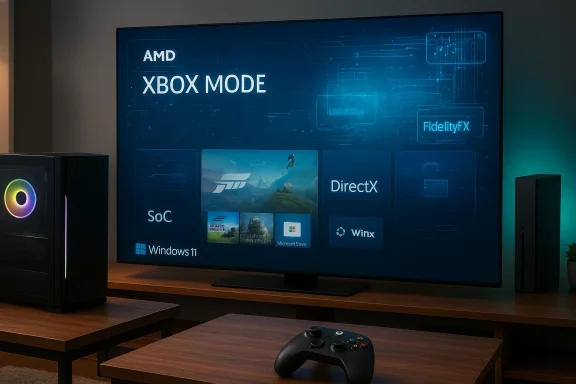
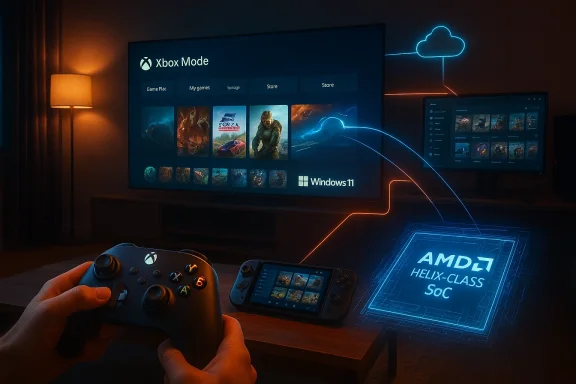
Finally, Microsoft confirmed the codename Project Helix for its next‑generation Xbox platform and explicitly described it as capable of running both Xbox and PC games. Microsoft’s leadership framed Project Helix around a custom AMD SoC, expanded ray‑tracing and path‑tracing ambitions, and a trajectory that includes shipping alpha developer hardware in 2027. The message to developers was clear: build first for PC (the flexible target) and the Xbox future will be an optimized point on that continuum. External reporting and Microsoft’s own messaging repeatedly emphasize the hardware and toolchain cohesion between Windows 11 and Project Helix.Xbox Mode explained: what it is and what it isn’t
The experience
Xbox Mode is intentionally narrow in scope: it’s a session posture — not a replacement OS. Booting into Xbox Mode presents a stripped‑down, console‑like interface whose job is to make game discovery and play fast and predictable. Expect:- A full‑screen launcher that surfaces Game Pass, installed titles, and a unified “My Library” view.
- Controller‑first navigation (think D‑pad and sticks as primary input).
- Reduced background process interference and OS noise while in the session.
What Xbox Mode won’t do (today)
- It will not remove the Windows desktop or make the machine a locked console that can’t be reverted.
- It will not force all third‑party PC storefronts to conform; rather, Microsoft is integrating discovery and launch via the Xbox PC app.
- It will not, on day one, magically fix compatibility edge cases for mods, anti‑cheat integrations, or legacy DRM titles — those remain the domain of developer work and ecosystem support.
Developer tooling: why Microsoft believes the future must be PC‑first
Game developers face a persistent dilemma: building for an enormous spectrum of PC hardware is expensive and unpredictable, while building for consoles yields tight, optimized performance but narrower platform reach. Microsoft’s pitch at GDC was tactical: make Windows "console‑friendly" by reducing variability and signaling a PC‑first workflow that doubles as an Xbox optimization target.Advanced Shader Delivery (ASD)
ASD is the flagship technical answer to one of PC gaming’s most visible pain points — shader compilation stutter. The idea is simple in principle: distribute precompiled shader packages with game installs so the runtime doesn’t need to compile complex shaders on first run. Microsoft wants storefronts and publishers to ship the right shader sets to the device ahead of time, improving startup times and smoothing framerate during early play sessions.Why this matters:
- Faster time‑to‑play for the end user.
- Predictable performance profiles across hardware classes.
- Reduced support burden for developers chasing shader‑related bug reports.
Other platform features
- DirectStorage improvements that further reduce load times by streamlining GPU<->storage paths.
- DirectML primitives and ML‑assisted rendering calls designed to make neural denoising, upscaling, and content streaming more consistent across devices.
- Tooling & certification hooks to help verify compatibility across the Windows‑to‑Xbox continuum.
Xbox PC app and the aggregation of PC storefronts
A less overt but equally consequential change is the continued expansion of the Xbox PC app as an aggregated gaming hub. The app has moved from a Game Pass storefront to a one‑stop launcher that can discover and launch games installed through Steam, Epic, GOG, Battle.net, and other launchers. Microsoft’s updates create a single "My Library" experience that reduces friction for users who otherwise must juggle multiple clients.Practical features of the aggregated Xbox PC app:
- Auto‑discovery of installed titles from supported storefronts.
- A "My Apps" area that lists third‑party launchers for one‑click access.
- Integrated Game Pass management, cloud saves indicator, and hybrid local/cloud install options.
Project Helix: what we know, and what remains speculative
Confirmed and near‑confirmed facts
- Codename: Project Helix. Microsoft has publicly used the name in executive communications and GDC presentations.
- Positioning: Microsoft explicitly framed Project Helix as hardware that will “lead in performance” and be able to run both Xbox and PC games, signaling a hybrid identity rather than a closed console silo.
- Partnered silicon: Microsoft confirmed continued partnership with AMD on a semi‑custom SoC for the platform, and AMD has publicly referenced collaboration on next‑generation console silicon.
- Timeline signals: Microsoft stated plans to distribute alpha developer hardware in 2027, which industry reporting correctly interprets as developer dev‑kits being made available then. That makes a 2028 retail target plausible but not guaranteed.
What remains uncertain or unverifiable
- Exact performance targets and final hardware configurations (core counts, GPU RDNA generation, or dedicated accelerators) remain under NDA; Microsoft’s public messaging focuses on capability and philosophy rather than raw specs.
- Pricing, final retail launch date, and SKU strategy (locked console vs. configurable Windows image) are not confirmed. Any specific retail timeline beyond developer alpha shipments in 2027 should be treated as speculative.
- How “PC‑like” Project Helix will be in practice: will it ship as a locked experience that can “exit to Windows,” or as a Windows 11 machine with a default Xbox shell? Microsoft’s messaging suggests the latter is conceptually possible, but final productization choices are not fully disclosed and may vary by OEM and partner decisions. Flag: unverifiable at present.
Why this matters: implications for players, developers, and OEMs
For players: convenience, but also new tradeoffs
Players will see immediate benefits from Microsoft’s plan:- Faster time to play thanks to ASD and DirectStorage improvements.
- Easier discovery across multiple stores via the Xbox PC app.
- A console‑like option on PCs when using a controller and TV.
- A console‑first UX on PCs could reduce transparency for some power users who prefer granular control over updates, shader compilation, and mod workflows.
- Compatibility and anti‑cheat concerns remain sticky; developer adoption of new tools takes time, and some legacy or niche titles may behave differently in Xbox Mode.
- Aggregation of discovery into one branded shell concentrates platform power and raises questions about neutrality for competing store owners.
For developers: a simpler target — if they opt in
Developers get a clear promise: if you adopt the GDK and deliver conditioned assets (precompiled shaders, targeted assets for Project Helix profiles), your game can run across a much wider set of hardware while delivering consistent quality. That reduces engineering churn and long tail support.But adoption costs money and priority:
- Studios must invest in the new ASD pipeline and in testing across the Windows‑to‑Helix spectrum.
- Middleware and anti‑cheat vendors must support Windows on Arm, ASD, and other changes.
- Publishers must decide whether the benefits justify the integration work for titles that will ship across many platforms.
For OEMs and hardware partners
Xbox Mode changes how OEMs can present a PC to consumers. A laptop or mini‑PC can now offer a living‑room optimized experience without changing the underlying OS. That’s an opportunity for OEMs to ship devices marketed as “Xbox‑ready” PCs or even create Helix‑compatible mini‑consoles.However, OEMs must also manage driver support, power profiles, and certification for Xbox Mode and for Project Helix compatibility. The pace of driver maturity — especially for newer features like FSR Next or path tracing on the GPU — will shape the rate of adoption.
Risks, regulatory angles, and competitive dynamics
Platform concentration & antitrust optics
Microsoft’s move to aggregate discovery and push a branded gaming posture across Windows raises natural competitive questions. Consolidating launch flows into the Xbox PC app increases Microsoft’s influence over who gets surfaced and how monetization flows through Game Pass and the Microsoft ecosystem. Regulators in major markets are paying closer attention to platform gatekeeping behaviors, and this consolidation could draw scrutiny if it disadvantages rival storefronts or erects barriers for smaller publishers.That said, Microsoft’s current approach is aggregative rather than exclusive — the Xbox PC app launches third‑party clients and shows titles installed from them — which is materially different from a closed, exclusive storefront. The nuance will matter in any regulatory evaluation.
Technical and ecosystem risks
- Anti‑cheat and DRM compatibility: new shader delivery systems and runtime changes can break or complicate anti‑cheat integrations. Microsoft will need to coordinate closely with vendors to avoid fragmenting the ecosystem.
- Windows on Arm: while Xbox’s move supports Arm Windows through native Xbox app builds, the broader PC ecosystem (drivers and anti‑cheat on Arm) remains an ongoing engineering effort. Progress here bolsters Microsoft’s thesis but is not a guaranteed, instant win.
Competitive reaction
Sony and Valve (and to a lesser extent Nintendo for first‑party IP) will observe Microsoft’s convergence strategy closely. Sony may double down on exclusive content and PlayStation’s locked‑down performance model, while Valve will push its desktop freedoms and Steam’s ecosystem. Microsoft’s advantage is breadth: if it can create a low‑friction path for developers to target one PC‑first workflow and have it run on Xbox hardware, the industry economics shift in Microsoft’s favor. But that advantage depends on developer buy‑in and execution across multiple partners and vendors.Practical advice for players and PC enthusiasts
- Try Xbox Mode as an optional session: treat it like a console skin. If you prefer desktop control for mods, dev tools, or PC‑only utilities, continue using the standard Windows session.
- Watch driver and anti‑cheat updates closely after April 2026. Early rollouts can reveal compatibility quirks.
- If you’re an explorer of new hardware (Arm laptops, handhelds), check which titles are supported natively and which still rely on streaming — the native Xbox PC app on Arm widens options but does not guarantee every title will run locally.
- Evaluate ASD and asset‑conditioning pipelines early. If you want to ship on both PC and Project Helix, plan for the ASD workflow.
- Coordinate with middleware and anti‑cheat vendors before committing to big architecture changes.
- Use alpha dev kits (when they become available in 2027) to begin profiling and optimizing. Shipping early builds on alpha hardware helps ensure your title looks and performs as intended on both PC and future Helix consoles.
Strengths and potential blind spots in Microsoft’s strategy
Notable strengths
- Cohesive platform vision: aligning OS features, developer tools, and hardware reduces fragmentation for developers and can significantly improve player experience if executed well.
- Real, tangible fixes for major PC problems: ASD and DirectStorage improvements directly target start‑up time and shader stutter, two complaints that have persisted for a decade.
- Leveraging scale: Microsoft can push these changes because it controls a large installed base of Windows 11 PCs, the Xbox Game Pass ecosystem, and a deep relationship with AMD to iterate on silicon.
Potential risks and blind spots
- Execution complexity: delivering a consistent experience across millions of different Windows hardware configurations is technically hard and will require years of driver and middleware maturity.
- Ecosystem coordination: success depends on buy‑in from storefronts, anti‑cheat vendors, and middleware. If those partners move slowly, the user experience suffers.
- Regulatory and competitive backlash: the more Microsoft consolidates discovery and platform control, the more likely it is to attract scrutiny from watchdogs and pushback from competitors.
The take: what this means for Windows gaming long‑term
Microsoft’s GDC package — Xbox Mode on Windows 11, Advanced Shader Delivery and a broader DirectX/devtool push, plus the nascent Project Helix hardware story — is more than marketing. It’s an engineering bet that the optimal path forward for big‑budget games is a PC‑first development model that can be tuned into a consistent console experience where appropriate.If Microsoft executes:
- Players get faster, more predictable launches and an easier path to play across devices.
- Developers get a single, more maintainable target that reduces the marginal cost of supporting multiple platforms.
- OEMs and partners can ship devices with built‑in living‑room play modes that lower friction for console‑style gaming on PCs.
The pragmatic reader should treat April 2026 as a milestone rather than a destination: Xbox Mode’s rollout will be the test case for n operationalize this convergence. Project Helix remains a multi‑year story with developer alpha hardware expected in 2027 — an important signal, but not a retail launch guarantee. For now, the era of “console vs PC” is clearly over; the competitive question is whether a hybrid, Windows‑anchored platform delivers the best of both worlds, or the worst compromises of each.
Conclusion
Microsoft’s recent moves — turning the Xbox Full Screen Experience into a first‑class Xbox Mode on Windows 11, shipping developer tools like Advanced Shader Delivery, and naming Project Helix as the future hardware anchor — collectively make a compelling case that Xbox and Windows gaming are entering a unified phase. That convergence promises real improvements: shorter load times, less shader stutter, easier discovery, and a single developer workflow that scales between PC variety and console predictability.But ambition does not guarantee success. The plan depends on software and silicon partners, anti‑cheat and middleware vendors, OEMs, and most importantly, developers adopting the new workflows. The early months of deployment — starting with Xbox Mode’s staged rollout in April 2026 and continuing through alpha Project Helix dev kits in 2027 — will determine whether Microsoft’s hybrid vision becomes the new default for gaming or remains a contentious, optional layer on top of Windows.
Readers should expect incremental improvement in the short term and substantive platform shifts over the next 18–36 months. For now, the most accurate headline is this: Microsoft has reshaped the conversation — Xbox is no longer simply a console family. It’s an operating posture for Windows that promises the simplicity of a living‑room experience and the flexibility of a PC, and whether that promise materializes will depend on execution across software, drivers, silicon, and ecosystem trust.
Source: Gizmodo The Xbox Is Now a PC. Every PC Is Now an Xbox