

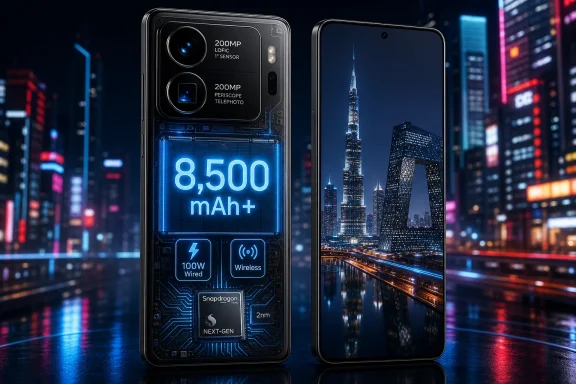
Xiaomi’s rumored 18 Pro Max is being tipped for a China debut in September 2026 with an 8,000mAh-plus battery, 100W wired charging, wireless charging, a next-generation Snapdragon-class chip, and dual 200MP camera hardware, according to leak reporting from GSMArena and Weibo tipster Digital Chat Station. If accurate, the leak marks another sharp escalation in China’s flagship-phone battery race. It also underlines how quickly the premium Android spec sheet is moving away from the assumptions that shaped the iPhone, Galaxy, and Pixel era of 4,500mAh-to-5,500mAh “all-day” phones.
For years, the smartphone arms race was easy to narrate: faster chips, brighter screens, bigger camera sensors, thinner bezels. Battery capacity mattered, but it rarely led the marketing story at the high end because big batteries fought against thinness, weight, thermals, charging speed, and certification logistics. The newest Xiaomi 18 Pro Max leak suggests that balance is changing.
GSMArena reports that Digital Chat Station has claimed Xiaomi’s next Pro Max flagship will exceed 8,000mAh, with other reports around the same leak cycle pointing to an engineering target closer to 8,500mAh. Either number would be enormous for a mainstream premium slab phone, especially one also expected to carry a large 2K-class display, a 2nm flagship chipset, and elaborate camera hardware.
The context matters. Xiaomi’s 17 Pro Max already pushed the category forward with a 7,500mAh battery in China, according to launch coverage from outlets including Android Central and Omdia’s smartphone market reporting. Moving from 7,500mAh to something above 8,000mAh would not be a gimmick jump from a small base; it would be Xiaomi trying to normalize tablet-adjacent battery capacity in a pocketable flagship.
That is the real story here. The old flagship bargain asked buyers to accept nightly charging as the cost of cutting-edge silicon and optics. Xiaomi appears to be betting that buyers would rather have a phone that is slightly denser, perhaps slightly heavier, and much harder to kill before bedtime.
That means the alleged Xiaomi 18 Pro Max battery is not a science-fiction leap. It is a continuation of a strategy Xiaomi is already using in China: make capacity a flagship feature, not a midrange compromise. Silicon-carbon battery chemistry has helped Chinese manufacturers squeeze more watt-hours into similar volumes, and Xiaomi has been one of the companies most willing to turn that into a headline specification.
The rumored 100W wired charging also fits Xiaomi’s established pattern. Chinese-market flagships have long treated fast charging as a competitive differentiator, while Apple, Samsung, and Google have moved more cautiously. Whether that caution is framed as battery-health prudence, thermal management, regulatory conservatism, or ecosystem inertia, the practical result is the same: Chinese OEMs have made charging speed part of the daily-use argument.
Wireless charging is the interesting extra detail. A giant battery is useful, but a giant battery that still supports fast wired and wireless charging is a different proposition from a rugged niche phone or endurance handset. Xiaomi is reportedly trying to keep the Pro Max firmly in the luxury flagship lane, not spin it into a battery-bank curiosity.
Still, the direction is unsurprising. Xiaomi has repeatedly tried to be early with Qualcomm flagship silicon, and the Xiaomi 17 series was widely covered as one of the first homes for the Snapdragon 8 Elite Gen 5 generation. A September China launch for the Xiaomi 18 family would line up with the rhythm of late-year Android flagship platforms, even if final branding remains uncertain.
The battery story and chip story are linked. A more efficient process node can improve performance per watt, but flagship phones rarely spend that efficiency purely on battery life. Vendors usually convert some of it into higher peak performance, brighter displays, more AI processing, heavier camera pipelines, and always-on background features.
That is why an 8,000mAh-plus battery matters even if the chip becomes more efficient. The next premium phone is not merely running yesterday’s workload for longer. It is running more local AI, larger image-processing stacks, console-like gaming modes, satellite or enhanced modem features in some markets, and high-refresh displays that rarely stay idle in the way spec-sheet battery tests imagine.
LOFIC, short for lateral overflow integration capacitor, is a sensor design approach intended to improve dynamic range by handling more charge before highlights clip. In plain English, it is one of the ways phone-camera makers are trying to keep bright skies, neon signs, and backlit subjects from turning into blown-out mush. A high-resolution main camera with improved highlight handling would fit Xiaomi’s recent push to compete not just on megapixel bragging rights but on difficult-scene performance.
A 200MP periscope telephoto camera is equally telling. Telephoto hardware is where premium phones increasingly separate themselves from merely good phones, because long-range zoom demands sensor area, stabilization, lens complexity, and image-processing discipline. If Xiaomi is really pairing a huge battery with high-end dual 200MP camera modules, the company is not designing a conservative endurance flagship.
That combination also explains why capacity has become strategically important. Big sensors, 4K and 8K video, computational photography, burst processing, and AI-assisted editing all draw power. The more a phone becomes a camera workstation, gaming handheld, translation device, and local AI terminal, the less persuasive a traditional “all-day battery” claim becomes.
A flat large display is a conservative choice in the best sense. It suggests Xiaomi may be prioritizing practical handling over showroom drama, especially on a phone already expected to carry a large battery and serious camera hardware. If the Xiaomi 18 Pro Max lands near the 6.9-inch class suggested in prior leaks, ergonomics will be under pressure before any curve is added.
Slim bezels remain part of the premium visual language, but the industry has mostly exhausted the emotional value of shaving another fraction of a millimeter from the border. The more meaningful shift is that flagship design has become less obsessed with looking impossibly thin and more willing to carry visible functional tradeoffs. Bigger camera islands, larger batteries, and flatter panels all say the same thing: the glass rectangle has matured, and the fight is now about what it can sustain.
That is why the battery leak resonates. A huge cell is not just a component choice. It is evidence that Xiaomi thinks the flagship buyer’s priorities have changed.
That split is not unusual. Regulatory certification, shipping constraints, charger packaging rules, warranty expectations, carrier requirements, and regional pricing all affect what a company sells outside China. A global Xiaomi 18 Pro Max, if it appears, may not carry the same battery capacity as the domestic model. It may also arrive later, under slightly different branding, or with charging accessories and firmware behavior tailored to specific markets.
For enthusiasts, that creates a familiar frustration. The most exciting Chinese hardware often appears online months before Western buyers can buy it, and sometimes never arrives through official channels. Importing can solve the itch but introduces bands, warranty, language, payment, update, and Android Auto complications.
For the broader industry, however, the China-first nature of the leak does not make it irrelevant. Chinese flagship design has become a preview of pressure that eventually reaches global brands. Even when a particular Xiaomi model does not ship broadly, its spec sheet still changes what buyers perceive as technically possible.
This is where Chinese Android skins have a complicated reputation. They can be aggressive about background restrictions, which helps standby life but can frustrate users who rely on messaging, automation, cloud sync, or wearable integrations. Enthusiasts know the dance: disable battery optimization here, lock an app in memory there, hope the next update does not reset something important.
That tradeoff becomes more visible as batteries grow. If a phone has 8,500mAh but still kills background services too eagerly, the user experience can feel artificially constrained. Conversely, a large battery gives the vendor room to relax some power-saving rules and deliver a more PC-like multitasking experience.
That is an under-discussed opportunity. If phones are becoming local AI devices and pocket workstations, they need battery capacity not merely to last longer but to behave less nervously. A truly generous battery should let the operating system stop treating every background task as a threat.
A premium phone with a roughly 5,000mAh battery can still beat a larger-battery rival in some workloads if its silicon, modem, display, and software are more efficient. But consumers do not buy spreadsheets of normalized watt-hours. They see 5,000mAh next to 8,500mAh and understand the emotional pitch immediately.
Charging speed has the same problem. A carefully managed 30W or 45W charging curve may be healthier for a cell over years, but it is difficult to market against 100W wired charging when a buyer needs a rescue charge before leaving the house. Chinese vendors have trained their domestic market to expect speed, and that expectation travels.
The incumbents do have defensible reasons for caution. Battery longevity, heat, safety certification, support costs, and global consistency matter. But if Xiaomi and its peers keep proving that huge batteries and fast charging can coexist in high-end phones, conservative brands will have to explain why their restraint benefits the user rather than simply protecting old design priorities.
The modern phone is also more deeply tied into Windows workflows than it used to be. Microsoft Phone Link, passkeys, authenticator apps, mobile hotspot use, remote desktop sessions, Teams calls, OneDrive camera uploads, and mobile device management all turn a phone into part of the workday stack. Battery capacity therefore affects more than personal convenience.
For IT departments, large-battery Android flagships can reduce one category of user pain: the employee whose phone is dead before the last MFA prompt of the day. But they can introduce other concerns, including regional firmware differences, uncertain update cadence, app compatibility quirks, and procurement complexity if the most attractive models are China-only.
That is why the Xiaomi 18 Pro Max rumor is more than enthusiast bait. It points toward a future where mobile endurance becomes a productivity feature again, not just a spec for hikers and gamers. The question is whether enterprise software and device-management policies are ready for the messy variety of hardware that will deliver it.
The name itself also sits inside a fast-moving branding game. Xiaomi skipped from the 15 generation to the 17 series to align more directly with Apple’s iPhone numbering, a move that made the rivalry impossible to miss. A Xiaomi 18 Pro Max would continue that framing, turning the product name into a comparative ad before the spec sheet even begins.
Still, leaks are not only about predicting final hardware. They reveal what companies are testing, what supply chains can support, and what marketing teams think will resonate. In that sense, the battery rumor is already meaningful even if the final number lands below the highest claimed target.
If Xiaomi is testing an 8,000mAh-plus Pro Max with 100W wired charging, wireless charging, a flagship chip, and dual 200MP camera hardware, the company is telling the market what kind of phone it believes the premium buyer is ready to consider. That is the signal.
 Xiaomi Is Turning Battery Capacity Into the New Flagship Flex
For years, the smartphone arms race was easy to narrate: faster chips, brighter screens, bigger camera sensors, thinner bezels. Battery capacity mattered, but it rarely led the marketing story at the high end because big batteries fought against thinness, weight, thermals, charging speed, and certification logistics. The newest Xiaomi 18 Pro Max leak suggests that balance is changing.GSMArena reports that Digital Chat Station has claimed Xiaomi’s next Pro Max flagship will exceed 8,000mAh, with other reports around the same leak cycle pointing to an engineering target closer to 8,500mAh. Either number would be enormous for a mainstream premium slab phone, especially one also expected to carry a large 2K-class display, a 2nm flagship chipset, and elaborate camera hardware.
The context matters. Xiaomi’s 17 Pro Max already pushed the category forward with a 7,500mAh battery in China, according to launch coverage from outlets including Android Central and Omdia’s smartphone market reporting. Moving from 7,500mAh to something above 8,000mAh would not be a gimmick jump from a small base; it would be Xiaomi trying to normalize tablet-adjacent battery capacity in a pocketable flagship.
That is the real story here. The old flagship bargain asked buyers to accept nightly charging as the cost of cutting-edge silicon and optics. Xiaomi appears to be betting that buyers would rather have a phone that is slightly denser, perhaps slightly heavier, and much harder to kill before bedtime.
The Leak Is Plausible Because the 17 Pro Max Already Changed the Baseline
Rumors deserve skepticism, especially when they originate from pre-release Weibo posts filtered through translation, aggregation, and competitive fan communities. But this particular leak has a plausible foundation because Xiaomi has already demonstrated the direction of travel. The Xiaomi 17 Pro Max did not arrive with a conservative 5,000mAh cell; it reportedly shipped in China with a 7,500mAh battery, 100W wired charging, and 50W wireless charging.That means the alleged Xiaomi 18 Pro Max battery is not a science-fiction leap. It is a continuation of a strategy Xiaomi is already using in China: make capacity a flagship feature, not a midrange compromise. Silicon-carbon battery chemistry has helped Chinese manufacturers squeeze more watt-hours into similar volumes, and Xiaomi has been one of the companies most willing to turn that into a headline specification.
The rumored 100W wired charging also fits Xiaomi’s established pattern. Chinese-market flagships have long treated fast charging as a competitive differentiator, while Apple, Samsung, and Google have moved more cautiously. Whether that caution is framed as battery-health prudence, thermal management, regulatory conservatism, or ecosystem inertia, the practical result is the same: Chinese OEMs have made charging speed part of the daily-use argument.
Wireless charging is the interesting extra detail. A giant battery is useful, but a giant battery that still supports fast wired and wireless charging is a different proposition from a rugged niche phone or endurance handset. Xiaomi is reportedly trying to keep the Pro Max firmly in the luxury flagship lane, not spin it into a battery-bank curiosity.
The 2nm Chip Claim Is the Most Ambitious Part of the Spec Sheet
The leak also reiterates a next-generation 2nm chipset, likely Qualcomm’s upcoming Snapdragon 8 Elite Gen 6 Pro, according to GSMArena’s summary of the rumor. That detail should be treated carefully. Qualcomm’s exact naming, node strategy, and partner launch calendar remain moving targets until the company announces the platform, and phone-makers often attach early engineering prototypes to silicon roadmaps that later shift.Still, the direction is unsurprising. Xiaomi has repeatedly tried to be early with Qualcomm flagship silicon, and the Xiaomi 17 series was widely covered as one of the first homes for the Snapdragon 8 Elite Gen 5 generation. A September China launch for the Xiaomi 18 family would line up with the rhythm of late-year Android flagship platforms, even if final branding remains uncertain.
The battery story and chip story are linked. A more efficient process node can improve performance per watt, but flagship phones rarely spend that efficiency purely on battery life. Vendors usually convert some of it into higher peak performance, brighter displays, more AI processing, heavier camera pipelines, and always-on background features.
That is why an 8,000mAh-plus battery matters even if the chip becomes more efficient. The next premium phone is not merely running yesterday’s workload for longer. It is running more local AI, larger image-processing stacks, console-like gaming modes, satellite or enhanced modem features in some markets, and high-refresh displays that rarely stay idle in the way spec-sheet battery tests imagine.
The Camera Rumor Shows Xiaomi Is Not Building a One-Trick Endurance Phone
The alleged camera setup is just as aggressive as the battery. GSMArena reports that the Xiaomi 18 Pro Max is tipped for a 200MP LOFIC primary camera and a 200MP periscope telephoto camera. Gadgets 360’s coverage of the same rumor cycle also points to dual 200MP camera hardware and a large-screen flagship positioning.LOFIC, short for lateral overflow integration capacitor, is a sensor design approach intended to improve dynamic range by handling more charge before highlights clip. In plain English, it is one of the ways phone-camera makers are trying to keep bright skies, neon signs, and backlit subjects from turning into blown-out mush. A high-resolution main camera with improved highlight handling would fit Xiaomi’s recent push to compete not just on megapixel bragging rights but on difficult-scene performance.
A 200MP periscope telephoto camera is equally telling. Telephoto hardware is where premium phones increasingly separate themselves from merely good phones, because long-range zoom demands sensor area, stabilization, lens complexity, and image-processing discipline. If Xiaomi is really pairing a huge battery with high-end dual 200MP camera modules, the company is not designing a conservative endurance flagship.
That combination also explains why capacity has become strategically important. Big sensors, 4K and 8K video, computational photography, burst processing, and AI-assisted editing all draw power. The more a phone becomes a camera workstation, gaming handheld, translation device, and local AI terminal, the less persuasive a traditional “all-day battery” claim becomes.
The Flat Display Detail Is Small but Politically Loaded
The rumored flat display with slim bezels may sound like a minor design note, but it reflects a broader premium-phone correction. Curved screens once made Android flagships look futuristic in store displays. They also made cases awkward, accidental touches more common, repairs more expensive, and screen protectors less pleasant.A flat large display is a conservative choice in the best sense. It suggests Xiaomi may be prioritizing practical handling over showroom drama, especially on a phone already expected to carry a large battery and serious camera hardware. If the Xiaomi 18 Pro Max lands near the 6.9-inch class suggested in prior leaks, ergonomics will be under pressure before any curve is added.
Slim bezels remain part of the premium visual language, but the industry has mostly exhausted the emotional value of shaving another fraction of a millimeter from the border. The more meaningful shift is that flagship design has become less obsessed with looking impossibly thin and more willing to carry visible functional tradeoffs. Bigger camera islands, larger batteries, and flatter panels all say the same thing: the glass rectangle has matured, and the fight is now about what it can sustain.
That is why the battery leak resonates. A huge cell is not just a component choice. It is evidence that Xiaomi thinks the flagship buyer’s priorities have changed.
China’s Flagship Market Is Pulling Away From the Global Spec Sheet
One of the most important caveats is regional. Xiaomi’s largest batteries often appear first, or only, in China-market models. Android Central’s coverage of previous Xiaomi 18 battery rumors noted that even the Xiaomi 17’s 7,000mAh figure applied to the Chinese version, while global variants can differ.That split is not unusual. Regulatory certification, shipping constraints, charger packaging rules, warranty expectations, carrier requirements, and regional pricing all affect what a company sells outside China. A global Xiaomi 18 Pro Max, if it appears, may not carry the same battery capacity as the domestic model. It may also arrive later, under slightly different branding, or with charging accessories and firmware behavior tailored to specific markets.
For enthusiasts, that creates a familiar frustration. The most exciting Chinese hardware often appears online months before Western buyers can buy it, and sometimes never arrives through official channels. Importing can solve the itch but introduces bands, warranty, language, payment, update, and Android Auto complications.
For the broader industry, however, the China-first nature of the leak does not make it irrelevant. Chinese flagship design has become a preview of pressure that eventually reaches global brands. Even when a particular Xiaomi model does not ship broadly, its spec sheet still changes what buyers perceive as technically possible.
The Battery Race Is Becoming a Software Story, Too
An 8,000mAh-plus phone is not automatically a two-day phone. Capacity is the raw material; software decides how much of that promise survives real use. Xiaomi’s HyperOS power management, background-app policies, modem tuning, thermal ceilings, display refresh behavior, and camera processing pipeline will determine whether the Pro Max feels liberating or merely impressive on paper.This is where Chinese Android skins have a complicated reputation. They can be aggressive about background restrictions, which helps standby life but can frustrate users who rely on messaging, automation, cloud sync, or wearable integrations. Enthusiasts know the dance: disable battery optimization here, lock an app in memory there, hope the next update does not reset something important.
That tradeoff becomes more visible as batteries grow. If a phone has 8,500mAh but still kills background services too eagerly, the user experience can feel artificially constrained. Conversely, a large battery gives the vendor room to relax some power-saving rules and deliver a more PC-like multitasking experience.
That is an under-discussed opportunity. If phones are becoming local AI devices and pocket workstations, they need battery capacity not merely to last longer but to behave less nervously. A truly generous battery should let the operating system stop treating every background task as a threat.
Apple, Samsung, and Google Now Have a Capacity Problem They Cannot Ignore
The Xiaomi 18 Pro Max rumor lands awkwardly for the global incumbents. Apple, Samsung, and Google have made enormous gains in chip efficiency, display tuning, and camera processing, but they remain more conservative on raw capacity and charging speed. Their phones can be excellent daily devices, but the spec comparison is becoming visually brutal.A premium phone with a roughly 5,000mAh battery can still beat a larger-battery rival in some workloads if its silicon, modem, display, and software are more efficient. But consumers do not buy spreadsheets of normalized watt-hours. They see 5,000mAh next to 8,500mAh and understand the emotional pitch immediately.
Charging speed has the same problem. A carefully managed 30W or 45W charging curve may be healthier for a cell over years, but it is difficult to market against 100W wired charging when a buyer needs a rescue charge before leaving the house. Chinese vendors have trained their domestic market to expect speed, and that expectation travels.
The incumbents do have defensible reasons for caution. Battery longevity, heat, safety certification, support costs, and global consistency matter. But if Xiaomi and its peers keep proving that huge batteries and fast charging can coexist in high-end phones, conservative brands will have to explain why their restraint benefits the user rather than simply protecting old design priorities.
The WindowsForum Angle Is the Same One IT Pros Already Know From Laptops
This may be an Android phone leak, but the lesson should feel familiar to Windows users and IT administrators. Battery claims are only useful when they survive real workloads. A laptop with a large battery but poor standby behavior is still a bad travel machine; a phone with a giant cell but chaotic background management can disappoint in the same way.The modern phone is also more deeply tied into Windows workflows than it used to be. Microsoft Phone Link, passkeys, authenticator apps, mobile hotspot use, remote desktop sessions, Teams calls, OneDrive camera uploads, and mobile device management all turn a phone into part of the workday stack. Battery capacity therefore affects more than personal convenience.
For IT departments, large-battery Android flagships can reduce one category of user pain: the employee whose phone is dead before the last MFA prompt of the day. But they can introduce other concerns, including regional firmware differences, uncertain update cadence, app compatibility quirks, and procurement complexity if the most attractive models are China-only.
That is why the Xiaomi 18 Pro Max rumor is more than enthusiast bait. It points toward a future where mobile endurance becomes a productivity feature again, not just a spec for hikers and gamers. The question is whether enterprise software and device-management policies are ready for the messy variety of hardware that will deliver it.
The Leak Cycle Is Selling a Direction Before It Sells a Phone
No one should treat the Xiaomi 18 Pro Max specification sheet as final. Digital Chat Station is a well-known source for Chinese hardware leaks, and GSMArena is right to frame the details as rumored rather than confirmed. Engineering prototypes change, battery ratings can be advertised differently, and launch models sometimes diverge from the hardware being tested months earlier.The name itself also sits inside a fast-moving branding game. Xiaomi skipped from the 15 generation to the 17 series to align more directly with Apple’s iPhone numbering, a move that made the rivalry impossible to miss. A Xiaomi 18 Pro Max would continue that framing, turning the product name into a comparative ad before the spec sheet even begins.
Still, leaks are not only about predicting final hardware. They reveal what companies are testing, what supply chains can support, and what marketing teams think will resonate. In that sense, the battery rumor is already meaningful even if the final number lands below the highest claimed target.
If Xiaomi is testing an 8,000mAh-plus Pro Max with 100W wired charging, wireless charging, a flagship chip, and dual 200MP camera hardware, the company is telling the market what kind of phone it believes the premium buyer is ready to consider. That is the signal.
The Numbers That Make This Leak Worth Watching
The Xiaomi 18 Pro Max rumor is still a rumor, but it is specific enough to clarify the stakes. The important details are not isolated specs; they are the way the specs cluster around a new definition of flagship endurance.- The Xiaomi 18 Pro Max is reportedly expected in China around September 2026, but Xiaomi has not formally announced the phone or confirmed the specifications.
- The leaked battery capacity is said to exceed 8,000mAh, with some surrounding reports describing engineering targets near 8,500mAh.
- The phone is tipped to support 100W wired charging and wireless charging, continuing Xiaomi’s aggressive charging strategy from the 17 Pro Max generation.
- The rumored platform is a next-generation 2nm Qualcomm flagship chip, though the final Snapdragon branding should be treated as unconfirmed until Qualcomm and Xiaomi announce it.
- The camera system is reportedly built around a 200MP LOFIC main camera and a 200MP periscope telephoto camera, suggesting Xiaomi is not sacrificing imaging ambition for battery capacity.
- The China-first launch pattern matters because global Xiaomi models can differ in battery size, charging configuration, software, and availability.
References
- Primary source: gsmarena.com
Published: 2026-07-06T07:25:16.945371
Xiaomi 18 Pro Max battery specifications surface - GSMArena.com news
It is rumored to offer dual 200MP rear cameras. The Xiaomi 18 Pro lineup is expected to debut in China this September. Ahead of the rumored launch, a new...www.gsmarena.com
- Related coverage: androidcentral.com
Xiaomi 18 sees a battery upgrade rumor that's passable at best | Android Central
It's a modest boost to its overseas battery, but it might signal something better for global markets.www.androidcentral.com - Related coverage: gizmochina.com
Xiaomi 18 Pro Max could be massive 8,500mAh battery - Gizmochina
Xiaomi 18 Pro Max leak reveals larger battery, fast charging, and upgraded camera setup, hinting at major improvements over previous generation ahead of launch. www.gizmochina.com
- Related coverage: allblogthings.com
Xiaomi 18 Pro and 18 Pro Max's Camera and Battery Details Leak
Leaked specifications for Xiaomi’s upcoming flagship series point to significant camera and battery upgrades for the 18 Pro and 18 Pro Max models. Thewww.allblogthings.com
- Related coverage: innogyan.in
Xiaomi 18 Pro Max Battery and Charging Details Leak
Today, insider Digital Chat Station disclosed that the Xiaomi 18 series will launch in September 2026, including three models: Xiaomiinnogyan.in - Related coverage: megamobilecontent.com
- Related coverage: gizchina.com
Xiaomi 18 Pro Specs Solidify: SmartSens 200MP and 100W Wireless Charging
Xiaomi 18 Pro specs leak confirms dual 200MP cameras, SmartSens LOFIC primary, 100W wireless charging, and Snapdragon 8 Elite Gen 6. September China launch expected.www.gizchina.com - Related coverage: gadgets360.com
- Related coverage: inews.zoombangla.com
Xiaomi 18 Pro Battery and Camera Details Surface in Fresh Leak
Xiaomi 18 Pro leaks point to a 7,000mAh battery, dual 200MP SmartSens cameras, LOFIC HDR 3.0, and Snapdragon 8 Elite Gen 6 ahead of an expected 2026 launch.inews.zoombangla.com - Related coverage: xiaomiui.net
Xiaomi 18 series model allegedly carries 8500mAh battery - Xiaomiui.Net
According to a tipster, Xiaomi is testing a flagship model with a huge battery, reaching up to 8000mAh.xiaomiui.net - Related coverage: los40.com
Una filtración sobre el Xiaomi 18 nos detalla su sistema de cámaras | Dispositivos | LOS40
Varios sensores de 200MP nos dan una configuración para todos los gustos.los40.com - Related coverage: tomsguide.com
Forget iPhone 17 Pro — Xiaomi 17 Pro just put a second screen on the back | Tom's Guide
Xiaomi's newest phones got straight for Apple but with some extra bells and whistles, including a second display on the rear.www.tomsguide.com
