

Microsoft’s Disclosure Complaint Is the Least Interesting Part of the Story
Microsoft’s first public posture around YellowKey was familiar: acknowledge the issue, assign a CVE, provide mitigations, and criticize the public release of exploit material before a patch was ready. That is the orthodox software-industry position, and there are good reasons for it. A working proof of concept compresses the window between “research finding” and “criminal playbook,” especially for an attack that reportedly needs little more than a prepared USB drive and a target machine.
But the disclosure drama risks making this a story about etiquette when it is really a story about assumptions. BitLocker is sold, deployed, and psychologically understood as the answer to a very specific fear: the lost laptop, the stolen workstation, the abandoned drive pulled from a chassis. YellowKey points directly at that scenario and says the machine’s recovery path may be more permissive than the security model suggests.
That does not make public exploit dumping noble. It does make Microsoft’s “best practices” objection feel incomplete. Coordinated disclosure protects users only if the vendor’s process produces timely, deployable fixes and if researchers believe their reports are being taken seriously. When that trust breaks, the public gets both the bug and the argument about the bug.
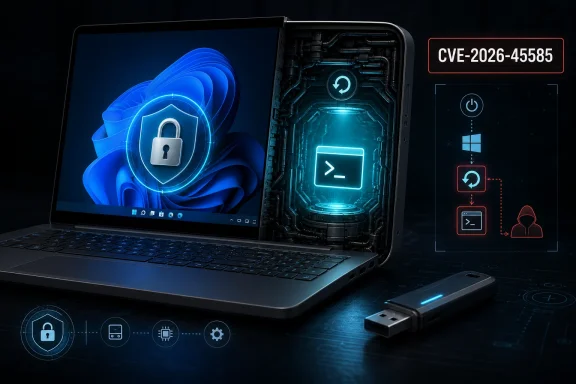
The result is a vulnerability story with two clocks. One is Microsoft’s engineering clock, which now has to produce a real patch for CVE-2026-45585. The other is the defender’s operational clock, which started the moment YellowKey became public.
YellowKey Turns Recovery Into the Attack Surface
The important technical point is not that BitLocker’s cryptography has been broken. There is no public evidence that YellowKey factors keys, cracks encryption, or defeats AES. The weakness sits in the Windows Recovery Environment, the stripped-down repair environment Windows uses when the normal operating system cannot boot cleanly.
According to public technical analysis, YellowKey abuses behavior in WinRE to reach an unlocked command shell while Windows still treats the protected volume as encrypted. That distinction matters. BitLocker may be doing its cryptographic job, while the surrounding boot-and-recovery chain hands an attacker a privileged moment after the drive has been made readable.
The described primitive involves recovery-time handling of file system transaction structures and a component associated with automatic file system recovery. In practical terms, the attack turns a trusted repair workflow into a path for command execution. Once that shell appears, the attacker is no longer arguing with BitLocker at the front door; they are standing inside the recovery environment with access to a volume that was supposed to remain protected from exactly this class of physical-access attack.
That is why YellowKey feels more serious than a generic local bug. It hits the boundary between “the device is off and encrypted” and “Windows has decided it is safe to help.” For defenders, that boundary is where laptop theft scenarios live.
Physical Access Is a Mitigation, Not a Dismissal
Microsoft and others are right to emphasize that YellowKey requires physical access. Remote code execution is not on the table here, and no one should confuse this with a wormable Windows bug. An attacker has to touch the machine, alter boot or recovery conditions, or otherwise stage media in a way that brings WinRE into the chain.
Still, “requires physical access” is not the same as “low risk.” BitLocker’s most important purpose is protecting data when physical access has already been lost. A stolen executive laptop, a field device left in a vehicle, a seized workstation, a discarded SSD, or an unattended machine in a hostile environment are all ordinary reasons organizations deploy full-disk encryption in the first place.
That is why the severity debate around physical-access attacks can become sterile. If the control exists primarily to survive device loss, then an attack requiring device possession is not outside the threat model. It is the threat model.
The more useful question is whether YellowKey is practical enough to matter. Public reporting and independent analysis suggest it is not a laboratory-only curiosity. If the exploit path can be staged with ordinary removable media and the affected system is using common TPM-only BitLocker behavior, many organizations will have to treat it as operationally relevant.
TPM-Only BitLocker Was Always a Bargain
The modern Windows endpoint bargain has been convenience in exchange for a measured amount of trust. TPM-only BitLocker is attractive because it encrypts the drive without forcing users to type a pre-boot PIN. The TPM releases secrets when the boot chain looks acceptable, and users get a seamless startup experience that feels almost identical to an unencrypted machine.
That convenience is also the weakness. TPM-only protection assumes that the boot and recovery path cannot be manipulated into unlocking the drive for an attacker-controlled context. YellowKey’s significance is that it reportedly finds a way to operate inside Microsoft’s own recovery tooling rather than replacing it with something obviously untrusted.
Adding a BitLocker startup PIN changes the equation because it requires user-supplied entropy before the system can unwrap the protected volume. That is why Microsoft’s mitigation guidance includes moving away from the default TPM-only posture. For high-risk users, the PIN is not an inconvenience; it is the part of the system that prevents a stolen laptop from becoming a self-unlocking vault.
But this is not a clean ending. Nightmare-Eclipse has reportedly claimed to have held back a variant that can bypass TPM+PIN protection. Microsoft has not confirmed that claim, and defenders should not treat it as established fact. They also should not ignore it, because the public exploit already demonstrates that WinRE deserves much more scrutiny than it has historically received outside specialist circles.
Windows 11 Takes the Heat Because the Defaults Matter
Public reports so far have focused on Windows 11, with some analysis also naming supported Windows Server releases. Windows 10 appears, according to the researcher and third-party writeups, not to behave the same way in the relevant recovery component. That distinction is technically important, but the bigger point is cultural: Windows 11 is the version where Microsoft has pushed hardest toward modern hardware roots of trust, TPM requirements, Secure Boot expectations, and default device encryption.
That makes YellowKey especially awkward. Windows 11 was marketed and designed around a more secure baseline, yet the exploit story says the security baseline can be undermined by a recovery environment behavior that most users have never heard of and most administrators rarely audit directly. It is a reminder that platform security is not a checklist of hardware requirements. It is an ecosystem of transitions between firmware, bootloader, recovery tools, operating system, identity, and policy.
For consumers, the practical problem is even sharper. Many Windows 11 users do not know whether they are using BitLocker, Device Encryption, TPM-only protection, or a recovery key escrowed to a Microsoft account. They know only that Windows said their data was protected. Asking those users to understand WinRE image servicing or registry hive edits is absurd.
For enterprises, the problem is less ignorance than scale. A single manual mitigation may be straightforward on one test machine and miserable across thousands of endpoints. Anything involving WinRE modification, BitLocker trust reestablishment, and validation across hardware models is the kind of task that turns a vulnerability advisory into a fleet-management project.
The Mitigation Is a Test of Endpoint Discipline
Microsoft’s interim guidance centers on reducing the attack surface in WinRE and hardening BitLocker protection. In broad terms, that means removing or disabling the vulnerable WinRE behavior involved in the exploit path, reestablishing BitLocker trust afterward, and considering startup PINs where risk justifies the support burden. Microsoft has also reportedly updated its guidance with scripting help for administrators.
That is useful, but it is not the same as a patch. A patch arrives through a familiar update channel, has a compliance state, and can be reported with the usual management tools. A mitigation that touches recovery images asks administrators to trust that every device’s hidden recovery partition is reachable, healthy, correctly modified, and still able to support legitimate recovery scenarios afterward.
WinRE has been a recurring operational sore spot because it is both critical and peripheral. It matters deeply when something fails, but it is not where admins spend their daily attention. It can be out of date, customized by OEMs, constrained by partition sizing, or affected by previous servicing workarounds. Security fixes that depend on WinRE hygiene therefore expose gaps that many organizations did not know they had.
Disabling WinRE entirely may close the immediate published path, but it also burns a safety net. Help desks rely on recovery options when boot fails, when users are remote, or when updates go badly. The choice is not between secure and insecure; it is between different kinds of operational pain.
The Researcher’s Backdoor Claim Needs Evidence, Not Vibes
Nightmare-Eclipse has described the responsible behavior in language that implies something more suspicious than an ordinary bug. The claim, in essence, is that a component exists in WinRE with functionality not present in the normal Windows installation, and that this looks “backdoor”-like. That is a serious allegation, and it should be treated carefully.
There are mundane explanations for recovery-specific behavior. WinRE is supposed to repair damaged systems, replay logs, recover from inconsistent file-system states, and perform actions that a normal locked-down Windows session should not. Recovery environments often contain tools and pathways that would be unacceptable in a fully running OS because their job is to fix the OS when it is broken.
But “not a backdoor” is not the same as “not a vulnerability.” If a recovery component allows an attacker to predictably convert a protected recovery session into an unlocked command shell, intent is secondary. Whether the path exists because of legacy design, insufficient threat modeling, a debugging artifact, or deliberate recovery functionality, defenders still have to live with the outcome.
Microsoft’s more cautious label — a security feature bypass — is therefore the right public framing until stronger evidence appears. The company does not need to concede malice for the bug to be serious. It only needs to concede that the recovery environment became a path around a security feature users relied on.
BitLocker’s Reputation Is Built on Boring Reliability
BitLocker has survived for years not because it is glamorous, but because it is boring. It integrates with Windows, works with enterprise management, supports recovery key escrow, and gives organizations a practical answer to lost-device reporting. In security, boring is a compliment.
YellowKey chips away at that confidence because it is easy to explain. “A stolen Windows 11 laptop and a USB stick” is not a nation-state lab scenario. It is the kind of phrase that travels quickly from security blogs to boardrooms, even if the technical reality is more nuanced.
That reputational damage matters because full-disk encryption is partly a compliance control and partly an act of faith. When an organization tells legal, HR, or a regulator that a lost laptop did not trigger a reportable data incident because BitLocker was enabled, it is relying on a shared assumption: the data was not reasonably accessible. Public bypasses complicate that conversation, especially when the affected configuration is common.
The sensible response is not to abandon BitLocker. The sensible response is to stop treating “BitLocker enabled” as a complete sentence. The configuration, protector type, recovery environment state, firmware posture, boot policy, and incident response process all matter.
The Recall and Notepad Comparisons Miss the Core Pattern
The PC Gamer framing understandably connects YellowKey to other recent Windows security anxieties, including concerns about Recall and even vulnerabilities in newly modernized inbox apps. That makes for a tidy “Windows 11 keeps having security problems” narrative, but it risks flattening very different issues into one mood.
Recall-style concerns are about data collection, local indexing, AI-era UX, and the consequences of building searchable memory into the desktop. A Notepad remote code execution bug is about parsing, file handling, and the attack surface of everyday applications. YellowKey is different. It is about the trusted path between firmware, recovery, encryption, and physical possession.
The common thread is not that Windows 11 is uniquely doomed. It is that Microsoft is loading more security-critical behavior into places users do not see. Recovery environments, AI snapshot stores, identity brokers, cloud escrow systems, firmware trust chains, and app sandboxes are all invisible until they fail. When they do fail, users discover that the reassuring label on the feature was only the front end of a much larger system.
That is the real Windows 11 security story. Microsoft has raised the baseline, but it has also made the baseline more complex. Complexity does not invalidate the security model, but it creates more seams where assumptions can drift away from reality.
Administrators Now Have to Decide How Much Friction They Can Sell
The hard part for enterprise IT is not understanding that TPM+PIN is stronger than TPM-only. The hard part is deploying it without drowning in support calls, accessibility problems, travel scenarios, forgotten PINs, and executive exceptions. Security controls fail politically before they fail technically.
YellowKey gives administrators a stronger argument for friction. If the organization handles sensitive data, issues laptops to travelers, faces device theft risk, or operates under breach-notification pressure, TPM-only BitLocker should no longer be treated as the gold standard. It is a baseline convenience mode.
That does not mean every kiosk, lab machine, or low-risk desktop needs the same treatment. Security teams should stratify devices by exposure and data sensitivity. The laptop that never leaves a locked office and holds no local data is not the same as the attorney’s notebook full of client documents or the engineer’s workstation with source material cached locally.
The danger is waiting for a perfect Microsoft patch before doing any of that thinking. A future update may remove the current exploit path, but it will not automatically fix weak device classifications, missing recovery-key audits, unmanaged WinRE partitions, or the assumption that encryption status alone answers every lost-device question.
The Windows Recovery Environment Has Become Too Important to Ignore
WinRE used to be background plumbing. It appeared when Windows failed to boot, offered repair options, and disappeared when the crisis ended. For most users, that was enough.
Now WinRE is a security boundary whether Microsoft intended it to be one or not. If it can influence whether encrypted data becomes readable, then it belongs in the same risk conversation as Secure Boot, TPM configuration, and endpoint detection. Treating it as a servicing afterthought is no longer defensible.
This also means Microsoft needs to make WinRE state easier to see and manage. Administrators should not have to become recovery-partition archaeologists every time a BitLocker-adjacent vulnerability appears. The platform needs clearer inventory, healthier update mechanisms, better reporting, and fewer fixes that depend on bespoke scripts against offline images.
The same goes for consumers. If Windows enables device encryption by default, Windows should also make the protection model understandable. A user should be able to see whether their device uses TPM-only unlock, whether a recovery key is backed up, whether a startup PIN is available, and whether recovery components are up to date without spelunking through enterprise documentation.
The Lesson Microsoft Should Not Waste
YellowKey gives Microsoft an opportunity to do more than close one hole. The company can treat this as another reminder that recovery code is security code. Anything that runs before, during, or around volume unlock deserves the same adversarial review as the cryptographic components themselves.
That review should include uncomfortable threat models. What if the attacker has the device but not the password? What if they can attach media? What if they can force recovery? What if they can remove the drive? What if they can modify an EFI partition? These are not exotic questions for a full-disk encryption product; they are the ordinary questions that determine whether the product keeps its promise.
Microsoft also needs to be more candid about the limits of default protection. The company has understandable reasons to prefer invisible security controls over user-hostile prompts. But invisible controls often produce invisible risk. If TPM-only BitLocker is primarily a convenience baseline, Microsoft should say so plainly and make stronger modes easier to adopt.
The industry’s disclosure process also needs repair, though not in the simplistic sense of scolding researchers harder. Vendors need credible intake, transparent triage, and escalation paths that do not make researchers feel ignored. Researchers need to understand that publishing turnkey exploit material before a fix can expose ordinary users who have no role in the dispute. Both things can be true.
The USB-Stick BitLocker Scare Leaves a Short To-Do List
For all the noise around YellowKey, the immediate defensive agenda is not mysterious. Organizations should resist both panic and complacency. This is a physical-access attack, but it is a physical-access attack against a control whose job is to withstand physical loss.
- Organizations should identify which Windows 11 and Windows Server systems rely on TPM-only BitLocker protection and prioritize mobile, executive, regulated, and high-data-value devices first.
- Administrators should review Microsoft’s CVE-2026-45585 mitigation guidance and test WinRE changes on representative hardware before attempting a broad rollout.
- Security teams should consider TPM+PIN for higher-risk fleets, while being honest that it adds help-desk and user-experience costs.
- Device-loss procedures should be updated so “BitLocker enabled” is not treated as the only fact needed for incident assessment.
- Consumer users with sensitive local data should verify that encryption is enabled, recovery keys are backed up, and firmware or recovery updates from Microsoft and their PC maker are being applied.
- Teams should track Microsoft’s eventual patch separately from interim mitigation, because a workaround deployed under pressure is not the same as a durable platform fix.
YellowKey will probably be patched, renamed in memory, and absorbed into the long ledger of Windows security incidents. The larger issue will remain. Microsoft has built a Windows security story around hardware roots of trust, transparent encryption, and recovery systems that rescue users from disaster; now it has to prove those pieces do not undermine one another when a laptop is in the wrong hands. For Windows users and administrators, the next phase is less about whether BitLocker is “broken” than whether its default convenience has been mistaken for complete protection.
References
- Microsoft says public sharing of Windows 11 vulnerability violates 'best practices' - PC Gamer PC Gamer · Thu, 21 May 2026 11:28:03 GMT