

German textile-finishing company ZEGO Textilveredelungszentrum has filed for insolvency after a cyberattack halted production for nearly six weeks, leaving the 37-year-old business unable to absorb the financial damage. The attack struck on March 29, 2026, and ZEGO says insolvency became unavoidable despite attempts to restore operations and stabilize its finances.
The Bavaria-based company has not identified the attackers or said whether ransomware, data theft, or extortion was involved. As first reported in English by The Register and detailed in German regional reporting, ZEGO is nevertheless drawing a direct line between the production shutdown and its insolvency filing.
Managing director Johannes Zenglein described the decision as one of the most difficult steps in the company’s history. In a notice to customers and suppliers, he said the cyberattack affected ZEGO to an extent the business could not fully compensate for, producing both a prolonged outage and severe financial strain.
That distinction matters. The confirmed damage is not a ransom payment or regulatory penalty but almost six weeks without normal production — a reminder that availability can be the decisive security requirement for an industrial business.
ZEGO, based in Aschaffenburg, provides textile finishing, processing, embroidery, sewing, printing, warehousing, and related services. Its customers span areas such as workwear, corporate clothing, automotive products, and technical textiles.
The company says it was founded in 1990 and employs around 60 people. Those numbers make the case especially relevant to the German Mittelstand: established small and midsized manufacturers that may run complex production environments without the financial reserves or dedicated security teams available to global enterprises.
ZEGO has not explained exactly how compromised IT systems prevented production. In a modern finishing operation, however, disruption does not need to reach industrial controllers directly to stop the factory floor. Production planning, order management, artwork and design files, inventory records, shipping documents, identity services, network storage, and communications can all become operational dependencies.
A production machine can remain mechanically functional while being commercially unusable because employees cannot retrieve instructions, verify customer specifications, schedule work, record completed jobs, or generate delivery paperwork. That is why dividing security into “office IT” and “the real factory” can create a dangerously incomplete picture of business continuity.
Windows environments often sit in the middle of those dependencies. Domain services, file shares, operator workstations, print systems, line-of-business applications, and remote-support tools may connect administrative and production workflows even where the machinery itself uses specialized controllers.
ZEGO has not published enough technical information to determine which systems failed or whether its recovery plans were tested before the attack. The length of the outage, however, demonstrates that restoring individual computers is not the same as restoring a functioning company.
The company is attempting to preserve jobs, customer relationships, and supplier support rather than immediately closing and selling its assets. An insolvency filing can provide a framework for continuing operations, but ZEGO will still need enough confidence and working capital to keep orders, materials, wages, and deliveries moving.
For customers, that creates a difficult calculation. Supporting the supplier may improve its chance of survival, but placing new work with a company undergoing restructuring introduces continuity and delivery risks. Suppliers face the equivalent problem when deciding whether to extend further credit or demand different payment terms.
Cyber recovery therefore extends well beyond rebuilding servers. A company must simultaneously restore technology, restart production, clear its backlog, communicate with customers, cover incident-response costs, and convince partners that another shutdown is unlikely.
Revenue may stop immediately during an outage, while expenses continue. Payroll, rent, energy contracts, equipment financing, insurance, specialist recovery services, and replacement hardware do not disappear because Active Directory or an ERP platform is unavailable.
When production eventually resumes, the financial loss does not end on the same day. Missed orders may already have moved to competitors, materials may need to be reordered, and overtime may be required to clear delayed work. A six-week technical outage can consequently become a much longer commercial disruption.
That leaves several important questions unresolved. If information was stolen, affected parties may still face notifications or follow-on phishing attempts. If the incident involved ransomware, the absence of a publicly identified gang does not prove that no extortion occurred; some negotiations and claims remain private, while criminal leak-site listings can appear later.
It would also be premature to present the insolvency as proof that a single technical control would have saved the company. Public statements establish the attack as the trigger for the production outage and financial crisis, but they do not provide enough information to judge ZEGO’s pre-incident finances, insurance position, backup architecture, or security maturity.
The practical lesson is broader than “deploy better antivirus.” Organizations need to know which systems must return first, how those systems depend on one another, and how long the business can survive while they are unavailable.
A viable recovery plan should account for more than copying data back onto a server. It must cover identity services, clean administrative access, application dependencies, network segmentation, supplier connectivity, endpoint rebuilding, validation of restored data, and temporary procedures for processing orders without the normal systems.
Recovery time is ultimately a financial limit, not merely an IT metric. If management believes the company can withstand seven days of disruption but a realistic rebuild takes six weeks, the backup system may be functioning exactly as designed while the continuity strategy still fails.
German phone repair and insurance group Einhaus also initiated insolvency proceedings for several operations after struggling with the consequences of a 2023 ransomware attack. Reporting on that case described years of recovery costs, restructuring, and lost confidence even after the company reportedly paid its attackers.
These cases differ in size, sector, finances, and technical circumstances. They should not be reduced to a claim that every serious attack inevitably destroys its victim. Most affected companies survive, although the full costs frequently remain private.
What the cases do show is that the ransom demand is only one line in the incident ledger. Lost production, delayed deliveries, emergency consultants, forensic work, hardware replacement, legal obligations, contractual penalties, higher insurance costs, and customer departures can collectively exceed the amount demanded by an attacker.
That changes how boards and IT departments should frame security investment. Endpoint detection, multifactor authentication, privileged-access controls, offline backups, segmentation, and patch management are important, but they must be tied to tested operational recovery.
A backup that has never been restored under realistic conditions is an assumption. A disaster-recovery document that depends on the same domain, credentials, network, storage, or personnel compromised in the attack is not independent resilience.
For Windows administrators, the relevant exercise is not simply asking whether servers are backed up. It is determining whether the organization can recover trusted domain services, issue clean credentials, rebuild endpoints at scale, restore line-of-business applications in the required order, and operate safely while forensic work continues.
That exercise should include executives, finance, production managers, logistics, legal advisers, and key suppliers. IT may restore the systems, but only the wider business can decide which processes are indispensable and how much downtime the company can finance.
ZEGO’s immediate future now rests on whether its administrator can maintain production and secure enough support to restructure the business. The company’s filing is not yet a closure notice, but it is a stark measure of the damage already done: an attack on March 29 turned into nearly six weeks of lost production, and by July the resulting financial burden had reached an insolvency court.
For other manufacturers, the warning is concrete. The critical cybersecurity calculation is not only whether attackers can enter the network, steal data, or encrypt Windows systems. It is how many days the business can remain unable to produce before recovery stops being a technical project and becomes a question of survival.
The Bavaria-based company has not identified the attackers or said whether ransomware, data theft, or extortion was involved. As first reported in English by The Register and detailed in German regional reporting, ZEGO is nevertheless drawing a direct line between the production shutdown and its insolvency filing.
Managing director Johannes Zenglein described the decision as one of the most difficult steps in the company’s history. In a notice to customers and suppliers, he said the cyberattack affected ZEGO to an extent the business could not fully compensate for, producing both a prolonged outage and severe financial strain.
That distinction matters. The confirmed damage is not a ransom payment or regulatory penalty but almost six weeks without normal production — a reminder that availability can be the decisive security requirement for an industrial business.
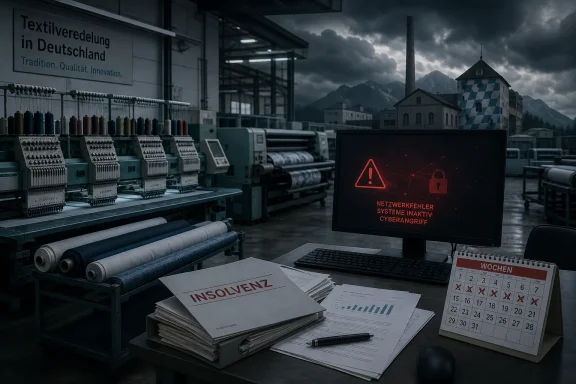 A Digital Attack Stopped a Physical Business
ZEGO, based in Aschaffenburg, provides textile finishing, processing, embroidery, sewing, printing, warehousing, and related services. Its customers span areas such as workwear, corporate clothing, automotive products, and technical textiles.The company says it was founded in 1990 and employs around 60 people. Those numbers make the case especially relevant to the German Mittelstand: established small and midsized manufacturers that may run complex production environments without the financial reserves or dedicated security teams available to global enterprises.
ZEGO has not explained exactly how compromised IT systems prevented production. In a modern finishing operation, however, disruption does not need to reach industrial controllers directly to stop the factory floor. Production planning, order management, artwork and design files, inventory records, shipping documents, identity services, network storage, and communications can all become operational dependencies.
A production machine can remain mechanically functional while being commercially unusable because employees cannot retrieve instructions, verify customer specifications, schedule work, record completed jobs, or generate delivery paperwork. That is why dividing security into “office IT” and “the real factory” can create a dangerously incomplete picture of business continuity.
Windows environments often sit in the middle of those dependencies. Domain services, file shares, operator workstations, print systems, line-of-business applications, and remote-support tools may connect administrative and production workflows even where the machinery itself uses specialized controllers.
ZEGO has not published enough technical information to determine which systems failed or whether its recovery plans were tested before the attack. The length of the outage, however, demonstrates that restoring individual computers is not the same as restoring a functioning company.
Insolvency Does Not Yet Mean Liquidation
ZEGO says production will continue during the insolvency process while administrators examine restructuring options. German reporting identifies attorney Maximilian Maierhofer of Ohly Zöller as the provisional insolvency administrator.The company is attempting to preserve jobs, customer relationships, and supplier support rather than immediately closing and selling its assets. An insolvency filing can provide a framework for continuing operations, but ZEGO will still need enough confidence and working capital to keep orders, materials, wages, and deliveries moving.
For customers, that creates a difficult calculation. Supporting the supplier may improve its chance of survival, but placing new work with a company undergoing restructuring introduces continuity and delivery risks. Suppliers face the equivalent problem when deciding whether to extend further credit or demand different payment terms.
Cyber recovery therefore extends well beyond rebuilding servers. A company must simultaneously restore technology, restart production, clear its backlog, communicate with customers, cover incident-response costs, and convince partners that another shutdown is unlikely.
Revenue may stop immediately during an outage, while expenses continue. Payroll, rent, energy contracts, equipment financing, insurance, specialist recovery services, and replacement hardware do not disappear because Active Directory or an ERP platform is unavailable.
When production eventually resumes, the financial loss does not end on the same day. Missed orders may already have moved to competitors, materials may need to be reordered, and overtime may be required to clear delayed work. A six-week technical outage can consequently become a much longer commercial disruption.
The Missing Attack Details Still Matter
ZEGO has not disclosed the initial access method, affected systems, recovery sequence, or whether backups were damaged. It has also not confirmed whether personal, customer, or commercially sensitive data was accessed.That leaves several important questions unresolved. If information was stolen, affected parties may still face notifications or follow-on phishing attempts. If the incident involved ransomware, the absence of a publicly identified gang does not prove that no extortion occurred; some negotiations and claims remain private, while criminal leak-site listings can appear later.
It would also be premature to present the insolvency as proof that a single technical control would have saved the company. Public statements establish the attack as the trigger for the production outage and financial crisis, but they do not provide enough information to judge ZEGO’s pre-incident finances, insurance position, backup architecture, or security maturity.
The practical lesson is broader than “deploy better antivirus.” Organizations need to know which systems must return first, how those systems depend on one another, and how long the business can survive while they are unavailable.
A viable recovery plan should account for more than copying data back onto a server. It must cover identity services, clean administrative access, application dependencies, network segmentation, supplier connectivity, endpoint rebuilding, validation of restored data, and temporary procedures for processing orders without the normal systems.
Recovery time is ultimately a financial limit, not merely an IT metric. If management believes the company can withstand seven days of disruption but a realistic rebuild takes six weeks, the backup system may be functioning exactly as designed while the continuity strategy still fails.
Cyber Risk Has Become a Balance-Sheet Risk
ZEGO is not the first established company to attribute its collapse or insolvency to a cyberattack. The best-known recent case is KNP Logistics Group, parent of the 158-year-old British haulage brand Knights of Old, which entered administration after a ransomware incident and the loss of critical systems. Roughly 700 jobs were affected.German phone repair and insurance group Einhaus also initiated insolvency proceedings for several operations after struggling with the consequences of a 2023 ransomware attack. Reporting on that case described years of recovery costs, restructuring, and lost confidence even after the company reportedly paid its attackers.
These cases differ in size, sector, finances, and technical circumstances. They should not be reduced to a claim that every serious attack inevitably destroys its victim. Most affected companies survive, although the full costs frequently remain private.
What the cases do show is that the ransom demand is only one line in the incident ledger. Lost production, delayed deliveries, emergency consultants, forensic work, hardware replacement, legal obligations, contractual penalties, higher insurance costs, and customer departures can collectively exceed the amount demanded by an attacker.
That changes how boards and IT departments should frame security investment. Endpoint detection, multifactor authentication, privileged-access controls, offline backups, segmentation, and patch management are important, but they must be tied to tested operational recovery.
A backup that has never been restored under realistic conditions is an assumption. A disaster-recovery document that depends on the same domain, credentials, network, storage, or personnel compromised in the attack is not independent resilience.
For Windows administrators, the relevant exercise is not simply asking whether servers are backed up. It is determining whether the organization can recover trusted domain services, issue clean credentials, rebuild endpoints at scale, restore line-of-business applications in the required order, and operate safely while forensic work continues.
That exercise should include executives, finance, production managers, logistics, legal advisers, and key suppliers. IT may restore the systems, but only the wider business can decide which processes are indispensable and how much downtime the company can finance.
ZEGO’s immediate future now rests on whether its administrator can maintain production and secure enough support to restructure the business. The company’s filing is not yet a closure notice, but it is a stark measure of the damage already done: an attack on March 29 turned into nearly six weeks of lost production, and by July the resulting financial burden had reached an insolvency court.
For other manufacturers, the warning is concrete. The critical cybersecurity calculation is not only whether attackers can enter the network, steal data, or encrypt Windows systems. It is how many days the business can remain unable to produce before recovery stops being a technical project and becomes a question of survival.
References
- Primary source: The Register
Published: 2026-07-13T16:53:00+00:00
German firm files for insolvency, blames cybercrims who shut down production for 6 weeks
ZEGO-TVZ says the financial fallout from a March cyberattack left shutting its doors as the only optionwww.theregister.com - Related coverage: webpronews.com
- Related coverage: pcgamer.com
German phone repair and insurance firm goes bankrupt after paying €200,000 to ransomware hackers despite reported revenue of 70 million | PC Gamer
11% of the company's data was reportedly leaked.www.pcgamer.com
