

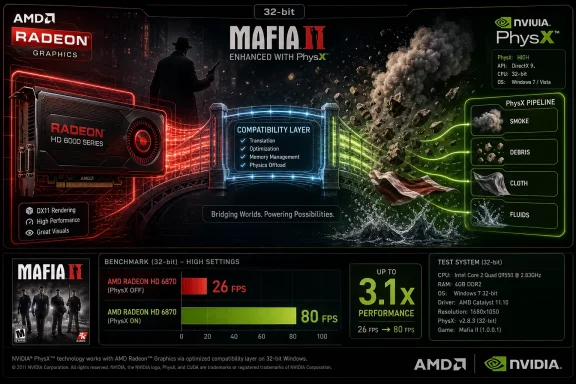
ZLUDA 6 was released on June 29, 2026, adding early 32-bit PhysX support that lets some older NVIDIA PhysX games run their GPU-accelerated effects on AMD Radeon hardware without a second NVIDIA card. The immediate headline is a reported threefold jump in Mafia II performance on Radeon when ZLUDA handles the PhysX path. The bigger story is stranger and more important: a weekend open-source compatibility project is now doing preservation work that GPU vendors have been unwilling, unable, or commercially unmotivated to do themselves.
For years, GPU PhysX sat in a weird place in PC gaming history. It was technically impressive, visually distinctive, and unmistakably tied to NVIDIA’s hardware strategy. If a game used GPU PhysX for debris, cloth, smoke, particles, or fluids, Radeon owners usually received either a slower CPU path or a diminished effects profile.
ZLUDA’s new release does not magically turn every AMD card into a native NVIDIA GPU, and it does not make PhysX a modern gaming platform again. What it does is more surgical: it translates enough of the old 32-bit CUDA-based PhysX stack to make certain classic titles behave as if a compatible CUDA device is present. That matters because many of the affected games come from the late-2000s and early-2010s era, when PC ports often treated NVIDIA features as premium extras rather than portable rendering techniques.
The reported Mafia II result is the kind of benchmark that makes enthusiasts stop scrolling. Wccftech, citing the ZLUDA update and Phoronix coverage, describes the same Radeon system moving from 26.2 FPS without ZLUDA PhysX to 80.2 FPS with ZLUDA PhysX. That is not an academic speedup in a synthetic kernel. That is the difference between “interesting but miserable” and “actually playable.”
The result also reframes the old PhysX argument. For years, the practical answer to “Can I play GPU PhysX games properly on Radeon?” was basically “not without compromises.” ZLUDA 6 suggests the answer may increasingly become “sometimes, if the wrapper supports the game and you are willing to tinker.”
The catch was that these effects were often built around NVIDIA’s CUDA stack. If you owned a GeForce card, you could get the show. If you owned a Radeon card, you might get a CPU fallback, a degraded implementation, or simply a much worse frame rate when enabling the same option.
That history is why this ZLUDA release lands with more emotional force than a normal compatibility update. It touches a long-running sore spot in PC gaming: the sense that some effects were not limited by the game engine so much as by ecosystem politics. Radeon hardware was not necessarily incapable of accelerating physics work in principle. It simply was not invited into that particular software path.
ZLUDA’s approach is powerful precisely because it attacks the boundary at the binary compatibility layer. Instead of asking game developers to patch decade-old titles or asking NVIDIA to re-engineer legacy support for competitors, it tries to make existing CUDA-targeted software run somewhere else. That is a fragile trick, but when it works, it feels like a door opening in a room everyone had stopped checking.
The project’s own update is cautious. The relevant PhysX pull request is described as long-running and not yet complete. Users are warned that fluid simulation can glitch, and loading ZLUDA into Steam games is not currently as smooth as a normal install-and-play experience. In other words, this is closer to a promising compatibility breakthrough than to a turnkey Radeon control-panel option.
That distinction matters for Windows users. The classic-PC-gaming community is comfortable with wrappers, DLL drops, launch flags, compatibility shims, and GitHub releases. The broader Windows gaming audience is not. A feature that requires manual placement of replacement libraries, awareness of ROCm components, and patience for edge cases will excite enthusiasts before it reassures ordinary players.
Still, rough edges do not erase the significance. PC gaming preservation often begins exactly this way: one project proves that an old assumption is false, then tooling, documentation, front ends, and community-tested compatibility lists turn the proof of concept into something approachable. ZLUDA 6 is not the end-user packaging layer. It is the technical breach in the wall.
That exposed a strange inversion. A feature once used to differentiate NVIDIA hardware became a legacy burden that even NVIDIA’s newest hardware did not automatically carry forward in the same way. The company later restored support for selected titles, but the episode reminded PC gamers that old vendor-specific features can become liabilities when architectural support, driver priorities, and commercial incentives move on.
ZLUDA’s work sits right in that gap. It is not merely about AMD users getting access to old NVIDIA effects. It is about what happens when software heritage depends on proprietary stacks whose owners have little reason to keep every corner case alive forever.
This is where the preservation argument becomes stronger than the brand-war argument. If an old game’s best visual mode depends on a deprecated vendor path, then the community needs translation layers, wrappers, and compatibility projects whether the user owns Radeon, GeForce, or something else. Today’s abandoned path is tomorrow’s missing feature.
ZLUDA’s history has always been tangled with corporate caution. It began as an effort associated with bringing CUDA-style compatibility to non-NVIDIA hardware, later became known for AMD-backed work on Radeon through ROCm, was open-sourced, taken down in earlier circumstances, and then continued under different support. The project’s trajectory reads less like a stable open-source roadmap and more like a tour through the legal, strategic, and commercial discomfort surrounding CUDA compatibility.
That matters because compatibility layers need sustained maintenance. They are not one-time hacks. Every supported workload exposes missing APIs, strange assumptions, driver interactions, timing issues, memory behavior, and platform-specific quirks. A lone developer can do extraordinary work, but the gap between “impressive demo” and “reliable ecosystem component” is usually filled with money, testers, infrastructure, and documentation.
There is also a strategic irony here. AMD benefits whenever CUDA-only software becomes less CUDA-only, but that does not mean AMD is willing to own the risk, support burden, or legal complexity of a drop-in CUDA implementation. NVIDIA benefits from CUDA’s moat and has no reason to bless a compatibility layer that weakens it. Users benefit most, but users are the least organized funding source.
The developer’s stated interest in improving Windows support is therefore not a side note. Better error messages when ROCm components are missing, smoother library loading, and more predictable behavior are the difference between a forum curiosity and a tool people recommend. For WindowsForum readers, that is the practical frontier.
Windows also complicates the story. Steam, game launchers, anti-tamper systems, redistributable runtimes, and old 32-bit binaries do not always welcome injected compatibility libraries. Even when the technical translation is sound, the packaging can be painful. A Linux user may be more accustomed to loader paths and environment variables; a Windows gamer expects the executable to launch.
That is why ZLUDA’s PhysX work will likely spread first through guides, compatibility spreadsheets, and community-tested recipes. A user will not ask, “Does ZLUDA support PhysX?” They will ask, “Does this work in Mafia II on my RX 7800 XT with this driver and this Steam build?” The answer will vary until the ecosystem around the tool matures.
Texture support matters because many real CUDA workloads are not just simple compute kernels. They use CUDA’s memory objects, sampling behavior, and graphics-adjacent features in ways that translation layers must emulate if they want to run more than toy examples. PhysX itself benefits from this kind of broader compatibility work, because game-era CUDA code often leans on assumptions that differ from clean modern compute samples.
The machine-learning angle is even more politically charged. CUDA remains one of NVIDIA’s strongest ecosystem advantages, not merely because the hardware is fast, but because the software stack is entrenched. Developers target CUDA because libraries, frameworks, documentation, deployment paths, and institutional knowledge all point that way.
ZLUDA does not erase that advantage. It does, however, nibble at one of its edges: the idea that binaries written for CUDA might not be forever bound to NVIDIA hardware. Even partial success is enough to make the market more interesting, because compatibility changes the cost of experimentation. If users can try workloads on Radeon without waiting for native ports, AMD hardware becomes easier to evaluate.
For preservationists, it offers a path to revive visual features stranded by old vendor dependencies. For AMD users, it reduces one of the historical penalties of choosing Radeon in an ecosystem where some software assumed GeForce. For developers and IT pros, it is another reminder that compatibility layers can shift the boundaries of what hardware is useful for.
But reverse-engineered or reimplemented compatibility always carries tension. The closer a project comes to behaving like the original proprietary stack, the more valuable it becomes and the more uncomfortable it may be for the companies whose platforms it intersects. That discomfort is not theoretical in ZLUDA’s case; the project’s stop-start funding history shows how difficult it is to commercialize this kind of work without attracting risk.
There is a reason Wine, Proton, DXVK, vkd3d-proton, and similar projects became so important to PC gaming. They did not merely emulate software; they changed platform expectations. ZLUDA is not yet in that league for CUDA, but the PhysX breakthrough gives ordinary enthusiasts a concrete reason to care about a problem that otherwise sounds abstract.
ZLUDA is not there yet. The current state is exciting because it is not boring: incomplete pull requests, glitches, manual setup, and dramatic benchmark deltas. That is the stage where enthusiasts experiment and journalists write headlines.
The next stage is less glamorous and more important. Someone needs to test games. Someone needs to document failure modes. Someone needs to identify which Radeon generations, ROCm versions, Windows builds, and launchers behave best. Someone needs to write instructions that do not assume the reader already knows how CUDA DLL loading works.
If that happens, ZLUDA’s PhysX support could become one of those quietly essential tools in the classic Windows gaming kit. Not universal, not official, not guaranteed, but useful enough to change recommendations. The difference between an abandoned feature and a restored one is often just enough persistence.
Near-term expectations should stay grounded.
The most interesting future for ZLUDA is not one where every Radeon owner suddenly becomes a CUDA power user overnight. It is one where the PC community keeps finding practical, stubborn ways to prevent old software from being trapped by abandoned assumptions. If a weekend project can make a 2010-era PhysX showcase run three times faster on hardware it was never meant to support, the next decade of Windows compatibility may depend less on what vendors officially preserve and more on what users refuse to let die.
 ZLUDA Turns a Vendor Lock-In Relic Into a Compatibility Layer
For years, GPU PhysX sat in a weird place in PC gaming history. It was technically impressive, visually distinctive, and unmistakably tied to NVIDIA’s hardware strategy. If a game used GPU PhysX for debris, cloth, smoke, particles, or fluids, Radeon owners usually received either a slower CPU path or a diminished effects profile.ZLUDA’s new release does not magically turn every AMD card into a native NVIDIA GPU, and it does not make PhysX a modern gaming platform again. What it does is more surgical: it translates enough of the old 32-bit CUDA-based PhysX stack to make certain classic titles behave as if a compatible CUDA device is present. That matters because many of the affected games come from the late-2000s and early-2010s era, when PC ports often treated NVIDIA features as premium extras rather than portable rendering techniques.
The reported Mafia II result is the kind of benchmark that makes enthusiasts stop scrolling. Wccftech, citing the ZLUDA update and Phoronix coverage, describes the same Radeon system moving from 26.2 FPS without ZLUDA PhysX to 80.2 FPS with ZLUDA PhysX. That is not an academic speedup in a synthetic kernel. That is the difference between “interesting but miserable” and “actually playable.”
The result also reframes the old PhysX argument. For years, the practical answer to “Can I play GPU PhysX games properly on Radeon?” was basically “not without compromises.” ZLUDA 6 suggests the answer may increasingly become “sometimes, if the wrapper supports the game and you are willing to tinker.”
The Old PhysX Tax Was Always About More Than Frame Rate
PhysX was never just a checkbox in a settings menu. In games such as Mafia II, Batman: Arkham Asylum, Borderlands 2, Mirror’s Edge, and others from that era, GPU PhysX could add visible flourishes that made the PC version feel materially different. Shattering debris, environmental particles, cloth behavior, smoke, flame, and fluid effects were part of the spectacle.The catch was that these effects were often built around NVIDIA’s CUDA stack. If you owned a GeForce card, you could get the show. If you owned a Radeon card, you might get a CPU fallback, a degraded implementation, or simply a much worse frame rate when enabling the same option.
That history is why this ZLUDA release lands with more emotional force than a normal compatibility update. It touches a long-running sore spot in PC gaming: the sense that some effects were not limited by the game engine so much as by ecosystem politics. Radeon hardware was not necessarily incapable of accelerating physics work in principle. It simply was not invited into that particular software path.
ZLUDA’s approach is powerful precisely because it attacks the boundary at the binary compatibility layer. Instead of asking game developers to patch decade-old titles or asking NVIDIA to re-engineer legacy support for competitors, it tries to make existing CUDA-targeted software run somewhere else. That is a fragile trick, but when it works, it feels like a door opening in a room everyone had stopped checking.
The Threefold Boost Is Real News, but It Is Not Yet a Consumer Feature
The temptation is to declare victory: AMD GPUs can now run NVIDIA PhysX games, the frame rate triples, old titles are saved. That would be premature. ZLUDA 6 is an open-source milestone, not a polished driver feature.The project’s own update is cautious. The relevant PhysX pull request is described as long-running and not yet complete. Users are warned that fluid simulation can glitch, and loading ZLUDA into Steam games is not currently as smooth as a normal install-and-play experience. In other words, this is closer to a promising compatibility breakthrough than to a turnkey Radeon control-panel option.
That distinction matters for Windows users. The classic-PC-gaming community is comfortable with wrappers, DLL drops, launch flags, compatibility shims, and GitHub releases. The broader Windows gaming audience is not. A feature that requires manual placement of replacement libraries, awareness of ROCm components, and patience for edge cases will excite enthusiasts before it reassures ordinary players.
Still, rough edges do not erase the significance. PC gaming preservation often begins exactly this way: one project proves that an old assumption is false, then tooling, documentation, front ends, and community-tested compatibility lists turn the proof of concept into something approachable. ZLUDA 6 is not the end-user packaging layer. It is the technical breach in the wall.
NVIDIA’s Blackwell PhysX Problem Made Legacy Support Visible Again
The timing is awkward for NVIDIA. The PhysX story might have remained a niche Radeon compatibility curiosity if not for the broader controversy around 32-bit CUDA and newer GeForce hardware. NVIDIA’s latest-generation Blackwell cards initially drew attention because some older 32-bit CUDA-dependent PhysX titles no longer behaved as long-time GeForce users expected.That exposed a strange inversion. A feature once used to differentiate NVIDIA hardware became a legacy burden that even NVIDIA’s newest hardware did not automatically carry forward in the same way. The company later restored support for selected titles, but the episode reminded PC gamers that old vendor-specific features can become liabilities when architectural support, driver priorities, and commercial incentives move on.
ZLUDA’s work sits right in that gap. It is not merely about AMD users getting access to old NVIDIA effects. It is about what happens when software heritage depends on proprietary stacks whose owners have little reason to keep every corner case alive forever.
This is where the preservation argument becomes stronger than the brand-war argument. If an old game’s best visual mode depends on a deprecated vendor path, then the community needs translation layers, wrappers, and compatibility projects whether the user owns Radeon, GeForce, or something else. Today’s abandoned path is tomorrow’s missing feature.
The Funding Cut Makes the Breakthrough Feel More Fragile
The other half of the ZLUDA 6 news is less celebratory. According to the project’s update and Phoronix’s reporting, ZLUDA has again lost commercial funding and is returning to life as a weekend project for lead developer Andrzej Janik. That is a sobering development for something now being asked to carry CUDA compatibility, Windows usability, PhysX translation, texture support, and machine-learning workloads.ZLUDA’s history has always been tangled with corporate caution. It began as an effort associated with bringing CUDA-style compatibility to non-NVIDIA hardware, later became known for AMD-backed work on Radeon through ROCm, was open-sourced, taken down in earlier circumstances, and then continued under different support. The project’s trajectory reads less like a stable open-source roadmap and more like a tour through the legal, strategic, and commercial discomfort surrounding CUDA compatibility.
That matters because compatibility layers need sustained maintenance. They are not one-time hacks. Every supported workload exposes missing APIs, strange assumptions, driver interactions, timing issues, memory behavior, and platform-specific quirks. A lone developer can do extraordinary work, but the gap between “impressive demo” and “reliable ecosystem component” is usually filled with money, testers, infrastructure, and documentation.
There is also a strategic irony here. AMD benefits whenever CUDA-only software becomes less CUDA-only, but that does not mean AMD is willing to own the risk, support burden, or legal complexity of a drop-in CUDA implementation. NVIDIA benefits from CUDA’s moat and has no reason to bless a compatibility layer that weakens it. Users benefit most, but users are the least organized funding source.
Radeon Owners Get a Win, but Windows Still Gets the Hard Part
ZLUDA has often been discussed in Linux and compute circles, but this release is unusually relevant to Windows users. The games in question are Windows PC classics. The pain point is not a data-center workload or a PyTorch experiment; it is the Steam library full of old titles that do not quite behave the way players remember.The developer’s stated interest in improving Windows support is therefore not a side note. Better error messages when ROCm components are missing, smoother library loading, and more predictable behavior are the difference between a forum curiosity and a tool people recommend. For WindowsForum readers, that is the practical frontier.
Windows also complicates the story. Steam, game launchers, anti-tamper systems, redistributable runtimes, and old 32-bit binaries do not always welcome injected compatibility libraries. Even when the technical translation is sound, the packaging can be painful. A Linux user may be more accustomed to loader paths and environment variables; a Windows gamer expects the executable to launch.
That is why ZLUDA’s PhysX work will likely spread first through guides, compatibility spreadsheets, and community-tested recipes. A user will not ask, “Does ZLUDA support PhysX?” They will ask, “Does this work in Mafia II on my RX 7800 XT with this driver and this Steam build?” The answer will vary until the ecosystem around the tool matures.
Textures and Windows ML Show ZLUDA Is Chasing More Than Nostalgia
The PhysX addition is the headline because it is visual, nostalgic, and easy to benchmark. But ZLUDA 6 also adds texture support and continues work on Windows machine-learning compatibility. Those changes point to a broader ambition: making CUDA-targeted applications less trapped inside NVIDIA’s ecosystem.Texture support matters because many real CUDA workloads are not just simple compute kernels. They use CUDA’s memory objects, sampling behavior, and graphics-adjacent features in ways that translation layers must emulate if they want to run more than toy examples. PhysX itself benefits from this kind of broader compatibility work, because game-era CUDA code often leans on assumptions that differ from clean modern compute samples.
The machine-learning angle is even more politically charged. CUDA remains one of NVIDIA’s strongest ecosystem advantages, not merely because the hardware is fast, but because the software stack is entrenched. Developers target CUDA because libraries, frameworks, documentation, deployment paths, and institutional knowledge all point that way.
ZLUDA does not erase that advantage. It does, however, nibble at one of its edges: the idea that binaries written for CUDA might not be forever bound to NVIDIA hardware. Even partial success is enough to make the market more interesting, because compatibility changes the cost of experimentation. If users can try workloads on Radeon without waiting for native ports, AMD hardware becomes easier to evaluate.
This Is Preservation, Competition, and Reverse Engineering All at Once
The cleanest way to understand ZLUDA 6 is not as a gaming utility, a CUDA clone, or an AMD booster. It is all three, and that is why it feels important.For preservationists, it offers a path to revive visual features stranded by old vendor dependencies. For AMD users, it reduces one of the historical penalties of choosing Radeon in an ecosystem where some software assumed GeForce. For developers and IT pros, it is another reminder that compatibility layers can shift the boundaries of what hardware is useful for.
But reverse-engineered or reimplemented compatibility always carries tension. The closer a project comes to behaving like the original proprietary stack, the more valuable it becomes and the more uncomfortable it may be for the companies whose platforms it intersects. That discomfort is not theoretical in ZLUDA’s case; the project’s stop-start funding history shows how difficult it is to commercialize this kind of work without attracting risk.
There is a reason Wine, Proton, DXVK, vkd3d-proton, and similar projects became so important to PC gaming. They did not merely emulate software; they changed platform expectations. ZLUDA is not yet in that league for CUDA, but the PhysX breakthrough gives ordinary enthusiasts a concrete reason to care about a problem that otherwise sounds abstract.
The Real Test Is Whether the Community Can Make It Boring
The best compatibility technologies eventually disappear into routine. Nobody wants to celebrate a wrapper every time an old game launches. They want the game to work, the effects to render, and the frame time graph to behave.ZLUDA is not there yet. The current state is exciting because it is not boring: incomplete pull requests, glitches, manual setup, and dramatic benchmark deltas. That is the stage where enthusiasts experiment and journalists write headlines.
The next stage is less glamorous and more important. Someone needs to test games. Someone needs to document failure modes. Someone needs to identify which Radeon generations, ROCm versions, Windows builds, and launchers behave best. Someone needs to write instructions that do not assume the reader already knows how CUDA DLL loading works.
If that happens, ZLUDA’s PhysX support could become one of those quietly essential tools in the classic Windows gaming kit. Not universal, not official, not guaranteed, but useful enough to change recommendations. The difference between an abandoned feature and a restored one is often just enough persistence.
The PhysX Wall Cracks, but It Does Not Collapse
The concrete lesson from ZLUDA 6 is that old GPU feature walls are often software walls. They may be hard walls, legally sensitive walls, or economically neglected walls, but they are not always laws of physics. That is good news for users and uncomfortable news for platform vendors.Near-term expectations should stay grounded.
- ZLUDA 6 adds early support for 32-bit PhysX, and the implementation is not yet complete.
- The reported Mafia II benchmark shows a jump from 26.2 FPS to 80.2 FPS on the tested Radeon setup when ZLUDA handles PhysX.
- Some Radeon users may see both higher performance and restored visual effects in older GPU PhysX titles.
- Steam integration and game loading remain rough enough that this is still enthusiast territory.
- Fluid simulation glitches and other rendering or physics bugs should be expected while support matures.
- The project’s loss of commercial funding means progress may continue, but less predictably and with fewer resources.
The most interesting future for ZLUDA is not one where every Radeon owner suddenly becomes a CUDA power user overnight. It is one where the PC community keeps finding practical, stubborn ways to prevent old software from being trapped by abandoned assumptions. If a weekend project can make a 2010-era PhysX showcase run three times faster on hardware it was never meant to support, the next decade of Windows compatibility may depend less on what vendors officially preserve and more on what users refuse to let die.
References
- Primary source: Wccftech
Published: Mon, 29 Jun 2026 21:05:00 GMT
AMD Radeon GPUs Can Now Run NVIDIA PhysX Games With 3x Boost Thanks To ZLUDA, Without Requiring A Dedicated PhysX GPU
AMD Radeon GPUs have now gained support for NVIDIA's PhysX with the ZLUDA v6 release, providing a massive boost in PhysX games.wccftech.com
- Related coverage: phoronix.com
ZLUDA v6 Gets PhysX Running Well On AMD GPUs But Loses Commercial Funding - Phoronix
ZLUDA as a reminder is the open-source project that began as drop-in CUDA support for Intel graphics hardware and then was quietly funded by AMD for years as a drop-in CUDA replacement on AMD GPUs that went open-source after losing fundingwww.phoronix.com
- Related coverage: vosen.github.io
- Official source: github.com
ZLUDA · vladmandic/sdnext Wiki · GitHub
SD.Next: All-in-one WebUI for AI generative image and video creation, captioning and processing - ZLUDA · vladmandic/sdnext Wiki github.com
- Related coverage: en.gamegpu.com
NVIDIA has revealed GPU-PhysX and Flow SDK sources — ZLUDA is preparing support for 32-bit physics on AMD and RTX 50
NVIDIA has taken another step towards open standards by announcing the full open source nature of the PhysX SDK, includingen.gamegpu.com
- Related coverage: developer.nvidia.com
CUDA Toolkit 6.0 | NVIDIA Developer
developer.nvidia.com
- Related coverage: gigazine.net
NVIDIAの「CUDA」とIntelのGPUをつなぐソフトウェア「ZLUDA」がAMD向けとして転身復活するも今後の開発は絶望的 - GIGAZINE
NVIDIAのコンピューティング向けGPU活用技術「CUDA」をIntel GPUで実行できるようにしたソフトウェア「ZLUDA」が復活しましたが、IntelではなくAMDのGPUで動作するよう改変が加えられていました。gigazine.net - Related coverage: hwupgrade.it
ZLUDA: il progetto per eseguire CUDA su GPU non NVIDIA cresce e fa progressi | Hardware Upgrade
Il progetto open source ZLUDA, che punta a eseguire codice CUDA su GPU non NVIDIA, ha compiuto significativi passi avanti. Il team si amplia, migliorano compatibilità e precisione, e si lavora sul supporto a PhysX 32-bit. Il tutto con NVIDIA pronta a mettere i bastoni tra le ruote.www.hwupgrade.it - Related coverage: docs.nvidia.cn
- Related coverage: docs.nvidia.com
