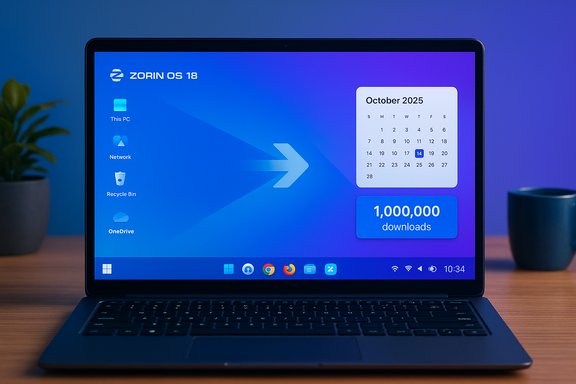
Zorin OS 18 has raced into the headlines with a milestone few Linux distributions ever manage: roughly one million downloads in a little over a month after launch — and, crucially, Zorin Group reports that nearly 78% of those downloads originated from Windows machines, a data point that frames the release as the most visible beneficiary of Windows 10’s end-of-support moment.
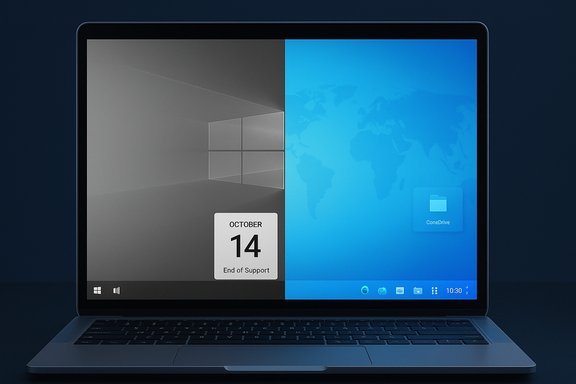
The calendar set the conditions. Microsoft ended mainstream, free support for Windows 10 on October 14, 2025, creating an immediate security and upgrade decision for a large installed base of PCs. That date did not render machines unusable, but it did stop routine security updates for retail Windows 10 editions unless devices are enrolled in Extended Security Updates (ESU) or otherwise supported — a limited, paid bridge Microsoft designed to buy time. Zorin Group timed Zorin OS 18 to land on that same date. The release is explicitly positioned as a migration-first Linux desktop aimed at reducing the friction that stops many Windows users from switching: familiar layouts, cloud continuity (OneDrive integration and web‑app tooling), and a sharpened Windows compatibility story powered by a modern Wine runtime. Those product choices — combined with timing — produced a rare, high‑visibility download spike that many outlets framed as a small but meaningful “Windows-to-Linux” migration signal.
Source: WebProNews Zorin OS’s Million-Download Surge: Windows 10’s End Ignites Linux Exodus
 Background / Overview
The calendar set the conditions. Microsoft ended mainstream, free support for Windows 10 on October 14, 2025, creating an immediate security and upgrade decision for a large installed base of PCs. That date did not render machines unusable, but it did stop routine security updates for retail Windows 10 editions unless devices are enrolled in Extended Security Updates (ESU) or otherwise supported — a limited, paid bridge Microsoft designed to buy time. Zorin Group timed Zorin OS 18 to land on that same date. The release is explicitly positioned as a migration-first Linux desktop aimed at reducing the friction that stops many Windows users from switching: familiar layouts, cloud continuity (OneDrive integration and web‑app tooling), and a sharpened Windows compatibility story powered by a modern Wine runtime. Those product choices — combined with timing — produced a rare, high‑visibility download spike that many outlets framed as a small but meaningful “Windows-to-Linux” migration signal. What Zorin OS 18 Ships and Why It Resonated
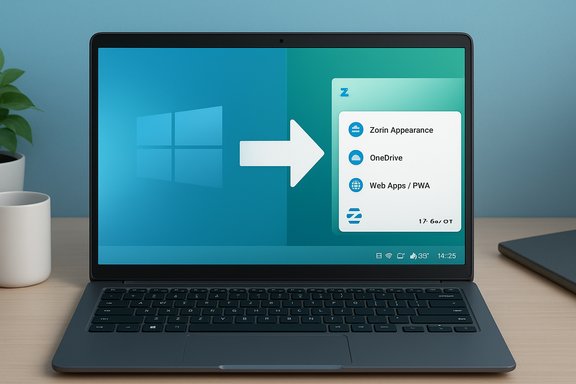
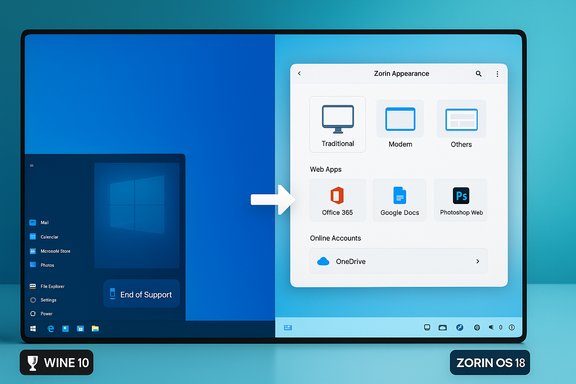
Zorin OS 18 is a major revision of the distro’s desktop offering. The primary technical and UX highlights that matter to Windows users are:- A GNOME-based desktop heavily customized for familiarity, with the Zorin Appearance and Layout Switcher tools that let users choose Windows 11, classic Windows, macOS, or compact/other layouts in a click.
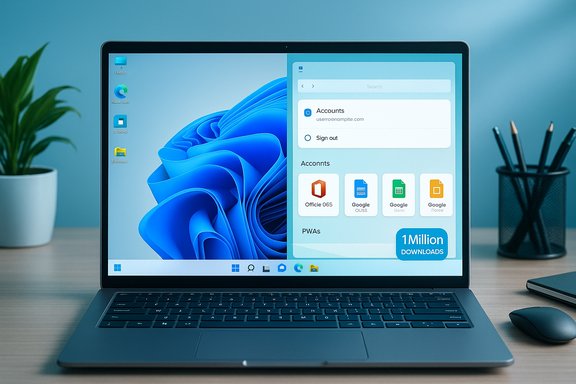
- A built-in Web Apps utility to convert frequently used cloud services (Office 365, Google Docs, Photoshop Web, Teams) into desktop-like launchers. This eases the perceived loss of Microsoft 365 workflows.
- OneDrive integration via Online Accounts so users can browse and open OneDrive-stored files directly in the Files app — an important continuity bridge for Microsoft 365 users.
- An improved Windows App Support stack powered by Wine 10, along with an installer-detection database that suggests native, web, or compatibility-layer options for over 170 common Windows installers.
- A modern LTS base and hardware enablement kernel series (reports from reviewers and distro trackers cite Ubuntu 24.04 LTS lineage and a 6.14 kernel series in practice), which offers broader driver coverage for older and newer hardware alike.
The Numbers: Downloads, Sources, and What They Really Mean
Zorin Group announced two load-bearing metrics: an early 100,000-download surge in the first 48+ hours after launch and a company-stated total of ~1,000,000 downloads by mid‑November, with about 78% of those downloads originating from Windows machines — a figure the project used to argue that many Windows users were actively testing the distro. Those announcements are publicly posted on Zorin’s blog and social channels. Independent press outlets and community aggregators — including Slashdot and XDA-reported roundups — repeated those claims and placed them in the wider context of Windows 10’s end-of-life. The cross‑reporting makes the download spike verifiable as a real event (announcement + media confirmation), but it’s essential to unpack what a “download” actually represents:- A downloaded ISO can become a live‑USB test session, a virtual machine install, multiple downloads by the same user, or a full bare‑metal replacement of Windows.
- Downloads are a strong indicator of interest and trial volume, not a direct measure of completed conversions or daily active users.
Strategic Positioning and Marketing: Timing, Messaging, and Channels
Zorin’s messaging and social‑media cadence made the release feel like a coordinated migration play. The company touts the distro as “faster, more powerful, secure, and privacy-respecting,” explicitly targeting users fatigued by forced upgrades, telemetry, or hardware replacement cycles. Key marketing levers were:- Launch-day timing to coincide with Windows 10 EoL, which provided a strong narrative hook and immediate relevance for millions of users.
- Social amplification of early milestones (100k in two days, 300k in a week, and 1M by mid‑November), with prominent posts showing Windows-origin percentages that framed Zorin as a Windows-focused migration path.
- A freemium edition mix (Core, Lite, Education free; Pro paid) that lowers the price barrier while creating a monetization route to fund development and support.
Technical Foundations: Compatibility, Kernel, and App Support
Beneath the polish, the technical decisions that matter to migrating Windows users include:- Ubuntu 24.04 LTS base and hardware enablement kernel: Zorin OS 18 rides an Ubuntu LTS lineage (widely reported as 24.04) with an updated kernel line to maximize hardware compatibility — a practical choice to extend life for older PCs. Publications and community trackers confirm the Ubuntu 24.04 base and the practical use of newer kernels (6.14 series reported in reviews).
- Wine 10 integration: Zorin explicitly bundles an updated Wine stack (Zorin’s release notes call out Wine 10) and builds a Windows‑installer detection and triage tool that reduces the uncertainty around legacy Windows applications. This is not perfect compatibility, but the maturity of Wine and Proton in 2025 makes many common consumer and productivity programs usable without virtualization.
- PipeWire audio, updated drivers, and PipeWire-based Bluetooth improvements: these platform improvements address long-standing Linux pain points for multimedia and Bluetooth audio on consumer devices.
Downloads vs. Installs: The Conversion Gap and Measurement Limits
It’s tempting to treat a million downloads as a proxy for market share movement. It is not. Key caveats:- Mirrors, torrent trackers, and caches can inflate counts; the most conservative reading is that downloads reflect “trial intent.” Zorin reports origin OS via web analytics (downloads initiated from Windows browsers), which is a meaningful but imperfect proxy for intent.
- Conversion sequence typically flows: download → live‑USB/VM test → partial use (dual‑boot) → full migration. Each step has drop-offs triggered by hardware/peripheral failures, app incompatibilities, or user comfort with the new environment.
- For enterprises and institutions, the critical metric is not downloads but pilot success rates, management/patching fit, and vendor support agreements.
Ecosystem Ripples: Ubuntu, Mint, OEMs, and Microsoft
Zorin’s headline success had immediate knock‑on effects across the desktop Linux ecosystem:- Ubuntu and other distros: Canonical and other projects reported upticks in downloads, mirror activity, and community support traffic because a general interest in Linux typically drives curiosity about other desktop distributions as well. Zorin’s Ubuntu‑based choices actually help by feeding familiarity into the wider ecosystem.
- Competitors: Linux Mint, Pop!_OS, and other Windows-friendly distros saw renewed attention; Mint remains a frequent recommendation for Windows-converts, but Zorin’s polish made it stand out in the October–November window.
- OEMs and refurbishers: a submarket for preinstalled Linux or refurbished hardware with Linux preloaded looks more attractive to price-conscious buyers unwilling to replace otherwise functional hardware. Zorin’s outreach to retail partners and a “buy a computer with Zorin pre-installed” option are tactical moves in that space.
- Microsoft: offering ESU at consumer and enterprise price points (consumer options vary from free/Rewards opt‑ins to low-cost paid paths; enterprise ESU is per‑device and escalates year-to-year) means Microsoft softened the worst immediate impact, but paid ESU also acts as an incentive to evaluate alternatives. Various outlets documented ESU terms and pricing as a significant factor in user choices.
Strengths: Where Zorin’s Playbook Works
- Lowered psychological cost of switching: the Layout Switcher and Microsoft-centric conveniences (OneDrive, Web Apps) directly attack the primary perceived losses that keep users on Windows.
- Timing + message clarity: launching on the Windows 10 EoL date turned a routine release into an event. Clear, measurable milestones (100k in 48 hours, 1M in a month) created social proof and media amplification.
- Technical pragmatism: using an Ubuntu LTS base with a recent HWE kernel, bundling Wine 10, and focusing on driver stacks and multimedia (PipeWire) made the distro pragmatic for older hardware that would otherwise be written off.
Risks, Caveats, and What Could Stall Momentum
- Downloads ≠ deployments: the most important risk is reading the download metric as a finished migration. Many will test and return to Windows because of app gaps, management needs, or habit. This is the single biggest uncertainty in the headline narrative.
- Compatibility and peripheral drivers: vendors of niche or enterprise peripherals (specialized medical devices, some printers, fingerprint readers) may lack mature Linux drivers, making full migration impractical for those users.
- Support expectations: home users can get help from communities and commercial Pro editions, but enterprise migrations require SLAs, imaging workflows, and management tooling that are still dominated by Windows ecosystems. Zorin’s paid Pro and support services help bridge that, but large-scale adoption requires wider ISV and hardware vendor buy‑in.
- Measurement transparency: Zorin’s reporting of “78% Windows-origin downloads” is plausible and tracked via web analytics, but the raw install/retention figures are private to the company and cannot be independently verified publicly at scale. Treat those origin metrics as directional, not definitive. Caveat: the exact number of completed installs and active users remains unverifiable from public data.
Practical Guidance: How Windows Users Should Evaluate Zorin OS 18
- Back up your system and data before any experiment.
- Create a bootable live USB and run Zorin for at least a week in real-world tasks (browsing, email, printing, media).
- Use a virtual machine or dual‑boot to keep a safety net for Windows‑only apps.
- Test critical peripherals (printers, scanners, audio interfaces) and mission‑critical apps in VMs or via Wine/Bottles before committing.
- If migration is for an organization, run a staged pilot with imaging, MDM/endpoint management tests, and helpdesk playbooks.
Developer View and the Road Ahead
Zorin Group is a relatively small, largely independent team that funds work through Pro sales and community support. A rapid spike to one million downloads is both an engineering and support challenge: upgrade-path bugs (Zorin warns that the Zorin 17→18 upgrader is in testing), bandwidth and mirror capacity, and more community support requests will stress resources. Zorin’s public push to stabilize in-place upgrades is the correct next step to retain new users who are already on Zorin 17 or testing via live media. If Zorin can convert a meaningful fraction of those downloads into paying Pro users or sustainable community contributors, the project will have the resources to improve vendor partnerships, driver testing, and enterprise‑grade tooling — the ingredients needed for long‑term retention.What This Means for the Desktop Landscape
Zorin’s milestone is best read as a meaningful signal, not an existential shift. It demonstrates that a vendor who removes the top adoption frictions can draw mainstream curiosity and trial at a scale that would have been unlikely just a few years ago. The structural pressures that created this moment — Windows 11 hardware gating, a hard security deadline for Windows 10, and persistent replacement costs — are real and measurable; the ESU program softened the short‑term pain but did not erase the incentive to explore alternatives. For Microsoft, the event is a reminder that lifecycle decisions have downstream effects on competition and customer sentiment. For OEMs and refurbishers, there is a business opportunity to offer Linux‑refreshed devices. For the Linux community, this is an unusually large opening to convert curiosity into durable users — but converting downloads into an installed, supported base requires ongoing work on compatibility, driver partnerships, and migration tooling.Conclusion
Zorin OS 18’s one‑million‑download milestone — with a reported 78% share of those downloads originating from Windows machines — is the clearest, most quantifiable sign yet that a non‑trivial slice of Windows users are actively testing Linux alternatives in the wake of Windows 10’s end of free support. The numbers are verified by Zorin’s own announcements and widely reported across independent outlets, but it is essential to read the metric correctly: downloads equal interest; installs and retention tell the long‑term story. For users and small organizations, Zorin OS 18 represents a practical, polished option to extend hardware life, preserve cloud workflows, and avoid immediate ESU costs. For the broader desktop market, it’s a formative moment: open‑source alternatives can scale attention fast when product design matches migration anxieties. The next stage — turning trial into durable adoption — will be decided by upgrades that work, deeper ISV and driver support, and vendor partnerships that remove the remaining migration risks.Source: WebProNews Zorin OS’s Million-Download Surge: Windows 10’s End Ignites Linux Exodus