
That discount does not suddenly transform the ROG Xbox Ally into a low-cost console replacement. It remains a Windows 11 handheld PC, complete with the benefits and occasional friction that label brings. But at ₹67,990, the standard model becomes easier to understand as a focused purchase: a handheld for Game Pass subscribers, Steam library owners, and players who value portable PC flexibility more than maximum graphics settings.
For Windows enthusiasts, this is also a significant product because it represents more than another ROG Ally refresh. The ROG Xbox Ally is a collaboration built around Microsoft’s growing effort to make Windows handheld gaming feel less like operating a tiny laptop and more like using an Xbox console that happens to support the wider PC ecosystem.
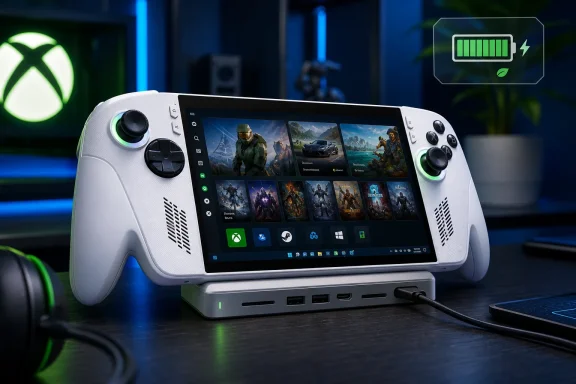 A handheld PC designed to begin with Xbox
The central appeal of the ASUS ROG Xbox Ally is not merely that it has Xbox controls. Plenty of portable PCs can map gamepad inputs to Windows. The important difference is the software path ASUS and Microsoft have designed around the hardware.
ASUS says the ROG Xbox Ally powers directly into the Xbox full-screen experience, while the dedicated Xbox button offers quick access to Game Bar and related features. ASUS’ official India product page describes the machine as launching directly into the console-style interface rather than asking users to navigate the conventional Windows desktop first. That is an important usability improvement for a form factor where small icons, touch targets, pop-up windows, and desktop maintenance are traditionally the least enjoyable parts of ownership.
The machine still runs Windows 11 Home, not a proprietary Xbox console operating system. Microsoft’s technical specification page confirms that the standard Ally uses Windows 11 Home, which gives it access to PC game stores, traditional Windows apps, browsers, mods, emulators where legally appropriate, and peripherals. It is an Xbox-oriented PC, in other words—not an Xbox Series console squeezed into a portable shell.
That distinction creates both the product’s greatest strength and its most important compromise.
The benefits of Windows flexibility
A conventional console interface has advantages: consistency, simplicity, predictable game compatibility, and a relatively controlled update process. Windows hardware offers a different set of benefits, especially for gamers whose libraries are spread across platforms.
On the ROG Xbox Ally, users can access:
- Xbox PC games and compatible Xbox Play Anywhere titles
- Xbox Game Pass downloads and cloud-enabled titles
- Steam, Epic Games Store, GOG, Battle.net, Ubisoft Connect, and other PC storefronts
- Xbox Remote Play for streaming games installed on a home Xbox console
- Streaming services, productivity apps, media software, and desktop utilities
- USB-C accessories, Bluetooth devices, microSD storage, keyboards, mice, and external displays
ASUS specifically says Windows 11 gives the ROG Xbox Ally access to PC games from Xbox and other stores, while Xbox Play Anywhere-supported games can preserve progress across PC and Xbox hardware. ASUS Store India’s listing also identifies Game Pass, Remote Play, and cloud streaming as part of the platform proposition.
For a player with years of purchases across Steam and Xbox, that open-library model can be far more valuable than a closed gaming appliance. A handheld that carries a large existing PC collection is not simply a second console; it can become a more personal, more flexible extension of a gaming setup.
The Windows caveat remains
However, an Xbox full-screen layer does not erase Windows entirely. Some games launch third-party clients. Some require logins, anti-cheat updates, launchers, drivers, or pop-ups that remain more comfortable with a mouse than a thumbstick. Game mods, legacy games, and store-specific account prompts can also pull the player back into the underlying desktop experience.
This is not merely theoretical. A Windows Central review notes the device’s Windows 11 foundation and lists its PC-like specifications and connectivity, while a separate TechRadar assessment argues that Windows remains less naturally suited to the handheld format than SteamOS, despite the Xbox interface improvements.
The right way to interpret the ROG Xbox Ally is therefore not as a device that removes PC gaming complexity. It is a device that reduces the frequency with which users have to confront that complexity.
The ₹67,990 configuration: what buyers receive
The sale model is the standard ROG Xbox Ally RC73YA-NH010W, not the more powerful ROG Xbox Ally X. Its key components align with ASUS’ Indian retail listing and Microsoft’s global technical specifications. ASUS Store India lists the Ryzen Z2 A processor, 16GB LPDDR5X memory, 512GB SSD, 7-inch Full HD screen, 120Hz refresh rate, and 60Wh battery, while Microsoft’s comparison page corroborates the core configuration.
| Component | ROG Xbox Ally at ₹67,990 |
|---|---|
| Processor | AMD Ryzen Z2 A |
| Graphics | Integrated AMD Radeon graphics |
| Memory | 16GB LPDDR5-class memory |
| Internal storage | 512GB M.2 2280 SSD |
| Display | 7-inch IPS touchscreen, 1920 × 1080 |
| Refresh rate | 120Hz with FreeSync Premium |
| Brightness | 500 nits |
| Operating system | Windows 11 Home |
| Battery | 60Wh |
| Weight | 670g |
| Wireless | Wi-Fi 6E and Bluetooth 5.4 |
| Ports | Two USB-C ports, microSD reader, 3.5mm audio |
The hardware is not intended to compete with a modern gaming laptop equipped with a mid-range or high-end discrete GPU. Instead, it is tuned around handheld realities: limited battery capacity, thermal constraints, a small display, and the need for playable performance at lower power levels.
The Ryzen Z2 A is the key to that positioning. Microsoft identifies it as the standard ROG Xbox Ally’s processor, while the Ally X receives the more capable Ryzen AI Z2 Extreme. Microsoft’s published specifications show the regular Ally with 16GB RAM and 512GB storage, against 24GB and 1TB for the premium model.
That difference matters. Buyers expecting every new AAA game to run at native 1080p with high settings will be disappointed. The standard ROG Xbox Ally is better approached as a machine for sensible compromises: lower settings, intelligent use of upscaling, frame-rate caps, and a willingness to prioritize stability over image-quality presets.
A 120Hz display is useful—but not a promise of 120 fps
The ROG Xbox Ally’s 7-inch display is one of its strongest specifications on paper. It offers 1920 × 1080 resolution, a 120Hz refresh rate, 500 nits of brightness, touchscreen support, and AMD FreeSync Premium variable refresh-rate support. Microsoft’s hardware page confirms those display specifications, including the IPS panel and Gorilla Glass Victus protection.
At this size, 1080p looks sharp. Text, user interfaces, and older titles can benefit from the higher pixel density, while the 120Hz panel can make menu navigation, esports games, indie titles, and less demanding action games feel more responsive.
But the word “120Hz” should not be confused with 120 frames per second in every game. The refresh-rate ceiling only shows what the panel can display. It does not create additional GPU performance.
For demanding games, a more realistic target may be 30, 40, 45, or 60 fps, depending on the title and settings. This is where variable refresh rate is valuable. It can help the display adapt more smoothly to changing frame rates, reducing the distraction of tearing and making imperfect performance feel more controlled.
ASUS also promotes support for AMD software technologies including FidelityFX Super Resolution, Radeon Super Resolution, and AMD Fluid Motion Frames in supported games. ASUS’ launch announcement identifies these as part of the graphics feature set available to the ROG Xbox Ally family. These technologies can improve apparent fluidity or allow games to render at lower internal resolutions before scaling upward, but results vary sharply by title and implementation.
The practical takeaway is straightforward: the ROG Xbox Ally’s screen is good enough to make lower internal render resolutions less punishing than they might look on a large desktop monitor. A well-tuned 720p or 900p presentation on a seven-inch screen can still look attractive, especially when it buys smoother gameplay and better battery life.
Battery life: larger capacity, realistic limits
Handheld PC battery claims need context, and ASUS provides more context than many manufacturers. The standard ROG Xbox Ally includes a 60Wh battery, a meaningful increase over the original ROG Ally’s 40Wh capacity. ASUS’ India page says the device can deliver up to 110% more battery life than the earlier model in selected tests.
Those results are not universal. ASUS’ stated comparison uses specific games, 720p resolution, frame-rate limits, low or default graphics settings, defined brightness, active wireless radios, and particular performance modes. In its published testing, ASUS cites up to 5.4 hours in Hollow Knight: Silksong in a 10W Silent mode scenario and up to 2.3 hours in Forza Horizon 5 in a 15W Performance mode scenario. ASUS documents those test conditions rather than presenting the figures as universal runtime promises.
That is the correct framing. Lightweight indie games, streaming, emulation, and modestly demanding titles can produce very respectable portable sessions. New graphically intensive games played at aggressive power settings will drain the 60Wh cell much faster.
How to think about handheld endurance
Battery life will depend on more than the game itself. The most influential settings include:
- Power profile — Silent, Performance, and Turbo modes can materially alter consumption.
- Resolution and render scale — Running at 720p or using upscaling often reduces GPU load.
- Frame-rate cap — A 40 or 60 fps limit can be more efficient than chasing the display’s 120Hz maximum.
- Screen brightness — The 500-nit panel is welcome outdoors, but high brightness costs power.
- Wireless activity — Cloud gaming, downloads, multiplayer, and remote play all depend on active networking.
- Game engine behavior — Some games are simply better optimized than others.
The 60Wh battery is a legitimate advantage over the original 40Wh ROG Ally, but it does not overturn the basic physics of handheld PC gaming. This is a portable machine, not an all-day device for local AAA gaming.
Ergonomics, controls, and why 670g deserves attention
ASUS has redesigned the chassis around Xbox-style controls and contoured grips. The official ROG India page says the grips are inspired by Xbox controllers and designed for balanced comfort during longer sessions. That is an important refinement because raw performance means little if the machine becomes uncomfortable after an hour.
The Xbox button also provides a physical route to Game Bar and widgets, rather than forcing a user to dig through a software menu. Microsoft states that pressing the button opens Game Bar and customizable widgets.
Yet the 670g weight deserves as much attention as the contoured design. Microsoft’s dimensions and weight listing places the standard model at 670g, and Windows Central’s spec rundown reaches the same figure. That is not excessive for a full Windows handheld with a 60Wh battery, but it is considerably more substantial than a typical controller or a lightweight tablet.
For short sessions, the mass should be manageable. For long sessions, many owners will likely rest the device on their lap, a pillow, desk edge, or handheld stand. The included stand listed by Microsoft is a useful touch, though it should not be mistaken for a complete dock. Microsoft’s accessories information identifies a 65W charger and stand as items included with the standard Ally.
Storage and connectivity make it more PC than console
The 512GB SSD is adequate as a starting point but modest for a modern game library. After Windows, recovery partitions, apps, and updates take their share, usable capacity will be lower than the number printed on the box. A handful of large current-generation games can consume much of the drive surprisingly quickly.
Fortunately, the storage decision is less restrictive than on many portable devices. Microsoft specifies a 512GB M.2 2280 SSD and explicitly notes that it is designed for easier upgrading. Microsoft’s storage specification confirms the standard 2280 format, while ASUS says the drive can be replaced with an off-the-shelf upgrade if more room is needed. ASUS’ ROG Xbox Ally page makes the same point.
That serviceability is a meaningful strength. Buyers can start with the included 512GB and later add capacity rather than treating storage as permanently fixed. Still, opening hardware and migrating or reinstalling Windows is not a console-like task, so users should factor in the cost and effort of an eventual upgrade.
Connectivity is similarly generous for a handheld:
- Two USB 3.2 Gen 2 Type-C ports with DisplayPort and Power Delivery support
- UHS-II microSD card reader
- 3.5mm combination audio jack
- Wi-Fi 6E
- Bluetooth 5.4
Those connections are confirmed in Microsoft’s hardware comparison. Microsoft’s I/O and networking specifications make clear that the machine can move beyond handheld-only use. A USB-C dock, display, keyboard, mouse, Ethernet adapter, and controller can turn it into a compact desktop-style Windows PC when needed.
That is not a substitute for a powerful desktop or gaming laptop. But it does increase the value proposition for buyers who want one device that can serve as a travel gaming system, a streaming client, and a lightweight general-purpose Windows computer.
Standard Ally versus ROG Xbox Ally X
The discounted standard model is the value-conscious entry in the lineup. The ROG Xbox Ally X is the performance-oriented alternative, equipped with AMD’s Ryzen AI Z2 Extreme processor, 24GB of LPDDR5X memory, a 1TB SSD, and an 80Wh battery. Microsoft’s comparison chart confirms those major differences, while the India launch pricing reported by Moneycontrol put the Ally X at ₹1,14,990.
The standard Ally is therefore not the model to buy for someone who wants the fastest possible handheld PC or the greatest headroom for demanding games. Its appeal is more restrained:
- It costs significantly less than the Ally X.
- It offers the same Xbox-oriented handheld experience.
- It retains the 7-inch 120Hz 1080p display.
- It includes 16GB RAM, which remains workable for mainstream handheld gaming.
- It uses the same broadly flexible Windows ecosystem.
- It has a larger battery than the original ROG Ally.
The Ally X earns its premium through more powerful silicon, more memory, more storage, and a larger battery. For buyers who plan to play the newest demanding titles locally and keep the device for several years, that extra headroom may justify the expenditure. For players focused on indies, older AAA releases, streaming, emulation, and Game Pass titles with careful settings, the standard model at ₹67,990 is the more financially balanced choice.
The Game Pass bundle adds value, with conditions
Microsoft advertises three months of Xbox Game Pass Premium with qualifying ROG Xbox Ally and Ally X purchases. The official Xbox handheld page describes the benefit as including access to hundreds of games that can be downloaded or streamed, subject to the service’s normal availability and terms.
That bundle can materially improve the first few months of ownership. Instead of purchasing several games immediately, a new owner can test the device across varied genres—indies, racing games, first-party Xbox releases, co-op titles, and cloud-enabled games—to learn which experiences suit the handheld best.
There are practical cautions, however. Game Pass catalogues change, cloud gaming quality depends on the network, and offer eligibility can vary by account status, region, redemption period, and retailer. The bundled subscription should be treated as a valuable extra, not as a permanent substitute for owning the specific games a buyer wants to play long term.
The bottom line: a better price for the right type of gamer
At the reported ₹67,990 price, the ASUS ROG Xbox Ally becomes a more persuasive Windows gaming handheld because it brings the entry cost closer to what its component mix and performance target justify. TechnoSports’ deal report identifies the listing as a limited retailer price rather than a new permanent MSRP, so buyers should verify the live figure, seller identity, warranty terms, and bundle eligibility before ordering.
Its strongest qualities are clear: a well-specified 7-inch 120Hz display, a more useful 60Wh battery than the original ROG Ally, upgradeable M.2 2280 storage, broad PC game-store access, strong connectivity, and an Xbox interface designed to make Windows handheld gaming less cumbersome. The ROG Xbox Ally’s biggest advantage is that it does not force a choice between Xbox services and the wider PC gaming world.
Its limitations are equally important. The Ryzen Z2 A is not a desktop-class graphics solution, 512GB fills quickly, Windows still occasionally behaves like Windows, 670g can feel heavy during extended handheld use, and the 120Hz panel does not guarantee triple-digit frame rates in modern AAA releases.
For gamers who want a portable Xbox-style experience with Steam, Game Pass, Remote Play, cloud streaming, and the open-ended utility of Windows 11, the discounted ROG Xbox Ally is a strong fit. It is not the handheld for uncompromising graphics settings or console-like simplicity in every scenario—but at ₹67,990, it is a far more compelling entry point into portable PC gaming with Xbox integration.
