

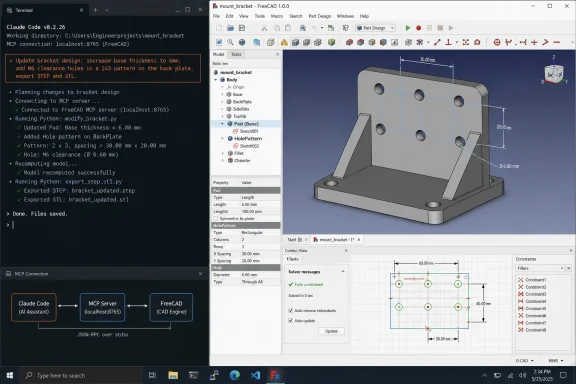
That can be a meaningful improvement for mounts, brackets, adapters, hole patterns, and simple enclosures. But the “half the time” figure, published by MakeUseOf on August 5, is a personal workflow measurement, not an independently benchmarked result. The article does not identify the parts used for comparison, whether print failures and post-processing were included, the Claude plan or token usage, the FreeCAD version, or how much prior prompt and CAD expertise the author brought to the test.
Those omissions do not disprove the experience. They do mean Windows users should treat this as evidence of a promising automation pattern, rather than proof that a conversational model has made conventional CAD dispensable.
FreeCAD remains the system doing the engineering work
The setup described by MakeUseOf relies on the open-source FreeCAD MCP project from developer neka-nat. MCP, or Model Context Protocol, is the connector that gives a model access to external tools. In this case, Claude can create and edit FreeCAD documents and objects, execute Python inside FreeCAD, obtain object details, capture a view, and run certain analyses.
FreeCAD is still responsible for building the actual parametric model: sketches, constraints, pads, booleans, fillets, bodies, and exports. That distinction is practical, not semantic. A generated .FCStd project can remain editable in FreeCAD after Claude’s session ends, which is far preferable to a black-box mesh generated by an AI service. FreeCAD’s current stable 1.1.1 release also follows the project’s work on more resilient parametric references, a relevant improvement when a model is repeatedly altered by scripts.
The real shift is that Claude Code can turn a plain-language request into a sequence of FreeCAD Python operations, observe a failure or incomplete result, and revise the sequence. A request such as “make a 120 mm by 80 mm mounting plate with four M4 clearance holes 10 mm from each corner” maps cleanly to dimensions, repeats, and simple constraints. Such work is often tedious precisely because it is routine.
Claude Code’s terminal-oriented workflow also supplies a place to keep a project folder, notes, earlier scripts, and generated files together. Anthropic’s documentation confirms that Claude Code supports local MCP servers and project-scoped configuration, so it can work against tools on the same PC and use a stable project directory. That is a better fit for iterative design files than treating every adjustment as an isolated desktop chat.
The claimed Claude Desktop limitation is not entirely borne out
MakeUseOf presents Claude Code’s ability to react to FreeCAD errors as a workflow that “was simply not possible” in Claude Desktop. The public record for the FreeCAD MCP server complicates that claim.
The main FreeCAD MCP project explicitly documents Claude Desktop support. Its tool list includes creating, editing, deleting, inspecting, and listing FreeCAD objects, obtaining screenshots, and executing arbitrary Python in FreeCAD. In other words, Claude Desktop with the same MCP server already has the basic ability to issue a CAD operation, receive a tool result, and issue another operation. The server’s own demonstration material is built around Claude Desktop control.
Claude Code may be a much more convenient environment for the author’s repeated error-handling loop, particularly when FreeCAD scripts and project files live alongside the ongoing session. But it is not accurate to attribute the entire capability to Claude Code alone. The important ingredient is an MCP-connected CAD application with a tool-capable agent, while Claude Code adds persistence, filesystem context, command-line management, and a development-oriented interaction model.
There is another unverified detail in the report. The FreeCAD MCP project’s public tool inventory does not list a dedicated command for reading FreeCAD’s Report View. It does expose execute_code, which can run Python in the application, and other inspection tools that can give Claude useful feedback. The author may indeed have built a working feedback loop, but the claim that Claude Code directly reads the Report View should be understood as a description of that individual configuration, not as a documented stock feature of FreeCAD MCP.
That is still enough to change the workflow. Most CAD users do not need a model to understand design intent in the abstract; they need it to notice a failed boolean, modify a radius or placement, and regenerate the model without making the human become the courier for every error string.
Text-only feedback is a cost control, not a geometry check
One of the more useful practical observations in the MakeUseOf report concerns --only-text-feedback. The project documentation confirms that this is a FreeCAD MCP server option that suppresses screenshots returned by tool calls. It is not a FreeCAD command-line switch and not a special Claude Code feature.
That matters because image output consumes context and can slow the agent’s loop. A server that sends a viewport screenshot after each edit can encourage an AI to repeatedly ask, inspect, and re-inspect before it has done much modeling. For straightforward operations, text describing object state and successful execution is often enough. The user can then look at the real FreeCAD viewport alongside Claude Code.
The trade-off is obvious: text feedback can confirm that an operation completed, but it cannot reliably establish that a part is visually or mechanically correct. A bracket can have the correct overall dimensions while a fillet is on the wrong edge, a hole is on the wrong face, or an orientation is reversed. It can also be geometrically valid yet unsuitable for a printer because of wall thickness, unsupported overhangs, shrinkage allowance, or a poor print orientation.
A safer operating pattern is to let Claude use text-only responses for intermediate construction and request visual verification at defined checkpoints: after the base profile, after functional features such as holes or snap fits, and before export. The project supports per-tool screenshot control as well, so the choice does not have to be global.
The easy jobs are the ones CAD automation has always favored
The author’s best examples—mounting plates, fixed bolt patterns, symmetric cutouts, pegboard hooks, and brackets—are strong candidates because they can be described as parameters. CAD already excels when intent is expressed as repeatable relationships; AI reduces the friction of translating that intent into the application’s commands and constraints.
This is why the workflow may feel dramatically faster to hobbyists even where it is not technically novel. FreeCAD has long had a Python interface, and experienced users could automate families of parts with macros or scripts. Claude makes that scripting layer accessible to people who know the desired object but do not know FreeCAD’s API syntax, object names, workbench conventions, or constraint vocabulary.
The limit arrives when the design intent itself is ambiguous or distributed across many dependent components. MakeUseOf reports that assemblies with three or four interacting parts, hinges, and snap-fit enclosures still require manual intervention or deliberate decomposition into separate conversations. That accords with the underlying problem: a language model may generate operations, but it does not automatically acquire a durable engineering model of every mating relationship, tolerance stack, manufacturing method, and revision dependency in an assembly.
Geometric dimensioning and tolerancing is the sharper boundary. “Make this fit tightly” is not an engineering specification. A designer still has to choose nominal dimensions, clearance or interference, material assumptions, printer calibration, layer direction, and the measurement method that will decide whether a part passes. Claude can help encode those decisions after they are made. It should not be trusted to silently make them.
The installation path deserves more scrutiny than the headline gives it
For an individual maker, the biggest risk may not be an incorrect bracket. It is the trust boundary created by installing an MCP server that can control FreeCAD and execute Python locally.
The neka-nat project requires a FreeCAD add-on in the user’s FreeCAD module directory plus a locally executed MCP server. Its documentation describes an execute_code capability that runs arbitrary Python in FreeCAD. That is a powerful feature and central to why the integration works. It also means the agent can cause more than a harmless viewport change if its tool permissions and local environment are not managed carefully.
The project defaults its RPC connection to localhost, which is the correct baseline. Users should leave it there unless a remote-control arrangement is genuinely needed. Enabling remote connections binds the service for network use and requires an explicit allowed-IP configuration; that is not something to turn on merely to make experimentation more convenient.
MCP’s own security guidance warns that local servers run with the user’s privileges and can present arbitrary-code-execution, data-loss, and data-exfiltration risks if they are malicious or compromised. Anthropic similarly advises users to treat third-party MCP servers as untrusted unless they have reviewed and accepted the risk. This FreeCAD bridge is a community project, not a Microsoft-, Anthropic-, or FreeCAD Foundation-supported component, and its GitHub repository currently publishes no formal releases.
For Windows enthusiasts, the sensible approach is to use a non-production FreeCAD profile, keep project files under version control or frequent backups, review the server code and dependencies before updating, and avoid granting the agent broad filesystem access. Do not place sensitive files in the same working directory simply because the CAD task itself appears low risk.
Claude Code can remove sketch drudgery; it cannot sign off a part
MakeUseOf has identified a credible sweet spot: low-complexity, parameter-driven printed parts where the human can visually inspect the model and test a prototype quickly. In that setting, Claude Code can reduce the time spent creating repetitive sketches and editing constraints, while FreeCAD preserves a proper parametric project that the user can reopen and correct.
The stronger conclusion is narrower than the headline. Claude Code has not replaced CAD software; it has made FreeCAD’s scripting interface easier to use for a class of tasks that many casual makers previously performed manually. The more safety-critical, tolerance-sensitive, or assembly-dependent the part becomes, the more the workflow returns to conventional CAD discipline.
For a one-off cable mount or pegboard hook, that may be exactly the right division of labor. For a hinge, enclosure, or component that must fit another manufactured part, the final authority remains the FreeCAD model, the calipers, and the physical test print—not the confidence of the chat session.