

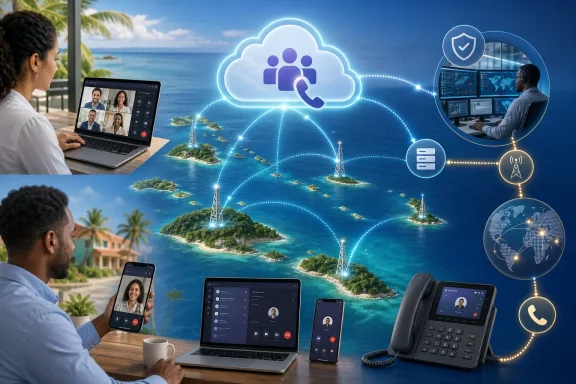
The deal puts LoopUp’s Operator Connect service behind Digicel’s local enterprise sales and support operation. For businesses that already use Teams for chat and meetings, it offers a way to replace—or at least reduce reliance on—traditional PBX equipment and bring ordinary external calling into the same Teams client on PCs, mobiles, Teams desk phones, and meeting-room devices.
Digicel and LoopUp describe it as the Caribbean’s first or only regionwide Microsoft-certified Operator Connect offering. Independent coverage from Intelligent CIO LATAM also reported that the service became available to Digicel Business customers in July. But the two companies have not published the details IT buyers need to turn “Caribbean-wide” into a deployment plan: no per-country launch list, no price card, no published service-level agreement, and no explanation of which legacy calling features or emergency-call arrangements vary by market.
This is Operator Connect, not a generic Teams add-on
Operator Connect is Microsoft’s carrier-integration model for Teams Phone. The carrier handles the connection to the public switched telephone network, provides or ports telephone numbers, and operates the telephony infrastructure; the customer administers users and assigns numbers in the Teams admin center.
Microsoft positions it between two familiar alternatives. Calling Plans make Microsoft the calling provider, while Direct Routing lets an organization connect its chosen carrier through a session border controller, or SBC. Operator Connect is designed to avoid the customer-operated SBC that Direct Routing commonly requires, but it does not remove the carrier relationship. The phone-number service contract remains between the organization and the Operator Connect provider.
For the Digicel customer, that means Digicel is the commercial and local-service face of the offering, while LoopUp supplies the Microsoft-certified Operator Connect platform. LoopUp’s interest is equally clear: it gains a route into Caribbean enterprises through an operator with local sales teams and established billing relationships. Digicel gains a Teams-native voice product without having to build and certify its own Operator Connect platform.
This is useful for a multinational with offices in Jamaica, Trinidad and Tobago, Barbados, or other Digicel markets that wants one Teams calling model rather than a collection of local PBXs and carrier contracts. It can also be useful for a Caribbean-based organization that wants to keep telecom support closer to home while moving the user experience into Microsoft 365.
The offering does not mean a regular Microsoft Teams or Microsoft 365 license suddenly gains external calling. Microsoft’s own Teams Phone documentation is explicit: users need the Teams Phone application license and a PSTN connectivity service. In this case, the PSTN service is purchased through the Digicel-LoopUp arrangement. That licensing cost, along with the carrier subscription and any implementation work, is absent from both companies’ announcements.
The “regionwide” claim has no country-by-country definition
The missing country list is more than a communications flaw. Telecom regulation, number portability, emergency calling, local caller ID, and availability of geographic or toll-free numbers are all country-specific. A business with a regional headquarters cannot safely assume that an offer described as “Caribbean” has uniform capability in every location where it operates.
LoopUp’s own public coverage page makes that gap more conspicuous. Its general matrix lists many Caribbean markets—including Jamaica, Trinidad and Tobago, Barbados, the Bahamas, Belize, the Dominican Republic, Anguilla, Antigua and Barbuda, and Turks and Caicos—with Direct Routing and SIP-trunking availability. But the same matrix currently shows no Operator Connect availability for those entries, including Jamaica and Trinidad and Tobago.
That conflicts with the July announcement that Digicel and LoopUp have launched Operator Connect in the Caribbean. The most charitable explanation is that LoopUp’s coverage matrix has not been updated for the new Digicel partnership, or that the table reflects LoopUp’s direct retail availability rather than services resold through Digicel. Neither company explains the distinction. Until it does, the matrix cannot be used as a reliable purchasing guide for the new service.
The public information also does not establish whether all of Digicel’s 25 markets are included, whether Central American markets are in scope, or whether “across the Caribbean” means only markets where Digicel Business has a particular fixed-line and enterprise-support presence. Digicel’s corporate announcement refers broadly to the Caribbean and beyond; LoopUp’s announcement also refers to the Caribbean region; neither publishes the actual service footprint.
That uncertainty matters most for organizations planning standardized rollouts. A customer may be able to use Operator Connect for employees in one country but need Direct Routing, a separate local carrier, or a different Teams PSTN model elsewhere. Microsoft supports mixed connectivity models inside one tenant precisely because geographic and technical requirements can differ by user group and region.
Retaining a number is a process, not a product checkbox
Digicel says customers can retain existing Digicel numbers or port numbers from other providers. That is a significant promise for organizations that have published main numbers, contact-center numbers, government lines, hotel reservations numbers, or emergency contacts for years.
But the statement does not say in which countries porting is available, what number types qualify, how long the process takes, whether temporary numbers will be issued during migration, or whether auto attendants, call queues, and analog-device dependencies must be redesigned first. Those are the implementation details that determine whether replacing a PBX is a short project or a staged migration.
Microsoft’s Operator Connect model is built around the carrier ordering and uploading numbers to the customer’s Teams tenant. That makes the carrier responsible for number acquisition and porting workflow, rather than allowing an admin to simply click “add number” and complete the job in the Teams admin center. For Digicel customers, it also means the exact migration experience will depend on Digicel’s order process and LoopUp’s provisioning process, not only on Microsoft’s interface.
The partnership should reduce infrastructure work for organizations currently operating their own Direct Routing SBCs. It will not eliminate call-flow design. Companies still need to plan user numbers, main reception numbers, resource accounts, auto attendants, call queues, delegated calling, compliance recording where required, and the cutover of any devices that cannot operate as Teams endpoints.
A customer with a straightforward knowledge-worker deployment may find Operator Connect markedly easier than building Direct Routing. A customer with complex contact-center integrations, specialist analog equipment, local regulatory obligations, or custom dial plans needs to confirm feature parity before retiring anything.
Emergency calling remains a local responsibility
The most consequential omission is emergency services. LoopUp’s marketing materials emphasize emergency-services routing as part of its broader telephony coverage, but neither the Digicel nor LoopUp announcement says how emergency calling works in each Caribbean jurisdiction, which emergency numbers are supported, or whether emergency addresses are carrier-managed or editable by tenant administrators.
Microsoft documents that Operator Connect partners can implement emergency-address management in different ways. Depending on the carrier’s configuration, the operator may assign the emergency address and allow customer edits; leave address assignment to the customer; or retain control of both the number and its assigned emergency address. That is not a cosmetic administrative difference. It determines who must act when an employee changes office location or when an organization reassigns a number.
This is particularly important for hybrid workers. Teams can support emergency-calling policies and location-aware routing in supported scenarios, but organizations should not treat a Teams softphone as a mobile emergency service merely because the user can make a call from a laptop. A rollout should include country-specific confirmation from Digicel on emergency dialing, location handling, remote-worker behavior, and escalation responsibilities.
Digicel and LoopUp are selling a carrier-managed service, so they should be able to provide that documentation before a customer signs. At present, it is not in the public launch material.
A useful new channel, but not yet a complete deployment specification
The practical development is real: Digicel Business now has a route to sell Microsoft Teams calling that is integrated with Microsoft’s Operator Connect framework rather than asking every enterprise customer to deploy and manage Direct Routing infrastructure. That should be attractive to organizations with standard Teams calling requirements and operations spread across Digicel-served markets.
The August 11 Telecompaper item, however, lands after the service’s June-and-July launch window and adds no new rollout detail. The announcement still leaves buyers without the essentials: eligible countries, pricing, number-porting rules, service guarantees, support boundaries, and emergency-calling treatment.
For IT teams, the next action is not to replace a PBX based on the phrase “regionwide.” It is to ask Digicel for a written per-country capability matrix that covers Operator Connect availability, number types, portability, emergency services, supported Teams Phone workloads, support ownership, and migration dates. Until that exists, the partnership is a promising sales channel for Teams telephony—not a complete specification for a Caribbean-wide voice deployment.