
The most useful fact for Windows users is also the simplest one: there is no official GTA VI PC download to authenticate. Rockstar’s current support documentation lists pre-orders only for PlayStation 5 and Xbox Series X|S, with the game scheduled to launch on November 19, 2026. Rockstar has not announced a Windows release, a PC demo, or a PC preload. A 113GB Windows ISO claiming to be GTA VI is therefore not an early version of a legitimate PC distribution channel; it is an unverified executable delivery mechanism wearing a highly recognizable game’s name.
The underlying sample has not been published for independent inspection by a major antivirus vendor, Microsoft, or a named malware-research lab. That leaves important limits on what can be stated: the reported code shows an apparent attempt to weaken defenses, but public reporting has not established a complete payload chain, a confirmed credential-stealer family, or a verified victim count. Calling it a proven password-stealing campaign goes further than the public evidence supports.
It is still dangerous enough to treat as an incident if it was launched. A program that successfully excludes C:\ from Defender scanning creates a broad blind spot, and Microsoft explicitly warns that antivirus exclusions reduce protection and should be used sparingly. The attacker does not need a 113GB game to do damage; the size is part of the social engineering.
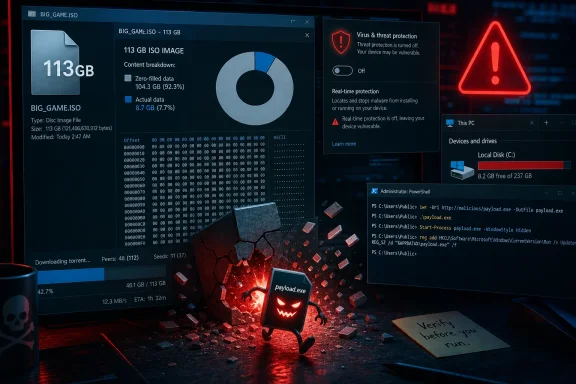 The file size is the scam’s most effective feature
A 113GB download sounds plausible for a modern open-world game. That is the point. Storage size is an easy visual signal for users to trust, especially when a supposed leak is framed as a developer build full of unoptimized assets, debug files, or incomplete content.
The reported analysis says the ISO is 99.99% empty zeroes. Zero-filled data consumes disk space, takes time to download, and makes a torrent listing look substantial without providing any game assets. It also changes the victim’s mental calculation: someone who has waited hours or days for 113GB to arrive may be more willing to ignore warnings, run an unfamiliar installer, or approve a User Account Control prompt rather than concede the download was fake.
This is an old malware tactic adapted to a current cultural event. Attackers frequently borrow legitimate software names, fake installers, cracks, cheats, and “early access” claims because users expect an unusual installation process. The GTA VI angle gives the operator a rare advantage: there is sustained public interest in alleged leaked material, while there is no authorized Windows client against which a user can compare the file.
That means file properties are largely useless as a trust signal. A large ISO, a Rockstar-style icon, a folder named build, screenshots in a torrent description, and even a working launcher window can all be fabricated. The only meaningful source validation here is the distribution channel itself—and Rockstar has not provided one for PC.
Defender exclusions would turn a fake game into a security incident
According to the reverse-engineering account cited by Tom’s Hardware, the malicious code contains a PowerShell command intended to add the entire system drive to Microsoft Defender Antivirus exclusions. Microsoft’s documentation confirms that Defender supports file, folder, process, and extension exclusions through PowerShell, including the Add-MpPreference cmdlet.
An exclusion for a single trusted development folder can be risky. An exclusion covering the Windows system drive is fundamentally different: it can prevent the antivirus engine from scanning a vast portion of the machine’s ordinary file activity. Microsoft describes every exclusion as a protection gap. It is especially alarming in a malware scenario because a dropped payload could write files, unpack archives, or stage follow-on components where routine scanning is reduced or absent.
The reported sample also attempts to kill security processes. Whether either action succeeds depends on the affected device’s configuration, the malware’s privileges, whether the victim approved elevation, and protections such as Defender Tamper Protection or enterprise policy. That technical uncertainty is not a reason to execute the file “to see what happens.” It is a reason to assume a machine may be compromised once the installer has run.
For enterprise administrators, the incident signal is broader than a file named after GTA VI. Look for unexpected Defender configuration changes, especially new path exclusions that include root directories; attempted security-process termination; suspicious PowerShell launched from a mounted ISO, temporary extraction directory, or a user Downloads path; and endpoints that suddenly stop reporting healthy antivirus status.
A well-managed environment should be able to answer a basic containment question quickly: did any endpoint recently receive a new Defender exclusion outside approved software deployment or administrator activity? If the answer requires manually inspecting each PC, this scam is a useful reminder that endpoint configuration changes deserve centralized monitoring.
The genuine leak chatter is useful cover, not proof
The fake ISO did not appear in a vacuum. Recent claims from an online identity calling itself Cyberleek have generated substantial attention around alleged GTA VI gameplay and development material. PC Gamer, Tom’s Hardware, and other gaming outlets have reported on the account’s stated opposition to digital pre-orders and its threats to release more material. Take-Two has reportedly sought information connected with accounts and services associated with the leaks.
Those events may explain why a fake download can persuade people who would normally reject an unsolicited game installer. When alleged clips, maps, and screenshots circulate, a “playable build” becomes just believable enough to lure users into searching for it. The operator behind the ISO does not need to prove possession of Rockstar code. They only need to take advantage of a conversation in which prospective victims already think an unauthorized build might exist.
But the official record breaks the premise. Rockstar’s own GTA VI platform page and customer-support materials identify PS5 and Xbox Series X|S, not Windows. The company says console preloads begin on November 12, 2026, ahead of the November 19 launch. Even physical copies contain a download code rather than a game disc. None of that creates a legitimate reason for a Windows user to seek a 113GB GTA VI ISO now.
The absence of an official PC release does not merely make the torrent suspicious. It makes the claimed product impossible to verify through normal storefront licensing, publisher hashes, signed installers, launcher entitlement checks, or known-good update infrastructure. That removes the ordinary guardrails Windows users rely on when installing major games.
If it was downloaded, the response depends on whether it ran
If the ISO was downloaded but never opened, mounted, or executed, delete it rather than inspecting its contents manually. Empty the Recycle Bin, update Defender or the organization’s endpoint protection product, and run a full scan. A download alone is not normally the same as execution, but torrents and installers are not collectibles; retaining the file creates a future mistake waiting to happen.
If the ISO was mounted or an installer was launched, treat the device as potentially compromised. Disconnect it from Wi-Fi and Ethernet to stop any possible command-and-control traffic or data exfiltration, but do not begin randomly deleting files or “cleaning” it with registry tools. Preserve enough information for an IT team to establish what ran, from where, and under which account.
Microsoft recommends a full malware scan before changing account passwords. For a deeper check on supported Windows 10 and Windows 11 systems, Microsoft Defender Offline can restart the PC and scan from outside the normal Windows environment: open Windows Security, select Virus & threat protection, choose Scan options, then select Microsoft Defender Offline scan. Microsoft notes that BitLocker-protected devices may ask for the recovery key during that restart, so users should have the key available before beginning.
A practical response sequence is:
- Disconnect the affected PC from networks if the suspicious program was executed or if it requested administrator access.
- Use a separate, known-clean device to change passwords for the Microsoft account, primary email, Rockstar account, Steam or other gaming accounts, browser-saved credentials, and any password reused between services.
- Revoke unfamiliar sessions, review account recovery details and forwarding rules, and enable multifactor authentication wherever it is available.
- Check Windows Security’s Protection history after scanning and verify that Microsoft Defender Antivirus exclusions have not been unexpectedly added.
- For company-managed hardware, report the event to IT or security operations rather than trying to self-remediate around endpoint controls.
The password step matters even if there is no confirmed infostealer in this specific ISO. The reported payload behavior is consistent with an attacker preparing a system for additional execution. Once a user has launched untrusted code with elevated permissions, the safer assumption is that credentials and browser sessions may have been exposed until the device has been assessed.
Windows users should treat unofficial GTA VI PC downloads as malicious by default
This incident is not an argument that every large torrent is malware, or that every public leak claim is fake. It is a more precise warning: a huge file can be deliberately engineered to look credible while carrying almost no legitimate content, and a game without an official Windows release offers no reliable way to distinguish a real early build from a trap.
For GTA VI specifically, the operational rule is straightforward through at least Rockstar’s currently announced November 19, 2026 console launch: do not download, mount, or execute Windows ISOs, demos, preload tools, cracks, “leaked builds,” or account-verification utilities claiming to provide PC access. There is no official PC GTA VI installer for those files to imitate.
The 113GB file may be mostly nothing, but the small portion that matters is enough to turn enthusiasm for a game leak into a compromised Windows machine.
