
The practical news is narrower than the KB number suggests. This is not a new Windows feature release, a general Intel driver update, or a patch for every PC with an Intel processor. Microsoft Support limits KB5124891 to the Copilot+ hardware class and says Windows Update will download and install it automatically. For affected users, the visible confirmation is an entry in Update history labeled “2026-08 Phi Silica version 1.2607.840.0 for Intel-powered systems.”
Microsoft’s own documentation also reveals what this August package is—and is not. KB5124891 carries the same Phi Silica version that Microsoft released for Intel Copilot+ PCs on Windows 11 versions 24H2 and 25H2 in July, but it is a separate, 26H1-specific servicing package. That points to OS-targeted packaging and compatibility work, rather than evidence of a newly trained model arriving in August.
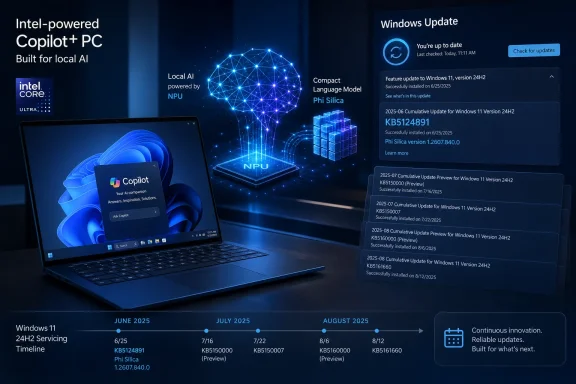 KB5124891 supersedes the 26H1 June package
Microsoft Support says KB5124891 replaces KB5103203, the Phi Silica component package released for Intel systems on Windows 11 version 26H1 in June. The outgoing package carried Phi Silica version 1.2605.856.0; the new package advances the component version to 1.2607.840.0.
The two-month version jump establishes that this is a meaningful component revision, but Microsoft does not publish a conventional changelog for it. The support article’s entire description of the payload is that it includes “improvements” to Phi Silica. It does not identify a bug fixed, a performance benchmark, a change in model behavior, a security issue, a new supported API, or a feature in Windows whose output will noticeably change.
That omission is important for administrators and developers. A model component can affect text summarization, rewriting, short-form generation, and other language operations without changing the Windows build number or an app’s version number. If an internally deployed application depends on consistent output, KB5124891 should be treated as a component update with behavioral-testing implications—not dismissed as an ordinary metadata refresh.
Microsoft’s documented replacement chain is straightforward:
- KB5103203 was the June 2026 Phi Silica update for Intel-powered Windows 11 26H1 Copilot+ PCs, delivering version 1.2605.856.0.
- KB5124891 is the August 2026 replacement for that 26H1 package, delivering version 1.2607.840.0.
- A separate July package, KB5121638, delivered Phi Silica 1.2607.840.0 to Intel-powered Copilot+ PCs on Windows 11 versions 24H2 and 25H2.
The shared component version does not make those KBs interchangeable. Windows Update evaluates the OS and hardware applicability rules behind each package. A 24H2 or 25H2 machine should not be expected to receive KB5124891 simply because it has Intel silicon or because it already uses the same Phi Silica model version.
The version matches July’s 24H2 and 25H2 rollout
Microsoft Support’s July documentation for KB5121638 lists Phi Silica version 1.2607.840.0 for Intel-powered Copilot+ PCs on Windows 11 24H2 and 25H2. KB5124891 gives 26H1 systems that same version in August, replacing the older June component branch.
This matters because it changes how the release should be interpreted. The new KB does not demonstrate that Microsoft has shipped a later Phi Silica model to 26H1 than it did to earlier Windows releases. Instead, it brings 26H1’s Intel Copilot+ PC component level into alignment with the version already documented for those earlier releases.
Microsoft Learn’s public “Release information for AI components” page, however, still lists the July Phi Silica entries for 1.2607.840.0 and KB5121638 but does not currently show the newer KB5124891 entry for 26H1. Microsoft Support’s dedicated KB page is therefore the authoritative record that the August 26H1 package exists and supersedes KB5103203; the catalog has not yet caught up with that separate OS-specific release.
For Windows servicing teams, this is a reminder that AI-component inventories can lag behind the individual Support KBs. The model version alone is insufficient for an accurate fleet picture. The relevant combination is the Windows release, the processor family, the Copilot+ eligibility state, and the installed KB recorded in Update history.
Phi Silica is part of the Windows AI runtime
Phi Silica is Microsoft’s compact, on-device language model for Windows. Microsoft describes it as a Transformer-based small language model optimized to run on the neural processing unit, or NPU, in Copilot+ PCs. Its intended tasks include text understanding, summarization, rewriting, and generating short-form content while keeping prompts and responses on the local device.
For developers, the bigger implication is that Phi Silica is serviced as a Windows AI component rather than bundled permanently into a particular application. Microsoft Learn positions the model behind Windows AI APIs, allowing applications to request local language processing without having to ship and manage a separate model package themselves.
That arrangement has advantages: the platform can improve its local AI model without each application distributing a multi-gigabyte update, and compatible apps can use a common runtime. It also means an app’s results may depend on what Windows Update has installed. A developer testing against the June 26H1 component should not assume that output, latency, moderation behavior, or edge-case handling will remain identical once the August package lands.
Microsoft’s platform documentation says Windows AI APIs ordinarily require a Copilot+ PC with an NPU for these experiences. Phi Silica has also expanded to some non-Copilot+ systems with supported NVIDIA or AMD GPUs in developer-focused scenarios, but that broader GPU availability is separate from KB5124891. This particular package’s stated scope remains Intel-powered Copilot+ PCs on Windows 11 26H1.
What affected users should check
Because Microsoft is distributing KB5124891 automatically, there is no standalone installer described in the support article and no user-facing feature switch to enable. The prerequisite is the latest cumulative update for Windows 11 version 26H1. A system missing that baseline will not meet the published installation requirement.
After Windows Update runs, users and support staff can verify the package through Settings > Windows Update > Update history. The expected entry is the August 2026 Phi Silica version 1.2607.840.0 package for Intel-powered systems, identified as KB5124891.
If the entry is absent, the first checks should be mundane ones: confirm the PC is actually running Windows 11 version 26H1, confirm it is an Intel-based Copilot+ PC rather than merely an Intel Windows machine, and install outstanding cumulative updates. The Support article does not provide an alternative download channel, manual-install procedure, known-issues list, or rollback instructions.
Enterprises should also note what Microsoft has not said. There is no published deployment ring, no indication of whether the component can be deferred independently of normal Windows Update policy, and no published compatibility statement for line-of-business apps that call Phi Silica through Windows AI APIs. The correct operational posture is to inventory the component through Update history and validate any application that relies on local text generation before treating the update as invisible plumbing.
KB5124891’s immediate effect is simple: Windows 11 26H1 now has its own Intel Copilot+ servicing package for Phi Silica 1.2607.840.0. The more consequential detail is that Microsoft is maintaining the local AI runtime on an OS-by-OS basis, even where the model version matches an earlier rollout.
