
Digital Citizen published the press-image set on August 2, and TechRadar independently inspected the same images, including the unusually broad port selection, Dolby Atmos speaker grilles, near-flat hinge and desktop UI. Separately, Android Central reported on a broader Lenovo leak first published by Android Headlines, describing two laptops and a detachable 2-in-1. Google has confirmed Lenovo as a launch partner, alongside Acer, Asus, Dell and HP, with the first Googlebooks due in fall 2026.
For Windows users, the immediate takeaway is straightforward: Lenovo appears to be putting the Googlebook badge on a conventional, well-equipped laptop chassis rather than on a stripped-down Chromebook-style machine. The unanswered question is whether the new platform can supply the professional applications, device management and peripheral reliability that make a Windows laptop practical beyond the browser.
 The Gemini key is the clearest hardware signal
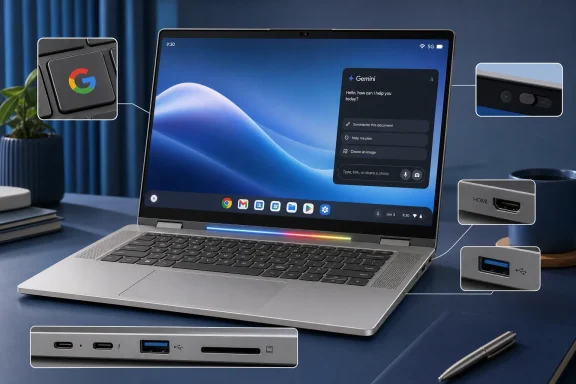
The most visible change in the Googlebook 15 render is the keyboard. A dedicated Google “G” key sits between Fn and Alt where a Windows laptop would ordinarily place the Windows key, placing Gemini at the center of the machine’s physical controls in much the same way Microsoft has pushed the Copilot key into recent AI PCs.
That placement is more than decoration. It gives Google a fixed, discoverable entry point for Gemini that is available regardless of which app is in the foreground. Google’s own Googlebook announcement says its Magic Pointer feature will surface contextual Gemini suggestions from the cursor, while its new “Create your Widget” capability can assemble desktop widgets based on a prompt and information from connected Google services.
The leak also shows a Chromebook-like combined launcher and Caps Lock key, plus a 14-key function row for navigation, window management, screenshots, display brightness, keyboard backlighting, microphone mute, volume and accessibility controls. Lenovo has omitted the numeric keypad despite the apparent 15-inch class, presumably to retain a centered keyboard and large trackpad.
That is a deliberate break from the Windows convention, but it does not make the machine unusable for Windows veterans. What it does do is make clear that Googlebook is not intended as a generic PC platform where an OEM adds a Google app to a familiar notebook. The keyboard treats Gemini and Google’s launcher as core operating-system functions.
The software images reveal an Android-derived desktop, not “Aluminum OS”
The screen captures inside the leaked press material are the most interesting part of the package. They show a desktop arrangement with a top status bar, including time, connectivity and battery indicators, and a bottom taskbar with a round Google launcher button and pinned apps. The visual language is unmistakably closer to Android than Windows 11, even though the taskbar-and-window model is designed for a laptop display.
But reports calling the software “Aluminum OS” go beyond the available record. Google has not publicly announced an operating system under that name. Its May 12 announcement describes Googlebook as bringing together Android’s app platform and ChromeOS’s browser experience, and says it is built on part of Android’s technology stack. Google’s consumer site similarly calls Googlebook a flagship category combining elements of ChromeOS and Android. Neither source publishes an operating-system product name, system requirements, release build or upgrade path.
That omission matters. A rendered desktop can demonstrate intended design; it cannot verify the underlying architecture, application compatibility or supported hardware. In particular, it cannot answer whether Googlebook uses a new desktop distribution, a reworked Android build, a ChromeOS-derived environment, or some mixture of those components behind a Googlebook-specific interface.
Google has stated that Googlebook will let users access apps and files from an Android phone and has promoted native Android applications as a central advantage. That is promising for mobile-first workflows. It is not evidence that Googlebook will run Windows applications, traditional Win32 tools, Windows drivers, or existing enterprise software stacks.
For IT departments, those distinctions are decisive. A laptop with HDMI and USB-A can physically join an office desk, but its value as a managed endpoint depends on identity integration, policy controls, encryption, endpoint detection, remote support, printing, VPN behavior and line-of-business application support. Google has not published those details for Googlebook.
Adobe Premiere Pro in a render is a message, not a compatibility guarantee
One pinned icon in the leaked taskbar has drawn attention: Adobe Premiere Pro. Digital Citizen identified it as the last application icon in the launcher row, and TechRadar also noted its presence. The imagery plainly signals that Google wants the Googlebook 15 associated with creative work rather than the education and light-browser-work stereotype that followed Chromebooks for years.
The conclusion should stop there for now. Neither Google, Lenovo nor Adobe has announced a Googlebook edition of Premiere Pro, a release date, feature set, codec support, offline capability, GPU acceleration path or subscription arrangement. There is no public indication from Adobe that the desktop Premiere Pro application is coming to Googlebook.
The icon could represent an Android version, a web service, a streamed or remote application, a forthcoming native build, or simply a future-looking marketing placeholder. Until Adobe or Google specifies which, readers should not purchase or plan around the assumption that a leaked taskbar proves professional desktop-video compatibility.
This is the main gap between Google’s aspiration and a Windows PC replacement. Windows workstations earn their place in creative and business environments because the whole chain is documented: application version, driver support, hardware acceleration, plug-ins, storage behavior and vendor support. A press render does not provide that chain.
Lenovo’s design suggests a premium category, but no price has surfaced
The Googlebook 15 looks substantially more practical than the port-starved premium laptops common in recent years. The leaked images show full-size HDMI, two USB-C ports, USB-A, a card reader and a 3.5mm audio jack. It also appears to have upward-facing speakers beside the keyboard, additional speaker cutouts on the lower chassis and Dolby Atmos branding.
The display has slim bezels with a small webcam notch and, more notably, a physical privacy shutter. Lenovo has long used mechanical camera shutters on ThinkPad and consumer laptops, so this is a familiar safeguard rather than a novel feature. It is still worth noting on a device whose headline experience calls for frequent interaction with cloud-connected AI services.
A textured lower panel, a silver finish and a hinge reportedly opening to 157.5 degrees reinforce the premium positioning Google announced in May. Google has explicitly separated Googlebooks from Chromebooks, describing the newer category as higher-end hardware with more powerful performance and tighter Android-phone integration.
Premium, however, is an intention rather than a price bracket. Lenovo has not confirmed the chip vendor, display quality, RAM floor, storage capacity, weight or battery capacity. Googlebook support from Intel, Qualcomm and MediaTek has been reported by Tom’s Hardware based on company statements and a Google executive interview, which means the platform may span both x86 and Arm systems. It does not reveal which processor will be used in Lenovo’s Googlebook 15.
The lack of pricing is especially consequential. If Lenovo prices the Googlebook 15 close to capable Windows 11 ultrabooks, it will be judged against laptops with mature desktop application catalogs, known hardware specifications and established management tooling. If it comes in closer to traditional Chromebook pricing, the hardware and performance compromises will be examined just as closely.
The full Lenovo leak includes a detachable, not only the 15-inch notebook
The Googlebook 15 is only part of Lenovo’s reported first wave. Android Central’s coverage of the Android Headlines material describes three Lenovo Googlebook devices: two laptops and a detachable 2-in-1 tablet with a kickstand, keyboard cover and stylus support. The tablet’s rear camera housing appears to incorporate Google’s distinctive Glowbar lighting element, while the laptop images suggest a similar visual marker.
Google’s official material has said all Googlebooks will carry a unique glowbar, making it an identity requirement for the category rather than an optional Lenovo design flourish. That may be why the Googlebook name, rather than Lenovo’s familiar Yoga, ThinkBook or IdeaPad branding, is visible on the 15-inch model’s palm rest.
Digital Citizen expects Lenovo to announce the devices at IFA in September, and TechRadar repeats that expectation. Lenovo itself has not announced an IFA event, named products or launch date. Google’s public commitment remains broader: Googlebooks are scheduled to arrive in fall 2026.
The next official Lenovo disclosure needs to answer the questions the renders deliberately avoid: exact models, silicon, memory, screen quality, battery life, pricing, software support terms and enterprise management. Until then, the Googlebook 15 is a convincing picture of Google’s desired laptop experience — Gemini-first, Android-connected and more premium than a Chromebook — rather than a documented alternative to a Windows 11 PC.
