

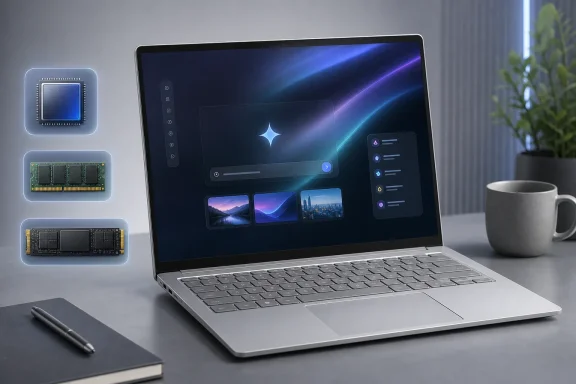
Notebookcheck first tied the GP714-91N family to Acer’s “Moonstone” Googlebook development work and reported multiple Bluetooth SIG entries for the series. A French reseller, PC21, independently lists the 50HP configuration with the same Core Ultra 5 325, 16GB memory, 256GB SSD, and 2.8K 120Hz OLED display. Google has already confirmed Acer as one of the manufacturers preparing first-wave Googlebooks for fall 2026, but neither Google nor Acer has announced this particular system.
The important detail for buyers and IT departments is that this is shaping up as a premium-tier Googlebook rather than a conventional low-cost Chromebook. The listed hardware clears the modest storage and memory profiles that still define much of the Chromebook market. But the retailer page also shows why early listings should not be mistaken for a complete product announcement: it labels the operating system “Google Chrome OS,” even though Googlebook is being positioned as Google’s newer Gemini-centered laptop platform.
The GP714-91N-50HP is a retail SKU, not a finished specification sheet
PC21’s entry identifies Acer part number NX.JWJEF.008 and describes a 14-inch machine with a 2.8K OLED display at 120Hz, Intel Core Ultra 5 325 processor, 16GB of “DDR5X” memory, and a 256GB SSD. That is substantially more concrete than the earlier code references to Moonstone, which established an Acer connection but did not establish the retail configuration.
There is a small but meaningful inconsistency in the memory description. Notebookcheck describes the machine as carrying 16GB of LPDDR5X, while PC21 uses “DDR5X,” a label that is not Intel’s or JEDEC’s normal consumer-facing memory terminology. LPDDR5X is the likely interpretation for a thin 14-inch laptop, but the retailer listing does not establish whether the memory is soldered, whether there will be 32GB variants, or whether Acer is using a conventional LPDDR5X implementation.
That distinction matters to anyone considering these systems for longer deployment cycles. A 16GB fixed-memory configuration is sensible for an AI-focused ultraportable in 2026, especially one expected to keep multiple Android applications, browser tabs, and Gemini features resident in memory. It is not, however, the same as a machine with an upgrade path. Acer has yet to publish a service manual, port map, memory configuration, battery rating, or chassis dimensions for the GP714-91N family.
The 256GB SSD deserves similar caution. It marks a break from the 64GB and 128GB eMMC storage configurations still common in cheaper ChromeOS hardware, but there is no evidence yet of a second M.2 slot, user-accessible storage, or the drive interface. For a device built around local Android applications and on-device AI functions, 256GB is a defensible starting point; it is not generous once offline media, Linux tooling, enterprise applications, and user profiles enter the equation.
Core Ultra 5 325 confirms a Panther Lake-class direction
The Core Ultra 5 325 is Intel’s lower-power Panther Lake-era part, not an older Meteor Lake or Lunar Lake processor being repackaged for a new operating system. Specifications published by Lenovo for systems using the same processor identify it as an eight-core design with four performance cores and four low-power efficiency cores, plus an NPU rated at up to 47 TOPS.
That validates the basic claim that Acer’s first Googlebook will use Intel’s next-generation mobile platform. It also corrects one common phrasing in early reports: the Core Ultra 5 325’s NPU is rated at 47 TOPS, not “more than 47 TOPS.” The system-level AI total can be higher when GPU and CPU acceleration are counted, but an NPU figure should not be inflated by mixing those measurements.
For Googlebook, the processor choice carries more weight than it would in a routine Chromebook refresh. Google has framed the new category around Gemini Intelligence, including the contextual Magic Pointer interaction and generated widgets. A capable NPU is therefore part of the product’s foundational requirement rather than a checkbox added to a browser-first laptop.
The listing does not prove every Googlebook-specific hardware element reported around Moonstone. A physical Gemini key, a privacy shutter, Wi-Fi 7, Bluetooth 5.4, Titan C2 security hardware, and the lid-mounted Glow Bar have all been associated with Acer’s forthcoming system in early coverage. Google has publicly highlighted the Glow Bar as a characteristic of the Googlebook category, and independent reporting has connected Moonstone to Acer. Still, Acer has not issued a device-level specification page confirming which of those features will survive into the GP714-91N-50HP.
That leaves the most interesting question unanswered: whether the Core Ultra 5 configuration is the entry model for a broad Acer Googlebook family, or the main configuration of a single premium 14-inch product. Notebookcheck also reported a Core Ultra 7 355 version, but the retailer listing substantiates only the Core Ultra 5 325 SKU.
The OLED panel is the clearest sign this is not a budget Chromebook
The 14-inch OLED display is the specification that most clearly separates the Googlebook 14 from Acer’s mainstream Chromebook range. PC21 lists a 2.8K panel with a 120Hz refresh rate, and Notebookcheck additionally reports 100 percent DCI-P3 color coverage. Acer has not confirmed the color-gamut figure, brightness, touchscreen support, variable refresh behavior, anti-reflective treatment, or panel supplier.
Even without those details, a 2.8K 120Hz OLED screen signals a target customer beyond schools and basic web workloads. It is the kind of panel used in premium Windows ultrabooks, where higher pixel density and wide color support benefit image work, video playback, and long sessions of text-heavy work. The tradeoff is power: OLED displays and 120Hz operation can affect battery life substantially depending on brightness and refresh-rate management, two areas where the current leak offers no useful data.
For Windows users watching Googlebook from the outside, this is the practical competitive consequence. Google is no longer leaving premium laptop hardware exclusively to Windows, macOS, and a small number of high-end Chromebooks. A 16GB, OLED-equipped, NPU-capable Googlebook becomes a credible alternative for people whose daily work increasingly lives in browsers and Android applications—but it must earn that status through software quality, battery life, peripheral support, and device management, not panel specifications alone.
The existing Acer Chromebook Spin 714 line shows that Acer can build competent 14-inch premium ChromeOS hardware. The Googlebook 14 appears positioned above that familiar formula: non-entry-level memory and storage, a faster OLED panel, newer Intel silicon, and Googlebook-specific branding. What remains unclear is whether it will retain the enterprise-friendly traits administrators expect from a mature ChromeOS deployment, including clear enrollment options, support terms, update policy, and repairability.
The French price is a channel signal, not Acer’s launch MSRP
PC21 lists the GP714-91N-50HP at €934.04 before tax, or €1,120.84 including French VAT. Notebookcheck reported a roughly €1,022 promotional price against a higher reference price, but neither number should be treated as Acer’s confirmed European MSRP.
Retailer databases routinely receive preliminary SKUs, placeholder availability information, and tax-inclusive figures before vendors formalize pricing. The PC21 listing itself presents the item as available on request rather than in stock. The difference between pre-tax and VAT-inclusive figures also explains why early coverage can appear to show different prices for the same machine.
Still, the channel pricing gives a credible indication of where Acer expects this hardware to sit. A system around the €1,000 mark would place the Googlebook 14 in direct competition with premium Windows ultrabooks and Apple’s lower-end MacBook offerings, not with education-focused Chromebooks. That price has to cover more than the screen and processor: buyers will expect premium construction, excellent standby behavior, a good keyboard and trackpad, reliable Android app scaling, and meaningful local Gemini functions.
Google’s official Googlebook site commits only to a fall 2026 launch window for hardware from Acer, Asus, Dell, HP, and Lenovo. It does not name the GP714-91N, publish its price, or give an exact sales date. A November 8, 2026 date appearing in early retail information therefore remains unconfirmed.
The GP714-91N-50HP is now real enough to be cataloged and priced, but it is not real enough to buy with confidence. Acer still needs to answer the questions that determine whether this is a capable premium laptop or simply an attractive panel attached to an unfinished platform: final software identity, port selection, battery life, memory options, security and enterprise management, regional availability, and support policy.