
Microsoft’s updated Microsoft 365 Roadmap entry, ID 561914, says the configuration will live in the Teams Admin Center and will apply to meetings hosted by the tenant. The feature is marked in development as of July 29, with general availability planned for Worldwide, GCC, GCC High, and DoD environments across Teams desktop, Mac, Android, and iOS clients.
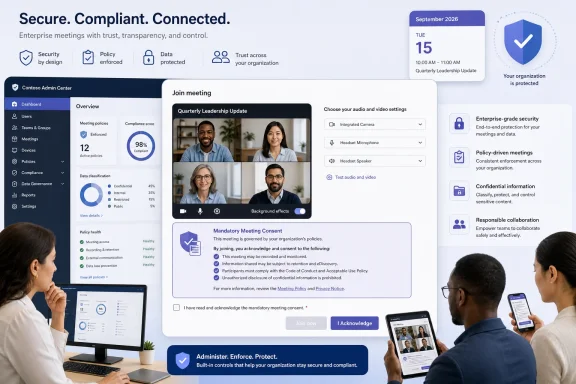 A Join Gate Rather Than a Recording Prompt
The planned setting is broader in placement than Teams’ existing consent controls for recording and transcription. Those controls deal with consent when recording or transcription begins; this new experience presents an explicit message before any attendee joins an organization-hosted meeting.
Microsoft has not yet specified the exact attendee workflow, whether users can decline and leave from the prompt, or whether the policy will apply to every meeting type and join method. The roadmap wording does make the central intent clear: admins will be able to enable the prompt and customize its text at the tenant level.
That makes the feature potentially useful for organizations that need participants to acknowledge meeting terms, confidentiality notices, acceptable-use policies, regulated-session disclosures, or AI-assistant rules before entering.
Administrators Should Treat the Message as Policy, Not Decoration
A pre-join consent screen can provide a consistent notice across a tenant, but it is not automatically a legal solution. IT and compliance teams will need to decide the message’s purpose, who owns its wording, and whether acknowledgment must be captured elsewhere for audit or recordkeeping requirements.
Teams administrators should also anticipate operational questions before rollout:
- The consent text should be short enough to be read on desktop and mobile pre-join screens.
- The policy should be tested with guests, anonymous users, federated users, and participants joining from meeting-room systems.
- Help desk teams should have a clear answer for attendees who cannot or will not accept the message.
- Organizations using separate recording-consent policies should ensure the two notices do not create contradictory or repetitive instructions.
Microsoft’s existing Teams documentation shows that meeting access behavior already varies by policy, client capability, lobby settings, and participant type. A new mandatory prompt adds another checkpoint to a workflow where external attendees are often the least predictable users.
September Is the First Rollout Target
The September 2026 date is a roadmap target rather than a detailed deployment schedule, and Microsoft can still alter scope or timing before release. No Teams client build number, PowerShell setting, Graph API support, or Message Center deployment notice has been published alongside the roadmap entry.
For Windows administrators, the practical next step is to watch the Teams Admin Center and Microsoft 365 Message Center for the policy’s final name, client limitations, and any reporting or audit behavior. The important change is not merely another notification: it is a tenant-controlled checkpoint placed directly in front of the Join button.
