
It is an intentionally enormous forecast, and Huang framed it as his personal estimate rather than a firm projection. But it explains why Nvidia is treating agentic AI, robotics and AI factories as the next demand layer beyond today’s chatbot-driven GPU boom.
Nvidia’s fiscal first-quarter 2027 results provide the immediate context. The company reported $81.6 billion in revenue, including $75.2 billion from Data Center, while forecasting approximately $91 billion for the following quarter. In its earnings materials, Nvidia has positioned agentic AI—models that can perceive, reason, plan and act—as a workload that consumes materially more inference capacity than a single prompt-and-response interaction.
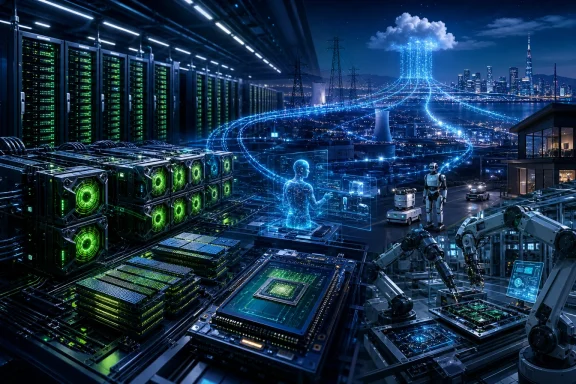 The endpoint count is Nvidia’s real argument
Huang’s case is not simply that existing AI models will become larger. It is that the number of systems requesting computation will rise dramatically as agents begin handling business processes and robots begin operating in physical environments.
For Windows users and IT teams, that distinction matters. The near-term deployment may not be a humanoid robot in an office; it may be an AI agent handling help-desk triage, threat investigation, document processing, software testing or endpoint-management actions. Each use case shifts AI from occasional assistance to continual background inference, potentially driving demand for both cloud capacity and local edge hardware.
Nvidia has already adjusted its reporting structure to reflect that thesis, separating Data Center from Edge Computing. The latter covers devices and infrastructure associated with agentic and physical AI, including PCs, workstations, robotics, automotive systems and AI radio networks.
Korea’s memory supply is part of the bet
The forecast also puts unusual attention on high-bandwidth memory, advanced packaging and dependable power—not merely GPU design. Nvidia and SK Group announced a $500 billion-plus partnership on July 24 spanning AI factories and next-generation memory, including a long-term collaboration between Nvidia and SK hynix on HBM technologies.
According to Nvidia, SK Telecom plans to build an AI cloud in Korea using Nvidia’s DSX platform and Vera Rubin infrastructure, with an initial AI factory expected online in 2027. That makes South Korea central to Huang’s expansion argument: AI capacity cannot scale at the projected rate if the industry cannot secure enough leading-edge memory and build facilities fast enough to run the resulting systems.
The practical constraint is that Nvidia’s demand narrative depends on a supply chain far broader than Nvidia. HBM suppliers, foundries, server makers, networking vendors, utilities and data-center builders must all expand without creating cost, energy or delivery bottlenecks.
A forecast that needs operational proof
Huang’s “10x” figure is a useful measure of Nvidia’s ambition, but it remains a demand thesis, not an industry forecast backed by committed orders. Enterprises will need to show that AI agents create enough measurable value to justify continuous inference spending, while cloud providers must demonstrate that their capital expenditures translate into sustainable revenue.
The checkpoints are now concrete: the Vera Rubin ramp, HBM supply agreements, deployment of gigawatt-scale AI factories and the pace at which organizations move agents from demonstrations into production workflows. If those pieces keep advancing together, Huang’s forecast will look less like rhetorical scale-setting and more like the operating plan behind the next semiconductor cycle.
