
The timing is useful for Windows enthusiasts because the history is not merely nostalgic. It explains why a current desktop buyer must weigh Windows 11 scheduler behavior, DDR5 cost, PCIe lanes, firmware maturity, cooling capacity, and upgrade paths alongside a benchmark average. The old assumption that a faster clock or bigger model number tells the whole story has been false for most of the last 30 years—and the modern market is built around that lesson.
Tom’s Hardware frames its anniversary around the publication’s own history, beginning with founder Thomas Pabst’s early coverage in 1996 and a pre-release Pentium II review in 1997. That review provoked a public dispute with Intel after the company reportedly challenged the German publications that shared access to the unreleased silicon. The episode helped establish a simple principle that still matters in enthusiast coverage: independent testing is most valuable when a vendor’s launch narrative and the measurable behavior of the hardware do not line up.
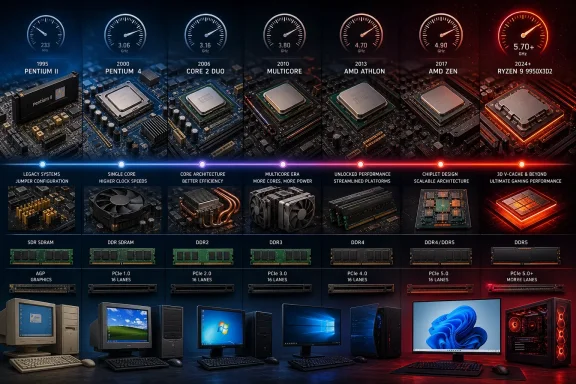 The Pentium II Era Made CPU Reviews Matter
The Pentium II and AMD K6 period looks primitive now—hundreds of megahertz, millions rather than billions of transistors, and boards that often relied on physical jumpers for configuration—but it set the template for the desktop CPU market. Intel led on performance in many workloads, while AMD positioned the K6 as a cheaper alternative that was strong enough to force comparison rather than dismissal.
That contest soon moved beyond price. AMD’s Athlon arrived in 1999 with a new K7 architecture and became a credible threat to Intel’s Pentium III line. The race to 1 GHz followed, and it produced one of the era’s defining cautionary tales: Intel recalled its initial 1.13 GHz Pentium III in August 2000 after stability problems emerged under certain conditions. Wired reported at the time that Intel had identified a potential failure scenario; the recall demonstrated that a frequency milestone was not useful if the processor could not reliably sustain it.
For modern PC builders, the parallel is clear. A launch-day headline score, an aggressive boost clock, or a premium “Extreme” designation is not a substitute for stable firmware, sensible power limits, and consistent performance across real applications. That was true when Windows 98 and Windows NT were competing desktop targets, and it remains true with Windows 11, where background services, hybrid-core scheduling, GPU drivers, and security features can all influence a benchmark result.
The Industry Learned That GHz Was a Dead End
The early 2000s made clock speed the central marketing weapon. Intel’s Pentium 4 NetBurst architecture pursued ever-higher frequencies, reaching 3 GHz in 2002 and introducing Hyper-Threading to mainstream desktop processors. AMD countered with Athlon XP model numbers designed to compare performance with higher-clocked Pentium 4 chips rather than advertise the raw frequency printed on the package.
That era produced a valuable shift in how enthusiasts judge CPUs. AMD’s argument—that work completed per clock could matter more than the clock itself—became increasingly difficult to dispute as Pentium 4 designs demanded more power and produced more heat. The arrival of Athlon 64, with AMD64 support, also put 64-bit desktop computing on the consumer roadmap before Windows x64 editions became commonplace.
Intel ultimately reset its strategy with Core 2 Duo in 2006. The company moved away from NetBurst’s thermal-heavy approach and brought stronger performance per watt to the desktop. Core 2 was not simply a faster Pentium; it was an example of the industry abandoning a familiar metric when the underlying architecture stopped scaling.
That reset remains relevant to Windows users running older systems. A processor from a later generation with lower nominal frequency can be significantly faster, cooler, and more responsive than an earlier high-clocked part. It can also offer newer instruction support, more capable integrated graphics, better media acceleration, and a platform with modern security features. CPU generations are architectural stories, not speedometer readings.
Core Counts Became a Platform Problem, Not Just a CPU Spec
The move from one core to two, then four and beyond, reshaped the PC more profoundly than any single frequency milestone. AMD’s Athlon 64 X2 and Intel’s Pentium D helped put dual-core computing into consumer systems in 2005, but Intel’s Core 2 Duo and Core 2 Quad made multicore performance far more practical. The operating system, applications, motherboard power delivery, memory subsystem, and cooling all became part of the CPU experience.
By the Nehalem generation, Intel had combined quad-core desktop chips with Hyper-Threading and DDR3 platforms, while AMD increasingly leaned on lower platform cost and longer socket support to remain competitive. Tom’s Hardware highlights this as a recurring AMD strategy: the company has repeatedly tried to make an upgrade less expensive by preserving a socket for more than one CPU generation.
That matters especially for Windows desktop owners who upgrade incrementally. A processor purchase is rarely just a processor purchase. It may bring a new motherboard, memory generation, cooler mounting kit, storage interface, and Windows activation question with it. A less expensive CPU on an established socket can be the more rational upgrade, particularly when the existing system already has a capable GPU and sufficient DDR4 or DDR5 memory.
The high-end desktop segment offers the clearest example of how quickly platform economics can change. Intel’s six-core Core i7-980X was a $999 statement product in 2010. Less than a decade later, AMD’s 16-core Ryzen 9 3950X brought far higher core counts into a far more attainable mainstream platform. The technical advance was real, but so was the market correction: workstation-class capability stopped being reserved for a tiny group of buyers.
Zen Returned Competition to the Desktop
AMD’s Zen launch in 2017 was the dividing line between Intel’s extended period of desktop dominance and the current era of rapid competitive change. Ryzen 7 1800X did not immediately win every gaming benchmark, but it restored serious competition in multithreaded workloads, pricing, and core counts. AMD then expanded the approach with Ryzen 5, Ryzen 3, and Threadripper, forcing Intel to respond more aggressively across its lineup.
The real breakthrough came with Zen 2 and Zen 3. AMD’s chiplet approach, paired with TSMC manufacturing, allowed it to scale core counts while competing much more effectively in single-threaded work and games. Ryzen 5000 eventually gave AMD a broadly recognized lead in the performance categories that had long been Intel territory.
For Windows users, the post-Zen market delivered direct benefits even when they did not buy AMD. Intel accelerated core-count increases in its mainstream products, while AMD pushed stronger value at the high end. The result was more capable systems for virtualization, media work, game streaming, code compilation, and background-task-heavy desktops. A PC no longer needed a four-figure HEDT platform to handle demanding parallel workloads.
Intel’s response with Alder Lake in late 2021 changed the design conversation again. Its Performance-core and Efficient-core arrangement made the desktop CPU a heterogeneous design, increasing the importance of scheduler support. Windows 11 was built with Intel Thread Director in mind, although practical outcomes still depend on BIOS updates, chipset drivers, application behavior, and the power profile selected by the user.
Cache, Not Cores, Is Now the Gaming Battleground
AMD’s Ryzen 7 5800X3D became one of the most consequential niche products in the last decade because it showed that a CPU could win games not through the highest frequency or most cores, but by placing far more cache close to the cores. AMD launched the eight-core chip in April 2022 with 96MB of L3 cache, and its gaming results established 3D V-Cache as a distinct product category.
That approach created an unusually practical upgrade path. Owners of mature AM4 systems could install a 5800X3D-class processor, retain DDR4 and an existing motherboard after a BIOS update, and achieve large gaming gains without replacing the entire platform. It was the opposite of the traditional flagship pitch: not a new platform demanding every new component, but a last-generation CPU extending the useful life of an old one.
Tom’s Hardware takes that arc through the Ryzen 9 9950X3D2, which AMD introduced in April 2026 as a 16-core Zen 5 processor with 3D V-Cache on both chiplets. AMD lists 208MB of total cache, a 200W TDP, and an $899 suggested price. Independent testing from TechSpot found that the extra cache did not universally justify the substantial premium, which is an important reminder that even a technically ambitious design is not automatically the right purchase.
The practical lesson is to buy for the bottleneck. A cache-heavy X3D processor can be excellent for high-refresh gaming, but it may offer a smaller advantage for an office system, GPU-limited 4K gaming rig, or workstation that spends most of its time in heavily threaded rendering. Conversely, a less glamorous CPU that delivers stronger application throughput per dollar may be the better Windows desktop choice.
Intel’s Arrow Lake Reset Has Not Ended the Fight
The retrospective closes in the unsettled present. Intel’s Arrow Lake desktop launch represented a major architectural bet: a tiled design, greater reliance on external manufacturing, a deeper hybrid-core strategy, and the removal of Hyper-Threading. Yet early results left Intel behind AMD in many gaming comparisons, even as Arrow Lake improved efficiency and delivered competitive productivity results in some configurations.
Intel’s 2026 Core Ultra 5 250K Plus and Core Ultra 7 270K Plus refreshes have changed the price-performance picture. Tom’s Hardware and TechSpot both found the Core Ultra 7 270K Plus particularly competitive in productivity work at roughly the $300 level, though its gaming standing remains more complicated than the headline claims surrounding the refresh. It is a sign that Intel is using pricing, tuning, and binning to regain ground while it prepares its next major desktop architecture.
That brings the three-decade history back to its central point. Intel and AMD have repeatedly traded leadership not because one metric permanently decides the market, but because the bottleneck changes: clocks, thermals, core counts, manufacturing nodes, cache capacity, memory latency, scheduler behavior, or platform cost.
As Tom’s Hardware enters its fourth decade, the next milestones are expected to come from AMD’s Zen 6 and Intel’s Nova Lake. But the smarter question for PC builders is not which company will claim the next headline. It is whether the next generation will deliver a meaningful improvement for the Windows workloads they actually run—and whether the platform cost makes that improvement worth buying.
