
AMD’s Ryzen AI Max+ PRO 495 has now appeared in a Windows 11 Geekbench 7 result from an HP ZBook Ultra G3a 16-inch Mobile Workstation, supplying the first public evidence that an OEM system using the 192GB-capable “Gorgon Halo” platform is in active testing. The result, uploaded on July 30, records 2,593 points single-core and 26,816 points multi-core, with the 16-core processor reaching 5.207 GHz.
VideoCardz first highlighted the entry on August 1, and eTeknix followed on August 2 with substantially the same figures and comparison. The primary Geekbench record confirms the system, operating system, processor string, memory capacity, clock speed and scores: Windows 11 Pro, HP’s 8F6D motherboard, 96GB of memory, and an AMD Ryzen AI Max+ PRO 495 with Radeon 8065S graphics.
The important correction is timing. eTeknix describes the 495 as an upcoming processor, but AMD formally unveiled the Ryzen AI Max PRO 400 series on May 21, 2026 and said HP and Lenovo systems would arrive in the third quarter. This result does not expose a newly leaked chip; it provides the first concrete public sign that the promised HP mobile-workstation rollout is moving through validation.
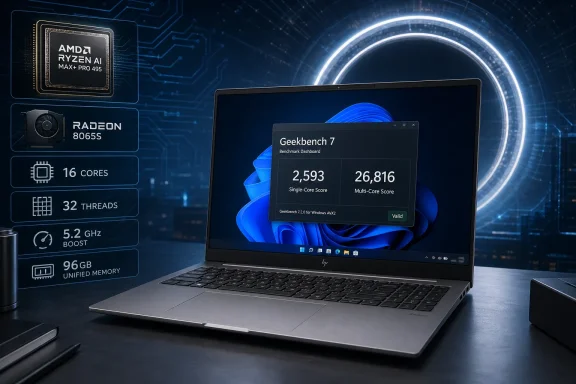
Geekbench identifies the machine as an “HP ZBook Ultra G3a 16 inch Mobile Workstation PC,” a model name that aligns with AMD’s stated target for the PRO 400 family: commercial PCs, mobile workstations, and compact workstation-class desktops. The score was recorded under HP’s “Optimized” power plan with Modern Standby enabled, which makes this look like an OEM-preproduction configuration rather than a hand-built test platform.
There is, however, a clear metadata inconsistency in the benchmark itself. Geekbench calls the processor’s codename “Strix Halo,” while AMD’s product page labels the Ryzen AI Max+ PRO 495’s former codename as Gorgon Halo. The distinction is meaningful: Strix Halo is the preceding Ryzen AI Max 300-series design, while Gorgon Halo is AMD’s refreshed PRO 400-series implementation.
The hardware identification fields settle the practical question. Geekbench reports a Ryzen AI Max+ PRO 495, 16 cores, 32 threads, a 3.10 GHz base frequency, 5.207 GHz maximum frequency, Socket FP11, and Radeon 8065S graphics. Those details match AMD’s published 495 specification, including its 3.1 GHz base clock and 5.2 GHz maximum boost. Geekbench’s codename field is therefore stale or generalized metadata, not evidence that HP is actually testing a previous-generation Strix Halo part.
That is a useful warning for inventory teams and enthusiasts who use benchmark databases to track incoming hardware. CPU names, PCI IDs, firmware strings and benchmark codenames can arrive out of sync during an OEM launch cycle. Here, the literal processor model and clocks are more reliable identifiers than the codename field.
That modest frequency increase is why the Geekbench result should not be read as proof of a dramatic CPU architecture gain. AMD did not introduce Zen 6 cores, a new graphics architecture, or a larger 40-CU GPU for the flagship. The Radeon 8065S in the 495 is a higher-clocked successor to the Radeon 8060S, and AMD lists it at 3.0 GHz.
The material platform change is memory. AMD specifies a 256-bit LPDDR5x-8533 memory interface and support for up to 192GB of unified memory, with up to 160GB assignable to graphics workloads. The prior Ryzen AI Max+ 395 platform topped out at 128GB. That extra 64GB is the feature aimed at local AI work, large datasets, CAD and visualization workloads, and GPU-accelerated applications that otherwise need a discrete GPU with large VRAM.
The public HP result contains 95.78GB of usable memory, generally presented as 96GB. It therefore verifies neither the 192GB ceiling nor AMD’s claim that up to 160GB can be allocated as graphics memory. It does show an OEM using an intermediate capacity that would be difficult to place in many conventional mobile workstations, where memory is split between system RAM and discrete-GPU VRAM.
For Windows users, unified memory has an obvious trade-off. A large allocation to the integrated Radeon reduces the memory left for Windows, local models, applications and file caching. AMD’s maximum figures establish what the silicon can address; HP will determine the usable configurations, memory partitioning controls, cooling design and pricing. None of that is visible in a single Geekbench submission.
A Geekbench processor ranking is an aggregate of submissions from different machines. It can include systems with different firmware, memory capacities, power limits, ambient temperatures, cooling systems, driver versions and Windows power plans. The 495 entry comes from an HP workstation platform running under HP’s optimized profile; the 395 average can include thinner laptops, tablets and mini PCs operating at lower sustained power.
The single-core comparison is somewhat more useful, though still incomplete. The 2,593-point result is about 6.6% above the cited 2,432-point 395 average, which broadly tracks AMD’s 100 MHz boost-clock increase and possible firmware refinements. But one score is not a performance profile. Geekbench does not expose sustained power consumption, package power, thermal throttling behavior, or whether HP has applied aggressive short-duration boost settings.
The multi-core score deserves particular restraint because the 495’s advertised 45W-to-120W configurable TDP span is enormous. A 16-core Zen 5 processor operating near the top of that range can sustain markedly higher all-core throughput than the same silicon in a lower-power chassis. Until the same reviewer tests a 495 and a 395 under comparable memory, firmware and sustained-power conditions, the public result is best understood as HP ZBook performance, not a clean measure of the generational uplift.
This is also why neither score says much about the 495’s real selling point: local AI and graphics workloads that consume large pools of unified memory. Geekbench 7’s CPU test cannot establish token-generation performance in llama.cpp, ROCm behavior in Windows applications, GPU rendering throughput, or the practical impact of assigning 160GB to the Radeon iGPU.
It does not establish a launch date. Benchmark uploads can precede an announcement by weeks or months, and HP has not yet published the configuration shown in the database. There is no public confirmation of display options, battery capacity, storage, networking, serviceability, ECC support, RAM upgradeability, MSRP, or whether the 96GB test system will be sold.
The use of soldered LPDDR5x is likely inherent to this class of high-bandwidth APU platform, which means buyers should assume memory choice will be fixed at purchase until HP says otherwise. That makes the eventual configuration list unusually important. For a workstation meant to run local models or reserve large unified-memory pools for graphics, 96GB, 128GB and 192GB are substantially different products, even with the same processor name.
The public benchmark makes one point solid: HP’s Gorgon Halo workstation is beyond a slide deck. The next meaningful disclosure is not another synthetic score; it is HP’s product page showing which memory capacities, power limits and prices will actually reach Windows workstation buyers in the third quarter.
The important correction is timing. eTeknix describes the 495 as an upcoming processor, but AMD formally unveiled the Ryzen AI Max PRO 400 series on May 21, 2026 and said HP and Lenovo systems would arrive in the third quarter. This result does not expose a newly leaked chip; it provides the first concrete public sign that the promised HP mobile-workstation rollout is moving through validation.
The benchmark identifies an HP ZBook, but Geekbench still calls it Strix Halo
Geekbench identifies the machine as an “HP ZBook Ultra G3a 16 inch Mobile Workstation PC,” a model name that aligns with AMD’s stated target for the PRO 400 family: commercial PCs, mobile workstations, and compact workstation-class desktops. The score was recorded under HP’s “Optimized” power plan with Modern Standby enabled, which makes this look like an OEM-preproduction configuration rather than a hand-built test platform.There is, however, a clear metadata inconsistency in the benchmark itself. Geekbench calls the processor’s codename “Strix Halo,” while AMD’s product page labels the Ryzen AI Max+ PRO 495’s former codename as Gorgon Halo. The distinction is meaningful: Strix Halo is the preceding Ryzen AI Max 300-series design, while Gorgon Halo is AMD’s refreshed PRO 400-series implementation.
The hardware identification fields settle the practical question. Geekbench reports a Ryzen AI Max+ PRO 495, 16 cores, 32 threads, a 3.10 GHz base frequency, 5.207 GHz maximum frequency, Socket FP11, and Radeon 8065S graphics. Those details match AMD’s published 495 specification, including its 3.1 GHz base clock and 5.2 GHz maximum boost. Geekbench’s codename field is therefore stale or generalized metadata, not evidence that HP is actually testing a previous-generation Strix Halo part.
That is a useful warning for inventory teams and enthusiasts who use benchmark databases to track incoming hardware. CPU names, PCI IDs, firmware strings and benchmark codenames can arrive out of sync during an OEM launch cycle. Here, the literal processor model and clocks are more reliable identifiers than the codename field.
The 495 is a memory-capacity refresh with modest CPU clocks
AMD’s own specification makes clear how close the Ryzen AI Max+ PRO 495 remains to the Ryzen AI Max+ PRO 395. Both flagship parts carry 16 Zen 5 CPU cores and 32 threads, 80MB of total cache, 40 RDNA 3.5 graphics compute units, a configurable 45W-to-120W thermal envelope, and the same FP11 platform. The 495 raises the base frequency from 3.0 GHz to 3.1 GHz and the stated maximum boost from 5.1 GHz to 5.2 GHz.That modest frequency increase is why the Geekbench result should not be read as proof of a dramatic CPU architecture gain. AMD did not introduce Zen 6 cores, a new graphics architecture, or a larger 40-CU GPU for the flagship. The Radeon 8065S in the 495 is a higher-clocked successor to the Radeon 8060S, and AMD lists it at 3.0 GHz.
The material platform change is memory. AMD specifies a 256-bit LPDDR5x-8533 memory interface and support for up to 192GB of unified memory, with up to 160GB assignable to graphics workloads. The prior Ryzen AI Max+ 395 platform topped out at 128GB. That extra 64GB is the feature aimed at local AI work, large datasets, CAD and visualization workloads, and GPU-accelerated applications that otherwise need a discrete GPU with large VRAM.
The public HP result contains 95.78GB of usable memory, generally presented as 96GB. It therefore verifies neither the 192GB ceiling nor AMD’s claim that up to 160GB can be allocated as graphics memory. It does show an OEM using an intermediate capacity that would be difficult to place in many conventional mobile workstations, where memory is split between system RAM and discrete-GPU VRAM.
For Windows users, unified memory has an obvious trade-off. A large allocation to the integrated Radeon reduces the memory left for Windows, local models, applications and file caching. AMD’s maximum figures establish what the silicon can address; HP will determine the usable configurations, memory partitioning controls, cooling design and pricing. None of that is visible in a single Geekbench submission.
The 31% multi-core claim is not a processor-to-processor result
VideoCardz and eTeknix compare the 495’s 26,816-point multi-core score with Geekbench’s 20,431-point Ryzen AI Max+ 395 ranking average and arrive at a 31.3% advantage. The arithmetic is correct. The conclusion would be premature.A Geekbench processor ranking is an aggregate of submissions from different machines. It can include systems with different firmware, memory capacities, power limits, ambient temperatures, cooling systems, driver versions and Windows power plans. The 495 entry comes from an HP workstation platform running under HP’s optimized profile; the 395 average can include thinner laptops, tablets and mini PCs operating at lower sustained power.
The single-core comparison is somewhat more useful, though still incomplete. The 2,593-point result is about 6.6% above the cited 2,432-point 395 average, which broadly tracks AMD’s 100 MHz boost-clock increase and possible firmware refinements. But one score is not a performance profile. Geekbench does not expose sustained power consumption, package power, thermal throttling behavior, or whether HP has applied aggressive short-duration boost settings.
The multi-core score deserves particular restraint because the 495’s advertised 45W-to-120W configurable TDP span is enormous. A 16-core Zen 5 processor operating near the top of that range can sustain markedly higher all-core throughput than the same silicon in a lower-power chassis. Until the same reviewer tests a 495 and a 395 under comparable memory, firmware and sustained-power conditions, the public result is best understood as HP ZBook performance, not a clean measure of the generational uplift.
This is also why neither score says much about the 495’s real selling point: local AI and graphics workloads that consume large pools of unified memory. Geekbench 7’s CPU test cannot establish token-generation performance in llama.cpp, ROCm behavior in Windows applications, GPU rendering throughput, or the practical impact of assigning 160GB to the Radeon iGPU.
HP’s appearance narrows AMD’s Q3 promise
AMD’s May announcement named HP and Lenovo as partners expected to ship Ryzen AI Max PRO 400 systems in the third quarter of 2026. At that point, the company had published the silicon specifications but had not named a commercial laptop configuration, price, on-sale date, or regional availability. The Geekbench record narrows that uncertainty: HP has at least one ZBook Ultra G3a configuration far enough along to run a public Geekbench 7 build.It does not establish a launch date. Benchmark uploads can precede an announcement by weeks or months, and HP has not yet published the configuration shown in the database. There is no public confirmation of display options, battery capacity, storage, networking, serviceability, ECC support, RAM upgradeability, MSRP, or whether the 96GB test system will be sold.
The use of soldered LPDDR5x is likely inherent to this class of high-bandwidth APU platform, which means buyers should assume memory choice will be fixed at purchase until HP says otherwise. That makes the eventual configuration list unusually important. For a workstation meant to run local models or reserve large unified-memory pools for graphics, 96GB, 128GB and 192GB are substantially different products, even with the same processor name.
The public benchmark makes one point solid: HP’s Gorgon Halo workstation is beyond a slide deck. The next meaningful disclosure is not another synthetic score; it is HP’s product page showing which memory capacities, power limits and prices will actually reach Windows workstation buyers in the third quarter.
References
- Primary source: eTeknix
Published: 2026-08-02T16:42:32+00:00
Loading…
www.eteknix.com - Independent coverage: videocardz.com
Published: 2026-08-01T11:30:57+00:00
Loading…
videocardz.com - Related coverage: amd.com
Loading…
www.amd.com - Related coverage: notebookcheck.net
Loading…
www.notebookcheck.net - Related coverage: eatyourbytes.com
Loading…
www.eatyourbytes.com - Related coverage: amd.com
Loading…
www.amd.com - Related coverage: notebookcheck-tr.com
Loading…
www.notebookcheck-tr.com - Related coverage: ai-stat.ru
Loading…
www.ai-stat.ru - Related coverage: geizhals.de
Loading…
geizhals.de - Related coverage: technical.city
Loading…
technical.city - Related coverage: tech.yahoo.com
Loading…
tech.yahoo.com - Related coverage: notebookcheck-ru.com
Loading…
www.notebookcheck-ru.com - Related coverage: pcgameshardware.de
Loading…
www.pcgameshardware.de - Related coverage: topcpu.net
Loading…
www.topcpu.net - Related coverage: tomshardware.com
Loading…
www.tomshardware.com - Related coverage: techradar.com
AMD’s Ryzen AI Halo enters 2026, taking on Nvidia DGX Spark mini PC with massive local AI performance ambitions | TechRadar
The computer will handle multiple displays and local AI jobs simultaneously with speedwww.techradar.com - Related coverage: pcgamer.com
The AMD Ryzen AI Max range gets two more entries, one of which looks perfect for the ultimate in handheld PC gaming | PC Gamer
It's certainly better for gaming than the 'new' Ryzen AI 400 chips, that's for sure.www.pcgamer.com - Related coverage: tomsguide.com
Two new AMD Ryzen AI Max+ chips just dropped and they could change mid-range gaming laptops forever | Tom's Guide
AMD just introduced the Ryzen AI Max+ 392 and 388 — both with the same insanely good integrated GPU that is sure to make Nvidia sweat and revolutionize mid-range gaming laptops at a lower price.www.tomsguide.com - Related coverage: hardware-journal.de
Loading…
www.hardware-journal.de - Related coverage: jagatreview.com
Loading…
www.jagatreview.com - Related coverage: ir.amd.com
Loading…
ir.amd.com - Related coverage: tech.yahoo.com
Loading…
tech.yahoo.com - Related coverage: tomshardware.com
Loading…
www.tomshardware.com