

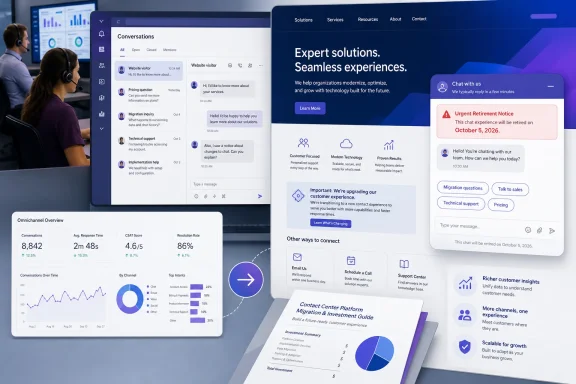
For small businesses that used the feature, this is a service retirement rather than a cosmetic Teams cleanup. Live chat — renamed Customer Connect in May — turned a website visitor’s message into a ticket and one-to-one Teams conversation, routing it to available staff without requiring a separate help-desk product. Microsoft’s own support material still describes that workflow as active, while its small-business Teams marketing page continues to promote real-time website chat. As of August 7, those public pages do not carry an end-of-service notice.
The mismatch is more than an editorial oversight. Organizations that administer Teams through product documentation rather than the Microsoft 365 Message Center could reasonably conclude that the capability remains deployable, especially when Microsoft’s support instructions still explain how to add appointment booking and a Copilot Studio bot to the same widget. The Register is the only outlet currently reporting the October 5 retirement timeline; Microsoft has not yet made a corresponding public retirement notice easy to find in its customer-facing documentation.
Customer Connect survived barely three months under its new name
The feature launched as Live chat in Microsoft Teams in March 2025, initially aimed at Microsoft 365 small-business tenants. Microsoft positioned it as a way to put a lightweight chat widget on a public website, keep staff in Teams, and avoid adding another customer-service inbox.
The mechanics were deliberately simple. A website visitor opened the widget, provided contact details, and sent a request. Teams created a request in a central team and channel, assigned it to an available support worker based on Teams presence, and retained previous requests in a dashboard for follow-up. Microsoft capped the support group at 25 people, a limit that made the feature an entry-level customer-engagement tool rather than a contact-center platform.
In April, Microsoft told administrators Live chat would be renamed Customer Connect, explicitly characterizing the change as name-only: no functional, configuration, or data-handling changes. The rollout completed by the end of May. Microsoft then announced global availability in 26 languages on May 20, promoting the ability for businesses anywhere to respond to website visitors directly from Teams.
That makes the reported retirement unusually abrupt. The worldwide launch announcement came roughly 10 weeks before new setups were blocked, and about 20 weeks before the service is due to stop handling conversations. Microsoft may have made an internal product decision after the global rollout, but it has not publicly explained why a feature it had just expanded internationally is being withdrawn.
The replacement path costs substantially more than the feature being removed
Microsoft has pointed affected customers toward Dynamics 365 Contact Center with Live Chat and Copilot Studio, according to The Register. Those are capable products, but they are not a like-for-like replacement for the small-business Teams widget.
Customer Connect was included with eligible Microsoft 365 Business subscriptions, including Business Basic, Business Standard, and Business Premium. It was designed around an existing Teams team, an embedded widget, basic business hours, and a small pool of responders. The customer-service interaction landed where the business already worked.
Dynamics 365 Contact Center Digital is currently listed at $95 per user per month, paid annually in the United States; the full Contact Center plan is listed at $110 per user per month. Microsoft’s pricing page also says digital messaging capacity is purchased through Copilot Studio. Copilot Studio can be provisioned with prepaid Copilot Credits or a pay-as-you-go model tied to an Azure subscription.
That is an architectural and commercial jump. A small firm that added Customer Connect because it was already covered by a Microsoft 365 Business license is now being directed toward a Dynamics deployment, license assignment, an Azure billing relationship for agents, and consumption management if it wants AI-driven web support. A business may decide that richer routing, persistent chat, analytics, CRM integration, or AI self-service justifies that move. But Microsoft’s recommended destination is a paid contact-center stack, not a continuation of the included Teams feature.
The practical alternative for many businesses will be a third-party website-chat provider, a help-desk platform, or a simpler contact form. Microsoft has not announced a free Teams-native successor with the same website widget and human handoff model.
Teams artifacts may remain, but the service workflow will not
The Register says existing Teams channels and customer data will remain available after the October deadline, while new chats, escalations, and interactions cease. That distinction matters for records retention but does not preserve the operating service.
Customer Connect did not merely create an ordinary Teams chat. It used a widget, support tags, availability logic, a central request dashboard, and automated assignment to bridge a public website to Teams staff. Leaving the historical team and channel in place preserves a record of prior conversations, but it does not create a workable inbound-support channel once the widget no longer passes messages into Teams.
Microsoft’s current documentation says previous requests and conversations are stored in the Live chat requests team dashboard. It does not yet explain what happens to that dashboard after retirement, whether historical requests remain searchable indefinitely, how long the underlying data is retained, or whether organizations will receive an export tool. Nor has Microsoft publicly detailed how organizations should handle customer consent language or privacy notices that specifically describe the old widget.
IT administrators should treat the October 5 date as a business-process deadline, not merely a widget-removal task. If the feature appears on a public page, marketing, support, legal, and web-development owners all need to know that the chat path will fail.
A concise shutdown plan should include the following:
- Inventory every public site, landing page, and regional page that carries the Customer Connect or Live chat widget code.
- Capture the support team, channel, request-dashboard configuration, staffing schedule, and business-hours settings before the service is disabled.
- Review historical conversation retention and export needs with compliance or legal teams, particularly if chat transcripts include sales leads, service commitments, or personal data.
- Replace the widget with an explicitly tested support path before October 5, rather than leaving visitors to discover a blank or hidden control.
- Update website privacy notices, customer-support instructions, and internal escalation procedures that refer to Teams-based web chat.
Microsoft’s public materials have not caught up
The most conspicuous part of this retirement is the state of Microsoft’s own documentation. The support page still tells users to select a “Customer Connect” notification when a new request arrives and says that prior conversations reside in the Live chat requests dashboard. The setup documentation still instructs administrators how to attach an AI chatbot and configure appointment booking in the widget.
Microsoft’s small-business Teams product page also continues to advertise that companies can “engage website visitors in real time through live chat in Microsoft Teams.” Those pages were accessible in the days immediately before this report and contain no retirement date or migration warning.
A stale product page is common after a retirement announcement, particularly when Message Center notices are tenant-scoped. The sharper issue is the timing: this is a public-facing website feature, and the difference between “available globally” and “remove it before it stops delivering customer messages” is operationally significant. Microsoft needs to publish a clear end-of-service notice on the setup and support pages, state the future of historical data, and spell out whether any configuration or transcript migration exists for Dynamics 365 Contact Center.
Until it does, the actual record is incomplete. The Register reports that data and Teams channels will remain, but Microsoft has not publicly specified the retention horizon, a migration path, or a no-cost replacement for existing Microsoft 365 Business customers.
October 5 is the real cutoff for customer-facing Teams chat
Teams users should not confuse this retirement with Microsoft’s separate removal of Teams Live Events or the retirement of Together mode. Customer Connect is the website widget previously called Live chat; it is a customer-support intake channel, not meeting chat, webinar chat, or regular Teams chat.
The immediate consequence is straightforward: any organization relying on Customer Connect must have another working web-contact route in place before October 5, 2026. Existing Teams channels may preserve the history, but they will not receive the next visitor asking for help.
Update: Microsoft reportedly confirms retention treatment for Customer Connect history (August 8, 2026)
NeoWin reports that Microsoft has clarified that existing Customer Connect customer data, chat history, and Teams channels will remain in affected organizations’ tenants under standard Microsoft 365 data-retention policies after the service ends on October 5, 2026.
That narrows one of the outstanding operational questions: retiring the website-chat service does not itself appear to delete prior conversations or the Teams artifacts created for them. Administrators should still verify their tenant’s own retention, eDiscovery, and deletion policies, since “standard” retention can differ based on configured compliance rules.
NeoWin also reports that embedded Live chat widgets will be hidden once the cutoff takes effect, in addition to no longer routing visitor messages into Teams.
Update: Microsoft’s Message Center notice cites shift to newer engagement tools (August 10, 2026)
UC Today reports that Microsoft’s August 7 Message Center notice, MC1449174, attributes the Customer Connect retirement to a need to focus investment on “newer customer engagement and communication experiences.”
That provides a rationale Microsoft had not publicly attached to the shutdown: the removal is not presented as a temporary service interruption or a rename reversal, but as a product-investment decision. The notice reportedly says the disablement rollout is expected to complete by mid-October, after the October 5 deadline for new customer interactions.
For administrators, October 5 remains the date to plan around. Any remaining website widget should be replaced and tested before then, since the later rollout window should not be treated as extra operating time for customer support.