
The roadmap entry, published August 3 and marked In development, assigns the feature to general availability for Worldwide standard multi-tenant tenants. Microsoft has not published screenshots, a required Teams app version, an administrative control, or a completion date within September. No independent outlet appears to have reported the exact Roadmap 567461 timing or feature set so far, leaving the roadmap as the primary record for what is planned.
For organizations supporting Teams on phones, this is a navigation change rather than a new collaboration capability. It is intended to reduce the number of taps required to locate conversation context and common actions, but it may also change where experienced users expect channel information and pinned items to appear.
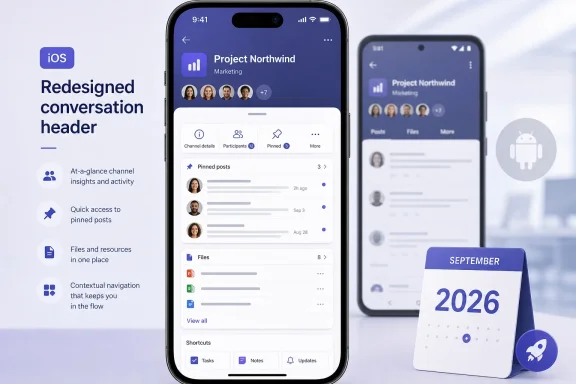 The dashboard expands an existing chat pattern
Teams already uses a chat dashboard on mobile. Microsoft’s current support documentation tells users on iOS and Android to enter a chat and tap the name at the top to access it. That view can expose chat management options along with partial lists of items such as files and apps.
Roadmap 567461 indicates that Microsoft will take that pattern beyond private and group chats, giving chats and channels a redesigned header and a lightweight dashboard containing “key channel details, people, and pinned content.” The phrasing suggests that opening the header will become a more consistent entry point for contextual information regardless of whether a user is in a one-to-one chat, a group chat, or a channel.
That consistency is useful in principle because Teams has spent the last two years consolidating chats and channels around a shared navigation model. Microsoft’s public support guidance describes the newer desktop experience as allowing a combined view, where favorites, chats, and teams and channels sit in one list, or separate Chat and Teams views. The company also exposes filters and Quick views to help users narrow a noisy conversation list.
The mobile change appears to be the next piece of that broader redesign: less emphasis on treating a channel as a separate destination, more emphasis on placing the relevant metadata and saved material behind a common header. For employees who work from a phone between meetings, that can make pinned instructions or a channel’s membership easier to retrieve without backing out into the team hierarchy.
Microsoft has not said whether the new channel dashboard will offer every management action available on desktop, whether it will show all channel members or merely a subset, or how many pinned items it will surface. Those details matter. A dashboard that only summarizes content is a discovery improvement; one that permits channel-level administration or pin management would be a functional change with support and governance implications.
“Mobile” does not mean Android in this announcement
The most significant omission is platform parity. Teams is available on both iOS and Android, and Microsoft’s existing mobile support page explicitly describes the current chat dashboard as available on both platforms. Yet the roadmap’s Platforms field for item 567461 contains only iOS.
That leaves three possibilities: Android could arrive later under a separate roadmap item; Microsoft could update the current item before release; or iOS could remain the sole launch platform. Microsoft has not specified which is planned. Administrators should not read the generic reference to “Teams on mobile” as a commitment that Android users will receive the same interface in September.
This is more than a wording issue in mixed-device deployments. A help-desk article or user training note that says “tap the chat or channel name to open the new dashboard” may describe a different experience for an iPhone user than for an Android user. Teams’ mobile interface is already exposed to frequent, service-side changes, which makes visual instructions brittle even when both platforms are nominally supported.
The roadmap also lists only Worldwide standard multi-tenant cloud instances. It does not identify availability for GCC, GCC High, Department of Defense, or other sovereign and regulated Microsoft 365 environments. That is normal for an early public roadmap listing, but it means government and regulated-sector administrators do not yet have a deployment date to communicate.
The listed release ring is General Availability, which means this is not being announced as a public-preview-only feature. It does not mean every eligible iOS user will see it on September 1. Microsoft routinely stages Teams feature delivery over a release window, and Roadmap 567461 supplies only “2026-09,” not a start date, completion date, or app-build threshold.
Why pinned content is the practical change to watch
The header redesign will be most noticeable for organizations that use channels as durable project spaces rather than as informal discussion feeds. Channel members often need a short list of stable material: an escalation process, a project plan, an onboarding post, a shift handoff, or a link to a SharePoint location. If the new dashboard surfaces pinned content reliably, it could make a phone a more usable endpoint for retrieval rather than merely messaging.
Microsoft’s wording is careful, however. It says the dashboard brings pinned content “into one intuitive place,” not that it creates a new pinning system, changes retention, alters SharePoint permissions, or adds a new compliance control. Pinned material will remain subject to the original item’s permissions and the tenant’s existing Teams, SharePoint, sensitivity-label, and information-protection policies.
The same restraint applies to the promised “key channel details” and “people.” Microsoft has not said that the dashboard will expose private-channel membership differently, make shared-channel participants easier to enumerate, or change external-user visibility. Security teams should treat the item as a user-interface refresh until Microsoft publishes more technical detail.
There is also a usability trade-off. A consolidated header dashboard can reduce navigation for users who know what they need, but it moves more information into an overlay or secondary surface. In the desktop rollout of Teams’ combined chat-and-channel experience, some users have objected to channels becoming harder to find amid chat-centric navigation. The iOS dashboard could ease that problem by making context visible within a channel, but it will not resolve discoverability if users cannot quickly locate the channel in the first place.
No admin action has been announced
Microsoft has not identified a Teams admin center policy, PowerShell setting, license requirement, migration task, or end-user opt-out for Roadmap 567461. Based on the information now available, this looks like a standard Teams client experience update rather than an administratively deployed feature.
That does not mean it deserves no preparation. IT teams that publish mobile job aids, standardized screenshots, or frontline-worker instructions should inventory material that describes Teams chat and channel navigation before September. The documentation most likely to age badly is anything that instructs users to find channel details, participants, files, or pinned guidance through a particular button sequence.
A focused preparation checklist is enough:
- Update training only after the redesigned iOS header is actually visible in the tenant, since Microsoft has not provided final interface images or a build number.
- Keep Android instructions separate from iOS instructions until Microsoft documents equivalent Android availability.
- Verify that critical pinned channel posts and links are current, because the new dashboard may make neglected pinned content more prominent.
- Avoid promising a simultaneous September rollout to regulated clouds or government tenants, which are absent from the roadmap entry.
Microsoft’s September target gives iPhone users a likely shortcut to the context that sits around a conversation, especially pinned material in channels. But the record does not yet support a broader claim of a fully unified Teams mobile experience: the announced rollout is iOS-only, cloud scope is limited to worldwide standard tenants, and the practical details of the dashboard remain unpublished.
