

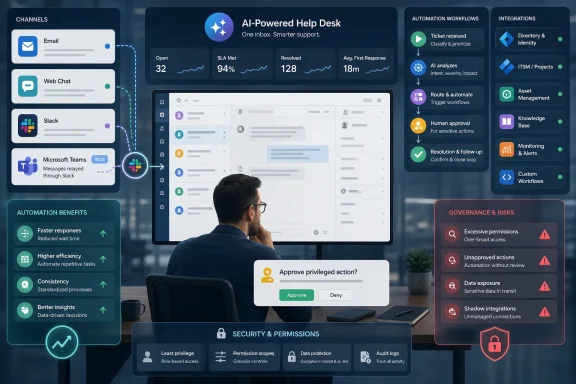
The practical appeal is clear for Windows and Microsoft 365 shops: fewer employees forced through a separate service portal, and fewer support engineers trying to reconstruct requests from chat threads, emails, and direct messages. But the product record shows a more specific reality than the interview’s omnichannel framing suggests. Unthread’s Microsoft Teams integration remains a Slack-centered beta, with several limits that an IT department should account for before treating it as a replacement for a conventional Teams-native service desk.
Bachant told Pulse 2.0 that Unthread emerged from an earlier startup’s customers adding his team to shared Slack channels instead of using email support. The company was founded in 2022 after his prior company, Dashride, was acquired by Cruise in 2018. Y Combinator separately announced that Unthread, from its Summer 2022 batch, raised a $3 million seed round; Bachant also told Pulse 2.0 that the company has reached $1 million in annual recurring revenue and landed its first FAANG customer. Those latter milestones have not been independently detailed by Unthread or another outlet, so they should be read as founder-provided figures rather than audited operating disclosures.
The Teams connector routes work through Slack
Unthread’s current public site calls the product native to both Slack and Teams, and says requests from Teams can join the same inbox as Slack, email, web chat, and API traffic. Its documentation tells a narrower story. The Microsoft Teams integration is explicitly labelled beta and is described as a way to manage Teams channel interactions “from within Slack.”
The workflow is essentially a relay: a selected Teams channel is connected to a chosen Slack channel; new Teams posts create tracked conversations; agents reply in Slack or the Unthread web dashboard; and replies are forwarded back into the original Teams channel. Attachments are meant to sync in both directions. That can be useful for support teams standardized on Slack but serving customers or business units that use Teams.
It is not the same as giving a Microsoft 365 organization a fully native Teams help desk. Unthread’s own documentation says Teams direct messages are not supported. It also excludes channels created by another tenant, which can matter for customer support in shared or cross-tenant collaboration scenarios. Formatting is not always preserved between the two platforms, and autoresponses for the Teams connector are listed as unsupported.
The permissions are worth closer inspection. The setup guidance says a Microsoft administrator may need to grant tenant-wide consent for ChannelMessage.ReadWrite and Group.ReadWrite.All. Those are powerful application permissions in a Microsoft 365 environment: one covers reading and writing channel messages, while the other reaches Microsoft 365 group content and membership management. A support deployment must therefore be reviewed as an integration with broad collaboration-data access, rather than merely as a lightweight ticketing bot installed in one channel.
For Windows administrators, that changes the evaluation question. If the objective is to centralize Slack-based customer support while carrying a limited set of Teams channels into the same queue, Unthread’s connector matches that job. If the requirement is to replace a Teams-first internal IT portal, handle private support conversations, or operate across customer tenants, the currently published limitations mean a proof of concept needs to test those exact cases before any migration plan is approved.
AI responses are only one part of the automation claim
Bachant’s central argument is that legacy ticketing systems merely add AI-generated reply drafts to the same old queues, while Unthread changes the underlying workflow. The product documentation supports part of that distinction. Unthread can use connected knowledge sources to generate responses, identify ticket types, apply tags, summarize closed conversations, surface similar resolved requests, and identify documentation gaps.
The important dividing line is whether the system only answers or can actually execute. Unthread says its workflow engine can trigger actions in connected tools including Microsoft Entra, Okta, GitHub, Salesforce, Jira, Freshservice, Zendesk, SharePoint, PagerDuty, Jamf, and HR platforms. Its public site currently advertises conditional and multi-step flows and more than 50 two-way integrations, while elsewhere on the same site it says there are more than 100 native integrations. The company does not explain the counting difference, so prospective buyers should ask for the exact integration catalogue and distinguish full two-way operational connectors from simpler notifications, links, or data-sync integrations.
This execution capability is where the technology becomes useful—and where deployment risk rises. An AI answer that points an employee to an approved VPN guide is low-risk. An automation that creates accounts, changes group memberships, alters CRM records, opens a GitHub issue, or triggers an approval workflow operates with real consequences. Unthread says its system supports approval requests, escalation logic, service-level tracking, on-call rotations, change management, and role-based access controls. Those features make the platform closer to an IT service management and workflow layer than a chat assistant.
The company’s technical documentation also shows that AI-generated replies can be configured either as private suggestions for an agent or as direct bot responses to a customer. Ticket categorization and tagging can be automatically applied, but agents can manually override them. That is a sensible operating model for support teams: start with AI assistance and human review, then expand into auto-resolution only for well-defined, reversible requests backed by reliable documentation.
Unthread has also added an administrative Model Context Protocol connector. Its published documentation says that connector can expose conversations, users, analytics, knowledge-base content, ticket types, surveys, and external-task information to AI assistants. It also supports limited writes, including updating a conversation, creating a conversation comment, and creating an approval request. The company says the connector uses OAuth 2.0 with PKCE, scoped access based on the user’s existing permissions, and revocable authorization.
That feature may be compelling to organizations using ChatGPT, Claude, or Cursor to query operational data. It also creates another governance surface: a support workspace can contain customer conversations, incident details, internal troubleshooting notes, and credentials accidentally pasted into chat. Security teams should decide which data classes can be available through an AI connector, how long those records are retained, and which users can authorize an external assistant against the service desk.
The 60% automation figure is not the observed baseline
The interview’s most eye-catching metric is Bachant’s claim that Unthread can currently automate about 60% of an IT team’s tickets. The company’s own public material does not present 60% as a universal realized result. On its comparison page with Zendesk, Unthread says its agentic AI can resolve up to 60% of tickets instantly. On its main site, it says the AI “deflects 40% on day one,” while a Lemonade customer testimonial on that page says Unthread automatically resolves about 40% of incoming tickets across different teams.
Those figures are not necessarily contradictory. “Up to 60%,” a day-one deflection claim, and a particular customer’s 40% resolution rate measure different things. But they do establish the right interpretation: 60% is a vendor performance ceiling or target, not a benchmark a buyer should assume will appear in every deployment.
The distinction matters most in IT support, where ticket volume is often a mix of repetitive requests and exception-heavy work. Password resets, access requests, standard software installations, device-order status checks, policy questions, and known VPN or Wi-Fi fixes are candidates for high automation rates. Privileged access, endpoint failures, identity incidents, executive support, licensing disputes, security alerts, and unusual hardware problems are not safely reduced to a generic percentage.
Unthread’s January 2026 product update described a second-generation knowledge-gap analysis feature that mines earlier tickets and Slack messages to propose new or updated documentation. The company claimed up to a 90% increase in the accuracy of newly generated article content, but did not define the test set, baseline, or measurement method. That does not invalidate the feature; it does mean the claim cannot tell a customer whether its own internal knowledge will be accurate enough for autonomous action.
A sensible pilot would establish separate metrics for deflection, first-contact resolution, human escalation, incorrect routing, reopened tickets, SLA breaches, and manually reversed automated actions. An AI system can improve its deflection rate by ending conversations early, but an IT department only benefits if employees actually receive correct fixes and if failed automations do not create more work downstream.
Security claims need a procurement-level review
Unthread says it is SOC 2 Type II certified, offers SAML single sign-on and SCIM provisioning, supports role-based access control, encrypts data in transit and at rest, and can provide HIPAA business associate agreements. It also says customers can use isolated, dedicated database instances in the United States, European Union, United Kingdom, Australia, or Canada. The company says its SOC 2 report and penetration-test summary are available through its trust center or on request, rather than publicly.
Its AI documentation says customer data is not used to train Unthread’s own model or generate answers for other customers. It also says higher-plan customers can bring their own accounts for OpenAI, Google Gemini, Anthropic Claude, Grok, or Mistral. Where Unthread uses OpenAI, the company says it creates a separate OpenAI workspace for each tenant.
Those are useful starting controls, but the public claims do not answer several implementation questions that matter for regulated or security-sensitive organizations. Unthread does not publicly specify its default data-retention periods, the exact default AI model and region used for an account, whether every connected knowledge source is available to every AI workflow, or how administrators can prevent a workflow from acting on untrusted text in a chat message. It also does not publish pricing or offer self-service sign-up; its site directs prospective customers to request a demo.
Unthread’s product has moved beyond the narrow Slack ticket tracker implied by its origin story. It now combines a shared inbox, knowledge management, AI-assisted triage, workflow automation, analytics, service-level controls, asset-tracking beta features, and connectors to identity and business systems. The company’s claim is credible in one important respect: it is building operational workflows around conversations rather than simply sending ticket notifications into chat.
For Microsoft-centric IT teams, however, the immediate consequence is straightforward. Treat Unthread as a potentially capable automation platform with a beta bridge to Teams, not yet as evidence that every Teams support interaction can remain fully inside Teams. The deciding test is whether its permissions, cross-channel relay model, AI guardrails, and automation controls fit the organization’s actual support paths—not whether a headline automation percentage looks attractive in a demo.