
KitGuru’s overview tracks Intel’s August 24 announcement, while independent Hot Chips coverage from Tom’s Hardware and HPCwire fills in the details Intel’s high-level newsroom post leaves out. Taken together, the presentations show Intel trying to make the CPU, memory fabric, GPU and client silicon parts of one deployment argument. They do not yet show the benchmarks, software maturity, shipped systems, or volume availability that buyers need to judge the strategy.
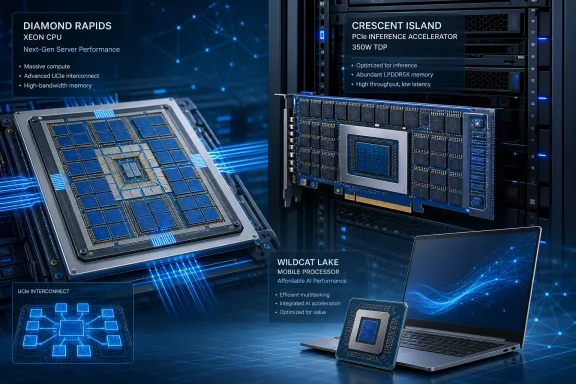 Diamond Rapids is a new Xeon package design, not merely a bigger core count
Diamond Rapids is the most consequential of the three designs for enterprise IT. Intel says the next Xeon 7 generation is built on its enhanced Intel 18A-P process and pairs adaptable compute blocks with unified memory and flexible I/O. The headline configuration reaches 256 CPU cores and 1.28 GB of last-level cache, with 16 memory channels running at up to 12,800 MT/s using MRDIMMs and as many as 128 lanes of PCIe 6.0 and CXL 3.0 connectivity.
Those core figures need one correction. Network World initially described the 256 cores as Efficiency cores, but the detailed Hot Chips material reviewed by Tom’s Hardware, HPCwire and others identifies them as Performance cores. Intel’s package comprises 16 compute chiplets, each carrying 16 P-cores, arranged as four Compute Building Blocks. That distinction changes the comparison considerably: this is a high-core-count P-core Xeon for workloads where per-thread performance, latency and conventional server software still matter, rather than an Intel E-core density play.
The more revealing change is physical layout. Diamond Rapids moves compute chiplets toward the edge of the package and centralizes memory and I/O functions in fabric hub tiles. Four CPU chiplets are bonded to each base tile with Foveros Direct 3D, while Intel uses UCIe-S links through the package substrate to reach the central fabric hubs. Tom’s Hardware reports that Intel chose UCIe-S rather than EMIB for this connection because it could provide more uniform, low-latency access across the very large package.
For infrastructure teams, that architecture matters more than the “agentic” label. Large language model deployments consume CPU time outside the accelerator: request routing, retrieval, tool execution, vector database queries, policy checks, session management, networking and post-processing all run somewhere. More memory bandwidth and I/O may improve the system’s ability to keep accelerators fed and attach CXL memory or additional devices, but the result will depend on the entire server design rather than on core count alone.
Intel is also bringing Advanced Performance Extensions, AVX 10.2 and improved Advanced Matrix Extensions to Diamond Rapids. APX expands the x86 register set, which Intel says can reduce memory traffic when software is rebuilt for it. That last condition is easy to overlook. Existing x86 binaries remain compatible, but the APX benefit will depend on compilers, libraries, hypervisors and applications being updated to generate the new instructions. A straightforward virtual-machine migration will not automatically expose the full benefit.
Intel has not published final clock speeds, thermal design power, SKU segmentation, memory capacity limits, pricing, or benchmark results for Diamond Rapids. It has also not fully detailed the Panther Cove-derived server core itself. Those omissions are normal for a 2027 platform, but they mean purchasing decisions still have to rest on today’s Xeon and EPYC offerings, not slides from Hot Chips.
Crescent Island is betting on capacity and air cooling
Crescent Island is Intel’s attempt to address a different constraint: the cost and operational friction of serving models after they have been trained. The data-center accelerator uses the Xe3P architecture, 32 Xe cores and 256 XMX engines, with a 350 W PCIe card design intended to fit into conventional air-cooled servers.
The memory specification is the central part of the pitch. Intel’s reference configuration has 160 GB of LPDDR5X, but board partners can design cards with up to 480 GB. The distinction is material. Up to 480 GB is a platform ceiling, not a promised baseline configuration, and Intel has not announced the actual products its partners will sell or their bandwidth, pricing and delivery dates.
Still, LPDDR5X capacity in an air-cooled PCIe card is a purposeful departure from the HBM-heavy accelerators that dominate high-end AI deployments. It could enable enterprises to keep larger quantized models, more model variants, or a larger active context in a single device without requiring liquid-cooled racks. It also gives Intel a product that can be installed in more familiar server designs, which is useful for organizations expanding on-premises inference capacity rather than building a purpose-built AI cluster.
There are trade-offs. Intel has not yet disclosed raw inference throughput, performance-per-watt measurements against competing accelerators, interconnect bandwidth between multiple Crescent Island cards, or the final software stack and framework support. Token throughput, latency under concurrency and usable model support will determine whether the card is attractive in practice. A memory-rich accelerator can avoid model-sharding problems, but it still needs enough compute and bandwidth to produce competitive response times.
Tom’s Hardware reports that the design includes data-center reliability features such as ECC and parity protection, and that graphics-oriented blocks including ray-tracing hardware have been removed to make room for compute features. That makes Crescent Island an inference appliance, rather than evidence of what Intel’s future Arc gaming GPUs will look like.
Intel first announced Crescent Island in October 2025 and targeted customer sampling for the second half of 2026. Its Hot Chips update did not replace that timeline with a launch date. As of August 27, 2026, prospective buyers should treat it as an upcoming accelerator whose basic architectural direction is known, but whose delivered performance and availability remain unproven.
Wildcat Lake will not qualify as a Copilot+ PC on NPU throughput alone
Wildcat Lake brings the same packaging theme to the low-cost client and edge end of Intel’s portfolio. Intel says the Intel Core Series 3 design uses two Performance cores, four Efficiency cores, integrated Xe3 graphics with XMX acceleration, support for LPDDR5X-7467, Wi-Fi 7 and Bluetooth 6.0. It is also Intel’s first processor to use UCIe, which lets the company split functions into separate package components rather than building a larger monolithic chip.
That is a manufacturing and cost story before it is an AI story. Intel and Tom’s Hardware characterize Wildcat Lake as a price-sensitive laptop and intelligent-edge design. UCIe could let Intel mix process technologies and size chips more economically, while allowing OEMs to build more capable entry-level systems. Whether those savings appear in retail Windows laptop prices will depend on memory, storage, display, chassis and OEM margins as much as the processor package.
The on-chip NPU is rated at up to 17 TOPS. That is enough for limited hybrid AI work when combined with the GPU and CPU, but it does not reach the more-than-40 TOPS NPU requirement Microsoft documents for the Copilot+ PC class. Wildcat Lake systems may still run Windows 11 and AI-enabled applications, and developers may target its NPU, GPU or CPU as appropriate. But an OEM cannot describe a Wildcat Lake system as a Copilot+ PC on the basis of Intel’s stated 17 TOPS figure.
This is where Intel’s terminology can blur the practical picture. “Client AI” does not identify which Windows features will run locally, which will use the GPU, which will fall back to the CPU or cloud, or how fast they will run on a budget notebook. Intel has not announced specific Wildcat Lake laptops, batteries, display classes, Windows configurations or release timing. The first thing to watch is therefore OEM product disclosure, not an NPU number in isolation.
Intel’s three presentations outline a coherent hardware division of labor: Diamond Rapids handles CPU-heavy server orchestration and expansion, Crescent Island targets model inference within ordinary air-cooled racks, and Wildcat Lake brings chiplet packaging into mainstream client systems. The shared Intel 18A, Foveros Direct and UCIe story is real, but it is chiefly a foundation for future products.
For Windows buyers, Wildcat Lake is the nearest consumer-facing development, yet its 17-TOPS NPU places it below the Copilot+ threshold. For enterprise administrators, the immediately actionable item is to avoid treating either Diamond Rapids or Crescent Island as available capacity: Diamond Rapids is a 2027 Xeon program, while Crescent Island still needs final products, software validation and shipment dates before it can be compared honestly with deployed inference hardware.
