

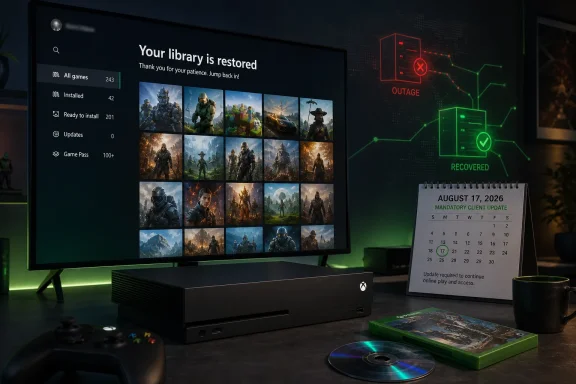
Xbox CTO Scott Van Vliet set out the clearest explanation yet in an August 10 post, later summarized by Windows Central. An update to an underlying service used for Home Console sharing, Game Pass purchases, and some PC cases put parts of that service into an unresponsive state. A separate bug in the Xbox client then caused other licence checks to fail too, multiplying the damage into a library and game-launch outage.
It is an unusually direct account for Xbox, and it is welcome. It also stops well short of proving that the platform has solved the larger problem the outage exposed: a paid game library can still depend on several live services correctly recognizing a customer’s rights at the same time.
The August 17 update fixes one failure path
Van Vliet’s new explanation draws an important line between the service outage and the console-side bug. The immediate underlying service failure placed systems needed for Home Console sharing and Game Pass-related purchases into an unresponsive condition. The Xbox client bug then failed to use other available licence checks properly once that first dependency disappeared.
That distinction makes the mandatory August 17 update more significant than a generic stability patch. Xbox is saying it has fixed the client behavior that allowed one unavailable service to cascade into failures elsewhere. In practical terms, that should reduce the risk that an outage in one entitlement-related component prevents a console from relying on valid information it already holds locally.
But it is equally important to state what Microsoft has not said. The company has not published an Xbox OS build number for the update, a list of affected console models, a list of affected games, or a technical explanation of precisely which cached-entitlement path failed. It has also not said whether the patch changes behavior only for discs, only for Home Console users, or for every purchased digital title that can be played offline.
Players therefore should not interpret “mandatory August 17” as a public guarantee that every installed Xbox game will be insulated from a future Xbox service incident. It is a fix for a documented bug in the client stack. The architectural work intended to prevent the original service failure from reaching that point remains described only as ongoing.
Xbox is taking control of the licensing service — but has not named it
The most consequential operational change in Van Vliet’s post is not the client patch. Xbox says it is “transitioning ownership” of the underlying licensing service to the Xbox team while engineers harden the relevant services and infrastructure for future updates.
That phrasing changes the reading of the initial incident report. In late July, Van Vliet described the failing licensing service as outside Xbox, and reporting from TechSpot, Tom’s Hardware, and others established that it was a dependency on which Xbox relied rather than a failure in the visible Xbox network alone. The new statement does not establish that the service belonged to an outside company; Microsoft has never publicly named the service or its owning organization. “Outside Xbox” can mean a separate Microsoft platform team just as easily as an external vendor.
What is now clear is that Xbox believes service ownership was misaligned with the user impact. A component capable of locking players out of games, account sign-in, game libraries, and partner workflows cannot be treated as a distant backend detail. Moving responsibility to the Xbox organization should give the product team more direct authority over deployment standards, incident response, rollback procedures, and testing against console behavior.
That is a real corrective action, not a public-relations flourish. Yet Microsoft has not said when the ownership transfer will finish, what service-level objectives will change, whether the service will gain independent failover capacity, or whether Xbox has removed the single dependency that proved so destructive in July. The CTO’s transparency is valuable precisely because it identifies those questions; it has not yet answered them.
The disc failure remains the most damaging evidence
The outage is especially difficult for Xbox to explain away because physical media was caught in it. During the July 26–27 interruption, the Xbox status page warned that some users could have trouble launching disc-based games. Tom’s Hardware reported that the service disruption lasted roughly 16 hours for some users and affected sign-in, libraries, and launches across Xbox 360, Xbox One, and Xbox Series X|S.
Van Vliet told The Verge after the outage that discs are subject to entitlement checks, but disc-based entitlement checks were not supposed to prevent access in this situation. He said Xbox was investigating reports that consoles did not correctly use entitlement information saved on the device. In other words, Microsoft’s intended offline design did not consistently survive a partial failure in online services.
Microsoft’s own Game Development Kit documentation gives that claim added weight. Xbox One and Xbox Series disc releases use encrypted XVC packages, and Microsoft provides a “full disc support” option designed to let a title install and operate offline when the required package data is on the disc. Its publishing guidance also requires testing that disc games install, launch, and play on an offline Xbox. A working physical disc is therefore not meant to be merely decorative proof of ownership.
The practical limitation is that a disc does not guarantee a wholly self-sufficient game. Modern Xbox consoles install game data to internal storage, publishers may ship incomplete builds that need updates, and online-only titles naturally require servers. But July’s failure was not a normal case of a game needing an update or a multiplayer server being down. Microsoft’s own CTO has said valid disc entitlements should not have been blocked.
That makes the incident a failure of the platform’s resilience, not evidence that every physical Xbox game is inherently useless offline. The difference matters. It would be inaccurate to say that discs never work without Microsoft’s servers. It would be just as inaccurate to tell buyers that a disc alone guarantees access when the console’s licensing implementation can fail open into a network dependency.
Digital ownership has a reliability problem, not merely a philosophical one
The familiar argument around digital ownership often becomes abstract: whether a licence is “really” ownership, whether resale should be possible, or whether a subscription model is preferable to buying individual games. The July outage turned the issue into a simpler operational question: what happens on a Sunday evening when a dependent licence service fails and the customer’s locally installed game will not start?
For a Game Pass title, the answer is expected to be constrained. A subscription needs periodic validation, and availability can change when a game leaves the catalog. For a game purchased outright, particularly one installed on the purchaser’s designated Home Console, the expectation is much higher. The customer has paid once, the console has the game, and Xbox says the local entitlement should work. The platform failed that test for some players.
Xbox’s response provides a useful model for the rest of Microsoft’s consumer software services. The company identified the service-level trigger, acknowledged the cascade, separated the backend service failure from the client-side defect, and committed to a mandatory remediation. That is more useful than the usual “we have resolved the issue” notice.
Still, public postmortems are judged by the controls they reveal, not their tone. There is no published root-cause analysis with timestamps, no stated recovery target, no explanation of why an update could leave the service unresponsive, and no assurance that another entitlement dependency cannot produce the same chain reaction. Nor has Xbox announced compensation for people who lost access to purchased content or subscription time during the outage.
What Xbox players should take from the fix
The sensible conclusion is neither that Xbox has made physical games pointless nor that the August patch restores complete trust in its digital library. It is that players now know the failure was two-layered: an underlying licensing-service incident triggered the outage, and an Xbox client flaw made the blast radius worse.
Xbox owners should install the update once it reaches their console rather than waiting for the August 17 enforcement date. Players who value offline access should also make sure their primary console is correctly configured as their Home Xbox and keep essential games fully installed and updated. Those steps cannot solve an online-only game’s server dependency, but they remain the configuration Xbox intends to use for local access.
Microsoft has fixed the client defect it says made saved entitlements unreliable during the outage. The harder promise — that a failure in one service cannot again turn an installed library, including valid disc games, into an unavailable collection — rests on the still-undetailed transfer and hardening work now underway inside Xbox.