

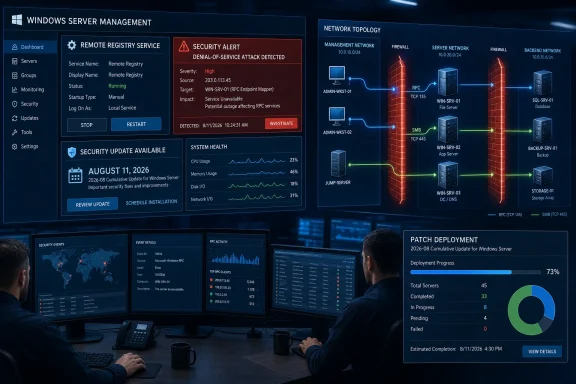
The advisory is unusually sparse. Microsoft identifies the affected component and impact, but its Security Update Guide entry does not publicly describe the flaw’s root cause, the protocol sequence that triggers it, affected build numbers, or a standalone mitigation for organizations unable to patch immediately. It also does not name a proof-of-concept exploit, active exploitation, or public disclosure prior to the patch release.
That leaves CVE-2026-61345 in a familiar but operationally awkward category: a confirmed Microsoft vulnerability whose practical risk depends far more on where the service is exposed than on the CVE title alone suggests.
Microsoft Has Confirmed the Flaw, but Not Its Technical Path
Microsoft’s August 11 advisory establishes that CVE-2026-61345 is a real vulnerability in Remote Registry and that the impact is denial of service. The record’s use of the CVSS exploit code maturity language should not be mistaken for a Microsoft finding that exploit code is public; that text explains the CVSS metric itself, rather than supplying an exploit status in the material published with the advisory.
At publication time, neither independently indexed vulnerability-record searches nor security-industry reporting surfaced a technical write-up, public proof of concept, packet trace, crash analysis, or named researcher for CVE-2026-61345. That absence does not mean the issue is harmless. It means defenders should avoid filling the gaps with assumptions—particularly the assumption that a Remote Registry denial of service must be either unauthenticated or limited to a single workstation.
Microsoft has also not publicly stated whether exploitation requires valid domain credentials, local network access, an existing RPC session, membership in a particular local group, or an exposed Remote Registry endpoint. Those distinctions determine whether the vulnerability is principally an internal lateral-movement concern, an availability problem for management infrastructure, or something more widely reachable through poor firewall segmentation.
The right reading is narrower: Microsoft has shipped a fix for a condition capable of disrupting the Remote Registry service or the host that runs it. Until Microsoft publishes more detail, the advisory does not support claims of remote code execution, privilege escalation, credential theft, wormability, or confirmed exploitation in the wild.
Remote Registry Is Often Dormant Until an Administrator Needs It
Remote Registry, implemented as the RemoteRegistry service, allows users and management software to connect to and modify a computer’s registry remotely. Microsoft’s Windows policy documentation is explicit that remote registry access requires the Remote Registry service to be enabled. That makes the service valuable in some centrally managed environments, but it also creates an administrative interface that deserves the same network-boundary scrutiny as other remote-management functions.
The service is far less common on consumer Windows devices than it is on older Windows Server deployments, domain management networks, specialized appliances, and systems tied to legacy monitoring or assessment tools. Microsoft documentation for services used by its assessment tooling still identifies remote registry access alongside RPC, DCOM, WMI, and SMB requirements. In other words, organizations may have Remote Registry enabled not because an administrator intentionally chose it this year, but because an inherited toolchain, deployment baseline, or vendor integration expected it.
A system can therefore look compliant in a broad patch-management dashboard while retaining a service exposure that nobody has reviewed in years. CVE-2026-61345 is a reason to inventory that exposure, not a reason to reflexively shut down every Remote Registry instance and discover too late that a monitoring platform, software-deployment process, or server assessment depends on it.
Microsoft’s own documentation also complicates the simple “service running equals exposed” picture. On supported Windows versions, Remote Registry can stop after a period of inactivity by design. A host may consequently appear safe during a quick service-status check while still being configured to start the service when remote management activity requires it. Conversely, a server may be deliberately configured to keep Remote Registry active through the DisableIdleStop registry value, increasing the time that the component is available to receive requests.
The Exposure Boundary Is the Important Unknown
Remote Registry is not normally an Internet-facing Windows feature, and it should not be one. Remote registry operations rely on Windows remote-management plumbing, including RPC and, in many configurations, SMB-related access. Microsoft’s networking guidance notes that RPC uses dynamic port assignments, while SMB commonly uses TCP port 445. The precise flow varies by configuration, which is why simply blocking one port does not prove that an endpoint is insulated from remote administration traffic.
For CVE-2026-61345, the useful question is not merely whether RemoteRegistry is installed—it is whether an unpatched machine can be reached by principals and networks that do not need the service.
Administrators should establish four facts before assigning a priority:
- Confirm whether the
RemoteRegistryservice is disabled, manual, or automatic, and whether it is running on any high-value server tier. - Identify which management systems, service accounts, jump hosts, and administrative workstations can communicate with the affected hosts over the remote-management paths used in the environment.
- Check whether firewall rules permit those paths broadly across user subnets, server VLANs, partner networks, or VPN address pools rather than restricting them to designated management systems.
- Determine whether disabling the service would interrupt endpoint-management, discovery, vulnerability-scanning, backup, monitoring, or line-of-business operations before using it as an emergency control.
A basic local inventory can begin with Get-Service -Name RemoteRegistry or sc.exe qc RemoteRegistry, but those commands only report the local service configuration. They do not identify network reachability, trigger-start behavior, firewall exceptions, or software dependencies. Centralized configuration management and firewall-policy review are more useful than an ad hoc endpoint sample.
Patching Is Safer Than Using Service Shutdown as the Primary Fix
Microsoft’s August update is the remediation. Disabling Remote Registry can reduce the exposed attack surface where the service has no business purpose, but it is not equivalent to installing the security update. A service may need to be enabled again during troubleshooting, a tool upgrade, or a policy change; any machine still missing the August fix would then return to the vulnerable state.
For enterprises, the cleanest deployment sequence is to apply the relevant August 2026 Windows cumulative update in the normal pilot ring, validate management and monitoring workflows that use RPC or remote registry, then accelerate rollout to systems that retain the service. Domain controllers, management servers, jump hosts, server clusters, and systems in administration-heavy networks deserve early attention because an availability problem in those tiers can interfere with recovery work and centralized operations.
The missing information in Microsoft’s public entry matters here. Without affected-build or KB-level detail in the advisory itself, security teams should not build detection logic around a guessed registry key, assumed port, or third-party severity score. They should map their Windows versions to Microsoft’s August security update packages, confirm successful installation through their endpoint-management platform, and retain normal rollback and recovery procedures.
This is also a case where “the service is stopped” is inadequate patch evidence. Remote Registry’s idle-stop behavior can make the service look inactive even when the system remains configured to expose it on demand. Patch compliance, service configuration, and network access are three separate controls and should be measured separately.
A Routine DoS Advisory Still Carries an Availability Cost
Denial-of-service bugs receive less attention than remote-code-execution flaws because they do not automatically hand an attacker control of a system. But a Remote Registry outage can still have consequences beyond a failed administrative convenience. Remote registry is used by some management workflows for inventory, configuration inspection, troubleshooting, and remote policy work; a deliberate crash or hang against the component can turn a limited vulnerability into an operational incident during a maintenance window or a broader intrusion.
The available record does not establish that CVE-2026-61345 crashes Windows, restarts the service, causes memory exhaustion, or enables repeated unauthenticated disruption. Microsoft has disclosed only the impact category. Administrators should treat it as a patch-and-exposure-management issue rather than an emergency incident unless their own telemetry shows Remote Registry failures, unexplained RPC disruption, or anomalous management traffic against unpatched hosts.
The concrete deadline is now: systems using Remote Registry should move into the August 11, 2026 update wave, while teams use the patch cycle to remove Remote Registry access from networks and machines that no longer require it.