

IO Interactive’s 007 First Light launched on May 27, 2026, with PC support for Nvidia DLSS 4.5 Super Resolution, Dynamic Multi Frame Generation, Reflex, and uncapped frame rates, making GeForce RTX hardware the clearest route to running the game at high resolutions and high refresh rates. The story is not simply that a new Bond game is demanding. It is that demanding now means something different on the PC, where raw raster performance is only one part of the graphics equation. For Windows gamers, 007 First Light is a showcase for how far Nvidia’s software-defined GPU stack has moved the goalposts — and how awkward that makes the upgrade conversation for everyone still sitting on older cards.
007 First Light is exactly the kind of PC game that turns a graphics menu into a hardware referendum. IO Interactive has built a cinematic origin story around fast motion, dense environments, reflective surfaces, dramatic lighting, and the sort of action sequencing that makes a GPU do more than paint pretty screenshots. Helicopter crashes, shattering glass, muzzle flashes, explosions, and stealth-heavy interiors all stress different parts of the rendering pipeline.
That matters because modern GPU performance is no longer adequately described by a single number. Average frames per second still matters, but so do frame pacing, input latency, image reconstruction quality, VRAM pressure, and how well a game handles rapid transitions between calm exploration and particle-heavy chaos. 007 First Light is not just asking whether your card can run the game. It is asking whether your system can keep the illusion intact.
The answer depends heavily on which GeForce generation is in your machine. RTX 20- and 30-series owners get DLSS Super Resolution, which remains a major lifeline. RTX 40-series owners add standard Frame Generation, which is often the difference between “smooth enough” and “high-refresh good.” RTX 50-series owners get the full Nvidia pitch: DLSS 4.5, Dynamic Multi Frame Generation, and the ability to chase 4K fluidity without pretending native rendering is still the only respectable target.
That is the uncomfortable but increasingly obvious takeaway. In a game like this, the GPU upgrade is not only about more shader throughput. It is about buying into a newer rendering model.
007 First Light makes the case that native 4K at ultra settings is no longer the most sensible default, even on expensive graphics cards. The workload is too dynamic, the visual effects too layered, and the target displays too fast. A 60Hz television and a 165Hz monitor ask very different things from the same GPU, and the latter has become the real battleground for enthusiast hardware.
The PC Gamer testing cited in the source material shows the shape of the problem clearly. A GeForce RTX 5080 could average around 54 fps at 4K with settings maxed and without DLSS or frame generation. That is playable in the old sense, but not impressive in the modern sense, especially for players who bought high-refresh panels and expect fluid camera motion to match visual spectacle.
Once DLSS Super Resolution enters the picture, the same class of hardware moves from merely capable to convincingly premium. Quality, Balanced, Performance, and Ultra Performance presets all push the game into a higher frame-rate tier, while DLSS 4.5’s newer reconstruction model helps avoid the smeared or unstable image quality that made earlier upscaling modes feel like compromise settings.
This is the new bargain. You are no longer choosing between honest pixels and fake pixels. You are choosing between a brute-force render path that may underuse your display and a reconstruction path designed around the reality that modern games are too visually ambitious for native rendering to remain sacred.
In 007 First Light, that foundation matters because so much of the game’s presentation depends on small details moving quickly. Fine geometry, reflective surfaces, distant lighting, and smoke-filled action scenes can all fall apart when reconstruction is poor. The source testing argues that DLSS 4.5’s transformer model preserves enough detail that even aggressive modes can be usable rather than merely desperate.
The broad compatibility is also important. DLSS Super Resolution runs across GeForce RTX generations, stretching back to the RTX 20-series. That means older cards are not abandoned outright, even if they miss the newer frame-generation features that define the RTX 40- and 50-series experience.
For Windows users still running RTX 3060 Ti-class hardware, that is the difference between being locked out of the game’s best-looking settings and having a credible tuning path. The reported 1080p results are telling: medium settings without DLSS can sit in the 60–70 fps range, ultra can fall closer to 50 fps, and DLSS can push performance above 100 fps. That is not a small tweak. That is a second life for a midrange Ampere card.
But it is also where the generational cliff begins to appear. Super Resolution can save a frame rate. It cannot create the same experience as the newer frame-generation stack.
That split matters because 007 First Light is fast. Generated frames are most convincing when the base frame rate is already healthy and latency is managed properly. Nvidia Reflex is meant to help keep the control loop responsive, but frame generation still works best as an amplifier, not a miracle cure. If the underlying experience is sluggish, generated frames can make motion look smoother without making the game feel truly responsive.
On RTX 40-series hardware, the equation is still attractive. The cited RTX 4080 Super results at 1440p show native performance hovering around 90–100 fps, with some less demanding scenes reaching roughly 117–120 fps. That is already good, but it does not fully exploit a 165Hz monitor. Add DLSS and 2x Frame Generation, and the same system can move into the high-refresh territory the display was bought for.
This is why the RTX 40-series remains a strong position for 007 First Light. It does not have Nvidia’s newest frame-multiplication trick, but it has the core feature that changes the feel of the game on modern monitors. For many players, that is enough.
The RTX 50-series, though, is clearly where Nvidia wants the conversation to land. Multi Frame Generation can generate several frames per rendered frame, and Dynamic Multi Frame Generation adjusts the multiplier on the fly to target smoothness without simply hammering the same setting across every scene. That turns frame generation from a switch into a control system.
Dynamic Multi Frame Generation is Nvidia’s attempt to make that adjustment automatic. Instead of asking the player to choose a static multiplier and live with its strengths and weaknesses, the system varies frame generation scene by scene. The promise is straightforward: smoother output when the game needs help, with latency kept in check when the rendered frame rate is already high enough.
That is a compelling idea for 007 First Light because the game’s pacing is not uniform. Bond games, at their best, shift between observation, stealth, pursuit, and spectacle. A rendering path that can adapt to those shifts fits the design better than one that treats every moment as the same workload.
The risk is that marketing language can flatten the nuance. Generated frames are not the same as fully rendered frames, and they do not remove the importance of base performance. Players should still aim for a strong rendered frame rate before layering on frame generation, especially in an action game where aiming, camera movement, and timing matter.
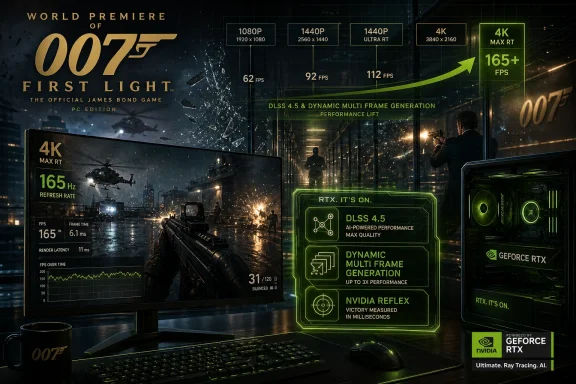
Still, the practical result is hard to ignore. On the RTX 5080, the source material reports 4K performance rising from sub-60 native averages to far beyond 165 fps with the full DLSS and Dynamic Multi Frame Generation stack enabled. That is not a marginal uplift. That is the difference between a demanding cinematic game and a showcase for a high-refresh 4K display.
At medium settings, the RTX 3060 Ti reportedly delivers 60–70 fps at 1080p without DLSS. Ultra settings push it harder, with performance closer to 50 fps, and VRAM pressure becomes a limiting factor. Turn on DLSS Super Resolution, though, and the card can climb above 100 fps without the sort of obvious image-quality collapse that used to haunt upscaling.
That should not be dismissed. The best PC graphics technologies are not only the ones that sell new cards. They are also the ones that extend the useful life of existing hardware. DLSS Super Resolution remains one of Nvidia’s strongest arguments precisely because it helps cards across several generations.
But equality ends there. No standard Frame Generation means RTX 30-series owners are stuck optimizing the rendered frame rate itself. No Multi Frame Generation means they cannot chase the same high-refresh ceiling as RTX 50-series owners. The game is playable, but the premium experience has moved on.
This is the new mid-cycle frustration for PC gamers. Your GPU may still be powerful enough in conventional terms, but missing the newest acceleration features can make it feel older than its raw specs suggest.
The limitation is not that the RTX 40-series fails. It is that the RTX 50-series reframes success. Once Dynamic Multi Frame Generation enters the conversation, a 100 fps experience stops sounding like the top of the mountain. It becomes the base camp.
That is a classic enthusiast trap. Hardware that was excellent yesterday becomes psychologically diminished because the newest stack changes expectations. For players on 1440p displays, an RTX 4080 Super still looks like a very strong match for 007 First Light. For players targeting 4K at very high refresh rates, the RTX 50-series has the cleaner story.
The sensible advice is to separate display ambition from upgrade temptation. If your monitor tops out at 144Hz or 165Hz and your RTX 40-series card can feed it with DLSS and Frame Generation, you are not suffering. If you are chasing 4K at extreme refresh rates with ultra settings, then Nvidia’s newest cards offer features the previous generation simply does not have.
That distinction matters because upgrade marketing often treats every missed feature as a crisis. It is not. But in 007 First Light, the missed feature is visible enough to count.
The best version of a PC game should not feel like it belongs to one GPU vendor. Yet the economics of modern rendering often push in that direction. Nvidia has invested aggressively in AI reconstruction, Reflex, and frame generation, and developers have every incentive to showcase the technology that produces the best-looking performance numbers at launch.
The result is a familiar asymmetry. GeForce owners get the latest DLSS stack. Others may get older or less capable alternatives, depending on what the developer ships. When the visual design of the game leans heavily on technologies that one vendor currently executes better, the graphics options menu becomes a market-share argument.
For Windows enthusiasts, this is both impressive and irritating. Nvidia’s technology works, and in 007 First Light it appears to work very well. But the healthier PC ecosystem would be one where cutting-edge reconstruction and frame pacing were not so unevenly distributed across hardware brands.
This is not a reason to ignore the GeForce advantage. It is a reason to name it plainly. 007 First Light is not merely demanding. It is demanding in a way that rewards Nvidia’s current architecture and software stack disproportionately.
On RTX 50-series hardware, the practical path is obvious. Start at the visual settings you actually want, enable DLSS Super Resolution, use Quality or Balanced before dropping lower, and then layer Dynamic Multi Frame Generation to match your display. Reflex should stay enabled, because generated frames are only persuasive if the game remains responsive.
On RTX 40-series hardware, DLSS Quality plus standard Frame Generation is likely the sweet spot for many players at 1440p and 4K. The goal should be to preserve a strong rendered base frame rate before asking Frame Generation to finish the job. If the base frame rate is already unstable, frame generation can improve perceived smoothness without solving the underlying feel.
On RTX 30-series and RTX 20-series cards, Super Resolution is the lever that matters. Players should be realistic about ultra textures, VRAM limits, and high-resolution targets. A 3060 Ti at 1080p with DLSS can still produce an excellent experience, but pretending it belongs in the same category as an RTX 5080 at 4K with Dynamic Multi Frame Generation only leads to bad expectations.
That is the more mature way to think about PC graphics in 2026. Settings are no longer a purity test. They are a toolset.
That is a triumph for Nvidia’s strategy and a warning for everyone else. The company has turned GeForce from a collection of chips into a layered performance platform, where image reconstruction, latency reduction, and generated frames are as central to the experience as traditional rendering. 007 First Light happens to be the latest glossy proof point, but it will not be the last. The next wave of PC blockbusters will keep asking the same question in different scenery: not just how fast is your GPU, but how modern is the stack around it.
 Bond Arrives as a Benchmark Disguised as a Blockbuster
007 First Light is exactly the kind of PC game that turns a graphics menu into a hardware referendum. IO Interactive has built a cinematic origin story around fast motion, dense environments, reflective surfaces, dramatic lighting, and the sort of action sequencing that makes a GPU do more than paint pretty screenshots. Helicopter crashes, shattering glass, muzzle flashes, explosions, and stealth-heavy interiors all stress different parts of the rendering pipeline.That matters because modern GPU performance is no longer adequately described by a single number. Average frames per second still matters, but so do frame pacing, input latency, image reconstruction quality, VRAM pressure, and how well a game handles rapid transitions between calm exploration and particle-heavy chaos. 007 First Light is not just asking whether your card can run the game. It is asking whether your system can keep the illusion intact.
The answer depends heavily on which GeForce generation is in your machine. RTX 20- and 30-series owners get DLSS Super Resolution, which remains a major lifeline. RTX 40-series owners add standard Frame Generation, which is often the difference between “smooth enough” and “high-refresh good.” RTX 50-series owners get the full Nvidia pitch: DLSS 4.5, Dynamic Multi Frame Generation, and the ability to chase 4K fluidity without pretending native rendering is still the only respectable target.
That is the uncomfortable but increasingly obvious takeaway. In a game like this, the GPU upgrade is not only about more shader throughput. It is about buying into a newer rendering model.
Native 4K Is No Longer the Moral High Ground
For years, PC gaming culture treated native resolution as the gold standard. Upscaling was tolerated on weak hardware, mocked when poorly implemented, and sometimes discussed as if it were an admission of defeat. That view is aging badly.007 First Light makes the case that native 4K at ultra settings is no longer the most sensible default, even on expensive graphics cards. The workload is too dynamic, the visual effects too layered, and the target displays too fast. A 60Hz television and a 165Hz monitor ask very different things from the same GPU, and the latter has become the real battleground for enthusiast hardware.
The PC Gamer testing cited in the source material shows the shape of the problem clearly. A GeForce RTX 5080 could average around 54 fps at 4K with settings maxed and without DLSS or frame generation. That is playable in the old sense, but not impressive in the modern sense, especially for players who bought high-refresh panels and expect fluid camera motion to match visual spectacle.
Once DLSS Super Resolution enters the picture, the same class of hardware moves from merely capable to convincingly premium. Quality, Balanced, Performance, and Ultra Performance presets all push the game into a higher frame-rate tier, while DLSS 4.5’s newer reconstruction model helps avoid the smeared or unstable image quality that made earlier upscaling modes feel like compromise settings.
This is the new bargain. You are no longer choosing between honest pixels and fake pixels. You are choosing between a brute-force render path that may underuse your display and a reconstruction path designed around the reality that modern games are too visually ambitious for native rendering to remain sacred.
DLSS 4.5 Turns Upscaling Into the Baseline
DLSS Super Resolution is the least flashy part of Nvidia’s stack, which is precisely why it is the most important. It renders internally at a lower resolution, then uses an AI model to reconstruct the image to the display target. The headline benefit is performance, but the better implementations increasingly deliver cleaner edges, more stable motion, and less temporal noise than native anti-aliasing paths.In 007 First Light, that foundation matters because so much of the game’s presentation depends on small details moving quickly. Fine geometry, reflective surfaces, distant lighting, and smoke-filled action scenes can all fall apart when reconstruction is poor. The source testing argues that DLSS 4.5’s transformer model preserves enough detail that even aggressive modes can be usable rather than merely desperate.
The broad compatibility is also important. DLSS Super Resolution runs across GeForce RTX generations, stretching back to the RTX 20-series. That means older cards are not abandoned outright, even if they miss the newer frame-generation features that define the RTX 40- and 50-series experience.
For Windows users still running RTX 3060 Ti-class hardware, that is the difference between being locked out of the game’s best-looking settings and having a credible tuning path. The reported 1080p results are telling: medium settings without DLSS can sit in the 60–70 fps range, ultra can fall closer to 50 fps, and DLSS can push performance above 100 fps. That is not a small tweak. That is a second life for a midrange Ampere card.
But it is also where the generational cliff begins to appear. Super Resolution can save a frame rate. It cannot create the same experience as the newer frame-generation stack.
Frame Generation Is the Feature That Splits the RTX Family
DLSS Frame Generation is where Nvidia’s lineup stops feeling unified. RTX branding spans multiple generations, but the practical feature set does not. RTX 20- and 30-series users get upscaling. RTX 40-series users get frame generation. RTX 50-series users get Multi Frame Generation and Dynamic Multi Frame Generation.That split matters because 007 First Light is fast. Generated frames are most convincing when the base frame rate is already healthy and latency is managed properly. Nvidia Reflex is meant to help keep the control loop responsive, but frame generation still works best as an amplifier, not a miracle cure. If the underlying experience is sluggish, generated frames can make motion look smoother without making the game feel truly responsive.
On RTX 40-series hardware, the equation is still attractive. The cited RTX 4080 Super results at 1440p show native performance hovering around 90–100 fps, with some less demanding scenes reaching roughly 117–120 fps. That is already good, but it does not fully exploit a 165Hz monitor. Add DLSS and 2x Frame Generation, and the same system can move into the high-refresh territory the display was bought for.
This is why the RTX 40-series remains a strong position for 007 First Light. It does not have Nvidia’s newest frame-multiplication trick, but it has the core feature that changes the feel of the game on modern monitors. For many players, that is enough.
The RTX 50-series, though, is clearly where Nvidia wants the conversation to land. Multi Frame Generation can generate several frames per rendered frame, and Dynamic Multi Frame Generation adjusts the multiplier on the fly to target smoothness without simply hammering the same setting across every scene. That turns frame generation from a switch into a control system.
Dynamic Multi Frame Generation Is Nvidia’s Real Sales Pitch
The word “dynamic” is doing a lot of work here. A fixed frame-generation multiplier is useful, but it is blunt. A quiet corridor, a nighttime stealth sequence, and a chaotic firefight do not put the same demand on the GPU, and they do not need the same frame-multiplication strategy.Dynamic Multi Frame Generation is Nvidia’s attempt to make that adjustment automatic. Instead of asking the player to choose a static multiplier and live with its strengths and weaknesses, the system varies frame generation scene by scene. The promise is straightforward: smoother output when the game needs help, with latency kept in check when the rendered frame rate is already high enough.
That is a compelling idea for 007 First Light because the game’s pacing is not uniform. Bond games, at their best, shift between observation, stealth, pursuit, and spectacle. A rendering path that can adapt to those shifts fits the design better than one that treats every moment as the same workload.
The risk is that marketing language can flatten the nuance. Generated frames are not the same as fully rendered frames, and they do not remove the importance of base performance. Players should still aim for a strong rendered frame rate before layering on frame generation, especially in an action game where aiming, camera movement, and timing matter.
Still, the practical result is hard to ignore. On the RTX 5080, the source material reports 4K performance rising from sub-60 native averages to far beyond 165 fps with the full DLSS and Dynamic Multi Frame Generation stack enabled. That is not a marginal uplift. That is the difference between a demanding cinematic game and a showcase for a high-refresh 4K display.
Older RTX Cards Are Not Obsolete, but They Are No Longer Equal Citizens
The RTX 3060 Ti results are the most interesting part of the testing because they complicate the upgrade narrative. A 30-series card can still play 007 First Light respectably, especially at 1080p with sane settings and DLSS enabled. That is good news for Windows gamers who do not upgrade every cycle and would rather tune intelligently than spend hundreds of dollars.At medium settings, the RTX 3060 Ti reportedly delivers 60–70 fps at 1080p without DLSS. Ultra settings push it harder, with performance closer to 50 fps, and VRAM pressure becomes a limiting factor. Turn on DLSS Super Resolution, though, and the card can climb above 100 fps without the sort of obvious image-quality collapse that used to haunt upscaling.
That should not be dismissed. The best PC graphics technologies are not only the ones that sell new cards. They are also the ones that extend the useful life of existing hardware. DLSS Super Resolution remains one of Nvidia’s strongest arguments precisely because it helps cards across several generations.
But equality ends there. No standard Frame Generation means RTX 30-series owners are stuck optimizing the rendered frame rate itself. No Multi Frame Generation means they cannot chase the same high-refresh ceiling as RTX 50-series owners. The game is playable, but the premium experience has moved on.
This is the new mid-cycle frustration for PC gamers. Your GPU may still be powerful enough in conventional terms, but missing the newest acceleration features can make it feel older than its raw specs suggest.
The RTX 40-Series Is the Sensible Middle, Not the Showcase
For RTX 40-series owners, 007 First Light is less a reason to panic and more a reason to understand the line between good and best. A card like the RTX 4080 Super remains a serious GPU, especially at 1440p. It has enough horsepower to run the game well, and DLSS Frame Generation gives it the headroom needed for high-refresh displays.The limitation is not that the RTX 40-series fails. It is that the RTX 50-series reframes success. Once Dynamic Multi Frame Generation enters the conversation, a 100 fps experience stops sounding like the top of the mountain. It becomes the base camp.
That is a classic enthusiast trap. Hardware that was excellent yesterday becomes psychologically diminished because the newest stack changes expectations. For players on 1440p displays, an RTX 4080 Super still looks like a very strong match for 007 First Light. For players targeting 4K at very high refresh rates, the RTX 50-series has the cleaner story.
The sensible advice is to separate display ambition from upgrade temptation. If your monitor tops out at 144Hz or 165Hz and your RTX 40-series card can feed it with DLSS and Frame Generation, you are not suffering. If you are chasing 4K at extreme refresh rates with ultra settings, then Nvidia’s newest cards offer features the previous generation simply does not have.
That distinction matters because upgrade marketing often treats every missed feature as a crisis. It is not. But in 007 First Light, the missed feature is visible enough to count.
The PC Version Shows the Power and Problem of Vendor-Optimized Games
There is another story underneath the GeForce celebration: 007 First Light appears heavily aligned with Nvidia’s current PC graphics strategy. That is good news if you own recent GeForce hardware. It is less comfortable if you are on Radeon or Intel Arc and expect equivalent access to the newest upscaling and frame-generation paths.The best version of a PC game should not feel like it belongs to one GPU vendor. Yet the economics of modern rendering often push in that direction. Nvidia has invested aggressively in AI reconstruction, Reflex, and frame generation, and developers have every incentive to showcase the technology that produces the best-looking performance numbers at launch.
The result is a familiar asymmetry. GeForce owners get the latest DLSS stack. Others may get older or less capable alternatives, depending on what the developer ships. When the visual design of the game leans heavily on technologies that one vendor currently executes better, the graphics options menu becomes a market-share argument.
For Windows enthusiasts, this is both impressive and irritating. Nvidia’s technology works, and in 007 First Light it appears to work very well. But the healthier PC ecosystem would be one where cutting-edge reconstruction and frame pacing were not so unevenly distributed across hardware brands.
This is not a reason to ignore the GeForce advantage. It is a reason to name it plainly. 007 First Light is not merely demanding. It is demanding in a way that rewards Nvidia’s current architecture and software stack disproportionately.
Settings Are Now Strategy, Not Shame
The old enthusiast instinct was to max every setting, disable upscaling, and judge the card. That still has value for benchmarking, but it is increasingly detached from how people should actually play. In 007 First Light, the right settings strategy depends on the GPU generation, display resolution, refresh target, and tolerance for latency.On RTX 50-series hardware, the practical path is obvious. Start at the visual settings you actually want, enable DLSS Super Resolution, use Quality or Balanced before dropping lower, and then layer Dynamic Multi Frame Generation to match your display. Reflex should stay enabled, because generated frames are only persuasive if the game remains responsive.
On RTX 40-series hardware, DLSS Quality plus standard Frame Generation is likely the sweet spot for many players at 1440p and 4K. The goal should be to preserve a strong rendered base frame rate before asking Frame Generation to finish the job. If the base frame rate is already unstable, frame generation can improve perceived smoothness without solving the underlying feel.
On RTX 30-series and RTX 20-series cards, Super Resolution is the lever that matters. Players should be realistic about ultra textures, VRAM limits, and high-resolution targets. A 3060 Ti at 1080p with DLSS can still produce an excellent experience, but pretending it belongs in the same category as an RTX 5080 at 4K with Dynamic Multi Frame Generation only leads to bad expectations.
That is the more mature way to think about PC graphics in 2026. Settings are no longer a purity test. They are a toolset.
The Bond Upgrade Path Is Written in Frames, Not Specs
The concrete lesson from 007 First Light is that Nvidia’s generational ladder now maps cleanly onto the game’s visual ambitions. Every RTX card gets something useful, but each newer generation unlocks a qualitatively different ceiling. That makes the upgrade decision less about whether the game runs and more about what kind of display experience you are trying to build.- RTX 20- and 30-series owners should treat DLSS Super Resolution as essential rather than optional in 007 First Light.
- RTX 3060 Ti-class cards can still deliver strong 1080p performance, but ultra settings and VRAM-heavy workloads will expose their limits quickly.
- RTX 40-series cards remain highly capable, especially at 1440p, because standard Frame Generation can push good native performance into high-refresh territory.
- RTX 50-series cards are the showcase option because Dynamic Multi Frame Generation gives them a performance path older RTX generations cannot reproduce.
- Players should prioritize a stable rendered frame rate before enabling frame generation, because smooth-looking output is not the same as responsive input.
- The game’s Nvidia-heavy feature set is a real advantage for GeForce users, but it also highlights the growing feature gap across PC GPU vendors.
007 First Light Makes the GPU a Platform Again
The most revealing thing about 007 First Light is that it does not behave like a simple graphics-card stress test. It behaves like a platform test. The same game can be a respectable 1080p DLSS experience on an older RTX card, a polished 1440p high-refresh experience on RTX 40-series hardware, or a 4K showcase on RTX 50-series hardware with Dynamic Multi Frame Generation doing much of the heavy lifting.That is a triumph for Nvidia’s strategy and a warning for everyone else. The company has turned GeForce from a collection of chips into a layered performance platform, where image reconstruction, latency reduction, and generated frames are as central to the experience as traditional rendering. 007 First Light happens to be the latest glossy proof point, but it will not be the last. The next wave of PC blockbusters will keep asking the same question in different scenery: not just how fast is your GPU, but how modern is the stack around it.
References
- Primary source: PC Gamer
Published: 2026-07-01T16:00:32.386239
How to push 007: First Light to the max with Nvidia GeForce GPUs | PC Gamer
007: First Light can put a strain on even the greatest PC, but the latest Nvidia GeForce GPUs have the tools to breeze through it.www.pcgamer.com - Related coverage: nvidia.com
007 First Light Early Access Begins Today - Elevate Your Espionage Adventure With DLSS 4.5
Also, Starminer and World of Tanks: HEAT launch this week, with both including support for DLSS. And Helldivers 2 is adding DLSS 4.5 Super Resolution tomorrow.www.nvidia.com - Related coverage: store.steampowered.com
007 First Light on Steam
Earn the Number. 007 First Light is a thrilling espionage action-adventure game from IO Interactive. Follow James Bond as a young, resourceful and sometimes reckless recruit in MI6's training programme, and discover an origin story of the world’s most famous spy.store.steampowered.com
- Related coverage: gadgets360.com
- Related coverage: overclock3d.net
Unacceptable - 007 First Light ships without AMD FSR 4 support - OC3D
007 First Light treats Nvidia users a first class citizens with DLSS 4.5 and a planned path tracing update, with AMD users lacking FSR 4.overclock3d.net - Related coverage: pccentral.net
007 First Light PC Lacks FSR 4.1 Due to Baked-in FSR 3.1.5
The PC version of 007 First Light ships with baked-in FSR 3.1.5, preventing driver upgrades for AMD users while offering DLSS 4.5 to NVIDIA owners.pccentral.net
- Related coverage: 007-first-light.wiki
007 First Light PC Requirements: Full Specs & Optimization Guide - 007 First Light Wiki
Explore the official 007 First Light pc requirements, featuring detailed hardware tiers for 1080p, 1440p, and 4K, plus DLSS 4.5 and optimization tips.www.007-first-light.wiki - Related coverage: gamespot.com
007: First Light PC Specs Updated: See If Your Computer Can Run The James Bond Game - GameSpot
IO worked alongside Nvidia on the James Bond game's PC edition.www.gamespot.com - Related coverage: allthings.how
007 First Light PC Requirements: Minimum, Recommended, and 4K Specs
The full hardware tiers from IO Interactive for running the new James Bond game at 1080p, 1440p, and 4K.allthings.how - Related coverage: gameinformer.com
007 First Light: Here Are The Full PC Specs And Requirements
Plus, IO Interactive has detailed PC-exclusive features and global accessibility options.gameinformer.com - Related coverage: games.gg
007 First Light Best PC Settings: Max FPS Graphics Guide | GAMES.GG
Get the best 007 First Light PC settings for your GPU. Optimize textures, shadows, upscaling, and more for smooth, cinematic performance. Full guide here.games.gg - Related coverage: gamesradar.com
007 First Light: Everything you need to know about IO Interactive's new Bond game | GamesRadar+
007 First Light is the James Bond origin story you've been waiting for and it's officially here on most platformswww.gamesradar.com - Related coverage: techradar.com
IO Interactive says 007 First Light was 'always' supposed to be an origin story — 'We wanted to take that risk and introduce a fresh Bond for the gamers' | TechRadar
IO Interactive has confirmed that 007 First Light was always intended to be a young James Bond story, and it collaborated frequently with Amazon MGM Studios.www.techradar.com - Related coverage: windowscentral.com
007: First Light delayed to May 2026 | Windows Central
Fans waiting for 007: First Light will need more patience as the game shifts to a May 2026 release.www.windowscentral.com - Related coverage: t3.com
007 First Light is perhaps the most cinematic game I've played in years – it's simply gorgeous on PC | T3
James Bond looks better than everwww.t3.com - Related coverage: creativebloq.com
007 First Light review: something borrowed, something Bond, and utterly brilliant | Creative Bloq
A slow-burning and brutally elegant blend of Hitman and Batman: Arkham.www.creativebloq.com - Related coverage: developer.nvidia.com
- Related coverage: images.nvidia.com
</rdf:Alt> </dc:title> <dc:description> <rdf:Alt> <rdf:li xml:lang="x-default"/> </rdf:Alt> </dc:description> <dc:creator> <rdf:Seq> <rdf:li>Nick St
</rdf:Alt> </dc:description> <dc:creator> <rdf:Seq> <rdf:li>Nick Stamimages.nvidia.com
- Related coverage: nvidianews.nvidia.com
