

CVE-2026-53160, published June 25, 2026, describes a Linux kernel FastRPC driver use-after-free race in
The first trap with CVE-2026-53160 is to read “Microsoft” and assume “Windows.” That is not what this is. The vulnerability is in the Linux kernel’s FastRPC subsystem, a driver path associated with Qualcomm’s remote procedure call mechanism for communicating with DSPs and related co-processors.
Yet the CVE appearing in Microsoft’s orbit is not strange anymore. Microsoft ships, hosts, supports, scans, mirrors, and depends on Linux in ways that would have sounded absurd in the Ballmer-era caricature of Redmond. Azure runs oceans of Linux. Windows developers use WSL as a daily tool. Windows on Arm has made Qualcomm silicon a front-page Microsoft platform story. Security Update Guide entries increasingly reflect the reality that “Microsoft customer exposure” is not synonymous with “bug in
That shift matters because it changes how administrators should read these notices. A Linux kernel CVE in a Microsoft security feed should not trigger panic on every Windows laptop, but it should trigger inventory thinking. Where are Linux kernels running under Microsoft management? Which images are pinned? Which appliances or Arm devices expose Qualcomm-adjacent driver code? Which developer machines are carrying kernels that security teams do not normally audit?
CVE-2026-53160 is a small bug in a specific driver, but it is also a clean example of the new patch-management problem: the vulnerable code may sit far away from the brand name printed on the machine, while the risk still belongs to the organization that operates it.
That is the classic shape of a use-after-free: code keeps using an object after the lifetime rules say the object may already be gone. In kernel space, that is never just a cleanliness issue. Freed memory can be recycled for another object, corrupted, or accessed in ways that turn a timing mistake into a crash or privilege boundary failure.
The fix described for CVE-2026-53160 is not glamorous. It restores a
That detail is important because it cuts against the temptation to overstate the bug. This is not, on the public facts available, a wormable network vulnerability or a browser-drive-by issue. The scoring published by vulnerability trackers points to a local, low-privilege attack path with no user interaction, serious potential impact, and the usual caveat that exploitability depends heavily on configuration, reachable device nodes, kernel hardening, and timing reliability.
For defenders, the most useful reading is not “the sky is falling.” It is “local kernel attack surface still matters, especially on systems where untrusted code can run.”
That is where driver subsystems like FastRPC become security-sensitive. They sit between user space, kernel space, shared memory, and firmware-backed execution environments. They are not flashy. They rarely have icons, marketing names, or settings toggles. But they are exactly the sort of code that turns a local app’s request into privileged coordination across hardware boundaries.
The map object at the center of CVE-2026-53160 is part of that choreography. Memory has to be mapped, referenced, shared, unmapped, and reclaimed safely. If one thread sees a map while another thread is tearing it down, the kernel must make the object’s lifetime unambiguous. The patch does that by moving the reference-taking back under the lock.
That may sound like a minor bookkeeping correction, but object lifetime is one of the oldest and hardest problems in C kernel programming. Reference counts, locks, RCU, workqueues, and teardown paths all exist because hardware and software do not politely wait in single-file order. Race bugs happen when code briefly assumes the world is still; attackers look for ways to make the world move at exactly the wrong moment.
The uncomfortable part is that these bugs are often born in perfectly reasonable refactoring. A helper returns a pointer. A caller takes a reference. A lock is released for performance or simplicity. Each line looks defensible in isolation. The vulnerability lives in the gap.
Kernel CVEs are rarely universal in the way that a bug in a ubiquitous userland library can be. Whether this one matters depends on kernel version, patch level, whether the FastRPC driver is present and enabled, whether the relevant device interface is reachable, and whether the hardware platform even uses the subsystem. On a garden-variety x86 Windows desktop, the answer is likely to be “not directly relevant.” On a Linux-on-Qualcomm environment, an Android-derived stack, an Arm developer board, or a specialized embedded deployment, the answer may be very different.
This is why vulnerability management teams get frustrated by CVSS-driven dashboards. A 7.8 score is useful as a sorting signal, but it does not know your fleet. It does not know that your production Azure images use a provider kernel already patched. It does not know that your lab has a pile of Snapdragon development machines running custom kernels. It does not know that your CI workers run untrusted build jobs inside containers on hosts with unusually broad device exposure.
The better question is not “is this high?” The better question is “where can untrusted local code reach the affected driver?” If the answer is nowhere, the CVE becomes routine patch hygiene. If the answer is “on multi-user systems, developer boxes, test farms, or devices that expose FastRPC nodes to app-level code,” it deserves faster attention.
The exploitability nuance also cuts both ways. Race conditions can be finicky, but local kernel races have a long history of becoming practical when attackers can repeatedly trigger the vulnerable path. A bug that looks theoretical in a lab note can become meaningful once someone wraps it in heap grooming, CPU pinning, namespace tricks, or device-specific knowledge.
That distinction matters because blame is less useful than patch path. If Microsoft includes a Linux kernel CVE in its guidance, administrators should ask which Microsoft-served products or environments might ingest the relevant kernel updates. Azure images, AKS node images, Linux-based appliances, WSL kernels, Defender-monitored Linux endpoints, and partner-provided Arm environments all have different update channels and timelines.
WSL deserves particular care in the public imagination. The presence of a Linux kernel CVE does not automatically mean every WSL user is exposed to every Linux driver flaw. WSL’s kernel configuration, device model, and hardware access differ from a bare-metal Linux installation. If a driver is not built, not loaded, or not reachable, the vulnerability may not be practically relevant there.
But WSL also illustrates the broader administrative blind spot. Many Windows shops have excellent processes for Patch Tuesday and comparatively fuzzy processes for developer-controlled Linux environments. A security team may know every Windows cumulative update state while having little visibility into WSL kernel versions, container base images, or local development VMs. CVE-2026-53160 is a nudge to close that gap before a more broadly reachable bug arrives.
Microsoft has spent years selling the idea that Windows is a platform for Linux development rather than a rival to it. That strategic bet has been good for developers. It also means Microsoft’s security story has to speak fluent Linux, even when the vulnerable line of code lives upstream.
That does not mean CVE-2026-53160 maps neatly onto commercial Snapdragon Windows laptops. It does mean the same architectural theme is everywhere: modern client hardware is a federation of processors, firmware, and shared memory channels. The operating system is less a monarch than a traffic controller.
Security researchers have spent years finding that device-driver edges are fertile ground. GPU drivers, modem interfaces, DSP bridges, camera pipelines, and vendor-specific IOCTL handlers all tend to combine high privilege with complicated state machines. They often serve performance-sensitive workloads, and they frequently evolve alongside proprietary firmware and vendor SDKs.
FastRPC bugs therefore sit in a category that Windows users should recognize even if they never boot Linux. Windows has its own history of vulnerable drivers, over-permissive IOCTLs, kernel pool lifetime mistakes, and privilege-escalation paths through hardware support packages. The language changes, but the failure mode is familiar: a local attacker finds a privileged driver that trusts object state for a few instructions too long.
The Snapdragon era makes those edges more visible. As AI acceleration, neural processing units, and heterogeneous compute become normal laptop features, more code will exist to broker access between apps and specialized hardware. Every broker is a potential security boundary. Every boundary needs lifetime rules that survive malicious concurrency, not just ordinary workloads.
Reference counting is supposed to make object lifetime explicit. If one part of the kernel wants to keep using an object, it increments the reference count; when it is done, it decrements it; the object is freed only when the count reaches zero. Locks are supposed to make concurrent access orderly. The bug appears when those two mechanisms are not composed correctly.
The vulnerability description makes clear that
Atomicity is the real fix. Not atomicity in the marketing sense, but the kernel engineering sense: the lookup and reference acquisition must be one indivisible operation from the perspective of competing teardown. If another thread cannot free the map between “found it” and “I own a reference,” the race collapses.
This is why small kernel patches can carry large security consequences. The diff may look like plumbing. The security property it restores is foundational.
CVE-2026-53160 is not the worst possible version of that problem because it appears to require local access and a specific driver path. But it is a good rehearsal. The response pattern is the same one organizations will need for higher-profile Linux kernel bugs: identify where the affected code exists, determine whether it is reachable, confirm vendor patch status, and update through the supported channel.
The inventory question is especially important for Arm and embedded systems. A company may have standard patching for Ubuntu servers and still forget about test rigs, IoT gateways, robotics controllers, mobile device labs, or custom kernels used by hardware teams. Those systems often run closer to the metal, expose more device nodes, and lag behind distribution kernels.
Container-heavy environments add another twist. Containers do not carry their own kernels; they share the host kernel. Updating a vulnerable userland image will not fix a host kernel driver flaw. If untrusted or semi-trusted workloads run on a host with the affected subsystem reachable, the relevant patch is a host update, not an image rebuild.
That distinction is obvious to kernel engineers and still missed in enterprise dashboards. CVE records are often ingested as package names, but kernel exposure is a property of the running host, loaded modules, hardware, and access controls. A scanner that says “Linux kernel vulnerable” is starting a conversation, not finishing one.
Vendors can publish guidance, but customers own the messy work of mapping that guidance to reality. Microsoft can list a CVE. Kernel maintainers can land patches. Cloud providers can publish affected-package statuses. Security vendors can assign scores. None of those parties can know every custom image, lab kernel, downstream vendor build, or unmanaged developer machine in a given organization.
That is not an argument against vendor guidance. It is an argument against treating vendor guidance as a complete operational answer. The more heterogeneous the Microsoft ecosystem becomes, the more security teams must stitch together information from Microsoft, upstream Linux, distribution maintainers, hardware vendors, and their own telemetry.
There is also a timing issue. Kernel patches may exist upstream before they arrive in every distribution. Cloud kernels may be marked not affected while downstream embedded products remain ambiguous. A CVE page may be published before NVD enrichment, CPE mapping, exploit intelligence, or vendor advisories have stabilized. Early vulnerability data is often directionally useful and operationally incomplete.
Good teams build workflows that tolerate that uncertainty. They do not wait for perfect metadata, but they also do not blindly reboot everything because a score crossed a threshold. They ask whether the vulnerable code is present, reachable, and exposed to untrusted actors. Then they patch according to actual risk.
Local privilege escalation remains one of the most useful links in an attack chain. An attacker who starts with a low-privilege foothold wants persistence, credential access, sandbox escape, security-tool tampering, and lateral movement. A kernel use-after-free is the sort of primitive that can turn “I can run code” into “I control the host,” if the exploit is practical and the target is configured just right.
The FastRPC specificity narrows the field. The bug is most relevant where the driver exists and can be exercised. But the security model lesson is general: local attack surface deserves almost as much respect as remote attack surface on systems that execute untrusted workloads by design.
This is particularly true for developer workstations. They are privileged, messy, and full of secrets: SSH keys, cloud tokens, signing credentials, source code, VPN access, and administrative tools. They also run experimental kernels, WSL instances, vendor SDKs, emulators, containers, and hardware drivers. A local kernel bug on a developer machine can be more valuable than a remote bug on a locked-down kiosk.
The same is true for build infrastructure. CI hosts often process untrusted input from branches, forks, dependency updates, and generated artifacts. If those jobs share a vulnerable host kernel and can reach sensitive device interfaces, “local” becomes a tenant isolation problem.
That said, exposure reduction is still useful while waiting for vendor updates. If FastRPC is not needed, it should not be exposed. If device nodes are accessible to broad user groups, permissions deserve review. If untrusted workloads run on hosts with specialized hardware interfaces, that should be an explicit risk decision rather than an accident.
The most dangerous posture is the default one: assuming that because a CVE mentions Linux, it has no relevance to a Microsoft-centered shop. The second most dangerous posture is the inverse: assuming that because Microsoft lists it, every Windows endpoint is vulnerable. Both are lazy readings. The correct answer is inventory.
Security teams should also resist the urge to treat “not affected” from one vendor as globally dispositive. Amazon’s advisory status for Amazon Linux packages is useful for Amazon Linux. It says little about a custom Qualcomm board, a downstream Android kernel, an OEM image, or a lab machine running a mainline release candidate. Kernel vulnerability management is local in the literal sense: what matters is the kernel actually booted on the system in front of you.
The operationally mature response is to tie CVE intake to asset context. Kernel version, configuration, loaded modules, hardware platform, device-node permissions, workload trust level, and patch source all belong in the same conversation.
fastrpc_map_create, where a concurrent memory-unmap operation can free a map object before the caller safely takes a reference to it. The bug is not a Windows kernel flaw, but its appearance in Microsoft’s Security Update Guide is a useful reminder that Microsoft’s security perimeter now includes Linux, Qualcomm-adjacent hardware plumbing, cloud kernels, developer stacks, and hybrid systems. The narrow fix is a locking and reference-counting correction. The larger story is that modern platform security increasingly lives in the seams between operating systems, device drivers, accelerators, and vendor update pipelines.
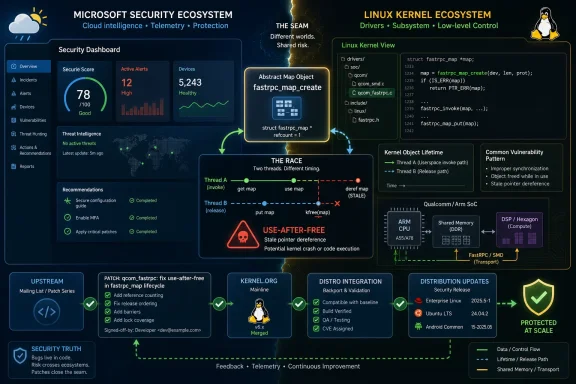 A Linux Driver Bug Lands in Microsoft’s Security Weather Report
The first trap with CVE-2026-53160 is to read “Microsoft” and assume “Windows.” That is not what this is. The vulnerability is in the Linux kernel’s FastRPC subsystem, a driver path associated with Qualcomm’s remote procedure call mechanism for communicating with DSPs and related co-processors.Yet the CVE appearing in Microsoft’s orbit is not strange anymore. Microsoft ships, hosts, supports, scans, mirrors, and depends on Linux in ways that would have sounded absurd in the Ballmer-era caricature of Redmond. Azure runs oceans of Linux. Windows developers use WSL as a daily tool. Windows on Arm has made Qualcomm silicon a front-page Microsoft platform story. Security Update Guide entries increasingly reflect the reality that “Microsoft customer exposure” is not synonymous with “bug in
ntoskrnl.exe.”That shift matters because it changes how administrators should read these notices. A Linux kernel CVE in a Microsoft security feed should not trigger panic on every Windows laptop, but it should trigger inventory thinking. Where are Linux kernels running under Microsoft management? Which images are pinned? Which appliances or Arm devices expose Qualcomm-adjacent driver code? Which developer machines are carrying kernels that security teams do not normally audit?
CVE-2026-53160 is a small bug in a specific driver, but it is also a clean example of the new patch-management problem: the vulnerable code may sit far away from the brand name printed on the machine, while the risk still belongs to the organization that operates it.
The Bug Is a Race, Not a Remote Internet Fire
The technical summary is terse but revealing.fastrpc_map_lookup returns a raw pointer after releasing fl->lock. The caller, fastrpc_map_create, then tries to take a reference with fastrpc_map_get, using kref_get_unless_zero. In the tiny interval between the lookup and the reference acquisition, a concurrent MEM_UNMAP operation can free the map.That is the classic shape of a use-after-free: code keeps using an object after the lifetime rules say the object may already be gone. In kernel space, that is never just a cleanliness issue. Freed memory can be recycled for another object, corrupted, or accessed in ways that turn a timing mistake into a crash or privilege boundary failure.
The fix described for CVE-2026-53160 is not glamorous. It restores a
take_ref parameter so the reference is acquired atomically while the relevant lock is still held, before the pointer is exposed to the caller. In other words, the kernel is being taught to stop handing someone a house key after the house may already have been demolished.That detail is important because it cuts against the temptation to overstate the bug. This is not, on the public facts available, a wormable network vulnerability or a browser-drive-by issue. The scoring published by vulnerability trackers points to a local, low-privilege attack path with no user interaction, serious potential impact, and the usual caveat that exploitability depends heavily on configuration, reachable device nodes, kernel hardening, and timing reliability.
For defenders, the most useful reading is not “the sky is falling.” It is “local kernel attack surface still matters, especially on systems where untrusted code can run.”
FastRPC Is Exactly the Kind of Plumbing Users Never See
FastRPC exists because modern systems are not a single CPU running a single operating system in splendid isolation. Qualcomm platforms, especially in mobile and Arm-centric designs, make heavy use of specialized processors for signal processing, audio, imaging, AI acceleration, modem functions, and other workloads. The host operating system needs controlled ways to share memory and invoke work on those remote processors.That is where driver subsystems like FastRPC become security-sensitive. They sit between user space, kernel space, shared memory, and firmware-backed execution environments. They are not flashy. They rarely have icons, marketing names, or settings toggles. But they are exactly the sort of code that turns a local app’s request into privileged coordination across hardware boundaries.
The map object at the center of CVE-2026-53160 is part of that choreography. Memory has to be mapped, referenced, shared, unmapped, and reclaimed safely. If one thread sees a map while another thread is tearing it down, the kernel must make the object’s lifetime unambiguous. The patch does that by moving the reference-taking back under the lock.
That may sound like a minor bookkeeping correction, but object lifetime is one of the oldest and hardest problems in C kernel programming. Reference counts, locks, RCU, workqueues, and teardown paths all exist because hardware and software do not politely wait in single-file order. Race bugs happen when code briefly assumes the world is still; attackers look for ways to make the world move at exactly the wrong moment.
The uncomfortable part is that these bugs are often born in perfectly reasonable refactoring. A helper returns a pointer. A caller takes a reference. A lock is released for performance or simplicity. Each line looks defensible in isolation. The vulnerability lives in the gap.
Severity Scores Tell Only Half the Story
Public vulnerability listings have treated CVE-2026-53160 as a high-severity issue in at least some scoring systems, with the familiar local-attack CVSS shape: local access required, low privileges required, no user interaction, and potentially high confidentiality, integrity, and availability impact. Amazon’s advisory view, meanwhile, marked its listed Amazon Linux kernel packages as not affected. That contrast is not a contradiction so much as a lesson.Kernel CVEs are rarely universal in the way that a bug in a ubiquitous userland library can be. Whether this one matters depends on kernel version, patch level, whether the FastRPC driver is present and enabled, whether the relevant device interface is reachable, and whether the hardware platform even uses the subsystem. On a garden-variety x86 Windows desktop, the answer is likely to be “not directly relevant.” On a Linux-on-Qualcomm environment, an Android-derived stack, an Arm developer board, or a specialized embedded deployment, the answer may be very different.
This is why vulnerability management teams get frustrated by CVSS-driven dashboards. A 7.8 score is useful as a sorting signal, but it does not know your fleet. It does not know that your production Azure images use a provider kernel already patched. It does not know that your lab has a pile of Snapdragon development machines running custom kernels. It does not know that your CI workers run untrusted build jobs inside containers on hosts with unusually broad device exposure.
The better question is not “is this high?” The better question is “where can untrusted local code reach the affected driver?” If the answer is nowhere, the CVE becomes routine patch hygiene. If the answer is “on multi-user systems, developer boxes, test farms, or devices that expose FastRPC nodes to app-level code,” it deserves faster attention.
The exploitability nuance also cuts both ways. Race conditions can be finicky, but local kernel races have a long history of becoming practical when attackers can repeatedly trigger the vulnerable path. A bug that looks theoretical in a lab note can become meaningful once someone wraps it in heap grooming, CPU pinning, namespace tricks, or device-specific knowledge.
Microsoft’s Role Is a Signal, Not the Root Cause
Microsoft’s Security Update Guide page for CVE-2026-53160 does not make this a Microsoft-authored bug. The affected component is described through the Linux kernel resolution text, and the available description points back to the upstream kernel fix pattern. Microsoft’s role is best understood as distribution, coordination, customer guidance, or ecosystem exposure rather than ownership of the vulnerable code path.That distinction matters because blame is less useful than patch path. If Microsoft includes a Linux kernel CVE in its guidance, administrators should ask which Microsoft-served products or environments might ingest the relevant kernel updates. Azure images, AKS node images, Linux-based appliances, WSL kernels, Defender-monitored Linux endpoints, and partner-provided Arm environments all have different update channels and timelines.
WSL deserves particular care in the public imagination. The presence of a Linux kernel CVE does not automatically mean every WSL user is exposed to every Linux driver flaw. WSL’s kernel configuration, device model, and hardware access differ from a bare-metal Linux installation. If a driver is not built, not loaded, or not reachable, the vulnerability may not be practically relevant there.
But WSL also illustrates the broader administrative blind spot. Many Windows shops have excellent processes for Patch Tuesday and comparatively fuzzy processes for developer-controlled Linux environments. A security team may know every Windows cumulative update state while having little visibility into WSL kernel versions, container base images, or local development VMs. CVE-2026-53160 is a nudge to close that gap before a more broadly reachable bug arrives.
Microsoft has spent years selling the idea that Windows is a platform for Linux development rather than a rival to it. That strategic bet has been good for developers. It also means Microsoft’s security story has to speak fluent Linux, even when the vulnerable line of code lives upstream.
Qualcomm’s Shadow Hangs Over the Windows on Arm Era
FastRPC is not a Windows on Arm vulnerability, but it inevitably lands in a news environment shaped by Windows on Arm. Qualcomm’s Snapdragon X push has made Arm laptops a serious Windows hardware category rather than a curiosity. At the same time, Linux enablement on those machines remains a complex dance of firmware, device trees, graphics stacks, power management, and accelerator interfaces.That does not mean CVE-2026-53160 maps neatly onto commercial Snapdragon Windows laptops. It does mean the same architectural theme is everywhere: modern client hardware is a federation of processors, firmware, and shared memory channels. The operating system is less a monarch than a traffic controller.
Security researchers have spent years finding that device-driver edges are fertile ground. GPU drivers, modem interfaces, DSP bridges, camera pipelines, and vendor-specific IOCTL handlers all tend to combine high privilege with complicated state machines. They often serve performance-sensitive workloads, and they frequently evolve alongside proprietary firmware and vendor SDKs.
FastRPC bugs therefore sit in a category that Windows users should recognize even if they never boot Linux. Windows has its own history of vulnerable drivers, over-permissive IOCTLs, kernel pool lifetime mistakes, and privilege-escalation paths through hardware support packages. The language changes, but the failure mode is familiar: a local attacker finds a privileged driver that trusts object state for a few instructions too long.
The Snapdragon era makes those edges more visible. As AI acceleration, neural processing units, and heterogeneous compute become normal laptop features, more code will exist to broker access between apps and specialized hardware. Every broker is a potential security boundary. Every boundary needs lifetime rules that survive malicious concurrency, not just ordinary workloads.
The Patch Is Small Because the Lesson Is Old
There is something almost boring about the CVE-2026-53160 fix: take the reference while still holding the lock. That is exactly the kind of answer kernel developers have known for decades. It is also exactly the kind of answer that is easy to regress when code is cleaned up, generalized, or optimized.Reference counting is supposed to make object lifetime explicit. If one part of the kernel wants to keep using an object, it increments the reference count; when it is done, it decrements it; the object is freed only when the count reaches zero. Locks are supposed to make concurrent access orderly. The bug appears when those two mechanisms are not composed correctly.
The vulnerability description makes clear that
kref_get_unless_zero was being called on an unprotected pointer. That function name itself tells the story: it tries to take a reference only if the object is not already on the path to destruction. But if the pointer can be freed before the function runs, the check arrives too late. You cannot safely ask a corpse whether it is still alive.Atomicity is the real fix. Not atomicity in the marketing sense, but the kernel engineering sense: the lookup and reference acquisition must be one indivisible operation from the perspective of competing teardown. If another thread cannot free the map between “found it” and “I own a reference,” the race collapses.
This is why small kernel patches can carry large security consequences. The diff may look like plumbing. The security property it restores is foundational.
Linux CVEs Have Become a Windows Admin Problem
Windows administrators used to be able to treat Linux kernel vulnerabilities as someone else’s weather. That division has been eroding for years. The modern Windows estate includes Linux containers on developer machines, WSL distributions, Azure Linux workloads, Kubernetes nodes, network appliances, security tooling, backup agents, and firmware-adjacent systems that rarely show up in traditional endpoint reports.CVE-2026-53160 is not the worst possible version of that problem because it appears to require local access and a specific driver path. But it is a good rehearsal. The response pattern is the same one organizations will need for higher-profile Linux kernel bugs: identify where the affected code exists, determine whether it is reachable, confirm vendor patch status, and update through the supported channel.
The inventory question is especially important for Arm and embedded systems. A company may have standard patching for Ubuntu servers and still forget about test rigs, IoT gateways, robotics controllers, mobile device labs, or custom kernels used by hardware teams. Those systems often run closer to the metal, expose more device nodes, and lag behind distribution kernels.
Container-heavy environments add another twist. Containers do not carry their own kernels; they share the host kernel. Updating a vulnerable userland image will not fix a host kernel driver flaw. If untrusted or semi-trusted workloads run on a host with the affected subsystem reachable, the relevant patch is a host update, not an image rebuild.
That distinction is obvious to kernel engineers and still missed in enterprise dashboards. CVE records are often ingested as package names, but kernel exposure is a property of the running host, loaded modules, hardware, and access controls. A scanner that says “Linux kernel vulnerable” is starting a conversation, not finishing one.
The Disclaimer Is Boilerplate, but the Risk Transfer Is Real
The Microsoft Knowledge Base disclaimer attached to the user-submitted material is legal boilerplate: information provided as-is, no warranties, no liability for damages. It is easy to skip because every vendor says some version of it. Still, in the context of ecosystem CVEs, the disclaimer captures a real asymmetry.Vendors can publish guidance, but customers own the messy work of mapping that guidance to reality. Microsoft can list a CVE. Kernel maintainers can land patches. Cloud providers can publish affected-package statuses. Security vendors can assign scores. None of those parties can know every custom image, lab kernel, downstream vendor build, or unmanaged developer machine in a given organization.
That is not an argument against vendor guidance. It is an argument against treating vendor guidance as a complete operational answer. The more heterogeneous the Microsoft ecosystem becomes, the more security teams must stitch together information from Microsoft, upstream Linux, distribution maintainers, hardware vendors, and their own telemetry.
There is also a timing issue. Kernel patches may exist upstream before they arrive in every distribution. Cloud kernels may be marked not affected while downstream embedded products remain ambiguous. A CVE page may be published before NVD enrichment, CPE mapping, exploit intelligence, or vendor advisories have stabilized. Early vulnerability data is often directionally useful and operationally incomplete.
Good teams build workflows that tolerate that uncertainty. They do not wait for perfect metadata, but they also do not blindly reboot everything because a score crossed a threshold. They ask whether the vulnerable code is present, reachable, and exposed to untrusted actors. Then they patch according to actual risk.
The Real Audience Is Anyone Running Untrusted Local Code
The attack path described for CVE-2026-53160 is local, which can sound reassuring until one remembers how much modern computing is built around running other people’s code locally. Browsers run complex content. Developer machines run package scripts. CI systems run pull requests. Container hosts run customer or tenant workloads. Desktop users install utilities with uncertain provenance.Local privilege escalation remains one of the most useful links in an attack chain. An attacker who starts with a low-privilege foothold wants persistence, credential access, sandbox escape, security-tool tampering, and lateral movement. A kernel use-after-free is the sort of primitive that can turn “I can run code” into “I control the host,” if the exploit is practical and the target is configured just right.
The FastRPC specificity narrows the field. The bug is most relevant where the driver exists and can be exercised. But the security model lesson is general: local attack surface deserves almost as much respect as remote attack surface on systems that execute untrusted workloads by design.
This is particularly true for developer workstations. They are privileged, messy, and full of secrets: SSH keys, cloud tokens, signing credentials, source code, VPN access, and administrative tools. They also run experimental kernels, WSL instances, vendor SDKs, emulators, containers, and hardware drivers. A local kernel bug on a developer machine can be more valuable than a remote bug on a locked-down kiosk.
The same is true for build infrastructure. CI hosts often process untrusted input from branches, forks, dependency updates, and generated artifacts. If those jobs share a vulnerable host kernel and can reach sensitive device interfaces, “local” becomes a tenant isolation problem.
The Fix Should Flow Through Kernels, Not Workarounds
For most administrators, the right mitigation is boring: take the kernel update from the distribution, cloud provider, device vendor, or Microsoft-managed channel that supplies the affected environment. Do not cherry-pick kernel driver patches unless you already operate at that level of engineering maturity. Do not assume that blacklisting a module is safe without understanding hardware dependencies.That said, exposure reduction is still useful while waiting for vendor updates. If FastRPC is not needed, it should not be exposed. If device nodes are accessible to broad user groups, permissions deserve review. If untrusted workloads run on hosts with specialized hardware interfaces, that should be an explicit risk decision rather than an accident.
The most dangerous posture is the default one: assuming that because a CVE mentions Linux, it has no relevance to a Microsoft-centered shop. The second most dangerous posture is the inverse: assuming that because Microsoft lists it, every Windows endpoint is vulnerable. Both are lazy readings. The correct answer is inventory.
Security teams should also resist the urge to treat “not affected” from one vendor as globally dispositive. Amazon’s advisory status for Amazon Linux packages is useful for Amazon Linux. It says little about a custom Qualcomm board, a downstream Android kernel, an OEM image, or a lab machine running a mainline release candidate. Kernel vulnerability management is local in the literal sense: what matters is the kernel actually booted on the system in front of you.
The operationally mature response is to tie CVE intake to asset context. Kernel version, configuration, loaded modules, hardware platform, device-node permissions, workload trust level, and patch source all belong in the same conversation.
The Small Race That Exposes the Big Patch Map
CVE-2026-53160 will not be remembered as the vulnerability that reshaped Windows security. It is too specific for that, and the public facts do not support that level of drama. But it is a useful, concrete marker of where the industry already is.- CVE-2026-53160 is a Linux kernel FastRPC use-after-free race, not a native Windows kernel vulnerability.
- The bug centers on a map pointer being exposed before a reference is safely acquired under lock.
- The practical risk depends on whether the affected FastRPC driver code is present, enabled, and reachable by untrusted local code.
- Microsoft’s publication of the CVE should be read as ecosystem guidance, not proof that all Windows systems are exposed.
- Administrators should verify Linux kernels in Azure, WSL-adjacent workflows, Arm labs, CI hosts, embedded devices, and developer environments rather than relying on brand-level assumptions.
- The durable mitigation is to consume the appropriate kernel update from the vendor or distribution that owns the running kernel.
References
- Primary source: MSRC
Published: 2026-06-28T01:40:33-07:00
Security Update Guide - Microsoft Security Response Center
 msrc.microsoft.com
- Related coverage: sentinelone.com
CVE-2026-31730: Linux Kernel Use-After-Free Vulnerability
CVE-2026-31730 is a use-after-free vulnerability in Linux Kernel. Learn about its impact, affected versions, and mitigation methods.www.sentinelone.com
- Related coverage: osv.dev

OSV - Open Source Vulnerabilities
Comprehensive vulnerability database for your open source projects and dependencies.
osv.dev
