

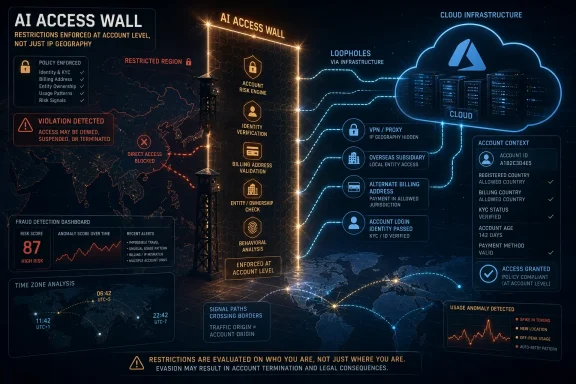
Anthropic is reportedly tightening enforcement around Claude access after the Financial Times said Chinese companies, including Ant Financial and ByteDance, used overseas subsidiaries, cloud infrastructure, VPNs, and other workarounds to keep using the AI system despite Anthropic’s China ban. The immediate story is not just that a terms-of-service wall was breached; it is that the wall was always porous in a cloud economy built to dissolve borders. Anthropic is now trying to turn a contractual restriction into something closer to an operational export-control regime. That shift matters far beyond Claude, because every major AI vendor is about to confront the same uncomfortable question: who is really using the model on the other side of the account?
The Financial Times report, summarized by Free Press Journal and other outlets, describes a familiar pattern in enterprise technology: the policy says one thing, the infrastructure quietly permits another. Ant Financial reportedly gave employees Claude accounts tied to its Singapore-based entity. ByteDance reportedly reimbursed engineers for personal subscriptions accessed through VPNs. Other companies allegedly used foreign subsidiaries and cloud services, including Microsoft Azure, to reach Claude from places Anthropic says are off limits.
That is not the same as an accusation of criminal hacking. The reporting says these routes may not violate U.S. or Chinese law, but they do appear to run directly into Anthropic’s terms of service. That distinction is the whole story. In AI geopolitics, the first line of enforcement is no longer a customs officer, an export license, or a border checkpoint. It is an account form, a billing address, a cloud reseller, and whatever anomaly detection a vendor can bolt onto the back end.
Anthropic has positioned itself more aggressively than some peers on China access. Last year, the company said its policy barred use not only from unsupported regions such as China, but also by companies controlled by entities headquartered there, including subsidiaries incorporated elsewhere. In other words, Anthropic was not merely asking, “Where is the user connecting from?” It was asking, “Who ultimately controls the organization?”
That is a much harder standard to enforce. Cloud computing was designed to let multinational companies route workloads where latency, cost, compliance, and business structure make sense. The same flexibility that lets a U.S. company run workloads in Ireland or Singapore lets a restricted company present itself through a legally distinct overseas affiliate. Anthropic’s problem is that the internet does not naturally encode beneficial ownership.
That is precisely why the story should worry AI vendors. The modern SaaS model assumes customers are distributed, employees are mobile, and enterprise identities are federated across jurisdictions. A serious ban on particular classes of users requires the vendor to behave less like a software company and more like a financial institution conducting sanctions screening.
Anthropic appears to understand this. According to the report, the company is monitoring accounts for signals such as computer time zones and targeting so-called “transfer station” services that relay requests through overseas Claude accounts. That is the language of fraud detection, not ordinary product support. It also suggests Anthropic believes the problem is not a few isolated users slipping through a registration form, but a repeatable access economy.
The “transfer station” phenomenon is especially important. Researchers and trade publications have described Chinese grey-market proxy services that resell access to Western AI models, sometimes at deep discounts, by routing prompts through accounts outside China. These services are not just a compliance headache. They are a security and privacy risk for users, because prompts and outputs flowing through an intermediary can become training material, resale inventory, or intelligence.
For enterprise IT, this is a useful reminder that AI access is now a supply-chain question. A developer may think they are calling Claude. In practice, they may be sending code, logs, proprietary documents, or customer data through a broker whose incentives are opaque. That risk exists whether the user is in China, Europe, or the United States.
This is where the company’s public posture becomes strategically useful. If Anthropic can persuade policymakers that its rules are more stringent than competitors’ rules, it can argue that it is acting responsibly while others leave gaps. If it can show that Chinese firms are still finding ways in, it can ask Washington for help turning private enforcement into public policy.
The risk is that Anthropic also makes itself a test case. Once a company advertises a strict geopolitical access policy, every evasion becomes evidence either of adversarial determination or vendor weakness. The stricter the line, the more embarrassing the bypass.
That tension is not unique to Anthropic. OpenAI, Google, Microsoft, Meta, and other AI players all face versions of it. But Anthropic has leaned especially hard into the idea that frontier model access should be controlled by ownership, jurisdiction, and strategic alignment. That is a far more ambitious project than blocking sign-ups from a country-code IP range.
It also creates tension with cloud partners. If a customer reaches Claude through a major cloud provider, who is responsible for checking whether the customer’s parent company is barred? The AI lab? The cloud platform? The reseller? The enterprise customer? The answer may vary by contract, but the policy problem does not.
Alibaba has not publicly validated Anthropic’s account, and the allegations should be treated as allegations. But the timing matters. Anthropic is not merely claiming that some Chinese firms wanted to use Claude for ordinary productivity work. It is claiming that unauthorized access can become a mechanism for distillation — using outputs from a stronger model to train or improve a competing one.
That raises the stakes dramatically. If a company uses Claude to draft emails, the vendor loses some subscription control. If a company uses Claude at industrial scale to generate training data, the vendor may be subsidizing a competitor. The same API call can be both a customer interaction and a transfer of capability.
This is the central anxiety of the frontier AI business. Unlike traditional software, where the source code is the crown jewel and outputs are often incidental, AI models can leak value through behavior. A rival does not need the weights if it can query the system enough times, structure the prompts carefully, and train another model on the responses. Rate limits, identity checks, and anomaly detection become part of the moat.
Anthropic’s critics will note the irony. Frontier AI companies themselves were built on enormous quantities of data scraped, licensed, purchased, or otherwise assembled from the internet and private corpora. Now the same companies are asking governments and customers to treat model outputs as strategically sensitive assets. That does not make Anthropic’s concern invalid, but it does make the politics more complicated.
Microsoft has its own complicated position in this ecosystem. It is OpenAI’s most important cloud partner, a major AI model distributor through Azure AI services, a Copilot vendor across Windows and Microsoft 365, and a platform on which third-party models can be offered. If customers use Azure infrastructure to reach models they are not supposed to access, Microsoft may find itself pulled into fights that began as another vendor’s terms-of-service issue.
That does not mean Microsoft is accused of wrongdoing in the reporting. Cloud platforms routinely serve as neutral infrastructure for lawful customers across many jurisdictions. The problem is that neutrality becomes harder to maintain when AI models are treated as strategic goods rather than ordinary software services.
Enterprise administrators should recognize the pattern from earlier eras: shadow IT, SaaS sprawl, unsanctioned file-sharing tools, and developer accounts expensed outside procurement. AI supercharges the problem because the tool is both useful and hard to monitor. A single developer with a personal subscription can move source code, architecture notes, customer records, or internal strategy into an external model before the security team knows the account exists.
The China angle is geopolitically charged, but the operational lesson is broader. If your organization does not know which AI models employees are using, through which accounts, under which data-retention terms, and from which jurisdictions, then your policy is mostly theater. Anthropic is discovering that at global scale. Many enterprises are discovering it one expense report at a time.
That has benefits. A model provider that can detect mass account creation, proxy routing, improbable usage patterns, and coordinated extraction campaigns is better equipped to protect users and intellectual property. It can also respond faster when accounts are used for fraud, malware development, influence operations, or data exfiltration.
But there are costs. Time-zone monitoring and identity verification can sweep in legitimate travelers, expatriates, contractors, privacy-conscious users, and multinational teams. Government-issued ID checks may reduce abuse, but they also create new data-protection obligations and new breach risks. The harder vendors push on identity, the more they become custodians of sensitive personal information.
There is also the danger of false confidence. Sophisticated organizations can standardize devices, route traffic consistently, use local payment instruments, and structure subsidiaries to appear compliant. Meanwhile, ordinary users get caught by blunt detection rules. Enforcement systems often punish the messy and under-resourced before they catch the powerful.
AI vendors will argue that they have no choice. If governments view advanced models as dual-use technologies, vendors must show that they can police access. If competitors can cheaply distill capabilities through automated querying, vendors must stop suspicious traffic. If customers demand data protection, vendors must know who is touching the system.
All of that is true. It still means the cheerful era of “sign up and start prompting” is ending for the most capable models.
That is unlikely to satisfy AI labs for long. The largest model companies increasingly want government backing for access controls, especially where China is involved. They want rules that make evasion not merely a breach of terms but a sanctionable or otherwise punishable act. They also want competitors held to similar standards, so that stricter enforcement does not become a commercial disadvantage.
Washington may be receptive. U.S. policy has already moved from controlling advanced chips toward scrutinizing model weights, cloud access, and AI capability transfer. The hard part is designing rules that do not break legitimate research, multinational business, open-source development, or ordinary cloud commerce.
Export controls work best when the controlled item is discrete: a chip, a machine tool, a software package, a shipment. AI model access is more fluid. It can be delivered through an API, embedded in an application, resold through a proxy, invoked through a coding tool, or hidden behind a contractor’s account. Regulating it requires a map of identity, ownership, location, and intent.
That map is never perfect. Corporate ownership structures shift. Employees move. Cloud workloads migrate. VPNs and proxies obscure geography. The more governments ask vendors to police these boundaries, the more vendors will ask users to prove who they are and what they control.
Developers will feel it first. Coding assistants and agentic tools are among the most valuable uses of frontier models, and they are also among the most sensitive. Source code reveals architecture, dependencies, vulnerabilities, credentials, and business logic. If Anthropic believes Chinese firms are targeting software engineering and agentic reasoning capabilities, it will scrutinize heavy coding workloads more closely.
That may change how organizations procure AI tools. Instead of letting teams choose whatever model performs best this month, enterprises may consolidate around approved providers with clear logging, retention, residency, and contractual controls. Procurement will care less about chatbot novelty and more about auditability.
It may also strengthen local and open-weight models. If access to U.S. frontier models becomes more identity-bound and politically constrained, companies outside favored jurisdictions will invest harder in domestic alternatives. Some of those alternatives will be weaker. Some will be good enough. A ban that is porous in the short term can still accelerate substitution in the long term.
That is the strategic paradox for Anthropic. Restricting Claude may protect its frontier capabilities today, but it also encourages restricted users to build, buy, or improve substitutes tomorrow. The company is betting that slowing capability transfer is worth the market it gives up.
 Anthropic’s China Ban Meets the Reality of Global Cloud Plumbing
The Financial Times report, summarized by Free Press Journal and other outlets, describes a familiar pattern in enterprise technology: the policy says one thing, the infrastructure quietly permits another. Ant Financial reportedly gave employees Claude accounts tied to its Singapore-based entity. ByteDance reportedly reimbursed engineers for personal subscriptions accessed through VPNs. Other companies allegedly used foreign subsidiaries and cloud services, including Microsoft Azure, to reach Claude from places Anthropic says are off limits.That is not the same as an accusation of criminal hacking. The reporting says these routes may not violate U.S. or Chinese law, but they do appear to run directly into Anthropic’s terms of service. That distinction is the whole story. In AI geopolitics, the first line of enforcement is no longer a customs officer, an export license, or a border checkpoint. It is an account form, a billing address, a cloud reseller, and whatever anomaly detection a vendor can bolt onto the back end.
Anthropic has positioned itself more aggressively than some peers on China access. Last year, the company said its policy barred use not only from unsupported regions such as China, but also by companies controlled by entities headquartered there, including subsidiaries incorporated elsewhere. In other words, Anthropic was not merely asking, “Where is the user connecting from?” It was asking, “Who ultimately controls the organization?”
That is a much harder standard to enforce. Cloud computing was designed to let multinational companies route workloads where latency, cost, compliance, and business structure make sense. The same flexibility that lets a U.S. company run workloads in Ireland or Singapore lets a restricted company present itself through a legally distinct overseas affiliate. Anthropic’s problem is that the internet does not naturally encode beneficial ownership.
The Loophole Was the Business Model
The most revealing part of the reported workaround is that none of it sounds exotic. There are no cinematic intrusions, no zero-day exploits, no stolen source code in the core allegation. There are corporate accounts, personal subscriptions, VPNs, offshore subsidiaries, and cloud platforms.That is precisely why the story should worry AI vendors. The modern SaaS model assumes customers are distributed, employees are mobile, and enterprise identities are federated across jurisdictions. A serious ban on particular classes of users requires the vendor to behave less like a software company and more like a financial institution conducting sanctions screening.
Anthropic appears to understand this. According to the report, the company is monitoring accounts for signals such as computer time zones and targeting so-called “transfer station” services that relay requests through overseas Claude accounts. That is the language of fraud detection, not ordinary product support. It also suggests Anthropic believes the problem is not a few isolated users slipping through a registration form, but a repeatable access economy.
The “transfer station” phenomenon is especially important. Researchers and trade publications have described Chinese grey-market proxy services that resell access to Western AI models, sometimes at deep discounts, by routing prompts through accounts outside China. These services are not just a compliance headache. They are a security and privacy risk for users, because prompts and outputs flowing through an intermediary can become training material, resale inventory, or intelligence.
For enterprise IT, this is a useful reminder that AI access is now a supply-chain question. A developer may think they are calling Claude. In practice, they may be sending code, logs, proprietary documents, or customer data through a broker whose incentives are opaque. That risk exists whether the user is in China, Europe, or the United States.
Anthropic Is Turning Terms of Service Into Policy Infrastructure
Anthropic’s response, as reported, is to reiterate that it prohibits access to Claude in unsupported regions and bars facilitation of that access. The company also says it is the only frontier AI company restricting sales to PRC-controlled companies, including subsidiaries incorporated outside China. That is a pointed claim, because it frames Claude access not merely as a commercial service but as a national-security boundary.This is where the company’s public posture becomes strategically useful. If Anthropic can persuade policymakers that its rules are more stringent than competitors’ rules, it can argue that it is acting responsibly while others leave gaps. If it can show that Chinese firms are still finding ways in, it can ask Washington for help turning private enforcement into public policy.
The risk is that Anthropic also makes itself a test case. Once a company advertises a strict geopolitical access policy, every evasion becomes evidence either of adversarial determination or vendor weakness. The stricter the line, the more embarrassing the bypass.
That tension is not unique to Anthropic. OpenAI, Google, Microsoft, Meta, and other AI players all face versions of it. But Anthropic has leaned especially hard into the idea that frontier model access should be controlled by ownership, jurisdiction, and strategic alignment. That is a far more ambitious project than blocking sign-ups from a country-code IP range.
It also creates tension with cloud partners. If a customer reaches Claude through a major cloud provider, who is responsible for checking whether the customer’s parent company is barred? The AI lab? The cloud platform? The reseller? The enterprise customer? The answer may vary by contract, but the policy problem does not.
The Alibaba Allegation Makes the Crackdown Harder to Dismiss
The latest Financial Times reporting lands just after Anthropic accused operators linked to Alibaba and its Qwen AI lab of running a large-scale campaign to extract Claude capabilities. Reuters, Ars Technica, and other outlets reported that Anthropic described nearly 25,000 fraudulent accounts and more than 28.8 million Claude interactions between April 22 and June 5, 2026. Anthropic reportedly made those claims in a letter to U.S. senators.Alibaba has not publicly validated Anthropic’s account, and the allegations should be treated as allegations. But the timing matters. Anthropic is not merely claiming that some Chinese firms wanted to use Claude for ordinary productivity work. It is claiming that unauthorized access can become a mechanism for distillation — using outputs from a stronger model to train or improve a competing one.
That raises the stakes dramatically. If a company uses Claude to draft emails, the vendor loses some subscription control. If a company uses Claude at industrial scale to generate training data, the vendor may be subsidizing a competitor. The same API call can be both a customer interaction and a transfer of capability.
This is the central anxiety of the frontier AI business. Unlike traditional software, where the source code is the crown jewel and outputs are often incidental, AI models can leak value through behavior. A rival does not need the weights if it can query the system enough times, structure the prompts carefully, and train another model on the responses. Rate limits, identity checks, and anomaly detection become part of the moat.
Anthropic’s critics will note the irony. Frontier AI companies themselves were built on enormous quantities of data scraped, licensed, purchased, or otherwise assembled from the internet and private corpora. Now the same companies are asking governments and customers to treat model outputs as strategically sensitive assets. That does not make Anthropic’s concern invalid, but it does make the politics more complicated.
The Azure Mention Is a Warning Shot for Microsoft Customers
For WindowsForum readers, the reported mention of Microsoft Azure is not a side detail. It is a sign of how AI access disputes will increasingly run through the same cloud platforms that enterprises already use for identity, compute, security logging, and procurement.Microsoft has its own complicated position in this ecosystem. It is OpenAI’s most important cloud partner, a major AI model distributor through Azure AI services, a Copilot vendor across Windows and Microsoft 365, and a platform on which third-party models can be offered. If customers use Azure infrastructure to reach models they are not supposed to access, Microsoft may find itself pulled into fights that began as another vendor’s terms-of-service issue.
That does not mean Microsoft is accused of wrongdoing in the reporting. Cloud platforms routinely serve as neutral infrastructure for lawful customers across many jurisdictions. The problem is that neutrality becomes harder to maintain when AI models are treated as strategic goods rather than ordinary software services.
Enterprise administrators should recognize the pattern from earlier eras: shadow IT, SaaS sprawl, unsanctioned file-sharing tools, and developer accounts expensed outside procurement. AI supercharges the problem because the tool is both useful and hard to monitor. A single developer with a personal subscription can move source code, architecture notes, customer records, or internal strategy into an external model before the security team knows the account exists.
The China angle is geopolitically charged, but the operational lesson is broader. If your organization does not know which AI models employees are using, through which accounts, under which data-retention terms, and from which jurisdictions, then your policy is mostly theater. Anthropic is discovering that at global scale. Many enterprises are discovering it one expense report at a time.
Enforcement Now Looks Like Fraud Detection, KYC, and Endpoint Telemetry
Anthropic’s reported detection methods — time-zone checks, suspicious account monitoring, and action against relay services — point toward the next phase of AI governance. The industry is moving away from polite acceptable-use policies and toward continuous identity and behavior scoring.That has benefits. A model provider that can detect mass account creation, proxy routing, improbable usage patterns, and coordinated extraction campaigns is better equipped to protect users and intellectual property. It can also respond faster when accounts are used for fraud, malware development, influence operations, or data exfiltration.
But there are costs. Time-zone monitoring and identity verification can sweep in legitimate travelers, expatriates, contractors, privacy-conscious users, and multinational teams. Government-issued ID checks may reduce abuse, but they also create new data-protection obligations and new breach risks. The harder vendors push on identity, the more they become custodians of sensitive personal information.
There is also the danger of false confidence. Sophisticated organizations can standardize devices, route traffic consistently, use local payment instruments, and structure subsidiaries to appear compliant. Meanwhile, ordinary users get caught by blunt detection rules. Enforcement systems often punish the messy and under-resourced before they catch the powerful.
AI vendors will argue that they have no choice. If governments view advanced models as dual-use technologies, vendors must show that they can police access. If competitors can cheaply distill capabilities through automated querying, vendors must stop suspicious traffic. If customers demand data protection, vendors must know who is touching the system.
All of that is true. It still means the cheerful era of “sign up and start prompting” is ending for the most capable models.
The Legal Gap Is Where the Politics Will Grow
One of the most striking claims in the reporting is that the alleged workarounds may not violate U.S. or Chinese law. If accurate, that exposes the gap between private AI governance and public regulation. Anthropic can ban a user under its terms. It can close accounts, pressure partners, and improve detection. But if the underlying conduct is not illegal, the company’s remedies remain contractual and technical.That is unlikely to satisfy AI labs for long. The largest model companies increasingly want government backing for access controls, especially where China is involved. They want rules that make evasion not merely a breach of terms but a sanctionable or otherwise punishable act. They also want competitors held to similar standards, so that stricter enforcement does not become a commercial disadvantage.
Washington may be receptive. U.S. policy has already moved from controlling advanced chips toward scrutinizing model weights, cloud access, and AI capability transfer. The hard part is designing rules that do not break legitimate research, multinational business, open-source development, or ordinary cloud commerce.
Export controls work best when the controlled item is discrete: a chip, a machine tool, a software package, a shipment. AI model access is more fluid. It can be delivered through an API, embedded in an application, resold through a proxy, invoked through a coding tool, or hidden behind a contractor’s account. Regulating it requires a map of identity, ownership, location, and intent.
That map is never perfect. Corporate ownership structures shift. Employees move. Cloud workloads migrate. VPNs and proxies obscure geography. The more governments ask vendors to police these boundaries, the more vendors will ask users to prove who they are and what they control.
Chinese Firms Are Not the Only Ones Learning From This
The focus here is Chinese access to Claude, but every major AI consumer should pay attention. Anthropic’s actions are a preview of a more restrictive model-access environment for everyone. The same systems used to identify barred Chinese-controlled entities can be used to enforce sector-specific rules, sanctions, age restrictions, copyright policies, rate limits, and internal risk scoring.Developers will feel it first. Coding assistants and agentic tools are among the most valuable uses of frontier models, and they are also among the most sensitive. Source code reveals architecture, dependencies, vulnerabilities, credentials, and business logic. If Anthropic believes Chinese firms are targeting software engineering and agentic reasoning capabilities, it will scrutinize heavy coding workloads more closely.
That may change how organizations procure AI tools. Instead of letting teams choose whatever model performs best this month, enterprises may consolidate around approved providers with clear logging, retention, residency, and contractual controls. Procurement will care less about chatbot novelty and more about auditability.
It may also strengthen local and open-weight models. If access to U.S. frontier models becomes more identity-bound and politically constrained, companies outside favored jurisdictions will invest harder in domestic alternatives. Some of those alternatives will be weaker. Some will be good enough. A ban that is porous in the short term can still accelerate substitution in the long term.
That is the strategic paradox for Anthropic. Restricting Claude may protect its frontier capabilities today, but it also encourages restricted users to build, buy, or improve substitutes tomorrow. The company is betting that slowing capability transfer is worth the market it gives up.
The AI Border Is Being Drawn Inside the Account Login
The practical lessons from the Claude access fight are narrower than the geopolitical rhetoric but more useful for administrators and technology buyers.- Anthropic’s reported crackdown shows that model access restrictions now depend on identity, ownership, billing, device signals, and partner enforcement, not just IP geolocation.
- The alleged use of overseas subsidiaries and personal subscriptions demonstrates how ordinary SaaS procurement paths can undermine strategic access policies.
- The reported Alibaba distillation allegations raise the stakes because high-volume model access can be treated as capability extraction, not just unauthorized usage.
- Cloud providers such as Azure may face increasing pressure to help AI vendors determine who ultimately controls customers and workloads.
- Enterprises should treat unsanctioned AI accounts as data-loss and compliance risks, even when employees use them for routine coding or productivity tasks.
- The next generation of AI controls will look more like financial compliance and fraud detection than traditional software licensing.
References
- Primary source: Free Press Journal
Published: 2026-07-03T10:30:13.190391
Anthropic Reportedly Moves Tightens Rules After Chinese Firms Bypass Claude Ban
Anthropic is tightening enforcement after reports that Chinese firms found ways to access its Claude AI models despite a formal ban. Companies including Ant Financial and ByteDance allegedly used overseas subsidiaries, cloud services such as Microsoft Azure, VPNs and account workarounds. The...www.freepressjournal.in - Related coverage: techradar.com
Anthropic accuses Alibaba of copying Claude by asking it millions of questions — and sets the stage for a new AI war | TechRadar
Can you recreate an AI just by talking to it enough?www.techradar.com - Related coverage: investing.com
Anthropic says Alibaba illicitly extracted Claude AI model capabilities By Reuters
Anthropic says Alibaba illicitly extracted Claude AI model capabilitieswww.investing.com - Related coverage: tomshardware.com
Anthropic claims that China's Alibaba used 25,000 fake accounts and 28.8 million exchanges to illicitly 'distill' its Claude model — violations occurred from April to June 2026 | Tom's Hardware
Someone is copying Anthropic's homework.www.tomshardware.com - Related coverage: techtimes.com
Alibaba Ran Largest Known AI Theft Campaign Against Claude, Anthropic Tells Senate
AI distillation attack records were shattered when Anthropic told the U.S. Senate that Alibaba’s Qwen lab ran 28.8 million unauthorized Claude exchanges through 25,000 fake accounts and proxywww.techtimes.com - Official source: anthropic.com
Updating restrictions of sales to unsupported regions \ Anthropic
Anthropic is an AI safety and research company that's working to build reliable, interpretable, and steerable AI systems.www.anthropic.com
- Related coverage: pondero.ai
Anthropic tells Senate that Alibaba ran 28.8 million Claude queries through 25,000 fake accounts in the largest known AI distillation attack
Anthropic submitted a formal letter to the Senate Banking Committee accusing Alibaba of running an industrial-scale model-distillation campaign against Claude from April 22 to June 5, 2026, generating 28.8 million unauthorized exchanges through roughly 25,000 fraudulent accounts.pondero.ai
- Related coverage: arstechnica.com
Anthropic says Alibaba must be punished for largest Claude cloning attack - Ars Technica
Alibaba allegedly used 25,000 accounts to mine Claude over 28.8 million exchanges.arstechnica.com - Related coverage: digitalapplied.com
Anthropic Accuses Alibaba of Record Model Distillation
Anthropic told US senators that Alibaba ran 28.8M Claude queries via 25,000 fake accounts, the largest model-distillation campaign it has disclosed.www.digitalapplied.com - Related coverage: notebookcheck.org
Anthropic impide a las empresas de propiedad china utilizar los modelos Claude según las nuevas condiciones - NotebookCheck.org News
Anthropic ha restringido el acceso a su IA, prohibiendo a las empresas con un 50% o más de propiedad china utilizar los modelos de Claude. www.notebookcheck.org
- Related coverage: stateofsurveillance.org
Anthropic Accuses Alibaba of Massive Claude Extraction Campaign - State of Surveillance
Day-1 brief on the Bloomberg/CNBC June 24, 2026 scoop: Anthropic alleges Alibaba ran 28.8M exchanges through 25K fraudulent accounts to distill Mythos capabilities over six weeks. Senate amendment incoming.stateofsurveillance.org - Related coverage: runtimewire.com
Anthropic Says Alibaba-Linked Operators Used 25,000 Accounts to Mine Claude for Qwen - RuntimeWire
Anthropic says Alibaba-linked operators used nearly 25,000 fraudulent accounts to generate 28.8 million Claude exchanges for Qwen-related distillation. runtimewire.com
- Related coverage: as.com
- Related coverage: musicbusinessworldwide.com
2026-06-10-Anthropic-to-Senate-Banking-re-Illicit-Distillation
PDF documentwww.musicbusinessworldwide.com
