

Google published CVE-2026-14076 on June 30, 2026, documenting a low-severity Chromium Network policy-enforcement flaw fixed in Chrome 150.0.7871.47 that could let a remote attacker bypass Content Security Policy through a crafted HTML page. The bug is not a headline-grabbing zero-day, and neither Google nor CISA says it is being exploited. But it is exactly the kind of browser defect enterprise defenders should not wave away: a small break in the browser’s policy machinery can become meaningful when chained with other bugs. As detailed by the NVD entry and Google’s Chrome Releases advisory, the practical answer is simple: Chrome and Chromium-based browsers need to move past the vulnerable build.
CVE-2026-14076 is, on paper, modest. Google rates the Chromium security severity as Low, while CISA’s ADP enrichment gives it a CVSS 3.1 score of 4.3, landing in Medium territory because the attack is network-reachable, requires no privileges, and needs user interaction. That distinction matters less than it first appears: both labels are saying this is not a standalone remote-code-execution emergency.
The bug sits in Chromium’s Network component and is described as insufficient policy enforcement. In plainer English, Chrome was not reliably enforcing a rule that web developers and security teams expect the browser to enforce. The rule in question is Content Security Policy, the web platform mechanism used to restrict where scripts, styles, frames, images, and other resources can be loaded from.
CSP is not magic armor. It is a damage-reduction system, often deployed to limit cross-site scripting, constrain injected content, and make sloppy web applications less catastrophic when something goes wrong. A bypass does not automatically hand an attacker your workstation, but it may let a malicious page do something the site author or administrator explicitly tried to prevent.
That is why this CVE deserves attention despite the low Chromium label. Browser security is layered by design, and attackers often do not need one glorious exploit if they can collect enough small policy failures to move from nuisance to compromise.
This is where vulnerability management gets less elegant than CVE summaries imply. Chrome updates itself for most consumer users, but organizations often sit behind staged rollouts, app-control policies, virtual desktop images, managed browser baselines, and change windows. A browser version number that looks current on one endpoint may not tell the whole story across a fleet.
The NVD change history also shows the familiar CPE wrinkle: the affected configuration is modeled as Google Chrome running on Windows, Linux, or macOS. That is useful for scanners, but not necessarily sufficient for real-world exposure management. Microsoft Edge, Brave, Vivaldi, Opera, Electron apps, embedded Chromium runtimes, and WebView-like components may inherit relevant Chromium fixes on their own schedules, even when the CVE record names Chrome.
That does not mean every Chromium-adjacent product is automatically vulnerable to this exact defect in the same way. It does mean defenders should avoid treating the NVD CPE list as a complete map of browser-engine risk. CPE tells you what the database has modeled; it does not replace vendor advisories, package inventories, or browser-engine version tracking.
A CSP bypass therefore has a strange profile. On its own, it may require a victim to visit a crafted page and may only affect integrity rather than confidentiality or availability. In combination with a vulnerable web app, a malicious ad slot, a compromised third-party script source, or a phishing workflow, it can undermine assumptions that developers and security teams have built into their threat models.
CISA’s vector reflects that middle ground. The attack is remote and low-complexity, but user interaction is required, and the recorded impact is limited to integrity. That is a fair technical read, not a dismissal.
The more mature way to think about CVE-2026-14076 is as a bypass of a browser-level promise. If your defensive posture assumes that Chrome’s network stack will enforce a CSP boundary in a particular way, then any failure of that enforcement deserves a patch, testing, and closure.
That context cuts both ways. On one hand, CVE-2026-14076 is not the scariest item in the bundle. Chrome updates regularly include memory-safety flaws, GPU issues, V8 bugs, sandbox escapes, UI spoofing problems, and browser-component policy failures that carry more obvious exploit potential.
On the other hand, the scale of the update makes selective patching irrational. Administrators are not being asked to surgically mitigate one CSP bypass. They are being asked to move the browser to a build that incorporates a large batch of fixes across the engine.
This is why Chrome patch management increasingly resembles operating-system patch management. The browser is the runtime for email, SaaS administration, identity workflows, internal dashboards, privileged cloud consoles, and developer tooling. A “low” browser CVE is still living inside one of the most exposed applications on the machine.
That sequence is normal, but it is worth spelling out because vulnerability scanners often present database fields as if they were immutable facts. Severity, weakness mapping, affected-product modeling, and exploitability status can arrive from different sources at different times. They can also change.
CWE-693, “Protection Mechanism Failure,” is a useful but broad bucket. It tells us the failure concerns a security control rather than, say, a classic memory-corruption primitive. It does not tell an administrator whether a specific intranet application’s CSP can be bypassed in a way that matters.
CISA’s SSVC enrichment is similarly restrained. It records no known exploitation, says the issue is not automatable, and characterizes the technical impact as partial. That should keep panic out of the room. It should not keep the patch out of the deployment queue.
Group Policy, Intune, Configuration Manager, third-party patch platforms, application allowlisting, and golden images all need to agree. If Chrome is installed per-user in one department and per-machine in another, the reporting can become noisy. If users are allowed to run portable Chromium-based browsers, the inventory picture can get worse.
The immediate verification path is simple: open Chrome’s About page or check the reported browser version through management tooling. The better operational path is to make browser-version compliance a measured control, not an occasional fire drill. In 2026, the browser is too important to be patched on vibes.
Edge deserves a separate note. Microsoft’s browser shares Chromium foundations but ships through Microsoft’s own channels and versioning. Administrators should follow Microsoft Edge release notes for corresponding Chromium fixes rather than assume Chrome’s version number maps directly to Edge’s state.
CVE-2026-14076 is a reminder that browser-enforced policy is still software. It can contain implementation gaps. The right lesson is not to abandon CSP, but to stop using it as an excuse for weak server-side controls, poor output encoding, or unnecessary third-party script sprawl.
For teams operating sensitive web applications, the best response is boring and effective. Keep the browser updated, keep the CSP tight, monitor CSP violation reports, reduce trusted script origins, and test important workflows across current browser versions after major updates. A CSP that nobody monitors is better than nothing, but not by as much as many teams think.
There is also a testing angle here. When a browser release fixes policy enforcement in Network, application owners should be alert for behavior changes. Most sites will never notice. A few may discover that a workaround, legacy integration, or overly clever resource-loading pattern depended on behavior Chrome has now corrected.
CVE-2026-14076 is not described as a sandbox escape, and there is no public indication that it is being exploited in the wild. That should shape the response. It belongs in normal priority patching, not emergency incident response, unless an organization has specific exposure or threat intelligence that changes the calculus.
But defenders should be wary of the psychological trap created by low-severity labels. A CSP bypass may be “only” an integrity issue in CVSS terms, yet integrity is exactly what many web attacks want first. Change what the victim’s browser is allowed to load, and you may change what the victim sees, submits, trusts, or executes.
The browser has become the front end for identity. Once that is true, policy bypasses are not cosmetic.
That sounds obvious, but enterprise vulnerability management has a habit of turning simple version thresholds into elaborate debates. Teams wait for scanner plugins. Scanners wait for NVD enrichment. NVD records may lag vendor advisories. Meanwhile, Chrome’s own updater has already solved the problem on machines where it is allowed to operate.
There is a place for compensating controls, especially in tightly governed environments. Network filtering, web isolation, EDR, application control, and user training can all reduce exposure. None of them are a substitute for taking the browser update when the vendor has already shipped it.
The cost of patching Chrome is usually low compared with the cost of explaining why a preventable browser bug remained open. That is especially true when the vulnerable component is part of the browser’s policy enforcement layer.
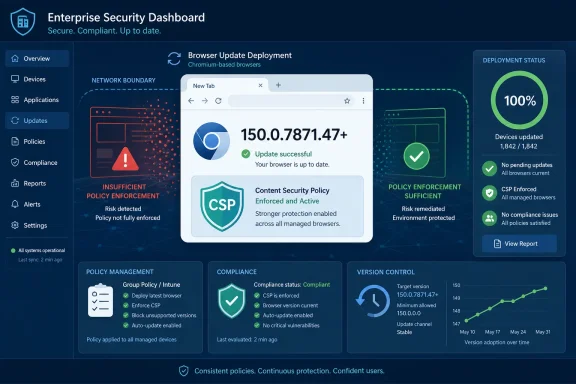 A “Low” Chrome Bug Still Lives in the Browser’s Trust Boundary
CVE-2026-14076 is, on paper, modest. Google rates the Chromium security severity as Low, while CISA’s ADP enrichment gives it a CVSS 3.1 score of 4.3, landing in Medium territory because the attack is network-reachable, requires no privileges, and needs user interaction. That distinction matters less than it first appears: both labels are saying this is not a standalone remote-code-execution emergency.The bug sits in Chromium’s Network component and is described as insufficient policy enforcement. In plainer English, Chrome was not reliably enforcing a rule that web developers and security teams expect the browser to enforce. The rule in question is Content Security Policy, the web platform mechanism used to restrict where scripts, styles, frames, images, and other resources can be loaded from.
CSP is not magic armor. It is a damage-reduction system, often deployed to limit cross-site scripting, constrain injected content, and make sloppy web applications less catastrophic when something goes wrong. A bypass does not automatically hand an attacker your workstation, but it may let a malicious page do something the site author or administrator explicitly tried to prevent.
That is why this CVE deserves attention despite the low Chromium label. Browser security is layered by design, and attackers often do not need one glorious exploit if they can collect enough small policy failures to move from nuisance to compromise.
Google Fixed the Bug, but the Version Math Is Messy
The clean remediation line is Chrome 150.0.7871.47 or later. The NVD entry says Chrome prior to that version is affected, and Google’s advisory ties the fix to the late-June Stable Channel update for desktop. Windows and macOS users should be looking for 150.0.7871.47 or newer; Linux builds in the same release train may show adjacent numbering depending on the packaging channel.This is where vulnerability management gets less elegant than CVE summaries imply. Chrome updates itself for most consumer users, but organizations often sit behind staged rollouts, app-control policies, virtual desktop images, managed browser baselines, and change windows. A browser version number that looks current on one endpoint may not tell the whole story across a fleet.
The NVD change history also shows the familiar CPE wrinkle: the affected configuration is modeled as Google Chrome running on Windows, Linux, or macOS. That is useful for scanners, but not necessarily sufficient for real-world exposure management. Microsoft Edge, Brave, Vivaldi, Opera, Electron apps, embedded Chromium runtimes, and WebView-like components may inherit relevant Chromium fixes on their own schedules, even when the CVE record names Chrome.
That does not mean every Chromium-adjacent product is automatically vulnerable to this exact defect in the same way. It does mean defenders should avoid treating the NVD CPE list as a complete map of browser-engine risk. CPE tells you what the database has modeled; it does not replace vendor advisories, package inventories, or browser-engine version tracking.
The CSP Bypass Is the Story, Not the Score
Content Security Policy is one of the web’s more underappreciated security controls because it rarely shows up when everything works. A strong CSP can prevent inline script execution, restrict third-party script sources, block unexpected framing, and reduce the blast radius of injection bugs. It is the seatbelt, not the engine.A CSP bypass therefore has a strange profile. On its own, it may require a victim to visit a crafted page and may only affect integrity rather than confidentiality or availability. In combination with a vulnerable web app, a malicious ad slot, a compromised third-party script source, or a phishing workflow, it can undermine assumptions that developers and security teams have built into their threat models.
CISA’s vector reflects that middle ground. The attack is remote and low-complexity, but user interaction is required, and the recorded impact is limited to integrity. That is a fair technical read, not a dismissal.
The more mature way to think about CVE-2026-14076 is as a bypass of a browser-level promise. If your defensive posture assumes that Chrome’s network stack will enforce a CSP boundary in a particular way, then any failure of that enforcement deserves a patch, testing, and closure.
The Chrome 150 Update Was Bigger Than This One CVE
CVE-2026-14076 arrived inside a very large Chrome 150 security update. Google’s Chrome Releases blog said the update included hundreds of security fixes, with many entries generated from internal work and fuzzing rather than traditional external researcher reports. Security outlets including Malwarebytes and Günter Born’s Born’s IT and Windows Blog also noted the unusually large volume of fixes in the release train.That context cuts both ways. On one hand, CVE-2026-14076 is not the scariest item in the bundle. Chrome updates regularly include memory-safety flaws, GPU issues, V8 bugs, sandbox escapes, UI spoofing problems, and browser-component policy failures that carry more obvious exploit potential.
On the other hand, the scale of the update makes selective patching irrational. Administrators are not being asked to surgically mitigate one CSP bypass. They are being asked to move the browser to a build that incorporates a large batch of fixes across the engine.
This is why Chrome patch management increasingly resembles operating-system patch management. The browser is the runtime for email, SaaS administration, identity workflows, internal dashboards, privileged cloud consoles, and developer tooling. A “low” browser CVE is still living inside one of the most exposed applications on the machine.
The NVD Record Shows How Vulnerability Data Is Still a Negotiation
The NVD entry for CVE-2026-14076 is also a snapshot of how modern vulnerability data is assembled. Chrome submitted the CVE, CISA-ADP added a CVSS 3.1 vector and CWE-693 classification, and NIST’s enrichment process added a CPE configuration. At the time reflected in the user-provided record, NVD had not yet supplied its own CVSS 4.0 or 3.x assessment.That sequence is normal, but it is worth spelling out because vulnerability scanners often present database fields as if they were immutable facts. Severity, weakness mapping, affected-product modeling, and exploitability status can arrive from different sources at different times. They can also change.
CWE-693, “Protection Mechanism Failure,” is a useful but broad bucket. It tells us the failure concerns a security control rather than, say, a classic memory-corruption primitive. It does not tell an administrator whether a specific intranet application’s CSP can be bypassed in a way that matters.
CISA’s SSVC enrichment is similarly restrained. It records no known exploitation, says the issue is not automatable, and characterizes the technical impact as partial. That should keep panic out of the room. It should not keep the patch out of the deployment queue.
Windows Admins Should Treat Chrome Like Shared Infrastructure
For Windows shops, the practical problem is not how to describe CVE-2026-14076 at a security meeting. It is how to know, by Monday morning, whether every managed endpoint has crossed the fixed version boundary. Chrome’s auto-update model is excellent for unmanaged machines, but enterprises often weaken that advantage by layering on controls that delay or block the updater.Group Policy, Intune, Configuration Manager, third-party patch platforms, application allowlisting, and golden images all need to agree. If Chrome is installed per-user in one department and per-machine in another, the reporting can become noisy. If users are allowed to run portable Chromium-based browsers, the inventory picture can get worse.
The immediate verification path is simple: open Chrome’s About page or check the reported browser version through management tooling. The better operational path is to make browser-version compliance a measured control, not an occasional fire drill. In 2026, the browser is too important to be patched on vibes.
Edge deserves a separate note. Microsoft’s browser shares Chromium foundations but ships through Microsoft’s own channels and versioning. Administrators should follow Microsoft Edge release notes for corresponding Chromium fixes rather than assume Chrome’s version number maps directly to Edge’s state.
Developers Should Read This as a Warning About Defense in Depth
Web developers sometimes treat CSP as a cure for dangerous application patterns. It is not. A strong policy can make exploitation harder, but it cannot turn unsafe templating, unreviewed dependencies, or permissive script-loading into a sound security architecture.CVE-2026-14076 is a reminder that browser-enforced policy is still software. It can contain implementation gaps. The right lesson is not to abandon CSP, but to stop using it as an excuse for weak server-side controls, poor output encoding, or unnecessary third-party script sprawl.
For teams operating sensitive web applications, the best response is boring and effective. Keep the browser updated, keep the CSP tight, monitor CSP violation reports, reduce trusted script origins, and test important workflows across current browser versions after major updates. A CSP that nobody monitors is better than nothing, but not by as much as many teams think.
There is also a testing angle here. When a browser release fixes policy enforcement in Network, application owners should be alert for behavior changes. Most sites will never notice. A few may discover that a workaround, legacy integration, or overly clever resource-loading pattern depended on behavior Chrome has now corrected.
The Real Risk Is the Chain, Not the Single Link
Browser exploitation has long been about chaining. A phishing page gets a user to interact. A rendering bug provides a foothold. A sandbox escape breaks containment. A policy bypass weakens a guardrail. A stolen token converts browser compromise into cloud access.CVE-2026-14076 is not described as a sandbox escape, and there is no public indication that it is being exploited in the wild. That should shape the response. It belongs in normal priority patching, not emergency incident response, unless an organization has specific exposure or threat intelligence that changes the calculus.
But defenders should be wary of the psychological trap created by low-severity labels. A CSP bypass may be “only” an integrity issue in CVSS terms, yet integrity is exactly what many web attacks want first. Change what the victim’s browser is allowed to load, and you may change what the victim sees, submits, trusts, or executes.
The browser has become the front end for identity. Once that is true, policy bypasses are not cosmetic.
The Fixed Build Is the Only Sensible Boundary
The useful line for most readers is not the CVSS score. It is the fixed build. If Chrome is at 150.0.7871.47 or later, this specific Chrome vulnerability is addressed. If it is below that, it is not.That sounds obvious, but enterprise vulnerability management has a habit of turning simple version thresholds into elaborate debates. Teams wait for scanner plugins. Scanners wait for NVD enrichment. NVD records may lag vendor advisories. Meanwhile, Chrome’s own updater has already solved the problem on machines where it is allowed to operate.
There is a place for compensating controls, especially in tightly governed environments. Network filtering, web isolation, EDR, application control, and user training can all reduce exposure. None of them are a substitute for taking the browser update when the vendor has already shipped it.
The cost of patching Chrome is usually low compared with the cost of explaining why a preventable browser bug remained open. That is especially true when the vulnerable component is part of the browser’s policy enforcement layer.
The July Browser Hygiene Test Is Already Here
The concrete lessons from CVE-2026-14076 are less dramatic than the CVE number suggests, but they are useful precisely because they are ordinary. This is the kind of vulnerability that separates organizations with functioning browser hygiene from organizations that only discover browser drift after a scanner report turns red.- Chrome should be updated to 150.0.7871.47 or later wherever the desktop Stable Channel is used.
- CISA’s enrichment records no known exploitation and no automation signal, so this is a patch-management issue rather than a confirmed active-attack crisis.
- The weakness is a Content Security Policy bypass in Chromium’s Network component, which makes it relevant to web-application defense-in-depth rather than just endpoint security.
- NVD CPE data is helpful but incomplete as an enterprise inventory guide, especially where Chromium-based browsers and embedded runtimes are present.
- Administrators should verify managed browser versions through tooling instead of assuming Chrome’s automatic updater reached every endpoint.
- Developers should keep CSP, but they should not rely on it as the only barrier against script injection or hostile resource loading.
References
- Primary source: NVD / Chromium
Published: 2026-07-03T07:00:01-07:00
NVD - CVE-2026-14076
 nvd.nist.gov
- Security advisory: MSRC
Published: 2026-07-03T07:00:01-07:00
Original feed URL
Security Update Guide - Microsoft Security Response Center
 msrc.microsoft.com
- Related coverage: cvefeed.io
CVE-2026-14076 - Google Chrome Content Security Policy Bypass
Insufficient policy enforcement in Network in Google Chrome prior to 150.0.7871.47 allowed a remote attacker to bypass content security policy via a crafted HTML page. (Chromium security severity: Low)cvefeed.io - Official source: nist.gov
National Vulnerability Database
NIST maintains the National Vulnerability Database (NVD), a repository of information on software and hardware flaws that can compromise computer security. This is a key piece of the nation’s cybersecurity infrastructure.www.nist.gov - Related coverage: labs.cloudsecurityalliance.org
NVD Enrichment Triage: Enterprise Vulnerability Programs Must Adapt
PDF documentlabs.cloudsecurityalliance.org
