

Google Chrome for Windows before version 150.0.7871.47 is affected by CVE-2026-14113, a use-after-free flaw in Chrome’s Updater component that could let an attacker who already compromised the renderer process attempt a sandbox escape through a crafted HTML page. That is the dry database sentence, but it understates the operational lesson. This is not a “click panic now” Chrome bug so much as a reminder that browser security increasingly depends on the glue code around the browser, not only the JavaScript engine at its center. As documented by NVD and Chrome’s own release notes, the patch boundary is clear; the risk story is messier.
The uncomfortable part is the mismatch in tone. Chromium labels the issue as low severity, while CISA’s ADP enrichment assigns a critical CVSS 3.1 score of 9.6, with network attack vector, low attack complexity, user interaction required, changed scope, and high impact to confidentiality, integrity, and availability. That gap is not a typo to wave away. It is a window into how differently browser vendors, vulnerability databases, and enterprise risk teams score chained exploitation.
Chrome’s sandbox model is designed around containment. The renderer is where hostile web content lives, and the security bet is that even if an attacker finds a memory corruption bug or logic flaw inside that renderer, the damage is limited by process isolation, brokered access, and operating-system-level boundaries. CVE-2026-14113 matters because its stated consequence is not initial code execution in the renderer. It is the next step: a possible escape from that containment.
That distinction explains the split personality of the advisory. From Chromium’s perspective, a bug that requires the renderer to have already been compromised may rank lower than a standalone remote code execution flaw. It is not the first domino. It is the second or third domino, and modern browser security teams often reserve their loudest labels for the bug that lets the attacker first run code.
But enterprise defenders do not live inside a single component’s severity taxonomy. They live inside exploit chains. If a malicious page first triggers a renderer compromise and then uses an Updater bug to cross a boundary, the victim does not experience two separate severity scores. The victim experiences a browser compromise that may have moved closer to host-level impact.
That is why CISA’s enrichment is so jarring and so useful. Its SSVC entry says exploitation is “none” and the issue is not automatable, but it also rates the technical impact as total. In plain English: this is not evidence of a wormable mass-exploitation event, but the consequence of a successful chain could be severe. That is the kind of nuance vulnerability management systems are still bad at preserving once everything is flattened into a red, yellow, or green queue.
Chrome on Windows is not merely a browser executable launched from a Start menu. It is an ecosystem of services, scheduled tasks, updater processes, profile data, policy hooks, enterprise templates, crash reporting, and signed binaries moving through a release pipeline. The browser is the visible part; the updater is one of the hidden systems that keeps the whole machine aligned with Google’s security cadence.
That hiddenness is precisely why bugs in update components are awkward for defenders. They are not always caught by the mental model that says “the risky thing is the tab rendering untrusted JavaScript.” In CVE-2026-14113, the public description says a remote attacker would need to have compromised the renderer process first, then use a crafted HTML page to potentially perform a sandbox escape. That framing puts the Updater in the middle of a web-originated exploit path.
Google has not publicly released the Chromium issue details at the time of the NVD entry, and the issue tracker reference is permission-restricted. That is normal for Chrome security bugs, especially soon after release, because Google commonly withholds technical details until most users have updated. It also means defenders should resist inventing specifics. We know the class, the affected component, the platform boundary, and the fixed version. We do not know the exact object lifetime failure, reachable interface, or chain mechanics from the public record.
That version detail matters because cross-platform Chrome advisories often hide platform-specific risk. A Chrome CVE can apply to all desktop platforms, only one operating system, or a shared library that downstream Chromium browsers inherit on their own timelines. CVE-2026-14113 is specifically described as Chrome on Windows. Linux and macOS administrators still need the broader Chrome 150 security update, but this particular Updater sandbox-escape description is Windows-bound.
For WindowsForum readers, that means the remediation question is not abstract. It is not “Is Chrome generally up to date?” It is “Do our Windows endpoints actually report a Chrome build at or beyond 150.0.7871.47, and have users relaunched the browser so the fixed code is active?” Chrome’s auto-update system is good, but auto-update is not the same thing as verified deployment.
The gap between downloaded and running versions remains a stubborn enterprise problem. A browser can stage an update while the user keeps dozens of tabs open for days. Remote work laptops can miss maintenance windows. Kiosk systems can be pinned by brittle application dependencies. VDI images can be reverted to a vulnerable snapshot. The release number is simple; the fleet reality is not.
The better question is whether the CPE expression is sufficient for how defenders actually inventory Chrome. NVD’s configuration captures “Google Chrome on Windows” at the application level, but it does not describe every place Chromium code may appear. It does not automatically cover Microsoft Edge, Brave, Vivaldi, Electron applications, embedded WebView use, or managed enterprise variants unless those products receive their own CVE mappings or advisories.
That is not necessarily an NVD defect. CVE-2026-14113 is described as a Google Chrome Updater vulnerability, not a generic Chromium library bug. Updater code is not always shared in the same way as Blink, V8, Skia, or WebRTC. A downstream Chromium browser may share the rendering engine while using its own update system. In that case, blindly applying the Chrome CPE to every Chromium-based browser would be misleading.
Still, defenders should treat the CPE as a starting point, not the whole inventory strategy. CPE names have always been a lossy abstraction. They are helpful for machine matching, compliance reporting, and vulnerability scanners, but they are not a substitute for vendor-specific evidence about binary versions, installation channels, and update mechanisms. When a CVE names a component like Updater, the operational question becomes more product-specific than “Chromium yes or no.”
CVE-2026-14113 requires the attacker to have compromised the renderer process. That is a major precondition. On its own, the Updater bug is not described as a one-click path from innocent browsing to arbitrary system compromise. But renderer compromise bugs are not exotic in the history of browser exploitation; they are exactly the kinds of flaws that Chrome, Edge, and other browsers patch constantly.
This is where “user interaction required” can also mislead. In browser CVEs, user interaction often means visiting or being redirected to a malicious page. It does not mean the user approved a UAC prompt, disabled a protection, or opened a suspicious executable. For phishing and watering-hole attacks, that is a meaningful but not comforting barrier.
CISA’s SSVC “automatable: no” signal is similarly easy to overread. It suggests this is not a trivial automated exploitation scenario as assessed from public information, but it does not make targeted use implausible. Sandbox escapes are especially valuable in targeted browser chains, where attackers already have an initial renderer bug and need a way to turn tab-level code execution into something with more reach.
The most responsible reading is therefore neither panic nor dismissal. Chromium’s low label tells us this is probably not the highest-priority standalone Chrome flaw in the release. CISA’s critical score tells us that if it is paired with the right first-stage bug, the impact profile becomes serious enough for fast enterprise remediation.
The June 30 Chrome release is also notable because it landed as part of a broader security-heavy update. Third-party tracking and Google’s release post describe a large number of fixes in the Chrome 150 stable release, with many CVEs across components. CVE-2026-14113 is one item in that larger pile, but its Windows-specific sandbox-escape shape makes it especially relevant to endpoint risk teams.
For consumer users, the advice remains blessedly boring: open Chrome’s About page, let it check for updates, and relaunch when prompted. For administrators, the advice is more complicated. They need to validate update policy, ensure browsers are restarted, monitor version telemetry, and account for devices that do not behave like normal user workstations.
Chrome’s silent update model has trained many organizations to assume browsers take care of themselves. Most of the time, that assumption works well enough to reduce risk. But a CVE like this is a reminder that “installed update” and “running protected code” are different states. The browser is a live process, not a static package entry.
The public description does not say which of those mechanics is involved, and it would be irresponsible to pretend otherwise. But the platform specificity still tells defenders where to look first. If an organization runs Chrome across Windows, macOS, and Linux, the Windows estate deserves special attention for CVE-2026-14113, even while all platforms should receive the Chrome 150 update for the broader set of fixes.
The Windows angle also matters because Chrome is rarely the only Chromium-based browser on a corporate machine. Microsoft Edge is the default on Windows and has its own update pipeline. Some users install Chrome for compatibility, others use Edge for Microsoft 365 integration, and developers may keep multiple channels installed. Security teams that only query the default browser can miss the browser that users actually open.
There is another subtlety: Chrome’s enterprise presence is often unmanaged in places where Windows itself is heavily managed. A company may have excellent Windows Update compliance while letting Chrome update through consumer-style background services. That split creates a governance gap. The OS patch dashboard looks clean, while the browser layer tells a different story.
But the thinness is partly intentional. Browser vendors sit on a dangerous disclosure knife-edge. Publish too much too early and attackers can reverse-engineer or weaponize a bug before the update reaches the long tail of users. Publish too little and defenders struggle to prioritize. Chrome typically resolves that tension by shipping the fix, naming the component, assigning severity, and keeping bug details restricted until update saturation improves.
That model works best when auto-update is fast and reliable. It works worst in enterprises with delayed rings, frozen images, compliance exceptions, or application owners who resist browser restarts. The less confidence an organization has in rapid patch uptake, the more painful sparse advisories become.
For CVE-2026-14113, the public record is enough to make the patch decision. It is not enough to make exploit-development claims. Any article claiming detailed exploitation steps from the public NVD text alone is guessing. Any administrator waiting for those steps before patching is confusing forensic curiosity with risk management.
Chrome has spent years attacking this class with sandboxing, fuzzing, hardened allocators, MiraclePtr-style mitigations, site isolation, and broader memory-safety work. Yet the bug class keeps appearing because browsers are enormous C++ systems with performance-sensitive code, legacy assumptions, and complex object lifetimes. The Updater component may not be where casual observers expect to see a browser exploit story, but it is still software managing state, objects, and trust boundaries.
The industry’s long-term answer is increasingly memory-safe languages and stronger isolation, but that migration is uneven. Critical browser components cannot simply be rewritten overnight. Meanwhile, attackers do not care whether a dangling pointer lives in a renderer, a PDF parser, a GPU path, or an updater interface. They care whether it can help move the chain forward.
That is why defenders should avoid component snobbery. A flaw in V8 sounds glamorous. A flaw in Updater sounds administrative. Both can matter if they sit on the path between untrusted web content and privileged host behavior.
Some tools will show critical. Some may show low because they surface Chromium severity. Some may show unknown until NVD completes more enrichment. Others will inherit the CPE configuration and flag any Windows Chrome below 150.0.7871.47. None of that changes the remediation endpoint.
For a vulnerability manager, this is where process maturity matters. The right response is not to hold a meeting about which score is philosophically pure. The right response is to identify exposed Chrome-on-Windows installations, confirm update availability, push the fixed version, and document the severity discrepancy for audit purposes.
That documentation is useful because auditors and executives often ask why a “low” Chrome bug was treated urgently or why a “critical” scanner finding did not trigger emergency incident response. The answer is that CVE-2026-14113 is a chained-exploitation risk with no public evidence of exploitation in CISA’s SSVC entry, but with high potential consequence if combined with a renderer compromise. That is a more honest sentence than any single number.
Microsoft Edge, for example, is Chromium-based but uses Microsoft’s own update infrastructure and release process. A vulnerability in Blink or V8 will often have obvious downstream relevance. A vulnerability in Google’s Updater may not. The same caution applies to other Chromium-derived browsers that package, update, and privilege their products differently.
That does not mean ignore them. It means check their advisories separately. If a downstream browser vendor ships a fix for the same CVE or announces a related updater issue, treat that vendor’s version boundary as authoritative for that product. If the vendor does not list the CVE, do not automatically assume safety; ask whether the vulnerable code is present.
In enterprise environments, the practical move is to inventory all Chromium-family browsers and then split them into two buckets. Chrome for Windows has a clear fixed version: 150.0.7871.47 or later. Everything else needs vendor-specific confirmation rather than CPE inference.
Windows makes this more complex because software inventory can fragment across machine-wide installs, per-user installs, packaged apps, portable binaries, and older remnants. A device can report one compliant Chrome installation while another stale executable sits in a user context. Security tools vary in how well they detect those cases.
The risk is not theoretical. Attackers target what users actually run, not what procurement approved. If a user’s default browser is patched but they open a legacy Chrome shortcut for an internal app, the exposure persists. If a help desk image includes an old Chrome build that updates only after first launch, there may be a window of unnecessary risk.
This is where version telemetry beats policy paperwork. Query the executable version, running process version, installation path, update channel, and last relaunch state where possible. For high-risk groups, verify with endpoint telemetry rather than trusting software inventory snapshots that refresh once a day.
Admins have options, but each carries trade-offs. Enterprise policies can notify users, enforce relaunch windows, or schedule restarts. Aggressive enforcement closes exposure faster but can disrupt workflows and web applications. Gentle reminders preserve goodwill but leave vulnerable code running longer.
For CVE-2026-14113, the best balance depends on the environment. A school lab, call-center kiosk, or shared workstation fleet can justify forced browser restarts outside usage windows. A developer workstation group may need staged enforcement with clear warnings. Executives and finance users deserve special attention because browser exploit chains often chase high-value sessions.
The key is not to treat relaunch as a cosmetic final step. For browser CVEs, relaunch is remediation. Until the fixed process is running, the system may still be exposed even if the package manager says the update is installed.
That timeline shows both the strength and fragility of modern vulnerability infrastructure. The strength is speed: defenders quickly received a CVE, a description, a fixed version, a CPE mapping, a weakness class, and a government enrichment score. The fragility is inconsistency: severity, CWE state, and practical meaning shifted as different parties added their view.
This is now normal. NVD enrichment delays and changes have forced organizations to rely on multiple sources: vendor advisories, CISA enrichment, EPSS-style probability feeds, threat intelligence, scanner plugins, and internal asset criticality. CVE-2026-14113 is not a catastrophic example of that fragmentation, but it is a clean example of why a single feed should not be treated as gospel.
The best triage programs preserve context. They record vendor severity, external scoring, known exploitation status, fixed version, affected platform, and compensating factors. They also know when not to overcomplicate the answer. Here, the fixed version is available, the affected product is common, and the update path is mature. Patch first, debate scoring later.
But sandboxing can also breed complacency. If defenders assume renderer compromise is contained by definition, then sandbox-escape bugs become a nasty surprise rather than a planned-for class of risk. Chrome’s architecture is strong precisely because it assumes compromise will happen somewhere and tries to limit blast radius. Enterprise security should make the same assumption.
That means browser hardening is not just patching. It includes site isolation, extension control, safe browsing protections, exploit mitigation, least-privilege user accounts, endpoint detection, credential isolation, and application control. None of those replace the Chrome 150.0.7871.47 update. They reduce the odds that one missed update becomes an incident.
Extensions deserve special mention because they remain one of the least disciplined parts of many browser fleets. A sandbox escape is dramatic, but a malicious or overprivileged extension can quietly undermine the same browsing environment. If a security team is using CVE-2026-14113 as a reason to audit Chrome versions, it should also look at extension policy while the hood is open.
But delay is not a neutral choice. Chrome is a high-exposure application that processes untrusted content all day. The fixed version is available. The affected platform is explicit. The remediation mechanism is familiar. Even if the probability of exploitation is not currently known to be high, the cost of patching should be low for most environments.
The deadline should therefore be short. Consumer devices should update immediately. Managed enterprises should push and verify the fixed build as part of accelerated browser patching, not wait for the next monthly operating-system cycle. High-risk users and internet-facing shared systems should be verified first.
There will be exceptions. Some environments run application compatibility testing against Chrome releases, especially where browser-based line-of-business systems are brittle. But those exceptions need owners, expiration dates, and compensating controls. “We will get to it when the normal cycle rolls around” is not a serious answer for a browser sandbox-escape class issue.
That nuance should not weaken the patch message. If anything, it should sharpen it. Browser exploit chains are built from exactly this kind of component interaction, where one bug gets code running in a constrained place and another bug changes what that code can reach. The fact that a vulnerability is a chain component does not make it academic.
For WindowsForum readers, the action is concrete:
The uncomfortable part is the mismatch in tone. Chromium labels the issue as low severity, while CISA’s ADP enrichment assigns a critical CVSS 3.1 score of 9.6, with network attack vector, low attack complexity, user interaction required, changed scope, and high impact to confidentiality, integrity, and availability. That gap is not a typo to wave away. It is a window into how differently browser vendors, vulnerability databases, and enterprise risk teams score chained exploitation.
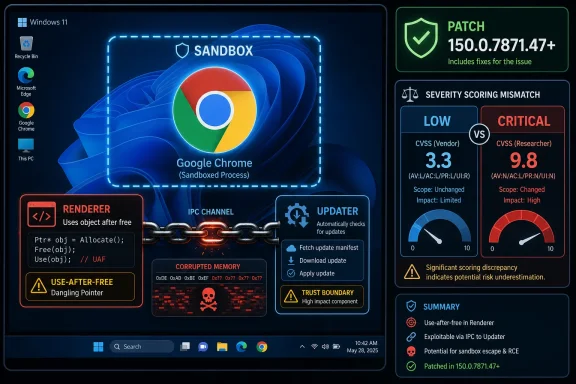 A Low-Severity Chrome Bug Can Still Be a High-Stakes Enterprise Event
Chrome’s sandbox model is designed around containment. The renderer is where hostile web content lives, and the security bet is that even if an attacker finds a memory corruption bug or logic flaw inside that renderer, the damage is limited by process isolation, brokered access, and operating-system-level boundaries. CVE-2026-14113 matters because its stated consequence is not initial code execution in the renderer. It is the next step: a possible escape from that containment.That distinction explains the split personality of the advisory. From Chromium’s perspective, a bug that requires the renderer to have already been compromised may rank lower than a standalone remote code execution flaw. It is not the first domino. It is the second or third domino, and modern browser security teams often reserve their loudest labels for the bug that lets the attacker first run code.
But enterprise defenders do not live inside a single component’s severity taxonomy. They live inside exploit chains. If a malicious page first triggers a renderer compromise and then uses an Updater bug to cross a boundary, the victim does not experience two separate severity scores. The victim experiences a browser compromise that may have moved closer to host-level impact.
That is why CISA’s enrichment is so jarring and so useful. Its SSVC entry says exploitation is “none” and the issue is not automatable, but it also rates the technical impact as total. In plain English: this is not evidence of a wormable mass-exploitation event, but the consequence of a successful chain could be severe. That is the kind of nuance vulnerability management systems are still bad at preserving once everything is flattened into a red, yellow, or green queue.
The Updater Is Not Just Plumbing Anymore
The name of the affected component should make Windows admins pause. “Updater” sounds boring by design, a background maintenance mechanism whose job is to make security problems go away before users think about them. But update machinery is privileged, persistent, network-aware, and tightly integrated with the host operating system. That makes it part of the browser’s attack surface, even when users never see it.Chrome on Windows is not merely a browser executable launched from a Start menu. It is an ecosystem of services, scheduled tasks, updater processes, profile data, policy hooks, enterprise templates, crash reporting, and signed binaries moving through a release pipeline. The browser is the visible part; the updater is one of the hidden systems that keeps the whole machine aligned with Google’s security cadence.
That hiddenness is precisely why bugs in update components are awkward for defenders. They are not always caught by the mental model that says “the risky thing is the tab rendering untrusted JavaScript.” In CVE-2026-14113, the public description says a remote attacker would need to have compromised the renderer process first, then use a crafted HTML page to potentially perform a sandbox escape. That framing puts the Updater in the middle of a web-originated exploit path.
Google has not publicly released the Chromium issue details at the time of the NVD entry, and the issue tracker reference is permission-restricted. That is normal for Chrome security bugs, especially soon after release, because Google commonly withholds technical details until most users have updated. It also means defenders should resist inventing specifics. We know the class, the affected component, the platform boundary, and the fixed version. We do not know the exact object lifetime failure, reachable interface, or chain mechanics from the public record.
The Version Boundary Is the One Fact Nobody Should Argue With
For operational purposes, the most important sentence is the least glamorous one: Chrome on Windows should be at 150.0.7871.47 or later. NVD’s affected configuration identifies Google Chrome versions up to, but excluding, 150.0.7871.47, combined with Microsoft Windows. Google’s Stable Channel update for desktop, published at the end of June 2026, moved Windows and macOS builds to the 150.0.7871.46/.47 line and Linux to 150.0.7871.46.That version detail matters because cross-platform Chrome advisories often hide platform-specific risk. A Chrome CVE can apply to all desktop platforms, only one operating system, or a shared library that downstream Chromium browsers inherit on their own timelines. CVE-2026-14113 is specifically described as Chrome on Windows. Linux and macOS administrators still need the broader Chrome 150 security update, but this particular Updater sandbox-escape description is Windows-bound.
For WindowsForum readers, that means the remediation question is not abstract. It is not “Is Chrome generally up to date?” It is “Do our Windows endpoints actually report a Chrome build at or beyond 150.0.7871.47, and have users relaunched the browser so the fixed code is active?” Chrome’s auto-update system is good, but auto-update is not the same thing as verified deployment.
The gap between downloaded and running versions remains a stubborn enterprise problem. A browser can stage an update while the user keeps dozens of tabs open for days. Remote work laptops can miss maintenance windows. Kiosk systems can be pinned by brittle application dependencies. VDI images can be reverted to a vulnerable snapshot. The release number is simple; the fleet reality is not.
NVD’s CPE Entry Is There, but It Tells Only Part of the Story
The user-facing question behind this CVE is whether a CPE is missing. Based on the NVD change history provided and the public NVD record, NIST did add a CPE configuration on July 1, 2026. The configuration combines a vulnerable Google Chrome application CPE for versions before 150.0.7871.47 with Microsoft Windows as the operating-system condition. So, in the narrow NVD sense, this is not a record with no CPE at all.The better question is whether the CPE expression is sufficient for how defenders actually inventory Chrome. NVD’s configuration captures “Google Chrome on Windows” at the application level, but it does not describe every place Chromium code may appear. It does not automatically cover Microsoft Edge, Brave, Vivaldi, Electron applications, embedded WebView use, or managed enterprise variants unless those products receive their own CVE mappings or advisories.
That is not necessarily an NVD defect. CVE-2026-14113 is described as a Google Chrome Updater vulnerability, not a generic Chromium library bug. Updater code is not always shared in the same way as Blink, V8, Skia, or WebRTC. A downstream Chromium browser may share the rendering engine while using its own update system. In that case, blindly applying the Chrome CPE to every Chromium-based browser would be misleading.
Still, defenders should treat the CPE as a starting point, not the whole inventory strategy. CPE names have always been a lossy abstraction. They are helpful for machine matching, compliance reporting, and vulnerability scanners, but they are not a substitute for vendor-specific evidence about binary versions, installation channels, and update mechanisms. When a CVE names a component like Updater, the operational question becomes more product-specific than “Chromium yes or no.”
The CVSS Fight Is Really About Exploit Chains
The disagreement between Chromium’s low severity label and CISA’s critical score is not just bureaucratic noise. It reflects a structural problem in vulnerability scoring: should we score a bug by itself, or by its role in a plausible chain? Browser teams often assume layered exploitation because the architecture is layered. CVSS often rewards the consequence if the preconditions are not too restrictive.CVE-2026-14113 requires the attacker to have compromised the renderer process. That is a major precondition. On its own, the Updater bug is not described as a one-click path from innocent browsing to arbitrary system compromise. But renderer compromise bugs are not exotic in the history of browser exploitation; they are exactly the kinds of flaws that Chrome, Edge, and other browsers patch constantly.
This is where “user interaction required” can also mislead. In browser CVEs, user interaction often means visiting or being redirected to a malicious page. It does not mean the user approved a UAC prompt, disabled a protection, or opened a suspicious executable. For phishing and watering-hole attacks, that is a meaningful but not comforting barrier.
CISA’s SSVC “automatable: no” signal is similarly easy to overread. It suggests this is not a trivial automated exploitation scenario as assessed from public information, but it does not make targeted use implausible. Sandbox escapes are especially valuable in targeted browser chains, where attackers already have an initial renderer bug and need a way to turn tab-level code execution into something with more reach.
The most responsible reading is therefore neither panic nor dismissal. Chromium’s low label tells us this is probably not the highest-priority standalone Chrome flaw in the release. CISA’s critical score tells us that if it is paired with the right first-stage bug, the impact profile becomes serious enough for fast enterprise remediation.
Patch Tuesday Thinking Does Not Fit Browser Time
Windows admins are conditioned by Patch Tuesday. Browser security laughs at that calendar. Chrome’s stable channel moves on Google’s release rhythm, emergency updates arrive out of band, and exploit chains do not wait for change-control meetings to become convenient.The June 30 Chrome release is also notable because it landed as part of a broader security-heavy update. Third-party tracking and Google’s release post describe a large number of fixes in the Chrome 150 stable release, with many CVEs across components. CVE-2026-14113 is one item in that larger pile, but its Windows-specific sandbox-escape shape makes it especially relevant to endpoint risk teams.
For consumer users, the advice remains blessedly boring: open Chrome’s About page, let it check for updates, and relaunch when prompted. For administrators, the advice is more complicated. They need to validate update policy, ensure browsers are restarted, monitor version telemetry, and account for devices that do not behave like normal user workstations.
Chrome’s silent update model has trained many organizations to assume browsers take care of themselves. Most of the time, that assumption works well enough to reduce risk. But a CVE like this is a reminder that “installed update” and “running protected code” are different states. The browser is a live process, not a static package entry.
Windows Is the Platform Detail That Changes the Priority
The Windows qualifier is not incidental. Chrome’s Updater behavior, service model, installation paths, and privilege interactions differ by platform. A bug in that area can be tightly coupled to Windows-specific assumptions about process boundaries, inter-process communication, services, handles, tokens, file system access, or brokered operations.The public description does not say which of those mechanics is involved, and it would be irresponsible to pretend otherwise. But the platform specificity still tells defenders where to look first. If an organization runs Chrome across Windows, macOS, and Linux, the Windows estate deserves special attention for CVE-2026-14113, even while all platforms should receive the Chrome 150 update for the broader set of fixes.
The Windows angle also matters because Chrome is rarely the only Chromium-based browser on a corporate machine. Microsoft Edge is the default on Windows and has its own update pipeline. Some users install Chrome for compatibility, others use Edge for Microsoft 365 integration, and developers may keep multiple channels installed. Security teams that only query the default browser can miss the browser that users actually open.
There is another subtlety: Chrome’s enterprise presence is often unmanaged in places where Windows itself is heavily managed. A company may have excellent Windows Update compliance while letting Chrome update through consumer-style background services. That split creates a governance gap. The OS patch dashboard looks clean, while the browser layer tells a different story.
The Public Record Is Thin by Design
Security practitioners often complain that Chrome CVE entries are too sparse. In one sense, they are right. “Use after free in Updater” is not enough to understand exploitability in detail, build detections, or model the vulnerable code path. The restricted Chromium issue link adds frustration because it confirms there is more information, just not for the public yet.But the thinness is partly intentional. Browser vendors sit on a dangerous disclosure knife-edge. Publish too much too early and attackers can reverse-engineer or weaponize a bug before the update reaches the long tail of users. Publish too little and defenders struggle to prioritize. Chrome typically resolves that tension by shipping the fix, naming the component, assigning severity, and keeping bug details restricted until update saturation improves.
That model works best when auto-update is fast and reliable. It works worst in enterprises with delayed rings, frozen images, compliance exceptions, or application owners who resist browser restarts. The less confidence an organization has in rapid patch uptake, the more painful sparse advisories become.
For CVE-2026-14113, the public record is enough to make the patch decision. It is not enough to make exploit-development claims. Any article claiming detailed exploitation steps from the public NVD text alone is guessing. Any administrator waiting for those steps before patching is confusing forensic curiosity with risk management.
Memory Safety Keeps Haunting the Browser Stack
The weakness classification is CWE-416: use after free. That puts CVE-2026-14113 in one of the most durable families of modern memory corruption bugs. A use-after-free occurs when software continues to reference memory after it has been released, creating an opportunity for stale pointers, corrupted object state, or attacker-influenced reuse.Chrome has spent years attacking this class with sandboxing, fuzzing, hardened allocators, MiraclePtr-style mitigations, site isolation, and broader memory-safety work. Yet the bug class keeps appearing because browsers are enormous C++ systems with performance-sensitive code, legacy assumptions, and complex object lifetimes. The Updater component may not be where casual observers expect to see a browser exploit story, but it is still software managing state, objects, and trust boundaries.
The industry’s long-term answer is increasingly memory-safe languages and stronger isolation, but that migration is uneven. Critical browser components cannot simply be rewritten overnight. Meanwhile, attackers do not care whether a dangling pointer lives in a renderer, a PDF parser, a GPU path, or an updater interface. They care whether it can help move the chain forward.
That is why defenders should avoid component snobbery. A flaw in V8 sounds glamorous. A flaw in Updater sounds administrative. Both can matter if they sit on the path between untrusted web content and privileged host behavior.
Scanner Output Will Be Noisier Than the Actual Decision
The NVD record includes an important tell: NIST had not provided its own CVSS score at the time of the described update, while CISA-ADP had supplied one. That means different scanners and dashboards may display different severity, depending on whether they ingest CISA enrichment, vendor severity, NVD analysis, or third-party databases.Some tools will show critical. Some may show low because they surface Chromium severity. Some may show unknown until NVD completes more enrichment. Others will inherit the CPE configuration and flag any Windows Chrome below 150.0.7871.47. None of that changes the remediation endpoint.
For a vulnerability manager, this is where process maturity matters. The right response is not to hold a meeting about which score is philosophically pure. The right response is to identify exposed Chrome-on-Windows installations, confirm update availability, push the fixed version, and document the severity discrepancy for audit purposes.
That documentation is useful because auditors and executives often ask why a “low” Chrome bug was treated urgently or why a “critical” scanner finding did not trigger emergency incident response. The answer is that CVE-2026-14113 is a chained-exploitation risk with no public evidence of exploitation in CISA’s SSVC entry, but with high potential consequence if combined with a renderer compromise. That is a more honest sentence than any single number.
Downstream Chromium Browsers Need Separate Confirmation
One predictable reaction to any Chrome CVE is to ask whether Edge, Brave, Vivaldi, Opera, Arc, and other Chromium-based browsers are affected. For CVE-2026-14113, the answer should not be guessed from the word “Chromium” alone. The affected component is Chrome’s Updater on Windows, and update systems are often product-specific.Microsoft Edge, for example, is Chromium-based but uses Microsoft’s own update infrastructure and release process. A vulnerability in Blink or V8 will often have obvious downstream relevance. A vulnerability in Google’s Updater may not. The same caution applies to other Chromium-derived browsers that package, update, and privilege their products differently.
That does not mean ignore them. It means check their advisories separately. If a downstream browser vendor ships a fix for the same CVE or announces a related updater issue, treat that vendor’s version boundary as authoritative for that product. If the vendor does not list the CVE, do not automatically assume safety; ask whether the vulnerable code is present.
In enterprise environments, the practical move is to inventory all Chromium-family browsers and then split them into two buckets. Chrome for Windows has a clear fixed version: 150.0.7871.47 or later. Everything else needs vendor-specific confirmation rather than CPE inference.
The Real Exposure Is the Browser You Forgot Was Installed
Most organizations have a browser policy. Fewer have a browser reality policy. Chrome may be sanctioned for developers, tolerated for power users, installed by line-of-business applications, left behind by former employees, or present in unmanaged user profiles. CVE-2026-14113 is exactly the kind of issue that exposes the gap.Windows makes this more complex because software inventory can fragment across machine-wide installs, per-user installs, packaged apps, portable binaries, and older remnants. A device can report one compliant Chrome installation while another stale executable sits in a user context. Security tools vary in how well they detect those cases.
The risk is not theoretical. Attackers target what users actually run, not what procurement approved. If a user’s default browser is patched but they open a legacy Chrome shortcut for an internal app, the exposure persists. If a help desk image includes an old Chrome build that updates only after first launch, there may be a window of unnecessary risk.
This is where version telemetry beats policy paperwork. Query the executable version, running process version, installation path, update channel, and last relaunch state where possible. For high-risk groups, verify with endpoint telemetry rather than trusting software inventory snapshots that refresh once a day.
The Patch Is Easy; the Relaunch Is the Hard Part
Chrome can download updates silently, but it cannot fully replace a running browser session without user cooperation or administrative force. The relaunch prompt is the human bottleneck in an otherwise automated pipeline. Users delay it because tabs are work, and work feels more urgent than a colored update icon.Admins have options, but each carries trade-offs. Enterprise policies can notify users, enforce relaunch windows, or schedule restarts. Aggressive enforcement closes exposure faster but can disrupt workflows and web applications. Gentle reminders preserve goodwill but leave vulnerable code running longer.
For CVE-2026-14113, the best balance depends on the environment. A school lab, call-center kiosk, or shared workstation fleet can justify forced browser restarts outside usage windows. A developer workstation group may need staged enforcement with clear warnings. Executives and finance users deserve special attention because browser exploit chains often chase high-value sessions.
The key is not to treat relaunch as a cosmetic final step. For browser CVEs, relaunch is remediation. Until the fixed process is running, the system may still be exposed even if the package manager says the update is installed.
This Is a Test of Vulnerability Triage, Not Just Chrome Hygiene
The CVE record’s history is unusually instructive. Chrome submitted the new CVE on June 30, 2026. CISA-ADP added CVSS, CWE, and SSVC information on July 1, then modified the CWE entry. NIST added the CPE configuration and vendor references later that same day. In less than 24 hours, the record moved through several layers of enrichment.That timeline shows both the strength and fragility of modern vulnerability infrastructure. The strength is speed: defenders quickly received a CVE, a description, a fixed version, a CPE mapping, a weakness class, and a government enrichment score. The fragility is inconsistency: severity, CWE state, and practical meaning shifted as different parties added their view.
This is now normal. NVD enrichment delays and changes have forced organizations to rely on multiple sources: vendor advisories, CISA enrichment, EPSS-style probability feeds, threat intelligence, scanner plugins, and internal asset criticality. CVE-2026-14113 is not a catastrophic example of that fragmentation, but it is a clean example of why a single feed should not be treated as gospel.
The best triage programs preserve context. They record vendor severity, external scoring, known exploitation status, fixed version, affected platform, and compensating factors. They also know when not to overcomplicate the answer. Here, the fixed version is available, the affected product is common, and the update path is mature. Patch first, debate scoring later.
The Browser Sandbox Is Still Worth Trusting, but Not Worshipping
It is tempting to read “sandbox escape” and conclude that the browser sandbox has failed. That is too simplistic. The sandbox is one of the reasons this CVE is not described as a direct remote system compromise from scratch. The attacker must first get into the renderer. The layered model forces attackers to chain bugs, burn more capability, and accept more chances of detection or failure.But sandboxing can also breed complacency. If defenders assume renderer compromise is contained by definition, then sandbox-escape bugs become a nasty surprise rather than a planned-for class of risk. Chrome’s architecture is strong precisely because it assumes compromise will happen somewhere and tries to limit blast radius. Enterprise security should make the same assumption.
That means browser hardening is not just patching. It includes site isolation, extension control, safe browsing protections, exploit mitigation, least-privilege user accounts, endpoint detection, credential isolation, and application control. None of those replace the Chrome 150.0.7871.47 update. They reduce the odds that one missed update becomes an incident.
Extensions deserve special mention because they remain one of the least disciplined parts of many browser fleets. A sandbox escape is dramatic, but a malicious or overprivileged extension can quietly undermine the same browsing environment. If a security team is using CVE-2026-14113 as a reason to audit Chrome versions, it should also look at extension policy while the hood is open.
The Windows Admin’s Job Is to Turn Ambiguity Into a Deadline
Security advisories rarely arrive with perfect clarity. CVE-2026-14113 has a sparse public description, a restricted bug tracker entry, a low Chromium severity label, a critical CISA CVSS score, and no public exploitation noted in the SSVC data. That is enough ambiguity for any organization inclined to delay.But delay is not a neutral choice. Chrome is a high-exposure application that processes untrusted content all day. The fixed version is available. The affected platform is explicit. The remediation mechanism is familiar. Even if the probability of exploitation is not currently known to be high, the cost of patching should be low for most environments.
The deadline should therefore be short. Consumer devices should update immediately. Managed enterprises should push and verify the fixed build as part of accelerated browser patching, not wait for the next monthly operating-system cycle. High-risk users and internet-facing shared systems should be verified first.
There will be exceptions. Some environments run application compatibility testing against Chrome releases, especially where browser-based line-of-business systems are brittle. But those exceptions need owners, expiration dates, and compensating controls. “We will get to it when the normal cycle rolls around” is not a serious answer for a browser sandbox-escape class issue.
The Practical Reading of CVE-2026-14113 Is Narrow but Urgent
The cleanest way to understand this CVE is to keep its scope narrow and its response urgent. It is not evidence that every Chromium browser updater is vulnerable. It is not publicly known to be exploited in the wild based on the CISA SSVC entry described in the NVD record. It is not a standalone renderer bug. It is a Windows Chrome Updater use-after-free flaw before 150.0.7871.47 that could matter greatly in an exploit chain.That nuance should not weaken the patch message. If anything, it should sharpen it. Browser exploit chains are built from exactly this kind of component interaction, where one bug gets code running in a constrained place and another bug changes what that code can reach. The fact that a vulnerability is a chain component does not make it academic.
For WindowsForum readers, the action is concrete:
- Chrome for Windows installations should be updated to version 150.0.7871.47 or later, and administrators should verify the running version after browser relaunch.
- The NVD record does include a CPE configuration for Google Chrome on Windows versions before 150.0.7871.47, but that mapping should not be treated as proof about other Chromium-based browsers.
- CISA’s critical CVSS score and Chromium’s low severity label can both be understood if the bug is viewed as a sandbox-escape component that requires prior renderer compromise.
- There is no public indication in the cited SSVC data that exploitation is currently occurring, but the technical impact of a successful chain is high enough to justify accelerated remediation.
- Enterprises should confirm update policy, relaunch enforcement, and inventory coverage for per-user and unmanaged Chrome installations, not only machine-wide deployments.
References
- Primary source: NVD / Chromium
Published: 2026-07-03T07:00:41-07:00
NVD - CVE-2026-14113
 nvd.nist.gov
- Security advisory: MSRC
Published: 2026-07-03T07:00:41-07:00
Original feed URL
Security Update Guide - Microsoft Security Response Center
 msrc.microsoft.com
- Related coverage: cvefeed.io
CVE-2026-14113 - Google Chrome Updater Use-After-Free Sandbox Escape
Use after free in Updater in Google Chrome on Windows prior to 150.0.7871.47 allowed a remote attacker who had compromised the renderer process to potentially perform a sandbox escape via a crafted HTML page. (Chromium security severity: Low)cvefeed.io - Related coverage: radar.offseq.com
CVE-2026-14113: Use after free in Google Chrome - Live Threat Intelligence - Threat Radar | OffSeq.com
Detailed information about CVE-2026-14113: Use after free in Google Chrome affecting Google Chrome. Get real-time updates, technical details, and mitigation strradar.offseq.com - Related coverage: labs.cloudsecurityalliance.org
CSA research note nist nvd riskbased enrichment governance 20260426 csa styled
PDF documentlabs.cloudsecurityalliance.org
