

Google fixed CVE-2026-14413 in Chrome 150.0.7871.46 on June 30, 2026, closing a high-severity ANGLE memory-initialization flaw that could let an attacker who had already compromised a renderer process use crafted HTML to attempt an escape from Chromium’s browser sandbox. The prerequisite matters: this is not described as a self-contained drive-by takeover. The consequence matters more: sandbox escapes are the second half of the exploit chains that turn a compromised tab into a compromised computer.
Google disclosed the vulnerability through the Chrome 150 Stable release, while the National Vulnerability Database published its entry on July 1 and CISA’s enrichment service assigned an 8.3 CVSS score. The sparse advisory leaves the underlying Chromium issue restricted, but the public record is enough to establish the operational priority: update Chromium-based browsers rather than waiting for exploit code or a more polished NIST assessment.
Browser vulnerability descriptions often collapse several security boundaries into one alarming sentence. CVE-2026-14413 is unusually explicit about where its attacker begins: the renderer process must already be compromised.
That renderer is the component responsible for processing much of the hostile material the web can deliver, including HTML, CSS, JavaScript, images and other page content. Chromium deliberately places renderers inside a restrictive sandbox because parsing the modern web safely on every code path is an impossible promise. The architecture assumes that renderer bugs will sometimes occur and tries to stop them from becoming operating-system compromises.
CVE-2026-14413 attacks that second line of defense. According to the Chrome CVE description carried by NVD, crafted HTML could potentially trigger an uninitialized use in ANGLE after an attacker had gained control of the renderer. The objective would be to cross from code execution inside the constrained renderer into a process or context with broader access.
This distinction prevents two opposite mistakes. It would be wrong to describe the flaw as harmless merely because it needs another vulnerability first. It would also be wrong to claim that visiting any malicious page automatically hands an attacker control of Windows.
The realistic threat is an exploit chain. One bug gets the attacker into the renderer; CVE-2026-14413 may then provide a route out of the sandbox. Browser attackers routinely seek this pairing because a renderer exploit without an escape can remain trapped, while a sandbox escape without an initial foothold has no position from which to begin.
That is why Google assigned the issue High severity even though the Chrome 150 release also contained numerous Critical vulnerabilities. CVE-2026-14413 is not necessarily the opening move, but it could be the move that converts a browser crash or constrained code execution into a much more consequential intrusion.
On Windows, that translation has historically helped Chromium deliver WebGL and other accelerated graphics through technologies such as Direct3D without exposing web content directly to every driver interface. ANGLE also supports multiple platforms and back ends, making it a compatibility layer between web-facing graphics APIs and the complicated reality of GPUs, drivers and operating systems.
That compatibility role places ANGLE in a sensitive position. A webpage can supply shaders, dimensions, states, textures and command sequences, but the browser must eventually transform those untrusted inputs into work that reaches powerful native graphics infrastructure. Every validation mistake at that junction risks creating a path from tightly controlled web content toward code operating under less restrictive conditions.
Chromium’s graphics architecture separates this work across processes. A sandboxed renderer cannot simply issue arbitrary operating-system graphics calls. Instead, graphics commands pass through Chromium’s command infrastructure to GPU-related code, where ANGLE may translate them into the appropriate native API.
The separation is a security feature, but it also creates an interface that must be defended. Renderer-originated data remains untrusted even after it crosses into the graphics pipeline. If ANGLE consumes an object or variable before every relevant field has been initialized, its behavior can depend on stale or indeterminate memory rather than a value deliberately set by the program.
That is the CWE-457 weakness attached to CVE-2026-14413: use of an uninitialized variable. In benign cases, such bugs cause unpredictable output or a crash. In security-sensitive native code, they may expose stale data, corrupt control state, alter bounds or allow an attacker to manipulate execution in ways the programmer never intended.
The advisory does not say which ANGLE object was affected, what graphics operation reached it or whether exploitation required a particular back end or driver configuration. Google routinely restricts such details until most users have received a fix, especially when a bug also exists in a component consumed by other projects. That restraint is sensible, but it means defenders should not invent platform-specific assurances that Google has not provided.
A malicious page can orchestrate far more than static markup. It can invoke JavaScript, construct graphics resources, compile shaders, exercise WebGL state machines and repeatedly generate precise sequences intended to move software into an unexpected condition. Calling the delivery mechanism HTML does not mean the underlying bug sits in basic tag parsing.
At the same time, the CISA-provided CVSS vector includes user interaction and high attack complexity. The 8.3 score reflects network reachability, no required application-level privileges, a changed security scope and potentially high confidentiality, integrity and availability impact. It also reflects that exploitation is not presented as straightforward or completely independent.
The changed-scope component is particularly important. CVSS uses that concept when exploitation can affect a security authority beyond the vulnerable component’s original boundary. For a sandbox escape, that is precisely the concern: the attacker is attempting to move from a restricted renderer security context into one with greater power.
CISA’s Stakeholder-Specific Vulnerability Categorization data was more restrained about present danger. Its July 2 assessment recorded no known exploitation, judged the issue not readily automatable and rated the possible technical impact as total. In plain English, CISA had no public evidence of active attacks, did not consider mass exploitation simple, but recognized that a successful chain could have severe consequences.
Those observations are not contradictory. A vulnerability can be difficult to exploit and still be highly valuable to a capable attacker. Sandbox escapes are often developed for targeted operations, commercial surveillance tooling or sophisticated exploit chains before they become useful to lower-skilled operators.
As of July 11, neither Google’s release announcement nor the NVD record says CVE-2026-14413 has been exploited in the wild. Google has explicitly called out active exploitation for other Chrome vulnerabilities when it had evidence to do so. The absence of that warning here should lower the immediate incident-response temperature, not justify postponing the update.
An uninitialized value exists when software reads memory before assigning the value that the current operation expects. The resulting bits may come from an earlier object, leftover stack contents, allocator behavior or a compiler-dependent state. The program then treats that accidental value as legitimate data.
Exploitability depends on how the value is used. A stale Boolean may change a branch. An uninitialized length may distort a bounds check. A pointer or index may direct code toward memory it should never access. A structure field may cause later operations to interpret an object in the wrong state.
Attackers try to replace randomness with influence. They may repeatedly allocate and release objects, shape surrounding memory, induce predictable process behavior or submit carefully ordered commands until the uninitialized region contains useful data. This is one reason CISA’s vector rates attack complexity as high: converting undefined state into reliable security impact can require substantial preparation.
Graphics software increases the analytical challenge. ANGLE sits amid asynchronous work, command serialization, validation layers, multiple back ends and vendor-specific drivers. A state transition harmless on one configuration may behave differently on another, while process restarts and allocator differences can make a proof of concept unreliable.
None of this means the flaw is theoretical. Google’s High rating and the sandbox-escape description indicate that its security team found a credible path to crossing a boundary. It does mean that the public CVE cannot support claims about universal exploit reliability, specific GPU vendors or a guaranteed route to kernel-level code execution.
The correct interpretation is narrower and stronger: untrusted web content could reach an ANGLE condition involving uninitialized memory, and an attacker already controlling the renderer might use that condition to escape the browser sandbox. Anything beyond that remains undisclosed.
CVE-2026-14413 was only one entry in a release containing 433 security fixes. Google listed it as a High-severity ANGLE issue internally reported on May 17, alongside a striking concentration of memory-safety and validation defects in ANGLE, Dawn, Skia, V8 and other Chromium components.
That context cuts both ways. The huge volume means CVE-2026-14413 should not be treated as an isolated emergency patch whose risk can be evaluated independently of the rest of Chrome 150. It also means organizations cannot responsibly reduce browser security management to watching for whichever CVE attracts the most dramatic headline.
Chrome’s major-version updates increasingly function as large security baselines. An endpoint left on Chrome 149 is not merely missing one ANGLE correction; it is missing the collective results of an entire development cycle’s fuzzing, sanitizers, code review and internal security testing.
Google said many of the release’s bugs were found with tools including AddressSanitizer, MemorySanitizer, UndefinedBehaviorSanitizer, Control Flow Integrity, libFuzzer and AFL. CVE-2026-14413 itself was reported by Google rather than an external researcher, and the public listing does not identify a reward.
The restricted Chromium issue prevents independent review of the triggering condition and patch. That is normal immediately after a release, but it puts more weight on version verification. Administrators do not need to reproduce the flaw to know whether their Chrome installations remain below the fixed threshold.
For Windows and macOS Chrome installations, 150.0.7871.46 and .47 were the initial corrected Stable builds. Because Google has already moved the channel forward, the safest target is not to pin specifically to that minimum. It is to install the newest available Stable build in the 150 branch or later.
Microsoft released Edge 150.0.4078.48 to the Stable Channel on July 2 and said it incorporated the latest security updates from the Chromium project. It followed with Edge 150.0.4078.65 on July 9, again incorporating current Chromium security updates.
Microsoft’s security release notes had not yet mapped every July CVE to the latest Edge entry as of July 11. The company explicitly noted that CVEs would be added as they became available. That publication lag should not be mistaken for evidence that older Edge 149 builds are protected from a Chromium 150 graphics flaw.
Administrators should use Microsoft’s Edge build numbers when auditing Edge, not compare the final digits with Chrome’s 150.0.7871.46 threshold. Chrome and Edge share a Chromium major version but maintain different product build sequences.
For unmanaged Windows systems, visiting Edge’s About page triggers an update check and displays the installed version. In managed environments, inventory tools, Edge management services, Intune, Configuration Manager or endpoint-detection platforms should provide a more useful fleet view.
The current defensible target is Edge 150.0.4078.65 or later on the Stable Channel. Edge 150.0.4078.48 was Microsoft’s initial July 2 Chromium 150 security-bearing release, but the July 9 build is newer and eliminates any reason to standardize on the earlier minimum unless an organization is working through a documented compatibility exception.
Other Chromium-based browsers face the same general dependency problem. Brave, Vivaldi, Opera and embedded Chromium products do not necessarily ship Google’s version string or release on Google’s timetable. Their maintainers must integrate the relevant upstream changes and publish their own corrected builds.
A Chromium major version is therefore a useful signal, not a universal remediation rule. Each browser vendor’s release record remains the authority for its own product.
That CPE is consistent with the CVE’s formally declared affected product. Chrome is the CVE Numbering Authority source, and the published CVE record names Google Chrome. NVD is therefore not necessarily “missing” Edge merely because Edge consumes Chromium code.
CPE data is product-oriented rather than a complete software bill of materials. A vulnerability assigned against Chrome may originate in an upstream Chromium component that is also shipped by multiple browsers, frameworks or applications. Those downstream products can receive separate advisories, vendor mappings or inventory identifiers without appearing in the original Chrome CPE configuration.
This creates a familiar weakness in automated vulnerability management. A scanner matching only the literal Google Chrome CPE may correctly identify vulnerable Chrome installations while failing to reason about Edge, WebView2 or another Chromium consumer. Conversely, blindly declaring every product containing ANGLE vulnerable would create false positives because versions, build flags, platform paths and backports differ.
The right approach is to combine NVD data with vendor release intelligence. Use the Chrome CPE to find Chrome below the fixed version, Microsoft’s release channel records to assess Edge, and each third-party browser’s advisory to determine its corrected build.
NVD’s lack of a NIST CVSS score also does not leave the vulnerability unranked. CISA’s Authorized Data Publisher enrichment supplied the 8.3 CVSS 3.1 vector, while Google supplied the High Chromium severity. Those measurements answer slightly different questions but point to the same operational conclusion.
A report to NVD about a missing CPE would be appropriate if Google Chrome itself were absent or incorrectly bounded. It is less useful as a request to enumerate every downstream Chromium browser under a CVE whose affected-product declaration names Chrome. Dependency-aware tooling must bridge that gap.
At disclosure, attackers know the affected component, weakness class, fixed version, report date and intended security consequence. They may not have the restricted bug details, but they can compare Chromium source revisions, inspect ANGLE changes and study binaries. The patch itself gradually becomes a roadmap.
This patch-diffing window changes the risk over time. On June 30, Google and the researchers who found the bug held the clearest picture. As updated source and binaries propagate, outside analysts gain more information while unpatched endpoints remain unchanged.
A staged rollout is still sensible. Browsers are business-critical software, and Chrome 150 was a large release with feature and security changes beyond this CVE. Enterprises need telemetry, application testing and rollback plans.
But a staged rollout should mean rapid rings measured in hours or a few days, not a month-long freeze. Internet-facing users, privileged administrators, developers handling untrusted content and systems used for cloud-management consoles deserve the earliest ring.
Extended Stable policies also require care. They reduce feature churn, but they do not absolve vendors or administrators from deploying security-bearing updates. Security teams should verify the actual supported build rather than infer safety from the channel name.
The most dangerous endpoints may not be ordinary desktops. Shared jump boxes, virtual desktop pools, kiosks, development workstations and machines running long-lived browser sessions can preserve old processes after an updater has placed new binaries on disk.
That makes restart enforcement part of remediation. A browser that has downloaded an update but still shows “Relaunch to update” may continue running vulnerable code. Inventory should distinguish installed version, running process version and update readiness wherever tooling allows.
WebView2 Evergreen installations normally update through Microsoft’s updater, independently of application releases. Fixed-version deployments are different: the application owner selects and distributes a particular runtime package, which can leave business software tied to an older Chromium generation.
This is where browser-only dashboards create false confidence. Chrome and Edge may both be current while an application bundles Chromium Embedded Framework, Electron or a fixed WebView2 runtime that has not moved with the upstream security baseline.
Whether CVE-2026-14413 is reachable in a given embedded application depends on enabled web features, process architecture, graphics configuration and the trustworthiness of content it renders. An application showing only packaged local UI is not exposed in the same way as one that navigates arbitrary internet pages or displays remote tenant-controlled content.
The absence of a matching CPE should prompt asset analysis, not automatic vulnerability assignment. Application owners should identify embedded browser engines, determine their Chromium lineage and consult the framework or vendor’s security release.
Disabling hardware acceleration across an organization is not an equivalent fix. It may alter which graphics paths are exercised, but the advisory does not present that setting as a mitigation, and ANGLE can participate in multiple rendering configurations. Broadly disabling acceleration also carries performance, video and compatibility costs without delivering a vendor-backed guarantee.
The dependable remediation remains replacement of vulnerable code with a corrected vendor build.
Network reachability and no required privileges describe an attacker delivering content remotely without first authenticating to the browser. User interaction reflects the need for a victim to reach attacker-controlled content. High complexity captures the renderer-compromise prerequisite and the difficulty of turning an uninitialized value into a reliable boundary escape.
High impacts across confidentiality, integrity and availability model the possible result after successful exploitation. They do not establish that every attempt produces all three outcomes, or that CVE-2026-14413 alone provides the entire attack chain.
CISA’s “technical impact: total” assessment similarly represents the potential consequence of a successful chain. Its simultaneous “exploitation: none” and “automatable: no” findings keep that worst case in perspective.
The most useful prioritization factors are therefore exposure and update friction. A widely deployed browser processing arbitrary web content, with a vendor fix already available and relatively low remediation cost, should be updated quickly even when exploitation is difficult.
By contrast, an isolated embedded runtime that never handles untrusted content may deserve investigation before emergency change approval. That decision should be documented from the application’s actual behavior, not inferred from the absence of its product name in NVD.
The CVSS score is a warning, not a deployment schedule. Browser patching policy should already be fast enough that a High sandbox escape is handled promptly without waiting for a crisis declaration.
Google disclosed the vulnerability through the Chrome 150 Stable release, while the National Vulnerability Database published its entry on July 1 and CISA’s enrichment service assigned an 8.3 CVSS score. The sparse advisory leaves the underlying Chromium issue restricted, but the public record is enough to establish the operational priority: update Chromium-based browsers rather than waiting for exploit code or a more polished NIST assessment.
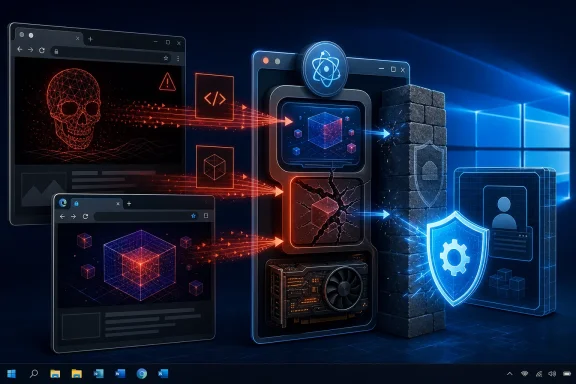 The Attacker Starts Inside the Renderer
Browser vulnerability descriptions often collapse several security boundaries into one alarming sentence. CVE-2026-14413 is unusually explicit about where its attacker begins: the renderer process must already be compromised.That renderer is the component responsible for processing much of the hostile material the web can deliver, including HTML, CSS, JavaScript, images and other page content. Chromium deliberately places renderers inside a restrictive sandbox because parsing the modern web safely on every code path is an impossible promise. The architecture assumes that renderer bugs will sometimes occur and tries to stop them from becoming operating-system compromises.
CVE-2026-14413 attacks that second line of defense. According to the Chrome CVE description carried by NVD, crafted HTML could potentially trigger an uninitialized use in ANGLE after an attacker had gained control of the renderer. The objective would be to cross from code execution inside the constrained renderer into a process or context with broader access.
This distinction prevents two opposite mistakes. It would be wrong to describe the flaw as harmless merely because it needs another vulnerability first. It would also be wrong to claim that visiting any malicious page automatically hands an attacker control of Windows.
The realistic threat is an exploit chain. One bug gets the attacker into the renderer; CVE-2026-14413 may then provide a route out of the sandbox. Browser attackers routinely seek this pairing because a renderer exploit without an escape can remain trapped, while a sandbox escape without an initial foothold has no position from which to begin.
That is why Google assigned the issue High severity even though the Chrome 150 release also contained numerous Critical vulnerabilities. CVE-2026-14413 is not necessarily the opening move, but it could be the move that converts a browser crash or constrained code execution into a much more consequential intrusion.
ANGLE Turns Web Graphics Into a Security Boundary
ANGLE is easy to overlook because users do not install or launch it as a separate application. Its name expands to Almost Native Graphics Layer Engine, and its job is to translate graphics commands into forms that can be handled by the operating system and available graphics back ends.On Windows, that translation has historically helped Chromium deliver WebGL and other accelerated graphics through technologies such as Direct3D without exposing web content directly to every driver interface. ANGLE also supports multiple platforms and back ends, making it a compatibility layer between web-facing graphics APIs and the complicated reality of GPUs, drivers and operating systems.
That compatibility role places ANGLE in a sensitive position. A webpage can supply shaders, dimensions, states, textures and command sequences, but the browser must eventually transform those untrusted inputs into work that reaches powerful native graphics infrastructure. Every validation mistake at that junction risks creating a path from tightly controlled web content toward code operating under less restrictive conditions.
Chromium’s graphics architecture separates this work across processes. A sandboxed renderer cannot simply issue arbitrary operating-system graphics calls. Instead, graphics commands pass through Chromium’s command infrastructure to GPU-related code, where ANGLE may translate them into the appropriate native API.
The separation is a security feature, but it also creates an interface that must be defended. Renderer-originated data remains untrusted even after it crosses into the graphics pipeline. If ANGLE consumes an object or variable before every relevant field has been initialized, its behavior can depend on stale or indeterminate memory rather than a value deliberately set by the program.
That is the CWE-457 weakness attached to CVE-2026-14413: use of an uninitialized variable. In benign cases, such bugs cause unpredictable output or a crash. In security-sensitive native code, they may expose stale data, corrupt control state, alter bounds or allow an attacker to manipulate execution in ways the programmer never intended.
The advisory does not say which ANGLE object was affected, what graphics operation reached it or whether exploitation required a particular back end or driver configuration. Google routinely restricts such details until most users have received a fix, especially when a bug also exists in a component consumed by other projects. That restraint is sensible, but it means defenders should not invent platform-specific assurances that Google has not provided.
“Crafted HTML” Is the Delivery Vehicle, Not the Whole Exploit
The CVE description says the flaw could be reached “via a crafted HTML page.” That phrase is accurate but dangerously easy to oversimplify.A malicious page can orchestrate far more than static markup. It can invoke JavaScript, construct graphics resources, compile shaders, exercise WebGL state machines and repeatedly generate precise sequences intended to move software into an unexpected condition. Calling the delivery mechanism HTML does not mean the underlying bug sits in basic tag parsing.
At the same time, the CISA-provided CVSS vector includes user interaction and high attack complexity. The 8.3 score reflects network reachability, no required application-level privileges, a changed security scope and potentially high confidentiality, integrity and availability impact. It also reflects that exploitation is not presented as straightforward or completely independent.
The changed-scope component is particularly important. CVSS uses that concept when exploitation can affect a security authority beyond the vulnerable component’s original boundary. For a sandbox escape, that is precisely the concern: the attacker is attempting to move from a restricted renderer security context into one with greater power.
CISA’s Stakeholder-Specific Vulnerability Categorization data was more restrained about present danger. Its July 2 assessment recorded no known exploitation, judged the issue not readily automatable and rated the possible technical impact as total. In plain English, CISA had no public evidence of active attacks, did not consider mass exploitation simple, but recognized that a successful chain could have severe consequences.
Those observations are not contradictory. A vulnerability can be difficult to exploit and still be highly valuable to a capable attacker. Sandbox escapes are often developed for targeted operations, commercial surveillance tooling or sophisticated exploit chains before they become useful to lower-skilled operators.
As of July 11, neither Google’s release announcement nor the NVD record says CVE-2026-14413 has been exploited in the wild. Google has explicitly called out active exploitation for other Chrome vulnerabilities when it had evidence to do so. The absence of that warning here should lower the immediate incident-response temperature, not justify postponing the update.
An Uninitialized Value Creates Controlled Uncertainty
Memory-safety flaws are often grouped together as if use-after-free, out-of-bounds access and uninitialized use were interchangeable. They are not, even though their effects can converge.An uninitialized value exists when software reads memory before assigning the value that the current operation expects. The resulting bits may come from an earlier object, leftover stack contents, allocator behavior or a compiler-dependent state. The program then treats that accidental value as legitimate data.
Exploitability depends on how the value is used. A stale Boolean may change a branch. An uninitialized length may distort a bounds check. A pointer or index may direct code toward memory it should never access. A structure field may cause later operations to interpret an object in the wrong state.
Attackers try to replace randomness with influence. They may repeatedly allocate and release objects, shape surrounding memory, induce predictable process behavior or submit carefully ordered commands until the uninitialized region contains useful data. This is one reason CISA’s vector rates attack complexity as high: converting undefined state into reliable security impact can require substantial preparation.
Graphics software increases the analytical challenge. ANGLE sits amid asynchronous work, command serialization, validation layers, multiple back ends and vendor-specific drivers. A state transition harmless on one configuration may behave differently on another, while process restarts and allocator differences can make a proof of concept unreliable.
None of this means the flaw is theoretical. Google’s High rating and the sandbox-escape description indicate that its security team found a credible path to crossing a boundary. It does mean that the public CVE cannot support claims about universal exploit reliability, specific GPU vendors or a guaranteed route to kernel-level code execution.
The correct interpretation is narrower and stronger: untrusted web content could reach an ANGLE condition involving uninitialized memory, and an attacker already controlling the renderer might use that condition to escape the browser sandbox. Anything beyond that remains undisclosed.
Chrome 150’s Fix Arrived Inside an Enormous Security Release
Google promoted Chrome 150 to Stable for Windows, macOS and Linux on June 30. The fixed builds were 150.0.7871.46 for Linux and 150.0.7871.46 or .47 for Windows and macOS, with the rollout scheduled over the following days and weeks.CVE-2026-14413 was only one entry in a release containing 433 security fixes. Google listed it as a High-severity ANGLE issue internally reported on May 17, alongside a striking concentration of memory-safety and validation defects in ANGLE, Dawn, Skia, V8 and other Chromium components.
That context cuts both ways. The huge volume means CVE-2026-14413 should not be treated as an isolated emergency patch whose risk can be evaluated independently of the rest of Chrome 150. It also means organizations cannot responsibly reduce browser security management to watching for whichever CVE attracts the most dramatic headline.
Chrome’s major-version updates increasingly function as large security baselines. An endpoint left on Chrome 149 is not merely missing one ANGLE correction; it is missing the collective results of an entire development cycle’s fuzzing, sanitizers, code review and internal security testing.
Google said many of the release’s bugs were found with tools including AddressSanitizer, MemorySanitizer, UndefinedBehaviorSanitizer, Control Flow Integrity, libFuzzer and AFL. CVE-2026-14413 itself was reported by Google rather than an external researcher, and the public listing does not identify a reward.
The restricted Chromium issue prevents independent review of the triggering condition and patch. That is normal immediately after a release, but it puts more weight on version verification. Administrators do not need to reproduce the flaw to know whether their Chrome installations remain below the fixed threshold.
For Windows and macOS Chrome installations, 150.0.7871.46 and .47 were the initial corrected Stable builds. Because Google has already moved the channel forward, the safest target is not to pin specifically to that minimum. It is to install the newest available Stable build in the 150 branch or later.
Edge Inherits the Chromium Clock, Not Chrome’s Version String
For WindowsForum readers, the most practical question is whether the ANGLE flaw matters to Microsoft Edge. Edge is built on Chromium and incorporates Chromium’s graphics stack, so a Chromium security release involving ANGLE is relevant to Microsoft’s browser even though Edge uses its own complete version number.Microsoft released Edge 150.0.4078.48 to the Stable Channel on July 2 and said it incorporated the latest security updates from the Chromium project. It followed with Edge 150.0.4078.65 on July 9, again incorporating current Chromium security updates.
Microsoft’s security release notes had not yet mapped every July CVE to the latest Edge entry as of July 11. The company explicitly noted that CVEs would be added as they became available. That publication lag should not be mistaken for evidence that older Edge 149 builds are protected from a Chromium 150 graphics flaw.
Administrators should use Microsoft’s Edge build numbers when auditing Edge, not compare the final digits with Chrome’s 150.0.7871.46 threshold. Chrome and Edge share a Chromium major version but maintain different product build sequences.
For unmanaged Windows systems, visiting Edge’s About page triggers an update check and displays the installed version. In managed environments, inventory tools, Edge management services, Intune, Configuration Manager or endpoint-detection platforms should provide a more useful fleet view.
The current defensible target is Edge 150.0.4078.65 or later on the Stable Channel. Edge 150.0.4078.48 was Microsoft’s initial July 2 Chromium 150 security-bearing release, but the July 9 build is newer and eliminates any reason to standardize on the earlier minimum unless an organization is working through a documented compatibility exception.
Other Chromium-based browsers face the same general dependency problem. Brave, Vivaldi, Opera and embedded Chromium products do not necessarily ship Google’s version string or release on Google’s timetable. Their maintainers must integrate the relevant upstream changes and publish their own corrected builds.
A Chromium major version is therefore a useful signal, not a universal remediation rule. Each browser vendor’s release record remains the authority for its own product.
The NVD CPE Tells Only the Chrome Part of the Story
The NVD configuration for CVE-2026-14413 identifies Google Chrome versions before 150.0.7871.46 using a Chrome CPE. The page’s temporary “CPEs loading” presentation can make the record appear incomplete, but its change history shows that NIST added the Chrome configuration on July 2.That CPE is consistent with the CVE’s formally declared affected product. Chrome is the CVE Numbering Authority source, and the published CVE record names Google Chrome. NVD is therefore not necessarily “missing” Edge merely because Edge consumes Chromium code.
CPE data is product-oriented rather than a complete software bill of materials. A vulnerability assigned against Chrome may originate in an upstream Chromium component that is also shipped by multiple browsers, frameworks or applications. Those downstream products can receive separate advisories, vendor mappings or inventory identifiers without appearing in the original Chrome CPE configuration.
This creates a familiar weakness in automated vulnerability management. A scanner matching only the literal Google Chrome CPE may correctly identify vulnerable Chrome installations while failing to reason about Edge, WebView2 or another Chromium consumer. Conversely, blindly declaring every product containing ANGLE vulnerable would create false positives because versions, build flags, platform paths and backports differ.
The right approach is to combine NVD data with vendor release intelligence. Use the Chrome CPE to find Chrome below the fixed version, Microsoft’s release channel records to assess Edge, and each third-party browser’s advisory to determine its corrected build.
NVD’s lack of a NIST CVSS score also does not leave the vulnerability unranked. CISA’s Authorized Data Publisher enrichment supplied the 8.3 CVSS 3.1 vector, while Google supplied the High Chromium severity. Those measurements answer slightly different questions but point to the same operational conclusion.
A report to NVD about a missing CPE would be appropriate if Google Chrome itself were absent or incorrectly bounded. It is less useful as a request to enumerate every downstream Chromium browser under a CVE whose affected-product declaration names Chrome. Dependency-aware tooling must bridge that gap.
Enterprise Delay Turns a Difficult Chain Into an Available Chain
Organizations often give browser updates short deployment deadlines because the browser continuously processes hostile external content. CVE-2026-14413 reinforces why that policy is justified even in the absence of active exploitation.At disclosure, attackers know the affected component, weakness class, fixed version, report date and intended security consequence. They may not have the restricted bug details, but they can compare Chromium source revisions, inspect ANGLE changes and study binaries. The patch itself gradually becomes a roadmap.
This patch-diffing window changes the risk over time. On June 30, Google and the researchers who found the bug held the clearest picture. As updated source and binaries propagate, outside analysts gain more information while unpatched endpoints remain unchanged.
A staged rollout is still sensible. Browsers are business-critical software, and Chrome 150 was a large release with feature and security changes beyond this CVE. Enterprises need telemetry, application testing and rollback plans.
But a staged rollout should mean rapid rings measured in hours or a few days, not a month-long freeze. Internet-facing users, privileged administrators, developers handling untrusted content and systems used for cloud-management consoles deserve the earliest ring.
Extended Stable policies also require care. They reduce feature churn, but they do not absolve vendors or administrators from deploying security-bearing updates. Security teams should verify the actual supported build rather than infer safety from the channel name.
The most dangerous endpoints may not be ordinary desktops. Shared jump boxes, virtual desktop pools, kiosks, development workstations and machines running long-lived browser sessions can preserve old processes after an updater has placed new binaries on disk.
That makes restart enforcement part of remediation. A browser that has downloaded an update but still shows “Relaunch to update” may continue running vulnerable code. Inventory should distinguish installed version, running process version and update readiness wherever tooling allows.
WebView2 and Embedded Chromium Need Their Own Inventory
The Chrome advisory does not formally name Microsoft Edge WebView2, and the public CVE does not provide enough detail to declare every WebView2 application exploitable. Still, embedded Chromium runtimes belong in the investigation because they may consume related upstream graphics code.WebView2 Evergreen installations normally update through Microsoft’s updater, independently of application releases. Fixed-version deployments are different: the application owner selects and distributes a particular runtime package, which can leave business software tied to an older Chromium generation.
This is where browser-only dashboards create false confidence. Chrome and Edge may both be current while an application bundles Chromium Embedded Framework, Electron or a fixed WebView2 runtime that has not moved with the upstream security baseline.
Whether CVE-2026-14413 is reachable in a given embedded application depends on enabled web features, process architecture, graphics configuration and the trustworthiness of content it renders. An application showing only packaged local UI is not exposed in the same way as one that navigates arbitrary internet pages or displays remote tenant-controlled content.
The absence of a matching CPE should prompt asset analysis, not automatic vulnerability assignment. Application owners should identify embedded browser engines, determine their Chromium lineage and consult the framework or vendor’s security release.
Disabling hardware acceleration across an organization is not an equivalent fix. It may alter which graphics paths are exercised, but the advisory does not present that setting as a mitigation, and ANGLE can participate in multiple rendering configurations. Broadly disabling acceleration also carries performance, video and compatibility costs without delivering a vendor-backed guarantee.
The dependable remediation remains replacement of vulnerable code with a corrected vendor build.
Security Teams Should Resist CVSS Theater
An 8.3 score gives vulnerability systems a sortable number, but it does not decide the deployment plan by itself. The vector says more than the decimal.Network reachability and no required privileges describe an attacker delivering content remotely without first authenticating to the browser. User interaction reflects the need for a victim to reach attacker-controlled content. High complexity captures the renderer-compromise prerequisite and the difficulty of turning an uninitialized value into a reliable boundary escape.
High impacts across confidentiality, integrity and availability model the possible result after successful exploitation. They do not establish that every attempt produces all three outcomes, or that CVE-2026-14413 alone provides the entire attack chain.
CISA’s “technical impact: total” assessment similarly represents the potential consequence of a successful chain. Its simultaneous “exploitation: none” and “automatable: no” findings keep that worst case in perspective.
The most useful prioritization factors are therefore exposure and update friction. A widely deployed browser processing arbitrary web content, with a vendor fix already available and relatively low remediation cost, should be updated quickly even when exploitation is difficult.
By contrast, an isolated embedded runtime that never handles untrusted content may deserve investigation before emergency change approval. That decision should be documented from the application’s actual behavior, not inferred from the absence of its product name in NVD.
The CVSS score is a warning, not a deployment schedule. Browser patching policy should already be fast enough that a High sandbox escape is handled promptly without waiting for a crisis declaration.
Chrome 150 Makes the Practical Decision Straightforward
The public record leaves technical questions unanswered, but it leaves little ambiguity about what Windows users and administrators should do now.- Chrome installations should be upgraded to the newest available Stable release, with 150.0.7871.46 as the documented fixed floor.
- Microsoft Edge Stable should be brought to 150.0.4078.65 or later rather than compared directly with Chrome’s build number.
- There is no public evidence as of July 11 that CVE-2026-14413 is being exploited in the wild.
- The flaw requires an existing renderer compromise, making it a likely chain component rather than a complete standalone browser takeover.
- NVD’s Chrome CPE is not a complete inventory of every downstream product that may consume Chromium or ANGLE.
- Administrators should verify that browsers have relaunched and that embedded Chromium runtimes are inventoried separately.
References
- Primary source: NVD / Chromium
Published: 2026-07-11T15:38:00-07:00
NVD - CVE-2026-14413
 nvd.nist.gov
- Security advisory: MSRC
Published: 2026-07-11T15:38:00-07:00
Original feed URL
Security Update Guide - Microsoft Security Response Center
 msrc.microsoft.com
- Related coverage: blog.chromium.org
Chromium Blog: Chromium Graphics Overhaul
For some time now, there’s been a lot of work going on to overhaul Chromium’s graphics system. New APIs and markup like WebGL and 3D CSS tr...blog.chromium.org
- Related coverage: chromium.org
- Related coverage: issues.chromium.org
Chromium
issues.chromium.org
