

Microsoft has patched CVE-2026-50674, an Important-rated use-after-free vulnerability in the Windows USB Print Driver that could let a locally authenticated attacker elevate privileges. The flaw carries a CVSS 3.1 base score of 7.0 and is addressed by the July 14, 2026 Windows security updates.
Detailed in Microsoft’s Security Update Guide and included in the July 2026 Patch Tuesday release, CVE-2026-50674 is not classified as publicly disclosed or exploited in the wild. Microsoft assesses exploitation as less likely, but a successful attack could compromise the confidentiality, integrity, and availability of the affected system.
That combination makes this a conventional privilege-escalation patch rather than an emergency remote-code-execution event. Administrators should still deploy it promptly, particularly on shared workstations, print-service systems, and endpoints where untrusted users can sign in or execute code.
Microsoft describes CVE-2026-50674 as a use-after-free condition in the Windows USB Print Driver. This class of memory-safety error occurs when software continues to reference memory after it has been released, potentially allowing an attacker to manipulate the reused memory and redirect program execution.
The vulnerability requires local access and existing low-level privileges. It cannot be exploited directly across the internet, and Microsoft’s scoring indicates that no separate user interaction is needed after the attacker begins the exploit. Attack complexity is rated high, suggesting successful exploitation depends on conditions beyond simply running a malicious executable.
Microsoft says an authorized attacker who successfully exploits the defect can elevate privileges locally. Although the public advisory does not provide exploit code or a detailed reproduction procedure, an elevation-of-privilege flaw in a Windows driver can serve as the second stage of a broader intrusion: initial access places an attacker on the machine, and the driver bug provides a route out of the restricted user context.
The CVSS vector gives the vulnerability high impact ratings for confidentiality, integrity, and availability. In practical terms, a successful privilege escalation could allow an attacker to access protected data, modify system resources, disable security controls, install persistent software, or interfere with the affected machine.
Microsoft’s report-confidence rating is Confirmed. That designation means the vendor has sufficient evidence to validate the vulnerability, even though the advisory leaves most of the technical internals undisclosed. It should not be interpreted as evidence that working exploit code is publicly available.
The remediation is the normal cumulative Windows security update rather than a separate USB printer driver download. That distinction matters in managed environments: updating a printer’s manufacturer-supplied software alone should not be treated as remediation for this Windows component vulnerability.
Endpoints receiving updates through Windows Update should obtain the fix under their configured servicing policies. Organizations using Windows Server Update Services, Microsoft Intune, Windows Autopatch, Configuration Manager, or another patch platform should verify installation by checking the resulting OS build, not merely whether the deployment job reported success.
There is no published workaround that offers equivalent protection. Disabling or restricting printing might reduce exposure in some narrowly defined deployments, but it is not a substitute for installing Microsoft’s corrected binaries. The affected driver may also be present on Windows systems that are not routinely connected to a USB printer.
That prerequisite lowers the urgency relative to July vulnerabilities reachable over a network. Trend Micro’s Zero Day Initiative listed CVE-2026-50674 as Important with a CVSS score of 7.0 and noted that Microsoft had not identified public disclosure or active exploitation when the update was released.
The absence of observed exploitation is useful prioritization data, but it is not a reason to leave the flaw open indefinitely. Local privilege-escalation vulnerabilities are routinely paired with initial-access techniques because administrator or SYSTEM rights make credential theft, endpoint-defense tampering, and persistence substantially easier.
Multi-user systems deserve particular attention. Remote Desktop Session Hosts, shared engineering workstations, kiosks that permit application execution, training-room PCs, and other machines used by accounts with limited privileges all provide scenarios in which the local-access requirement may already be satisfied.
Print infrastructure also tends to receive uneven attention. A server may continue operating for years because its function appears stable, while workstations accumulate printer packages through USB attachment, Plug and Play detection, administrative deployment, or previous hardware use. Security teams should therefore inventory by Windows version and update state rather than trying to identify only machines with a currently attached USB printer.
The individual flaws have different scores and exploitation requirements, so they should not be treated as interchangeable entries. Their concentration in one component does, however, strengthen the case for validating the cumulative update across every supported Windows build rather than tracking only a single CVE result from a vulnerability scanner.
Security products may initially report CVE-2026-50674 using package presence, OS build, or file-version checks. Conflicting results shortly after Patch Tuesday should be reconciled against the installed July cumulative update and Microsoft’s current product matrix, especially because vulnerability feeds can lag behind revisions to the Security Update Guide.
For administrators triaging the July release, CVE-2026-50674 belongs behind actively exploited and unauthenticated network-reachable vulnerabilities, but ahead of routine deferral. The immediate operational target is straightforward: move Windows 11 24H2 and 25H2 systems to builds 26100.8875 and 26200.8875, Windows 11 26H1 systems to build 28000.2525, and Windows Server 2025 systems onto KB5099536 or a later cumulative update.
Detailed in Microsoft’s Security Update Guide and included in the July 2026 Patch Tuesday release, CVE-2026-50674 is not classified as publicly disclosed or exploited in the wild. Microsoft assesses exploitation as less likely, but a successful attack could compromise the confidentiality, integrity, and availability of the affected system.
That combination makes this a conventional privilege-escalation patch rather than an emergency remote-code-execution event. Administrators should still deploy it promptly, particularly on shared workstations, print-service systems, and endpoints where untrusted users can sign in or execute code.
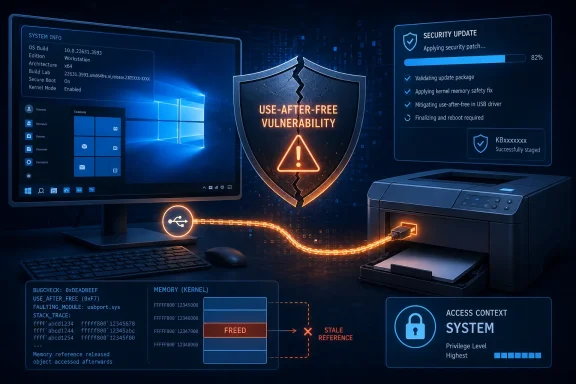 A Use-After-Free Bug With SYSTEM-Level Stakes
Microsoft describes CVE-2026-50674 as a use-after-free condition in the Windows USB Print Driver. This class of memory-safety error occurs when software continues to reference memory after it has been released, potentially allowing an attacker to manipulate the reused memory and redirect program execution.The vulnerability requires local access and existing low-level privileges. It cannot be exploited directly across the internet, and Microsoft’s scoring indicates that no separate user interaction is needed after the attacker begins the exploit. Attack complexity is rated high, suggesting successful exploitation depends on conditions beyond simply running a malicious executable.
Microsoft says an authorized attacker who successfully exploits the defect can elevate privileges locally. Although the public advisory does not provide exploit code or a detailed reproduction procedure, an elevation-of-privilege flaw in a Windows driver can serve as the second stage of a broader intrusion: initial access places an attacker on the machine, and the driver bug provides a route out of the restricted user context.
The CVSS vector gives the vulnerability high impact ratings for confidentiality, integrity, and availability. In practical terms, a successful privilege escalation could allow an attacker to access protected data, modify system resources, disable security controls, install persistent software, or interfere with the affected machine.
Microsoft’s report-confidence rating is Confirmed. That designation means the vendor has sufficient evidence to validate the vulnerability, even though the advisory leaves most of the technical internals undisclosed. It should not be interpreted as evidence that working exploit code is publicly available.
July’s Updates Close the Vulnerable Code Path
Available vulnerability and update mappings identify supported releases of Windows 11 and Windows Server 2025 among the affected products. The relevant July security packages include:- KB5101650 updates Windows 11 versions 24H2 and 25H2 to builds 26100.8875 and 26200.8875, respectively.
- KB5101649 updates Windows 11 version 26H1 to build 28000.2525.
- KB5099536 supplies the July 2026 security update for Windows Server 2025.
The remediation is the normal cumulative Windows security update rather than a separate USB printer driver download. That distinction matters in managed environments: updating a printer’s manufacturer-supplied software alone should not be treated as remediation for this Windows component vulnerability.
Endpoints receiving updates through Windows Update should obtain the fix under their configured servicing policies. Organizations using Windows Server Update Services, Microsoft Intune, Windows Autopatch, Configuration Manager, or another patch platform should verify installation by checking the resulting OS build, not merely whether the deployment job reported success.
There is no published workaround that offers equivalent protection. Disabling or restricting printing might reduce exposure in some narrowly defined deployments, but it is not a substitute for installing Microsoft’s corrected binaries. The affected driver may also be present on Windows systems that are not routinely connected to a USB printer.
Local Access Narrows the Attack, Not the Consequence
CVE-2026-50674 does not give an unauthenticated remote attacker an immediate path into a Windows PC. An adversary first needs authorization to run code locally, whether through a compromised account, malicious application, another vulnerability, or an existing foothold established by phishing or malware.That prerequisite lowers the urgency relative to July vulnerabilities reachable over a network. Trend Micro’s Zero Day Initiative listed CVE-2026-50674 as Important with a CVSS score of 7.0 and noted that Microsoft had not identified public disclosure or active exploitation when the update was released.
The absence of observed exploitation is useful prioritization data, but it is not a reason to leave the flaw open indefinitely. Local privilege-escalation vulnerabilities are routinely paired with initial-access techniques because administrator or SYSTEM rights make credential theft, endpoint-defense tampering, and persistence substantially easier.
Multi-user systems deserve particular attention. Remote Desktop Session Hosts, shared engineering workstations, kiosks that permit application execution, training-room PCs, and other machines used by accounts with limited privileges all provide scenarios in which the local-access requirement may already be satisfied.
Print infrastructure also tends to receive uneven attention. A server may continue operating for years because its function appears stable, while workstations accumulate printer packages through USB attachment, Plug and Play detection, administrative deployment, or previous hardware use. Security teams should therefore inventory by Windows version and update state rather than trying to identify only machines with a currently attached USB printer.
One of Several USB Print Driver Fixes This Month
CVE-2026-50674 was not the only Windows USB Print Driver vulnerability fixed on July 14. Microsoft’s July release also included CVE-2026-55000, CVE-2026-54991, CVE-2026-54996, CVE-2026-49802, and CVE-2026-49806 under the same component family.The individual flaws have different scores and exploitation requirements, so they should not be treated as interchangeable entries. Their concentration in one component does, however, strengthen the case for validating the cumulative update across every supported Windows build rather than tracking only a single CVE result from a vulnerability scanner.
Security products may initially report CVE-2026-50674 using package presence, OS build, or file-version checks. Conflicting results shortly after Patch Tuesday should be reconciled against the installed July cumulative update and Microsoft’s current product matrix, especially because vulnerability feeds can lag behind revisions to the Security Update Guide.
For administrators triaging the July release, CVE-2026-50674 belongs behind actively exploited and unauthenticated network-reachable vulnerabilities, but ahead of routine deferral. The immediate operational target is straightforward: move Windows 11 24H2 and 25H2 systems to builds 26100.8875 and 26200.8875, Windows 11 26H1 systems to build 28000.2525, and Windows Server 2025 systems onto KB5099536 or a later cumulative update.
References
- Primary source: MSRC
Published: 2026-07-14T07:00:00-07:00
Security Update Guide - Microsoft Security Response Center
 msrc.microsoft.com
