

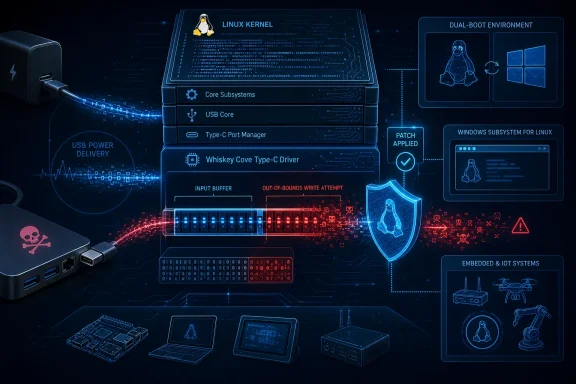
CVE-2026-63960 is a newly published Linux kernel vulnerability that turns an apparently narrow USB Type-C driver flaw into a useful reminder that physical-port security still depends on painstakingly correct memory handling deep inside the operating system. The issue affects the Whiskey Cove Type-C and USB Power Delivery driver, where a receive routine could write beyond the bounds of a fixed-size Power Delivery message structure while handling data reported by a connected USB-C partner. The patch is compact, but the defect it corrects is not: it combines an untrusted hardware-reported length with a register-access API used through the wrong pointer type, producing an out-of-bounds write on a kernel interrupt-thread stack. For Windows users, the vulnerability is not a native Windows kernel flaw, but it matters to anyone running Linux through dual boot, on dedicated appliances, in embedded deployments, or under Windows Subsystem for Linux configurations that pass through or otherwise depend on affected hardware and host kernels.
CVE-2026-63960 was published on July 19, 2026, and subsequently incorporated into the National Vulnerability Database dataset. At publication time, the record did not include a final NVD CVSS assessment, so administrators should avoid treating the absence of a score as evidence that the issue is harmless. The Linux kernel community has already resolved the underlying flaw and identified stable-kernel fixes for supported maintenance series.
The vulnerable code sits in
That location sharply narrows the practical attack surface. This is not a generic vulnerability affecting every Linux system with a USB-C port, every USB controller, or every implementation of USB Power Delivery. It depends on the affected WCOVE driver being present and active, and an attacker needs an opportunity to influence Power Delivery traffic through a connected Type-C device, cable, dock, adapter, charger, or purpose-built malicious partner.
The relevant message structure is 30 bytes long: a two-byte header followed by up to seven four-byte Power Delivery data objects. The receive-length field exposed by the controller is five bits wide, however, meaning it can represent a value as high as 31 bytes.
That one-byte difference is enough to matter in kernel code. If the controller accepts or reports a 31-byte incoming frame, the original loop could write the 31st byte immediately beyond a 30-byte
That API expects an
In ordinary iterations, later writes tended to overwrite the extra zero bytes. At the tail of the copy, however, no later writes existed to erase the spill. With an otherwise valid 30-byte receive length, the final iteration could already write three zero bytes past the end of the destination structure.
Those capabilities rely on USB Power Delivery, commonly called USB PD. PD traffic is distinct from the ordinary USB data stream; it travels over the Configuration Channel, or CC, pins and enables the connected devices to negotiate policy before, during, and after a data connection is established.
This is a sensible design. A device needs to negotiate charging and roles early, often before a full userspace environment is available, and decisions about power sourcing can have direct electrical and safety implications. The trade-off is that data originating outside the machine is processed in privileged kernel context.
A PD message parser must therefore treat length fields, message headers, object counts, and controller state as security boundaries. The vulnerability in CVE-2026-63960 arose when the software trusted a received byte count more than it trusted the capacity of its own destination object.
The driver has been present since Linux kernel 4.15. That historical reach explains why the issue appears across several long-term stable branches rather than being isolated to a single recent development release.
At first glance, this is a familiar register-copy loop. It is also exactly the kind of compact hardware-interface code where two small assumptions can compound into a security defect.
The flaw was not merely that the maximum field value was 31 while the destination was 30 bytes. The deeper error was architectural: the loop limit was governed solely by an externally influenced value, while the object being written had a smaller, known compile-time capacity.
A robust low-level receive path should always use the smaller of two values:
The vulnerable code apparently contained a note acknowledging uncertainty over whether the receiver hardware always enforced that object-count limit. That uncertainty matters because a driver cannot safely rely on a protocol invariant unless the layer enforcing it is understood and verified.
A malicious or nonconforming partner does not have to persuade every component in the path that a frame is legitimate. It only needs the hardware and driver combination to expose an oversized byte count before higher-level validation rejects or interprets the message. By that point, an unsafe memory write may already have happened.
Why
The oversize-length flaw is easy to understand: a 31-byte copy into a 30-byte object can write one byte too far. The API mismatch is subtler, because it converts what appears to be byte-by-byte copying into repeated machine-word writes.
For each register read, the driver wanted only the low eight bits—the actual value of the 8-bit controller register. But
That appearance was deceptive. The final write extended beyond the intended message object even when the reported byte count was exactly 30. A software bug that merely “works because subsequent writes mask previous damage” is not stable behavior; it is a delayed memory-corruption condition.
The final write in the former implementation landed beyond the packed object. According to the CVE description, this object was located on the stack in the Type-C interrupt-thread path. Stack-adjacent corruption is always security-relevant because the exact neighboring values depend on compiler behavior, kernel build configuration, architecture, and the surrounding call chain.
It would be irresponsible to claim that this automatically yields reliable arbitrary code execution. The overflow is small, the bytes written are constrained, and exploitability can vary dramatically by platform. But kernel memory corruption should never be dismissed simply because an overflow is one to three bytes in a particular nominal case.
First, the number of copied bytes is capped at the size of the destination
This separation also makes code review easier. A reviewer can see that the hardware read and the wire-format storage are different operations, with a clear narrowing conversion between them. In security-sensitive driver code, that visibility is valuable.
That distinction is important. A clamped 31-byte input becomes a safely stored 30-byte message, after which normal protocol parsing and validation must decide whether the frame is acceptable. Memory-safety fixes and protocol-validity checks are complementary layers, not interchangeable ones.
Those numbers should be treated as upstream reference points, not as the only safe package versions an administrator may encounter. Enterprise and consumer distributions often backport individual security fixes into kernels whose visible version strings do not match upstream stable releases.
Conversely, a long-lived embedded product may run a heavily customized kernel and be more exposed than its version label suggests. Appliance vendors sometimes retain old kernel trees with selective patches, and their published support documentation may be incomplete. Hardware inventory and source-level patch verification matter more than assumptions.
That partner might be a specially engineered USB-C device, malicious charging accessory, programmable test board, dock, cable assembly with active electronics, or another device acting as a PD source or sink. The vulnerability should not be interpreted as a conventional network-exposed remote attack.
The practical risk rises when users connect untrusted USB-C accessories. Public charging locations, borrowed docks, conference-room adapters, accessory testing, and second-hand hardware are all examples where the connected partner may not deserve implicit trust. The familiar advice to avoid unknown USB peripherals has broadened in the Type-C era: power negotiation itself is an input channel.
In these environments, physical access controls matter. A machine in a locked datacenter is different from a service terminal in a public lobby. Security teams should evaluate whether untrusted people can attach USB-C hardware, whether ports are externally accessible, and whether Type-C functionality is actually needed for the deployed workflow.
The vulnerability does not mean those workflows must stop. It means lab policies should assume that PD test equipment can deliver malformed signaling, whether accidentally or by design. Updating kernel images, isolating test devices, and avoiding privileged production credentials on experimental systems are sensible controls.
Still, WindowsForum readers increasingly operate mixed environments. They may dual-boot Linux, administer Linux servers from Windows, develop with cross-platform tooling, run embedded Linux hardware, or use Windows Subsystem for Linux.
This distinction helps avoid a common security-reporting failure: confusing a shared physical port with a shared operating-system vulnerability. The USB-C connector is common to both operating systems, but the vulnerable code path exists only when the affected Linux driver is loaded and servicing the controller.
USB device attachment and pass-through can change the picture, especially in advanced development configurations. But the right response is still not panic; it is verification. Keep WSL current through supported Windows and WSL update channels, understand which devices are passed into the Linux environment, and distinguish generic Linux advisories from flaws in components WSL actually uses.
The relevant questions are operational:
Administrators should not attempt to “patch around” the issue by changing USB preferences in a desktop environment. The vulnerable receive path occurs below those controls, in the kernel’s interaction with the controller.
Disabling the WCOVE driver may be a valid short-term option only after careful testing. Doing so can affect charging, USB-C role handling, power delivery, or display output. On a portable device, a mitigation that prevents charging may be operationally worse than the vulnerability for some use cases.
In other words, “the hardware told us” is not a valid substitute for a bounds check.
However, the opposite response—ignoring the defect because it is “only one byte” or “only a niche driver”—would also be a mistake. Kernel vulnerabilities involving externally influenced memory writes warrant prompt verification, particularly on systems with accessible ports and uncertain patch status.
As Type-C becomes the default connector across laptops, tablets, industrial equipment, and accessories, kernel developers and hardware vendors will need to keep treating PD messages as adversarial inputs. Strict length validation, correct typed access to device registers, fuzzing of controller-facing receive paths, and regression tests for malformed frames should be standard engineering expectations.
The wider message is encouraging as well as cautionary: the Linux kernel fix replaces fragile assumptions with explicit boundaries. That is exactly how mature platform security should work—small flaws are found, their real mechanics are understood, stable updates are delivered, and administrators are given a clear path from uncertainty to a defensible configuration.
The practical response to CVE-2026-63960 is therefore straightforward: do not confuse it with a universal USB-C or Windows flaw, but do not underestimate it on the systems where the affected Linux driver and hardware meet. Update the kernel, confirm the patched kernel is booted, treat unfamiliar USB-C partners with appropriate caution, and use this incident as a prompt to audit other driver paths where device-reported lengths and generic APIs may be crossing memory-safety boundaries.
 Overview
CVE-2026-63960 was published on July 19, 2026, and subsequently incorporated into the National Vulnerability Database dataset. At publication time, the record did not include a final NVD CVSS assessment, so administrators should avoid treating the absence of a score as evidence that the issue is harmless. The Linux kernel community has already resolved the underlying flaw and identified stable-kernel fixes for supported maintenance series.The vulnerable code sits in
drivers/usb/typec/tcpm/wcove.c, which supports the Whiskey Cove, or WCOVE, USB Type-C controller implementation. This driver participates in the Type-C Port Manager framework, a kernel subsystem responsible for USB-C role negotiation, power delivery messaging, alternate-mode coordination, and related policy functions.That location sharply narrows the practical attack surface. This is not a generic vulnerability affecting every Linux system with a USB-C port, every USB controller, or every implementation of USB Power Delivery. It depends on the affected WCOVE driver being present and active, and an attacker needs an opportunity to influence Power Delivery traffic through a connected Type-C device, cable, dock, adapter, charger, or purpose-built malicious partner.
The headline problem
The central defect is a receive-buffer handling error. The driver copied bytes from the controller’s Power Delivery receive FIFO into astruct pd_message object without ensuring that the hardware-reported number of bytes fit in that destination.The relevant message structure is 30 bytes long: a two-byte header followed by up to seven four-byte Power Delivery data objects. The receive-length field exposed by the controller is five bits wide, however, meaning it can represent a value as high as 31 bytes.
That one-byte difference is enough to matter in kernel code. If the controller accepts or reports a 31-byte incoming frame, the original loop could write the 31st byte immediately beyond a 30-byte
pd_message.The less obvious problem
The CVE description identifies a second, more consequential coding error in the same loop. Rather than reading each 8-bit register value into a temporary integer and assigning a single byte to the message buffer, the driver passed a byte pointer directly toregmap_read().That API expects an
unsigned int * output pointer. Even when the register itself is only eight bits wide, regmap_read() writes a full unsigned int to its output location. Consequently, every iteration could store four bytes beginning at msg + i, not one byte.In ordinary iterations, later writes tended to overwrite the extra zero bytes. At the tail of the copy, however, no later writes existed to erase the spill. With an otherwise valid 30-byte receive length, the final iteration could already write three zero bytes past the end of the destination structure.
Background
USB Type-C changed the role of a USB connector from a mostly passive physical interface into an active negotiation channel. A modern USB-C connection can determine which side supplies power, how much power may be delivered, whether the connection can enter DisplayPort Alternate Mode, whether data roles should swap, and whether sophisticated charging or docking behavior is permitted.Those capabilities rely on USB Power Delivery, commonly called USB PD. PD traffic is distinct from the ordinary USB data stream; it travels over the Configuration Channel, or CC, pins and enables the connected devices to negotiate policy before, during, and after a data connection is established.
Why Power Delivery parsing belongs in the kernel
On Linux, the kernel’s Type-C and TCPM subsystems translate low-level controller events into a usable policy framework. The controller hardware detects line conditions and PD frames, while the driver reads registers and passes the results upward to the Type-C policy engine.This is a sensible design. A device needs to negotiate charging and roles early, often before a full userspace environment is available, and decisions about power sourcing can have direct electrical and safety implications. The trade-off is that data originating outside the machine is processed in privileged kernel context.
A PD message parser must therefore treat length fields, message headers, object counts, and controller state as security boundaries. The vulnerability in CVE-2026-63960 arose when the software trusted a received byte count more than it trusted the capacity of its own destination object.
WCOVE and its platform context
Whiskey Cove is associated with Intel-connected mobile and tablet-era platform designs, particularly systems where power-management and USB-C functions are closely integrated. Its Linux driver is specialized rather than universal, which makes broad panic inappropriate but does not make patching optional for affected deployments.The driver has been present since Linux kernel 4.15. That historical reach explains why the issue appears across several long-term stable branches rather than being isolated to a single recent development release.
The Vulnerable Receive Path
The affected function,wcove_read_rx_buffer(), reads a receive-status register and then copies bytes from the controller’s receive FIFO into a caller-provided struct pd_message. The original flow effectively said: determine the received byte count, iterate from zero to that count, and read each FIFO register into the corresponding address in the message object.At first glance, this is a familiar register-copy loop. It is also exactly the kind of compact hardware-interface code where two small assumptions can compound into a security defect.
An external length was treated as authoritative
The receive count was derived fromUSBC_RXINFO_RXBYTES(info). Because that value comes from the controller’s receive information register, it describes what the hardware says arrived from the other end of the Type-C connection.The flaw was not merely that the maximum field value was 31 while the destination was 30 bytes. The deeper error was architectural: the loop limit was governed solely by an externally influenced value, while the object being written had a smaller, known compile-time capacity.
A robust low-level receive path should always use the smaller of two values:
- The number of bytes reported as available by the device.
- The number of bytes the destination buffer can safely hold.
sizeof(struct pd_message). This establishes an unconditional memory-safety boundary even if the hardware receives, reports, or exposes a malformed length.The protocol’s normal limits were not enough
USB Power Delivery normally constrains the structure of messages through a header-defined data-object count. A standard PD message with the maximum seven data objects fits the 30-byte destination exactly: two header bytes plus 28 payload bytes.The vulnerable code apparently contained a note acknowledging uncertainty over whether the receiver hardware always enforced that object-count limit. That uncertainty matters because a driver cannot safely rely on a protocol invariant unless the layer enforcing it is understood and verified.
A malicious or nonconforming partner does not have to persuade every component in the path that a frame is legitimate. It only needs the hardware and driver combination to expose an oversized byte count before higher-level validation rejects or interprets the message. By that point, an unsafe memory write may already have happened.
Why regmap_read() Changes the Severity Discussion
The oversize-length flaw is easy to understand: a 31-byte copy into a 30-byte object can write one byte too far. The API mismatch is subtler, because it converts what appears to be byte-by-byte copying into repeated machine-word writes.regmap_read() is designed around an unsigned int output value. That convention allows a common abstraction to support registers with different widths, but it also means callers must provide storage sized appropriately for an unsigned int.A byte pointer was not a valid output buffer
Passingmsg + i to an API expecting unsigned int * violates the contract of that function. The pointer denotes an address within a packed byte buffer, not an aligned four-byte integer storage location.For each register read, the driver wanted only the low eight bits—the actual value of the 8-bit controller register. But
regmap_read() wrote a full integer at that address. With eight-bit register values, the remaining bytes were generally zero, which may have made the code appear to function during routine testing.That appearance was deceptive. The final write extended beyond the intended message object even when the reported byte count was exactly 30. A software bug that merely “works because subsequent writes mask previous damage” is not stable behavior; it is a delayed memory-corruption condition.
Packed structures magnify the hazard
struct pd_message is packed. Packed structures are sometimes necessary for protocol layouts because they keep the in-memory representation identical to the wire format. They also remove natural padding that might otherwise, though never safely, absorb an accidental overrun.The final write in the former implementation landed beyond the packed object. According to the CVE description, this object was located on the stack in the Type-C interrupt-thread path. Stack-adjacent corruption is always security-relevant because the exact neighboring values depend on compiler behavior, kernel build configuration, architecture, and the surrounding call chain.
It would be irresponsible to claim that this automatically yields reliable arbitrary code execution. The overflow is small, the bytes written are constrained, and exploitability can vary dramatically by platform. But kernel memory corruption should never be dismissed simply because an overflow is one to three bytes in a particular nominal case.
A Technical Walkthrough of the Fix
The remediation uses two defensive changes rather than attempting to rely on a single protocol rule. This is the correct approach because the original defect had two independent causes.First, the number of copied bytes is capped at the size of the destination
pd_message. Second, each FIFO register read goes into a local unsigned int variable before the low byte is copied into the message buffer.The corrected safety model
The new conceptual flow is straightforward:- Read the receive metadata from the controller.
- Derive the reported received-byte count.
- Limit that count to the fixed size of
struct pd_message. - Read each register into correctly typed temporary storage.
- Store only the low byte into the indexed message buffer.
- Return the sanitized message to the higher-level Type-C and PD processing code.
Why a local temporary is more than style
Reading into a localunsigned int might look like a minor coding-style refinement, but it restores the API’s intended type discipline. The register-map layer receives a properly sized output address; the message buffer receives exactly one explicitly selected byte.This separation also makes code review easier. A reviewer can see that the hardware read and the wire-format storage are different operations, with a clear narrowing conversion between them. In security-sensitive driver code, that visibility is valuable.
The patch prevents corruption, not malformed traffic
The fix guarantees that the destination is not overwritten. It does not, by itself, transform an oversize hardware report into a fully valid USB PD message.That distinction is important. A clamped 31-byte input becomes a safely stored 30-byte message, after which normal protocol parsing and validation must decide whether the frame is acceptable. Memory-safety fixes and protocol-validity checks are complementary layers, not interchangeable ones.
Affected Kernel Versions and Patch Status
The CVE record identifies the issue as affecting the Linux kernel from version 4.15 until the relevant stable fixes. The listed remediation points are Linux 5.10.259, 5.15.210, 6.1.176, 6.6.143, 6.12.93, 6.18.35, and 7.0.12.Those numbers should be treated as upstream reference points, not as the only safe package versions an administrator may encounter. Enterprise and consumer distributions often backport individual security fixes into kernels whose visible version strings do not match upstream stable releases.
Upstream versions that contain the fix
Administrators using unmodified upstream-style kernels should regard the following releases as fixed:- Linux 5.10.259 or later within the 5.10 stable series.
- Linux 5.15.210 or later within the 5.15 stable series.
- Linux 6.1.176 or later within the 6.1 stable series.
- Linux 6.6.143 or later within the 6.6 stable series.
- Linux 6.12.93 or later within the 6.12 stable series.
- Linux 6.18.35 or later within the 6.18 stable series.
- Linux 7.0.12 or later within the 7.0 stable series.
Do not equate age with exposure
The age of a kernel branch alone does not determine risk. The driver must be built, the relevant Type-C controller hardware must exist, and the driver must bind to it. A headless server without the WCOVE hardware is not exposed through this particular driver merely because it runs an affected kernel version.Conversely, a long-lived embedded product may run a heavily customized kernel and be more exposed than its version label suggests. Appliance vendors sometimes retain old kernel trees with selective patches, and their published support documentation may be incomplete. Hardware inventory and source-level patch verification matter more than assumptions.
Exposure Scenarios
The most plausible attack model involves a physical USB-C connection to an affected Linux device. An adversary would need to present a malicious or malformed Power Delivery frame through a connected partner capable of manipulating PD traffic.That partner might be a specially engineered USB-C device, malicious charging accessory, programmable test board, dock, cable assembly with active electronics, or another device acting as a PD source or sink. The vulnerability should not be interpreted as a conventional network-exposed remote attack.
Consumer devices
For consumers, the immediate concern is concentrated in devices that combine older or specialized Intel mobile hardware with Linux and USB-C. A laptop, tablet, detachable, development board, or repurposed small-form-factor device could be relevant if it uses the WCOVE controller and the driver is active.The practical risk rises when users connect untrusted USB-C accessories. Public charging locations, borrowed docks, conference-room adapters, accessory testing, and second-hand hardware are all examples where the connected partner may not deserve implicit trust. The familiar advice to avoid unknown USB peripherals has broadened in the Type-C era: power negotiation itself is an input channel.
Enterprise and industrial systems
Enterprise exposure may be less about employee laptops and more about unmanaged edge devices. Kiosks, point-of-sale terminals, factory tablets, logistics handhelds, lab systems, medical-adjacent equipment, and ruggedized field devices can retain specialized kernels and unusual hardware long after mainstream desktop fleets have moved on.In these environments, physical access controls matter. A machine in a locked datacenter is different from a service terminal in a public lobby. Security teams should evaluate whether untrusted people can attach USB-C hardware, whether ports are externally accessible, and whether Type-C functionality is actually needed for the deployed workflow.
Development and validation labs
Hardware labs deserve special attention because they intentionally connect experimental chargers, cables, docks, and PD analyzers. Engineers often run development kernels, debug builds, or older board-support packages that lag behind distribution security updates.The vulnerability does not mean those workflows must stop. It means lab policies should assume that PD test equipment can deliver malformed signaling, whether accidentally or by design. Updating kernel images, isolating test devices, and avoiding privileged production credentials on experimental systems are sensible controls.
Why This Matters to Windows Users
CVE-2026-63960 is a Linux kernel issue, not a Microsoft Windows vulnerability. It does not mean that a Windows 11 PC becomes vulnerable merely by plugging in a USB-C charger, nor does it indicate a flaw in the Windows USB stack.Still, WindowsForum readers increasingly operate mixed environments. They may dual-boot Linux, administer Linux servers from Windows, develop with cross-platform tooling, run embedded Linux hardware, or use Windows Subsystem for Linux.
Dual boot and dedicated Linux installs
A Windows PC with a separate Linux installation should treat the Linux environment independently. If the Linux installation runs on compatible Whiskey Cove hardware and includes the vulnerable driver, its kernel needs the relevant vendor update even though the Windows installation itself is unaffected.This distinction helps avoid a common security-reporting failure: confusing a shared physical port with a shared operating-system vulnerability. The USB-C connector is common to both operating systems, but the vulnerable code path exists only when the affected Linux driver is loaded and servicing the controller.
Windows Subsystem for Linux
WSL users should not assume that every Linux kernel CVE maps directly onto their local setup. WSL uses a Microsoft-managed Linux kernel architecture, and normal WSL environments do not automatically expose every host USB controller driver to the Linux guest.USB device attachment and pass-through can change the picture, especially in advanced development configurations. But the right response is still not panic; it is verification. Keep WSL current through supported Windows and WSL update channels, understand which devices are passed into the Linux environment, and distinguish generic Linux advisories from flaws in components WSL actually uses.
Cross-platform fleet management
For administrators managing both Windows endpoints and Linux appliances, this CVE reinforces the value of a unified asset inventory. A vulnerability scanner that only compares broad kernel versions can generate noise, while a Windows-centric inventory may miss small Linux systems connected to the same enterprise network and accessory ecosystem.The relevant questions are operational:
- Does the device run Linux with the Type-C TCPM stack enabled?
- Does it contain hardware supported by the WCOVE driver?
- Is the patched change present in the vendor kernel package?
- Can an untrusted party connect a USB-C partner to the affected port?
- Is there a business reason to leave the port enabled?
Patch Management Guidance
The primary mitigation is to install the vendor-supplied kernel update containing the fix and reboot into that updated kernel. Because the defect is in kernel-space driver code, updating user-space packages alone does not remove it.Administrators should not attempt to “patch around” the issue by changing USB preferences in a desktop environment. The vulnerable receive path occurs below those controls, in the kernel’s interaction with the controller.
A practical verification sequence
A disciplined remediation process can be organized as follows:- Identify the kernel actually running, rather than only the packages installed on disk.
- Determine whether the WCOVE driver is built or loaded on potentially affected hardware.
- Check the distribution’s security advisory or changelog for the CVE or corresponding upstream patch.
- Install the supported kernel update provided for the device’s operating-system release.
- Reboot and confirm the new kernel is active before closing the remediation ticket.
- Test expected Type-C functions, including charging, display output, docking, and role negotiation where applicable.
- Document exceptions for unsupported embedded devices and apply compensating physical controls.
Temporary mitigation options
When an update cannot be deployed immediately, organizations should reduce access to Type-C ports associated with affected systems. This can include restricting physical access, disconnecting unnecessary docks, avoiding unknown accessories, and disabling the relevant hardware path where platform controls permit it.Disabling the WCOVE driver may be a valid short-term option only after careful testing. Doing so can affect charging, USB-C role handling, power delivery, or display output. On a portable device, a mitigation that prevents charging may be operationally worse than the vulnerability for some use cases.
Strengths and Opportunities
The handling of CVE-2026-63960 offers several positive lessons for kernel maintenance and device security.- The fix addresses both root causes. It does not merely cap the reported byte count; it also corrects the misuse of the register-map API that enabled wider-than-intended writes.
- The safe bound is intrinsic to the destination. Using the size of
struct pd_messagemakes the protection durable even if hardware behavior, protocol assumptions, or future controller revisions differ. - Stable backports broaden practical protection. Fixes were prepared for multiple maintained upstream branches, reducing the likelihood that long-term deployments are left without a clean remediation path.
- The issue demonstrates the value of code comments and unresolved notes. The earlier uncertainty around receiver enforcement did not solve the bug, but it highlighted the exact assumption that required hardening.
- The case supports more defensive driver review. Similar patterns—hardware-reported sizes combined with packed protocol structures and generic register APIs—are ideal targets for static analysis and focused audit work.
A model for hardware-facing code
The strongest design lesson is simple: data coming from a device register deserves the same suspicion as data arriving from a network socket. A peripheral may be trusted hardware in normal operation, but its registers can reflect electrical faults, firmware defects, protocol violations, malicious accessories, or unexpected state transitions.In other words, “the hardware told us” is not a valid substitute for a bounds check.
Risks and Concerns
The CVE also exposes several risks that should shape remediation priorities and future engineering work.- Exploitability remains platform-specific. The overwrite is constrained, but it occurs in kernel context and on a stack-adjacent object, so its impact cannot be evaluated from byte count alone.
- Asset discovery may be difficult. WCOVE is specialized hardware, and organizations may not know which older mobile or embedded devices contain it.
- Version-only scanning can mislead. Distribution backports and custom kernels mean a visible kernel version may not accurately indicate vulnerability status.
- USB-C accessories are increasingly complex. A port that appears to be “only for charging” can still participate in active PD negotiation and exchange security-relevant control traffic.
- Temporary driver disablement can break essential functions. Charging, docking, display output, or role switching may depend on the affected stack, making mitigation a business-continuity decision.
The danger of overreaction
Not every Linux USB-C machine needs emergency intervention. The driver and hardware specificity substantially limit exposure, and no CVSS score or confirmed exploitation details were included in the newly published record at the time of publication.However, the opposite response—ignoring the defect because it is “only one byte” or “only a niche driver”—would also be a mistake. Kernel vulnerabilities involving externally influenced memory writes warrant prompt verification, particularly on systems with accessible ports and uncertain patch status.
Looking Ahead
CVE-2026-63960 is likely to be remembered less for the size of its overflow than for the way it illustrates a recurring systems-security theme: protocol correctness, hardware behavior, and API contracts must all hold at once. The first flaw trusted a length that exceeded the destination’s known capacity. The second trusted a function interface whose output width did not match the destination pointer. Either mistake is dangerous; together, they created an avoidable memory-corruption path.More scrutiny for USB-C’s control plane
USB-C security discussion often centers on malicious USB storage devices, Thunderbolt DMA, cable authenticity, rogue chargers, or data-blocking adapters. Power Delivery deserves equal attention because it is the control plane that decides how the connected devices relate to each other.As Type-C becomes the default connector across laptops, tablets, industrial equipment, and accessories, kernel developers and hardware vendors will need to keep treating PD messages as adversarial inputs. Strict length validation, correct typed access to device registers, fuzzing of controller-facing receive paths, and regression tests for malformed frames should be standard engineering expectations.
Better triage than blanket alarm
For IT teams, the next step is targeted triage rather than broad panic. Identify affected hardware, map the live kernel package to vendor patch status, update systems with exposed Type-C ports, and use temporary physical controls only where patching cannot happen quickly.The wider message is encouraging as well as cautionary: the Linux kernel fix replaces fragile assumptions with explicit boundaries. That is exactly how mature platform security should work—small flaws are found, their real mechanics are understood, stable updates are delivered, and administrators are given a clear path from uncertainty to a defensible configuration.
The practical response to CVE-2026-63960 is therefore straightforward: do not confuse it with a universal USB-C or Windows flaw, but do not underestimate it on the systems where the affected Linux driver and hardware meet. Update the kernel, confirm the patched kernel is booted, treat unfamiliar USB-C partners with appropriate caution, and use this incident as a prompt to audit other driver paths where device-reported lengths and generic APIs may be crossing memory-safety boundaries.
References
- Primary source: NVD / Linux Kernel
Published: 2026-07-21T01:03:29-07:00
NVD - CVE-2026-63960
 nvd.nist.gov
- Security advisory: MSRC
Published: 2026-07-21T01:03:29-07:00
Original feed URL
Security Update Guide - Microsoft Security Response Center
 msrc.microsoft.com
