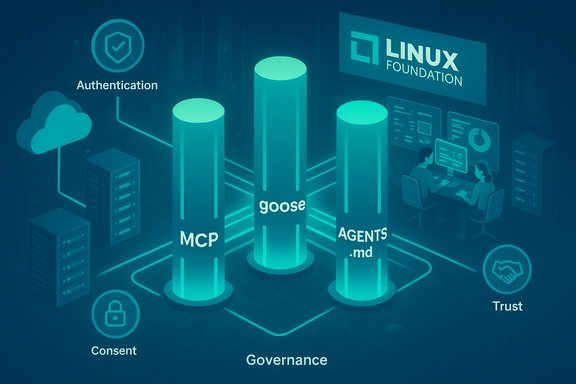
The Linux Foundation’s creation of the Agentic AI Foundation (AAIF) marks a decisive moment in the maturation of “agentic AI” — a coordinated, tool-enabled class of autonomous systems — by placing three rapidly adopted open projects from Anthropic, Block and OpenAI under a single neutral governance roof and lining up the industry’s largest cloud and software players as founding members. The Model Context Protocol (MCP), Block’s goose framework and OpenAI’s AGENTS.md now share stewardship in a directed fund managed by the Linux Foundation, a move designed to lock in interoperability, reduce fragmentation and accelerate enterprise adoption of agents — but it also raises new questions about governance, security, and whose interests will shape the rules of the agent era.
For Windows-focused developers and IT teams, the AAIF’s practical benefits are immediate: fewer bespoke connectors to maintain, clearer repository guidance for agent-driven automation, and reference runtimes to validate security postures. The prudent path is to experiment with MCP-compliant connectors and AGENTS.md guidance in non-production settings, adopt guarded sandboxes and logging, and participate in AAIF technical groups to influence standards that will soon shape how agents run on enterprise infrastructure. The agent era is arriving faster than many expected. The AAIF’s success will not be measured by press releases or adoption counts alone, but by the extent to which it helps developers build interoperable, auditable and safe agentic systems that enterprises can trust to do real work — reliably, transparently, and under meaningful public-interest governance.
Source: IT Brief Australia https://itbrief.com.au/story/linux-foundation-launches-agentic-ai-open-standards-hub/
 Background
Why “agentic AI” is different
Agentic AI describes systems that don't just chat; they plan, coordinate, call external tools, modify state, and act autonomously across multiple steps and contexts. These systems require a different set of primitives than single-turn conversational models: persistent context, standardized ways to discover and call tools, safe execution sandboxes, and repository-level guidance so automation behaves predictably across codebases and organizational policies. The AAIF brings three building blocks that respectively address connectivity (MCP), an execution/runtime reference (goose), and repository-level behavior rules (AGENTS.md).The announcement in brief
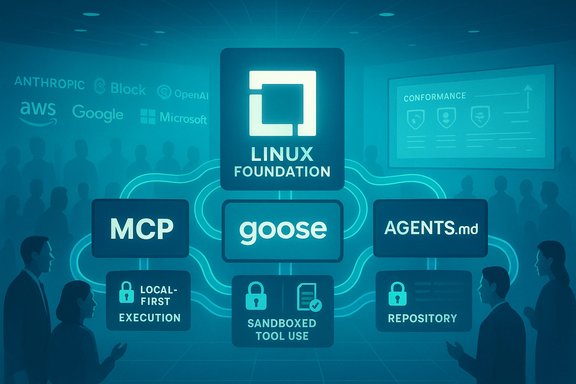
The Linux Foundation announced the AAIF on December 9, 2025. Anthropic donated its Model Context Protocol (MCP), Block contributed the goose local-first agent framework, and OpenAI contributed the AGENTS.md convention. Major cloud and software vendors — including Amazon Web Services, Google, Microsoft and SAP — are listed among early members in a tiered membership structure. The AAIF will host community events (the MCP Dev Summit will continue under its umbrella) and provide neutral governance and technical stewardship for the new agentic stack.What the three founding projects are — and why they matter
Model Context Protocol (MCP): the connectivity layer
- What it does: MCP standardizes how models and agent runtimes connect to external tools, APIs, data sources and applications, offering a common RPC and discovery format so a tool writer or a data provider can be integrated once and consumed by many agents and model platforms.
- How it works (technical snapshot): The protocol uses a JSON-RPC-style message flow and supports multiple transports (including stdio for local processes and HTTP-based transports), capability negotiation, resource discovery, and tool call semantics tailored to multi-step agent workflows. MCP’s design reuses lessons from prior successful developer protocols — separating lifecycle, resource descriptions, tools, and utilities to make connectors composable and discoverable.
- Momentum claims to know about: Anthropic and AAIF materials report rapid adoption — more than 10,000 publicly published MCP servers and wide support across major products such as ChatGPT, Claude, Gemini, Microsoft Copilot, Cursor and VS Code. These numbers are important signals of traction, but they are vendor-reported telemetry and should be treated as strong indicators rather than independently audited market statistics.
goose: a local-first, reference runtime
- What it does: goose is an open-source framework designed to run agentic workflows in user-controlled environments, pairing language models with extensible tools and using MCP as a standard integration layer. It emphasizes local-first execution patterns — placing control, data residency and auditability in the hands of the user or operator.
- Why a reference runtime matters: Specifications alone don’t capture runtime trade-offs. goose provides a runnable implementation that surfaces security, UX and latency considerations for real workloads, and gives enterprises a tested baseline for local deployments where privacy and compliance are paramount.
AGENTS.md: repository-level instructions for agents
- What it does: AGENTS.md is a markdown-based convention that standardizes how projects provide machine-readable guidance to coding agents — build steps, tests to run, files to avoid, environment constraints and stylistic guidance. The goal is to make agent behavior more predictable across thousands of repositories and toolchains.
- Adoption: OpenAI and AAIF materials state AGENTS.md has been added to tens of thousands of open-source projects and integrated into many agent frameworks, which helps the ecosystem avoid brittle, repository-specific behavior surprises. As with MCP metrics, these adoption figures are vendor-supplied and highly indicative, but not a neutral audit.
Governance, membership and funding: a neutral home — with industry muscle
AAIF structure and members
The AAIF is formed as a directed fund under the Linux Foundation. The founding platinum members include Anthropic, Block, OpenAI, Amazon Web Services, Google, Microsoft, Bloomberg and Cloudflare, with a broad set of gold and silver members spanning infrastructure, observability, cloud, and enterprise software providers. The foundation publishes explicit membership tiers, benefits and fees — a familiar model for Linux Foundation projects that mixes corporate sponsorship and community participation.The argument for neutral stewardship
Proponents say stewardship by a neutral foundation guards against unilateral protocol changes, helps ensure vendor-neutral evolution, and gives enterprises confidence that core primitives will remain open and interoperable. Backers argue this is precisely what helped technologies like Kubernetes and Linux scale commercially while remaining community-driven. The Linux Foundation brings governance processes, IP management frameworks, and a track record of running large-scale open-source ecosystems.Possible governance tensions to watch
- Board influence vs. community voice: Platinum seat guarantees, financial tiers and closed funding channels can tilt strategic control toward large corporate members unless governance design enshrines robust community, academic and small-contributor representation.
- Conformance and certification: As AAIF establishes conformance or compatibility programs, the rules that govern who can claim “AAIF-compliant” will materially affect market competition and vendor differentiation.
- Directed fund model: Operating as a directed fund under the Linux Foundation confers operational speed and legal clarity but can create perceived distance between grassroots contributors and financial steering committees.
Technical analysis: interoperability, standards design, and developer tooling
A layered, pragmatic design
The AAIF’s founding projects create a logical three-layer stack:- AGENTS.md — repository-level guidance so agents know how to behave in a codebase.
- MCP — a standard connectivity and discovery protocol for tools, data and actions.
- goose — an executable reference runtime demonstrating safe, local-first agent patterns.
Spec and transport choices
MCP’s use of JSON-RPC-style messaging and support for multiple transports (stdio for local subprocesses; streamable HTTP for remote servers) is a practical decision that supports both local-first runtimes and cloud-hosted MCP servers. Tool discovery via a registry makes it possible to locate MCP servers that expose particular resource types or connectors — a pattern that helps avoid bespoke connector sprawl. Documentation and SDKs already exist in multiple languages, reportedly driving large numbers of SDK downloads — a signal that developer workflows are rapidly adopting the protocol.Developer experience gains
- Reduced connector duplication: build a single MCP-compliant server for a data source and multiple agent platforms can use it.
- Predictability for coding automation: AGENTS.md reduces the “surprise” factor when agents run in unfamiliar repos.
- Reference patterns: goose provides tested patterns for sandboxing, tool invocation and local execution.
Security, safety and operational risks
Expanded attack surface
Agentic systems that call out to tools and services create an expanded attack surface versus purely conversational models. A single compromised MCP server, malicious tool descriptor, or poor allow-listing policy can cause agents to access sensitive data, execute privileged operations, or exfiltrate secrets. Security researchers and operators have already warned that tool composition and agent chaining magnify the risk of accidental data leakage or intentional misuse. These risks mean the difference between safe automation and dangerous, uncontrolled behaviors in production.Common vulnerability classes to mitigate
- Tool spoofing: Lookalike tools or abused discovery entries that misrepresent function or permissions.
- Over-privileged execution: Agents granted broad filesystem, network or API privileges without least-privilege constraints.
- Supply chain for MCP servers: Third-party servers listed in public registries with insufficient vetting or cryptographic identity.
- Behavioral spec ambiguity: Ambiguous AGENTS.md entries that leave too much interpretation to heuristics, resulting in unintended changes.
Recommended operational controls
- Strict allow-listing and policy enforcement for MCP tool usage.
- Cryptographic server identity and attestation for MCP registry entries.
- Sandboxed execution with least privilege and fine-grained escalation pathways.
- Auditing, immutable logging and human-in-the-loop approvals for high-risk actions.
- Conformance test suites and security checklists embedded into AAIF workflows and reference implementations.
Safety beyond technical controls
Safety is not only a technical engineering exercise; it also requires organizational controls: change-management gates, incident response plans for rogue agents, compliance mapping to regulatory obligations (privacy, export controls, financial rules) and transparent escalation procedures. The availability of open standards helps enable shared safety tooling — but the existence of standards alone does not eliminate the need for robust enterprise governance.Commercial implications and competitive dynamics
For cloud providers
Cloud vendors see MCP and AAIF as ways to make their platforms easier integration targets without forcing customers into proprietary connectors. By supporting an industry-wide protocol, major clouds avoid a race to lock in connectors while still providing value-added hosting, observability, and managed MCP infrastructure. That said, clouds will compete on the quality, latency, and compliance guarantees of their MCP hosting offerings.For enterprise adopters
Open standards reduce the cost and risk of adoption by enabling:- Portable connectors and migration paths between clouds and on-prem.
- Shared best practices for security and auditability.
- Easier procurement when multiple vendors can interoperate.
For startups and toolmakers
Startups benefit from a common protocol to plug into larger platforms, while incumbents gain a playbook for delivering managed MCP services. However, the conformance program and certification costs (if instituted) will influence who can participate economically in this ecosystem. The membership fee structure AAIF publishes makes this tension explicit: deeper governance influence comes with higher-tier financial commitments.Regulatory, legal and ethical considerations
Data protection and cross-border flows
When agentic systems call external tools and third-party MCP servers, data may cross jurisdictional boundaries. Organizations need to map data flows, apply data residency controls and ensure that agent decisions which use personal data comply with GDPR, CCPA and other applicable privacy regimes. The AAIF can help by promoting machine-readable metadata for data handling constraints in MCP server descriptors, but legal compliance remains the deploying organization’s responsibility.Accountability and audit trails
Agents that take irrevocable actions (financial transfers, code pushes, infrastructure changes) require auditable trails and clear assignment of accountability. AGENTS.md and MCP can contribute metadata that supports auditing, but governance frameworks and audit-ready tooling are necessary complements. Auditable, tamper-evident logging for tool calls and agent decisions should be considered a baseline requirement for regulated industries.Standards and public interest
The AAIF’s public mission is to ensure open, interoperable agentic AI that benefits the broader community. Maintaining that public-interest orientation will require inclusive governance — with seats and meaningful influence for smaller contributors, academia, civil society and independent security researchers — not just corporate signatories. The credibility of AAIF rests on process as much as code.Events, roadmap and ecosystem signals
Developer community and events
AAIF will absorb the MCP Dev Summit series (donated by Obot.ai) and run future summits, starting with an MCP Dev Summit in New York (April 2–3, 2026) and a European edition planned for 2026. These events will be important community touchpoints for technical working groups, compliance discussions and real-world adoption case studies.Roadmap priorities to watch
- Formal conformance and certification paths for MCP and AGENTS.md.
- Security and identity primitives for MCP server attestation and registry integrity.
- Reference implementations and hardened runtimes evolving from goose.
- Interop testbeds and public bug bounties to discover systemic issues before they are exploited at scale.
Critical analysis: strengths, blind spots and the path forward
Strengths and opportunities
- Pragmatic, layered approach: The combination of repository conventions, protocol-level connectivity and a reference runtime gives developers a clear, interoperable path to build agentic systems without reinventing connectors.
- Rapid ecosystem adoption: Vendor-reported metrics (thousands of MCP servers, tens of thousands of AGENTS.md projects, widespread product support) indicate that the technical approach aligns with developer needs and industry incentives. These are strong signals that standards momentum exists.
- Neutral governance model: Linux Foundation stewardship reduces the immediate risk of unilateral control by any single vendor, helping enterprises feel safer investing in the stack.
Blind spots and risks
- Vendor-reported telemetry: The most eye-catching numbers are company-supplied metrics. They should be used as directional evidence, not audited truth. Independent validation and transparency about measurement methodologies are missing from public materials.
- Security and supply chain risk: Agentic systems amplify consequences when things go wrong. Operational controls, server attestation, allow-listing and audited registries are not optional; they must be built into the ecosystem. Early incentive structures may prioritize feature velocity over robust safety guarantees.
- Governance capture: Corporate membership tiers and guaranteed governing seats create pressure points where large vendors may steer priorities in ways that favor their commercial interests. Ensuring meaningful community representation will be essential to the AAIF’s claim of neutrality.
- Regulatory ambiguity: Existing laws around privacy, automated decision-making and sector-specific rules (finance, healthcare) will intersect with agent deployments in complex ways. The standardization effort must include compliance-oriented extensions and patterns.
Pragmatic recommendations for adopters
- Treat AAIF outputs as baseline standards, not a turnkey safety solution. Build additional controls for data governance, authorizations and incident management.
- Insist on independent audits and conformance test results before relying on MCP servers from third parties.
- Adopt reference implementations like goose to understand trade-offs — especially around sandboxing, latency and offline operation.
- Participate: organizations that want to influence agentic norms should engage with AAIF working groups and contribute security reviews, test suites and interoperability tooling.
Conclusion
The Agentic AI Foundation is an important, timely experiment in how the industry governs the plumbing of an era when AI systems act on our behalf. By donating MCP, goose and AGENTS.md into a Linux Foundation-managed directed fund, three of the most influential builders in the space have created a pragmatic, layered stack that addresses connectivity, runtime behavior and repository-level guidance — all of which are essential if agentic AI is to scale safely in enterprises and the public sector. That progress comes with caveats. Reported adoption numbers signal momentum but are vendor-controlled; security and supply-chain risks are elevated when agents can call tools and change state; and governance structures must be actively shaped so the foundation remains community-driven rather than simply vendor-branded. The coming months will be decisive: the AAIF’s early work on conformance, server attestation, registry integrity and community inclusion will determine whether open standards truly reduce fragmentation — or chiefly serve as a coordination mechanism that preserves incumbents’ competitive advantages.For Windows-focused developers and IT teams, the AAIF’s practical benefits are immediate: fewer bespoke connectors to maintain, clearer repository guidance for agent-driven automation, and reference runtimes to validate security postures. The prudent path is to experiment with MCP-compliant connectors and AGENTS.md guidance in non-production settings, adopt guarded sandboxes and logging, and participate in AAIF technical groups to influence standards that will soon shape how agents run on enterprise infrastructure. The agent era is arriving faster than many expected. The AAIF’s success will not be measured by press releases or adoption counts alone, but by the extent to which it helps developers build interoperable, auditable and safe agentic systems that enterprises can trust to do real work — reliably, transparently, and under meaningful public-interest governance.
Source: IT Brief Australia https://itbrief.com.au/story/linux-foundation-launches-agentic-ai-open-standards-hub/