

ABB Ability Camera Connect versions 1.5.0.14 and earlier, along with version 1.5.0.15, are affected by critical vulnerabilities inherited from an outdated bundled VLC media player component, according to a CISA republication issued on May 26, 2026. The immediate fix is straightforward: update the ABB package and remove the vulnerable third-party media component. The more important lesson is less tidy. Industrial software is still shipping risk through ordinary desktop dependencies, and defenders are being asked to secure not only control systems, but the forgotten utilities that make them usable.
This advisory is not about a newly discovered flaw in ABB’s camera logic, authentication model, or industrial protocol stack. It is about VLC media player 2.2.4, an old version of a widely used open-source application that was delivered with ABB Ability Camera Connect. That distinction matters, because it turns a familiar industrial-control advisory into a software supply-chain case study.
VLC is not exotic. It is the kind of tool administrators, engineers, and vendors reach for because it plays almost anything and because it is useful when dealing with camera streams, RTSP feeds, and awkward codecs. In consumer contexts, that flexibility is a feature. In industrial environments, it can become a long-lived attack surface hiding inside an installer.
ABB’s advisory says the vulnerable component was included with Camera Connect version 1.5.0.14 and below, and the CISA republication also lists version 1.5.0.15 among affected versions. The vulnerability set carries a CVSS v3 score of 9.8, the kind of number that immediately gets dashboards glowing red. But the operational reality is more complicated than the score suggests.
The exploitation path described by the advisory requires a specially crafted media file and a user or attacker action that causes VLC to open it on an affected system node. ABB says the product is deployed in air-gapped environments, which reduces exposure. CISA, meanwhile, repeats the standard industrial-control warning: minimize network exposure, isolate control systems, and treat remote access as a risk-management problem rather than a convenience feature.
That combination — critical score, local-ish exploitation path, air-gapped assumptions, and third-party component drift — is exactly where industrial cybersecurity becomes difficult. The risk is neither imaginary nor automatically catastrophic. It is the kind of risk that accumulates quietly until a maintenance workstation, portable drive, misconfigured firewall, or contractor laptop connects the supposedly isolated world to the very threats it was designed to avoid.
The vulnerability classes listed in the advisory are serious: heap-based buffer overflow, integer underflow, out-of-bounds write, uncontrolled search path element, integer overflow, off-by-one error, out-of-bounds read, double free, improper restriction of operations within memory bounds, and use after free. That is a greatest-hits album of memory corruption. In practical terms, successful exploitation could crash the affected component, make the node unavailable, or potentially allow arbitrary code execution.
But this is not described as a clean unauthenticated network exploit against Camera Connect itself. ABB’s FAQ frames exploitation as requiring a specially crafted file that is copied to affected system nodes and manually opened through VLC media player. It also says the attacker would need access to the system network, direct access through a poorly configured or compromised firewall, malicious software already present on a node, or some other way of infecting the environment.
That is a narrower path than “internet wormable,” but it is not a harmless one. Industrial systems often rely on exactly the workflows attackers love: file transfer, vendor support, engineering laptops, removable media, and maintenance windows where people are under pressure to restore visibility or diagnose field equipment. A malicious video file is not science fiction when the application in question exists to help people interact with camera data.
The advisory also says ABB had not received reports of exploitation at the time it was originally issued. That is useful, but it should not be overread. Absence of reported exploitation is not proof of absence, especially in industrial networks where forensic visibility may be limited and where incidents are often handled quietly.
But air-gapped has always been more of an operational discipline than a physical law. Many industrial networks are air-gapped until a vendor needs to troubleshoot something, a laptop moves between environments, a USB stick carries logs or updates, or a temporary connection becomes a permanent exception. The mythology of isolation often survives long after the architecture has changed.
That is why CISA’s defensive recommendations are familiar but still relevant. Minimize exposure for control-system devices. Keep them off the public internet. Place control networks and remote devices behind firewalls. Separate them from business networks. Use VPNs when remote access is necessary, but do not pretend a VPN is magic; it is only as secure as the devices and credentials attached to it.
For Windows administrators, the uncomfortable part is that this looks like a workstation hygiene problem as much as an OT vulnerability. The affected component is a media player. The trigger is file handling. The likely operational context is a Windows system used by engineers, integrators, or operators. If that machine can open untrusted media and also reach sensitive control assets, the boundary between desktop security and industrial security has already dissolved.
That boundary has been dissolving for years. Windows machines remain central to engineering, monitoring, configuration, and vendor tooling in industrial environments. They may not be PLCs, but they often sit close enough to the process to matter. When they carry outdated libraries, bundled runtimes, browser engines, database engines, or media players, they become part of the control-system attack surface.
That model is unavoidable. Nobody wants every industrial vendor to write its own media decoder, database engine, or cryptographic stack. Reusing mature components is usually safer than reinventing them. The problem comes when reuse becomes abandonment — when a dependency is bundled, shipped, forgotten, and left to age inside environments where change is expensive.
VLC 2.2.4 belongs to an older generation of the media player. It dates back years, and the VLC 3.x line has long since superseded it. The precise vulnerability mix here matters less than the pattern: a general-purpose media parser with years of accumulated security fixes sits inside a specialized industrial tool, and users of that tool may not even think of themselves as running VLC.
That invisibility is the heart of the risk. An administrator can inventory “ABB Ability Camera Connect” and still miss “VLC 2.2.4.” A vulnerability scanner may catch the component if it looks in the right place, recognizes the bundled files, and has permission to inspect the machine. But many industrial environments still depend on manually maintained asset lists, vendor documentation, and cautious change control.
Software bills of materials were supposed to help with this. In practice, they help only if they are complete, current, machine-readable, and integrated into procurement and vulnerability management. A PDF advisory after the fact is better than silence, but it is not the same as a living inventory that tells an operator which plant machines contain which third-party components.
The Camera Connect advisory is therefore not just a patch notice. It is a reminder that dependency management has moved from the developer’s desk to the plant floor. If a product ships a media player, that media player needs a lifecycle. If a vendor packages a database engine, that database engine needs a patch story. If a control-system workstation carries general-purpose parsers, those parsers need to be treated as security-relevant software, not incidental utilities.
That caveat may sound bureaucratic, but it is important. CISA is amplifying vendor information rather than independently rewriting the technical record. For defenders, that means the advisory should be treated as authoritative enough to act on, but not as a substitute for reading ABB’s own documentation, testing the update, and confirming asset exposure.
The timing is notable. ABB’s initial advisory dates to November 27, 2025, with a correction on November 28, 2025. CISA’s republication arrived on May 26, 2026. That gap is not necessarily scandalous; the industrial advisory ecosystem often involves vendor portals, national CERTs, sector-specific feeds, and delayed republication. But it does expose a familiar lag between vendor disclosure and broad public operational awareness.
For organizations that already follow ABB PSIRT advisories closely, this should not be new. For smaller operators, integrators, municipal utilities, or mixed IT/OT teams that rely heavily on CISA’s ICS feed, the republication may be the first time the issue lands in their workflow. That is a distribution problem as much as a security problem.
It also shows why “initial release date” and “CISA publication date” should not be conflated. The vulnerability story did not begin on May 26, 2026. That is when CISA’s page made it more visible to a broader audience. Mature vulnerability management programs need to track both vendor advisories and government advisories, then reconcile duplicates, corrections, and republished notices without creating confusion or double-counting risk.
Engineering workstations occupy an awkward security category. They are often too operationally important to patch casually, too customized to rebuild easily, and too exposed to vendor workflows to isolate perfectly. They may run old drivers, hardware dongle utilities, proprietary configuration packages, and local administrator sessions that would make a corporate endpoint team wince.
That does not mean they are neglected by lazy administrators. It means they sit at the intersection of uptime, vendor support, and change control. The security model that works for a fleet of office laptops — rapid patch rings, automatic reboot windows, aggressive endpoint hardening — may not map cleanly to a plant-floor workstation that supports production.
Still, the basics matter. If ABB’s fix removes or updates the vulnerable VLC component, that update should be evaluated and deployed according to the organization’s OT change process. If older Camera Connect installers remain in software shares, golden images, backup media, or vendor laptops, they should be replaced or quarantined. If affected systems can open arbitrary media files, that workflow should be narrowed.
The more subtle task is inventory. Teams should identify where Camera Connect is installed, which version is present, whether VLC 2.2.4 exists independently on the same machine, and whether the vulnerable files remain after an upgrade. They should also review whether the machines can receive files from business networks, removable media, email, shared drives, remote support sessions, or camera management workflows.
This is where Windows endpoint controls can help without pretending to solve everything. Application control, controlled folder access, removable-media restrictions, least privilege, logging, and endpoint detection can reduce the likelihood that a crafted file becomes code execution. But those controls must be tested against the realities of the vendor software. Breaking the operator’s ability to view or diagnose camera feeds is not a security win if it drives people toward shadow IT.
Camera Connect is not the kind of product that usually dominates cyber headlines. It is connective tissue. It helps industrial users see, verify, monitor, or integrate visual information. That is precisely why its dependencies matter: small utilities can sit near important workflows without being treated as primary assets.
In critical infrastructure, visibility tools can become operationally important even when they are not safety systems in the formal sense. ABB’s FAQ says the vulnerabilities primarily affect confidentiality, integrity, and availability and do not directly affect functional safety in the traditional sense. But it also acknowledges that a compromised system or critical service crash could disrupt safety-related processes dependent on VLC, business operations, or compliance.
That is the right distinction. A vulnerability in a camera tool is not the same as a vulnerability in a safety instrumented system. But if operators rely on camera visibility during maintenance, inspection, loading, perimeter monitoring, or process verification, losing that visibility at the wrong moment can still matter. Security impact and safety impact are not identical, but they can touch.
This is why OT risk assessment cannot stop at CVSS. A high score tells you the technical severity under a model. It does not tell you whether a particular affected node is isolated, whether the workflow is used daily, whether compensating controls exist, whether the update has been validated, or whether the camera view is operationally critical during hazardous procedures.
The advisory’s sector list should therefore be read as a map of where to ask questions, not as a universal declaration of emergency. A lab system used for occasional configuration may carry a different risk than a production workstation used during live operations. The same vulnerable component can be a nuisance in one place and a serious operational risk in another.
Physical access in OT is not always as clean a boundary as outsiders imagine. A contractor with a laptop, a remote support session that transfers files, a USB device used to move diagnostics, or malware that has already reached an engineering workstation can all change the practical meaning of “local.” The attacker may not need to stand in the plant with a keyboard if the environment provides other ways to place and open the crafted file.
This is the same pattern seen across countless parser vulnerabilities. The vulnerable code may only run when a user opens a file, but attackers are good at shaping workflows so someone does exactly that. In office IT, the lure may be a document, archive, or image. In an industrial camera context, a malicious file could plausibly masquerade as diagnostic media, exported footage, configuration evidence, or a vendor-supplied test clip.
That does not make exploitation inevitable. It does mean defenders should resist the comforting binary of “remote” versus “local.” Many real intrusions are chains. An attacker compromises a business endpoint, steals credentials, reaches a shared drive, pivots into a remote access pathway, lands on an engineering host, and then uses a local parser bug to escalate or execute code in a more valuable context.
The advisory itself hints at this chain-based thinking when it mentions wrongly configured or penetrated firewalls and malicious software on a system node. The vulnerable VLC component may not be the front door. It may be a side door opened after the attacker is already close to the target.
For incident responders and system owners, the practical response is to reduce opportunities for that chain to form. Limit file movement. Scan imported data. Keep remote access narrow and monitored. Separate business and control networks. Review local administrative rights. Do not leave vulnerable installers lying around because “the system is air-gapped.”
Industrial environments do not live in that perfect world. Updates may require planned downtime, validation against site-specific configurations, coordination with vendors, and rollback planning. Some machines may be difficult to access. Some may be managed by integrators. Some may be treated as appliances even though they are Windows systems under the hood.
That complexity is real, but it should not become an excuse for indefinite deferral. The strongest argument for timely action is not that this specific vulnerability is currently being exploited in the wild against Camera Connect. ABB says it had no such reports when the advisory was originally issued. The stronger argument is that an outdated media parser on an OT-adjacent Windows node is precisely the kind of avoidable weakness that ages badly.
There is also a cleanup problem. Updating the application may not remove every old component in every deployment scenario. Administrators should verify not only the Camera Connect version but also the presence of old VLC binaries, plugins, and installer artifacts. If VLC 2.2.4 was separately installed for troubleshooting or copied into tool folders by engineers, the ABB update may not touch those instances.
The same goes for backups and images. A vulnerable installer preserved in a software repository can reintroduce the problem months later during a rebuild. A golden image used for engineering workstations can quietly reset the clock. A contractor’s field kit can bring the old component back into an otherwise remediated environment.
Good remediation therefore has two phases. First, patch the known affected systems. Second, eliminate the conditions that let the vulnerable component return. That second phase is less glamorous, but it is where mature operations separate themselves from checkbox compliance.
That bundling creates a duty of care. If a vendor ships a component, it inherits the obligation to monitor vulnerabilities in that component, communicate risk, and provide a safe update path. The customer should not need to become an archaeologist to discover which media library, database engine, or runtime was tucked into an installer years earlier.
The advisory also shows why product security teams have become essential inside industrial companies. A PSIRT is not just a mailbox for CVEs. It is the organizational mechanism that connects upstream vulnerabilities, product packaging, customer communication, and remediation. When that mechanism works, a third-party issue becomes a vendor advisory before customers have to reverse-engineer the exposure themselves.
But customers still need leverage. Procurement language should require component transparency, vulnerability notification, supported update paths, and lifecycle commitments. Asset owners should ask vendors not only “is your product vulnerable?” but “which third-party components do you ship, how do you track them, and how quickly can you update them without breaking validated deployments?”
That conversation is uncomfortable because it moves beyond glossy product security claims. It asks how the sausage is made. In 2026, that is no longer optional. The security of a control-system workstation depends as much on the forgotten helper DLL as on the headline application.
A Windows workstation in a plant may be subject to maintenance windows, production schedules, vendor validation, and regulatory documentation. Applying an update without coordination can cause outages. Failing to apply it can leave a known vulnerability in place. The job is to translate the advisory into site-specific action without losing urgency.
That translation starts with scope. Which sites use ABB Ability Camera Connect? Which versions are installed? Are affected versions present on production nodes, engineering stations, test benches, or archived virtual machines? Does version 1.5.0.15 appear because it was assumed to be safe after 1.5.0.14 and earlier were first discussed?
Next comes exposure. Can those machines receive files from outside the control environment? Are removable drives permitted? Are camera exports or media files moved between networks? Are contractors allowed to bring diagnostic content onto the node? Is VLC launched manually, automatically, or only through Camera Connect?
Then comes mitigation. If the update cannot be installed immediately, organizations should restrict file handling, tighten access to affected nodes, disable unnecessary VLC usage, review application allow-listing, and monitor for suspicious process behavior. Those are compensating controls, not permanent solutions. The endpoint still needs the vendor update.
Finally comes verification. Document the installed version, confirm the vulnerable component is gone or updated, preserve evidence for compliance, and update asset inventories. The process should close the loop, not merely record that someone “patched Camera Connect.”
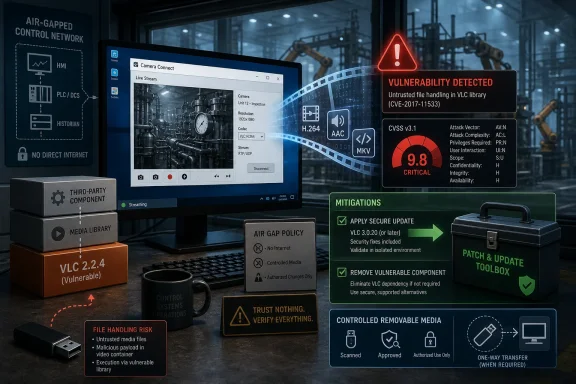 A Camera Tool Becomes a Supply-Chain Story
This advisory is not about a newly discovered flaw in ABB’s camera logic, authentication model, or industrial protocol stack. It is about VLC media player 2.2.4, an old version of a widely used open-source application that was delivered with ABB Ability Camera Connect. That distinction matters, because it turns a familiar industrial-control advisory into a software supply-chain case study.VLC is not exotic. It is the kind of tool administrators, engineers, and vendors reach for because it plays almost anything and because it is useful when dealing with camera streams, RTSP feeds, and awkward codecs. In consumer contexts, that flexibility is a feature. In industrial environments, it can become a long-lived attack surface hiding inside an installer.
ABB’s advisory says the vulnerable component was included with Camera Connect version 1.5.0.14 and below, and the CISA republication also lists version 1.5.0.15 among affected versions. The vulnerability set carries a CVSS v3 score of 9.8, the kind of number that immediately gets dashboards glowing red. But the operational reality is more complicated than the score suggests.
The exploitation path described by the advisory requires a specially crafted media file and a user or attacker action that causes VLC to open it on an affected system node. ABB says the product is deployed in air-gapped environments, which reduces exposure. CISA, meanwhile, repeats the standard industrial-control warning: minimize network exposure, isolate control systems, and treat remote access as a risk-management problem rather than a convenience feature.
That combination — critical score, local-ish exploitation path, air-gapped assumptions, and third-party component drift — is exactly where industrial cybersecurity becomes difficult. The risk is neither imaginary nor automatically catastrophic. It is the kind of risk that accumulates quietly until a maintenance workstation, portable drive, misconfigured firewall, or contractor laptop connects the supposedly isolated world to the very threats it was designed to avoid.
The CVSS Score Is Loud, but the Attack Path Is Specific
A 9.8 CVSS score is built to command attention, and in many IT settings it means “patch now, ask questions later.” In operational technology, the first half of that sentence is still right, but the second half can be dangerous. Patching an industrial node without understanding operational impact can create downtime, break validation assumptions, or disrupt a safety-adjacent workflow.The vulnerability classes listed in the advisory are serious: heap-based buffer overflow, integer underflow, out-of-bounds write, uncontrolled search path element, integer overflow, off-by-one error, out-of-bounds read, double free, improper restriction of operations within memory bounds, and use after free. That is a greatest-hits album of memory corruption. In practical terms, successful exploitation could crash the affected component, make the node unavailable, or potentially allow arbitrary code execution.
But this is not described as a clean unauthenticated network exploit against Camera Connect itself. ABB’s FAQ frames exploitation as requiring a specially crafted file that is copied to affected system nodes and manually opened through VLC media player. It also says the attacker would need access to the system network, direct access through a poorly configured or compromised firewall, malicious software already present on a node, or some other way of infecting the environment.
That is a narrower path than “internet wormable,” but it is not a harmless one. Industrial systems often rely on exactly the workflows attackers love: file transfer, vendor support, engineering laptops, removable media, and maintenance windows where people are under pressure to restore visibility or diagnose field equipment. A malicious video file is not science fiction when the application in question exists to help people interact with camera data.
The advisory also says ABB had not received reports of exploitation at the time it was originally issued. That is useful, but it should not be overread. Absence of reported exploitation is not proof of absence, especially in industrial networks where forensic visibility may be limited and where incidents are often handled quietly.
“Air-Gapped” Is a Control, Not a Spell
ABB’s mitigation language leans on an important fact: Camera Connect is deployed in environments described as air-gapped, with no internet connectivity or external network access. That does reduce risk. It may reduce it dramatically in a well-run plant where removable media is controlled, remote support is tightly governed, and engineering workstations are treated as crown-jewel assets.But air-gapped has always been more of an operational discipline than a physical law. Many industrial networks are air-gapped until a vendor needs to troubleshoot something, a laptop moves between environments, a USB stick carries logs or updates, or a temporary connection becomes a permanent exception. The mythology of isolation often survives long after the architecture has changed.
That is why CISA’s defensive recommendations are familiar but still relevant. Minimize exposure for control-system devices. Keep them off the public internet. Place control networks and remote devices behind firewalls. Separate them from business networks. Use VPNs when remote access is necessary, but do not pretend a VPN is magic; it is only as secure as the devices and credentials attached to it.
For Windows administrators, the uncomfortable part is that this looks like a workstation hygiene problem as much as an OT vulnerability. The affected component is a media player. The trigger is file handling. The likely operational context is a Windows system used by engineers, integrators, or operators. If that machine can open untrusted media and also reach sensitive control assets, the boundary between desktop security and industrial security has already dissolved.
That boundary has been dissolving for years. Windows machines remain central to engineering, monitoring, configuration, and vendor tooling in industrial environments. They may not be PLCs, but they often sit close enough to the process to matter. When they carry outdated libraries, bundled runtimes, browser engines, database engines, or media players, they become part of the control-system attack surface.
The Real Bug Is Dependency Drift
The most revealing phrase in the advisory is not “heap-based buffer overflow.” It is “3rd party component.” Modern software is assembled as much as it is written, and industrial software is no exception. Vendors package components, codecs, drivers, frameworks, runtimes, and helper tools into installers that may then remain in production for years.That model is unavoidable. Nobody wants every industrial vendor to write its own media decoder, database engine, or cryptographic stack. Reusing mature components is usually safer than reinventing them. The problem comes when reuse becomes abandonment — when a dependency is bundled, shipped, forgotten, and left to age inside environments where change is expensive.
VLC 2.2.4 belongs to an older generation of the media player. It dates back years, and the VLC 3.x line has long since superseded it. The precise vulnerability mix here matters less than the pattern: a general-purpose media parser with years of accumulated security fixes sits inside a specialized industrial tool, and users of that tool may not even think of themselves as running VLC.
That invisibility is the heart of the risk. An administrator can inventory “ABB Ability Camera Connect” and still miss “VLC 2.2.4.” A vulnerability scanner may catch the component if it looks in the right place, recognizes the bundled files, and has permission to inspect the machine. But many industrial environments still depend on manually maintained asset lists, vendor documentation, and cautious change control.
Software bills of materials were supposed to help with this. In practice, they help only if they are complete, current, machine-readable, and integrated into procurement and vulnerability management. A PDF advisory after the fact is better than silence, but it is not the same as a living inventory that tells an operator which plant machines contain which third-party components.
The Camera Connect advisory is therefore not just a patch notice. It is a reminder that dependency management has moved from the developer’s desk to the plant floor. If a product ships a media player, that media player needs a lifecycle. If a vendor packages a database engine, that database engine needs a patch story. If a control-system workstation carries general-purpose parsers, those parsers need to be treated as security-relevant software, not incidental utilities.
CISA’s Republication Turns Vendor Disclosure Into Operational Pressure
CISA’s role here is also worth reading carefully. The agency says the advisory is a republication of ABB PSIRT material converted from the vendor’s Common Security Advisory Framework advisory. It also says the material is provided as-is for visibility and that CISA is not responsible for the editorial or technical accuracy of the republished advisory.That caveat may sound bureaucratic, but it is important. CISA is amplifying vendor information rather than independently rewriting the technical record. For defenders, that means the advisory should be treated as authoritative enough to act on, but not as a substitute for reading ABB’s own documentation, testing the update, and confirming asset exposure.
The timing is notable. ABB’s initial advisory dates to November 27, 2025, with a correction on November 28, 2025. CISA’s republication arrived on May 26, 2026. That gap is not necessarily scandalous; the industrial advisory ecosystem often involves vendor portals, national CERTs, sector-specific feeds, and delayed republication. But it does expose a familiar lag between vendor disclosure and broad public operational awareness.
For organizations that already follow ABB PSIRT advisories closely, this should not be new. For smaller operators, integrators, municipal utilities, or mixed IT/OT teams that rely heavily on CISA’s ICS feed, the republication may be the first time the issue lands in their workflow. That is a distribution problem as much as a security problem.
It also shows why “initial release date” and “CISA publication date” should not be conflated. The vulnerability story did not begin on May 26, 2026. That is when CISA’s page made it more visible to a broader audience. Mature vulnerability management programs need to track both vendor advisories and government advisories, then reconcile duplicates, corrections, and republished notices without creating confusion or double-counting risk.
The Windows Angle Is the Engineering Workstation
For WindowsForum readers, the most relevant machine in this story is probably not a controller. It is the Windows workstation that runs vendor software, opens camera streams, imports files, and bridges human operators to industrial assets. That is where an old media player dependency becomes more than a line item in a vulnerability database.Engineering workstations occupy an awkward security category. They are often too operationally important to patch casually, too customized to rebuild easily, and too exposed to vendor workflows to isolate perfectly. They may run old drivers, hardware dongle utilities, proprietary configuration packages, and local administrator sessions that would make a corporate endpoint team wince.
That does not mean they are neglected by lazy administrators. It means they sit at the intersection of uptime, vendor support, and change control. The security model that works for a fleet of office laptops — rapid patch rings, automatic reboot windows, aggressive endpoint hardening — may not map cleanly to a plant-floor workstation that supports production.
Still, the basics matter. If ABB’s fix removes or updates the vulnerable VLC component, that update should be evaluated and deployed according to the organization’s OT change process. If older Camera Connect installers remain in software shares, golden images, backup media, or vendor laptops, they should be replaced or quarantined. If affected systems can open arbitrary media files, that workflow should be narrowed.
The more subtle task is inventory. Teams should identify where Camera Connect is installed, which version is present, whether VLC 2.2.4 exists independently on the same machine, and whether the vulnerable files remain after an upgrade. They should also review whether the machines can receive files from business networks, removable media, email, shared drives, remote support sessions, or camera management workflows.
This is where Windows endpoint controls can help without pretending to solve everything. Application control, controlled folder access, removable-media restrictions, least privilege, logging, and endpoint detection can reduce the likelihood that a crafted file becomes code execution. But those controls must be tested against the realities of the vendor software. Breaking the operator’s ability to view or diagnose camera feeds is not a security win if it drives people toward shadow IT.
Critical Infrastructure Turns Small Utilities Into Big Dependencies
The affected sectors listed in the advisory span chemical, commercial facilities, communications, critical manufacturing, energy, and transportation systems. That breadth is not surprising. Camera systems are everywhere, and tools that connect to them tend to follow.Camera Connect is not the kind of product that usually dominates cyber headlines. It is connective tissue. It helps industrial users see, verify, monitor, or integrate visual information. That is precisely why its dependencies matter: small utilities can sit near important workflows without being treated as primary assets.
In critical infrastructure, visibility tools can become operationally important even when they are not safety systems in the formal sense. ABB’s FAQ says the vulnerabilities primarily affect confidentiality, integrity, and availability and do not directly affect functional safety in the traditional sense. But it also acknowledges that a compromised system or critical service crash could disrupt safety-related processes dependent on VLC, business operations, or compliance.
That is the right distinction. A vulnerability in a camera tool is not the same as a vulnerability in a safety instrumented system. But if operators rely on camera visibility during maintenance, inspection, loading, perimeter monitoring, or process verification, losing that visibility at the wrong moment can still matter. Security impact and safety impact are not identical, but they can touch.
This is why OT risk assessment cannot stop at CVSS. A high score tells you the technical severity under a model. It does not tell you whether a particular affected node is isolated, whether the workflow is used daily, whether compensating controls exist, whether the update has been validated, or whether the camera view is operationally critical during hazardous procedures.
The advisory’s sector list should therefore be read as a map of where to ask questions, not as a universal declaration of emergency. A lab system used for occasional configuration may carry a different risk than a production workstation used during live operations. The same vulnerable component can be a nuisance in one place and a serious operational risk in another.
“No Remote Exploit” Does Not Mean “No Remote Risk”
ABB’s FAQ says the vulnerability could not be exploited remotely in the described scenario and that an attacker would need physical access to an affected system node. That statement is reassuring in the narrow technical sense. It also deserves careful interpretation.Physical access in OT is not always as clean a boundary as outsiders imagine. A contractor with a laptop, a remote support session that transfers files, a USB device used to move diagnostics, or malware that has already reached an engineering workstation can all change the practical meaning of “local.” The attacker may not need to stand in the plant with a keyboard if the environment provides other ways to place and open the crafted file.
This is the same pattern seen across countless parser vulnerabilities. The vulnerable code may only run when a user opens a file, but attackers are good at shaping workflows so someone does exactly that. In office IT, the lure may be a document, archive, or image. In an industrial camera context, a malicious file could plausibly masquerade as diagnostic media, exported footage, configuration evidence, or a vendor-supplied test clip.
That does not make exploitation inevitable. It does mean defenders should resist the comforting binary of “remote” versus “local.” Many real intrusions are chains. An attacker compromises a business endpoint, steals credentials, reaches a shared drive, pivots into a remote access pathway, lands on an engineering host, and then uses a local parser bug to escalate or execute code in a more valuable context.
The advisory itself hints at this chain-based thinking when it mentions wrongly configured or penetrated firewalls and malicious software on a system node. The vulnerable VLC component may not be the front door. It may be a side door opened after the attacker is already close to the target.
For incident responders and system owners, the practical response is to reduce opportunities for that chain to form. Limit file movement. Scan imported data. Keep remote access narrow and monitored. Separate business and control networks. Review local administrative rights. Do not leave vulnerable installers lying around because “the system is air-gapped.”
The Update Is the Easy Part; Trusting the Install Base Is Hard
ABB says an update is available that resolves the outdated third-party component issue. In a perfect world, that would be the end of the article. Install the update, verify the version, document the change, move on.Industrial environments do not live in that perfect world. Updates may require planned downtime, validation against site-specific configurations, coordination with vendors, and rollback planning. Some machines may be difficult to access. Some may be managed by integrators. Some may be treated as appliances even though they are Windows systems under the hood.
That complexity is real, but it should not become an excuse for indefinite deferral. The strongest argument for timely action is not that this specific vulnerability is currently being exploited in the wild against Camera Connect. ABB says it had no such reports when the advisory was originally issued. The stronger argument is that an outdated media parser on an OT-adjacent Windows node is precisely the kind of avoidable weakness that ages badly.
There is also a cleanup problem. Updating the application may not remove every old component in every deployment scenario. Administrators should verify not only the Camera Connect version but also the presence of old VLC binaries, plugins, and installer artifacts. If VLC 2.2.4 was separately installed for troubleshooting or copied into tool folders by engineers, the ABB update may not touch those instances.
The same goes for backups and images. A vulnerable installer preserved in a software repository can reintroduce the problem months later during a rebuild. A golden image used for engineering workstations can quietly reset the clock. A contractor’s field kit can bring the old component back into an otherwise remediated environment.
Good remediation therefore has two phases. First, patch the known affected systems. Second, eliminate the conditions that let the vulnerable component return. That second phase is less glamorous, but it is where mature operations separate themselves from checkbox compliance.
ABB’s VLC Problem Is a Warning for Every Vendor Bundle
The industry should resist the temptation to treat this as an ABB-only story. The brand name is in the advisory, and ABB owns the responsibility for updating its package, but the pattern is much broader. Industrial vendors routinely bundle third-party components because customers need complete, working tools.That bundling creates a duty of care. If a vendor ships a component, it inherits the obligation to monitor vulnerabilities in that component, communicate risk, and provide a safe update path. The customer should not need to become an archaeologist to discover which media library, database engine, or runtime was tucked into an installer years earlier.
The advisory also shows why product security teams have become essential inside industrial companies. A PSIRT is not just a mailbox for CVEs. It is the organizational mechanism that connects upstream vulnerabilities, product packaging, customer communication, and remediation. When that mechanism works, a third-party issue becomes a vendor advisory before customers have to reverse-engineer the exposure themselves.
But customers still need leverage. Procurement language should require component transparency, vulnerability notification, supported update paths, and lifecycle commitments. Asset owners should ask vendors not only “is your product vulnerable?” but “which third-party components do you ship, how do you track them, and how quickly can you update them without breaking validated deployments?”
That conversation is uncomfortable because it moves beyond glossy product security claims. It asks how the sausage is made. In 2026, that is no longer optional. The security of a control-system workstation depends as much on the forgotten helper DLL as on the headline application.
The Patch Queue Needs an OT Translation Layer
For enterprise IT teams, a critical advisory usually enters a patch queue. For OT teams, it enters a risk process. The difference is not philosophical; it is operational.A Windows workstation in a plant may be subject to maintenance windows, production schedules, vendor validation, and regulatory documentation. Applying an update without coordination can cause outages. Failing to apply it can leave a known vulnerability in place. The job is to translate the advisory into site-specific action without losing urgency.
That translation starts with scope. Which sites use ABB Ability Camera Connect? Which versions are installed? Are affected versions present on production nodes, engineering stations, test benches, or archived virtual machines? Does version 1.5.0.15 appear because it was assumed to be safe after 1.5.0.14 and earlier were first discussed?
Next comes exposure. Can those machines receive files from outside the control environment? Are removable drives permitted? Are camera exports or media files moved between networks? Are contractors allowed to bring diagnostic content onto the node? Is VLC launched manually, automatically, or only through Camera Connect?
Then comes mitigation. If the update cannot be installed immediately, organizations should restrict file handling, tighten access to affected nodes, disable unnecessary VLC usage, review application allow-listing, and monitor for suspicious process behavior. Those are compensating controls, not permanent solutions. The endpoint still needs the vendor update.
Finally comes verification. Document the installed version, confirm the vulnerable component is gone or updated, preserve evidence for compliance, and update asset inventories. The process should close the loop, not merely record that someone “patched Camera Connect.”
The Concrete Lessons Hidden Inside the Advisory
The practical reading of this advisory is narrower than panic and broader than indifference. It is not a public report of active exploitation against ABB Camera Connect. It is also not a paper-only risk that can be ignored because the word “air-gapped” appears nearby. It is a critical third-party component issue in software used around industrial camera workflows, and it deserves the kind of disciplined response that does not break operations while trying to protect them.- Organizations running ABB Ability Camera Connect should identify installations of versions 1.5.0.14 and earlier, as well as version 1.5.0.15, and plan an update using ABB’s fixed package.
- Administrators should verify whether VLC 2.2.4 or its plugins remain on affected Windows systems after remediation, including in tool directories, old installers, images, and engineering shares.
- OT teams should treat the exploit path as file-handling risk, especially where removable media, remote support, shared folders, or contractor laptops can introduce untrusted content.
- Network isolation remains valuable, but it should be validated against real workflows rather than assumed from architecture diagrams.
- Asset owners should use this incident to ask vendors for clearer third-party component inventories, update commitments, and vulnerability notification practices.
- Temporary mitigations should reduce exposure and file movement, but they should not become a substitute for applying the vendor update.
References
- Primary source: CISA
Published: 2026-05-26T12:00:00+00:00

ABB Ability Camera Connect | CISA
www.cisa.gov
- Related coverage: support.ipconfigure.com
- Related coverage: cyber.gc.ca
[Control systems] ABB security advisory (AV26-286) - Canadian Centre for Cyber Security
[Control systems] ABB security advisory (AV26-286)www.cyber.gc.ca - Related coverage: supports.zositech.com
How to View IPC Camera Footage via RTSP – Zosi Help Center Support
This guide will help you easily view your IPC (Internet Protocol Camera) footage using VLC Media Player and the RTSP protocol. Please...supports.zositech.com - Related coverage: library.e.abb.com
