

ABB and CISA warned in June 2026 that CVE-2025-7064 affects ABB Freelance Security Lock across Freelance versions from 2013-era systems through Freelance 2024, allowing a local authenticated attacker to bypass operator restrictions and reach Windows functions under certain configurations. The vulnerability is not the kind of remote-code-execution fireworks that dominate patch headlines, but it cuts into something industrial sites often treat as more fundamental: the boundary between the operator console and the general-purpose operating system underneath it. In plain terms, a workstation meant to behave like a locked-down control interface may still carry enough Windows escape hatches to become a control-system management problem. That makes this advisory less about one ABB component than about the uneasy bargain industrial automation has made with Windows for decades.
The immediate facts are narrow. ABB Freelance Security Lock is an access-control component used with ABB’s Freelance distributed control system, and CVE-2025-7064 is rated CVSS 6.6, a medium-severity flaw with local attack requirements and low complexity. The affected range is broad: ABB lists systems up to Freelance 2013, Freelance 2013 SP1, Freelance 2016, Freelance 2016 SP1, Freelance 2019, Freelance 2019 SP1, Freelance 2019 SP1 FP1, and Freelance 2024 when installed with Security Lock.
The exploit condition is oddly mundane. An attacker first needs to bypass Freelance Operations, the operator-facing environment that is supposed to block access to the underlying Windows operating system. ABB’s description points to undocumented or special key combinations available on modern keyboards, which may expose Windows functions depending on system configuration and user permissions.
That is the sort of sentence that should make industrial defenders sit up. It does not describe a packet storm from the public internet or a novel exploit chain from a nation-state lab. It describes the kind of physical or local-console interaction that many risk models quietly downgrade because the machine is assumed to be inside the plant, inside the control room, and therefore inside the circle of trust.
But control rooms are not magic circles. They are places where contractors, integrators, night-shift operators, maintenance staff, vendor technicians, auditors, and emergency responders may all interact with machines that are both specialized and ordinary. A human-machine interface can look like an appliance, but underneath it may still be a Windows workstation with keyboard shortcuts, accessibility features, shell behaviors, cached credentials, and file-system permissions.
The cost of that convenience is that Windows remains a general-purpose operating system even when dressed as an appliance. Lockdown layers can hide the desktop, suppress menus, constrain user actions, and steer operators into a vendor application. They do not erase the underlying platform. If the lockout model depends on intercepting every meaningful escape path, then every new keyboard feature, OS behavior, accessibility shortcut, and peripheral quirk becomes part of the security surface.
That appears to be the uncomfortable territory around this ABB advisory. Security Lock is intended to mediate access control for configuration and operation. ABB says the weakness can allow attacks on Freelance user management after the operator environment is bypassed, and the company’s own advisory notes that manipulation of Security Lock data files could affect access control across the Freelance system.
This is why a “local” vulnerability can matter in operational technology. In normal enterprise IT, local access often means the attacker has already won enough to make the issue less urgent. In industrial environments, local access to an operator station may be exactly the plausible scenario: a shared console, a maintenance window, a plant-floor workstation, or a vendor session where the attacker’s goal is not data theft but influence over process visibility and control.
A system that stops responding is obvious. A system that leaks information is serious. But a system whose access-control data can be manipulated creates subtler failure modes: operators may lose access, unauthorized users may gain it, expected role boundaries may erode, or management functions may become exposed in ways the site did not intend.
ABB’s advisory language is careful, but its implications are direct. A successful attacker could cause the affected node to stop or become inaccessible, and could potentially take control of the system node. That does not mean every plant running Freelance is one keyboard shortcut away from catastrophe. It does mean Security Lock should not be treated as a hard wall if the surrounding Windows configuration and physical-access model are weak.
CISA also says it has no reports of known public exploitation specifically targeting the vulnerability and describes the issue as not remotely exploitable in its advisory text. ABB’s CSAF material, however, discusses the possibility of exploitation by an attacker with network access to an affected node. That apparent tension is a reminder that industrial advisories often compress different threat paths into different audiences’ language. The practical reading is that this is not an internet-reachable bug by itself, but remote access to a Windows node can collapse the distance between “remote” and “local” if interactive access is available.
That recommendation carries a quiet message. ABB is not merely telling customers to change a registry value or apply a small hotfix. It is steering supported customers toward a different access-management model, one that leans on Windows accounts rather than the vulnerable Security Lock mechanism. For administrators already managing identity through hardened Windows configurations, that may be a cleaner fit.
For older deployments, the picture is less comfortable. ABB says that for Freelance 2016 SP1 and older, no workaround is available. That is the moment where a medium-severity advisory becomes a lifecycle conversation. Industrial sites often keep control systems running for many years because downtime is expensive, validation is slow, and “if it works, don’t touch it” can be a rational operating principle. But unsupported or workaround-less systems accumulate architectural risk even when they are not facing a currently exploited bug.
This is one of the recurring asymmetries in operational technology security. Vendors can publish mitigations that assume a reasonably modern baseline, while asset owners may be running a plant reality shaped by capital cycles, spare-part availability, validation burdens, and scheduled outages. The gap between “use the newer management feature” and “we can safely migrate this production system” can be measured in quarters, not days.
This is not a new class of problem. Windows kiosk deployments, point-of-sale terminals, school testing systems, shared lab machines, and airport check-in screens have all wrestled with the same basic issue: hiding the desktop is not the same as hardening the session. A locked-down application must account for task switching, accessibility features, system dialogs, device insertion, browser invocation, shell escape, help links, print dialogs, crash handlers, and administrative tools.
Industrial systems add higher stakes and longer service lives. A workstation image hardened in 2016 may meet the assumptions of that period’s keyboards, operating-system policies, and site procedures. Ten years later, the same image may be attached to different peripherals, patched unevenly, managed by a different team, and connected through remote-support tooling that did not exist when the system was commissioned.
ABB’s mitigation advice reflects that reality. The company recommends disabling unnecessary accessibility features, using hardened OS configurations that suppress system-level shortcuts, and implementing BIOS or UEFI-level restrictions on keyboard input during runtime. None of those steps are glamorous. All of them recognize that the endpoint’s physical interface is not beneath the dignity of a serious security program.
A vulnerability like CVE-2025-7064 becomes far more dangerous when the affected node is reachable through weak remote access. If a remote-support tool, jump host, VPN, or domain credential gives an attacker interactive access to the operator station, the “local” nature of the bug stops being reassuring. The attack path becomes less about walking into a control room and more about reaching a Windows session that was never supposed to expose the OS beneath Freelance Operations.
That is why segmentation still matters even when a bug is not remotely exploitable in the classic sense. Network controls cannot fix a local authentication-bypass weakness in a console application. They can, however, decide who has a path to the machine, how interactive sessions are mediated, whether remote keyboard input is possible, and whether a compromised business account can become an OT incident.
The same is true of physical security. Plants often invest heavily in perimeter controls but treat consoles inside the facility as shared tools. If the control station is a shared endpoint, its lockout model has to survive shared-use reality. Badge access to a room is not the same as least privilege on a Windows node.
Configuration drift is the long tail of industrial cybersecurity. A system may have shipped with a recommended hardening profile, then gained exceptions over time for troubleshooting, vendor access, printer support, antivirus compatibility, domain migration, remote desktop convenience, or operator usability. Each exception may be justified in isolation. Together, they can reopen paths the original lockdown model assumed were closed.
The advisory’s file-permission angle is especially important. ABB’s FAQ-style material says the vulnerability is caused by non-admin users not being blocked from modifying Security Lock data files. That sounds like a permissions problem, but in a control-system context it is also a trust-boundary problem. If a low-privilege user can reach the OS and alter access-control data, then the system has confused application containment with operating-system authorization.
For Windows administrators, the lesson is familiar: access control belongs as low in the stack as possible. Application-level locks are useful, but file-system ACLs, group policy, endpoint hardening, credential hygiene, and privilege separation decide what happens when the application boundary fails. Industrial vendors can provide the architecture, but operators inherit the outcome.
Freelance 2016 SP1 and older customers have a harder conversation. With no workaround available, they are left with compensating controls: stricter physical access, more aggressive endpoint hardening, keyboard and peripheral restrictions, network isolation, remote-access review, monitoring, and procedural controls around operator stations. Those controls may be sufficient for some environments, but they do not remove the underlying flaw.
This is where industrial asset owners often face the uncomfortable arithmetic of deferred modernization. The system may be stable. Operators may know it well. Spare parts may be on the shelf. But when a vendor advisory says the only practical workaround exists in newer versions, the security debt becomes harder to ignore.
The right response is not panic replacement. Rushed industrial upgrades can create their own risks, especially where process uptime and safety dependencies are complex. The right response is to stop treating old control-system software as merely old software. It is infrastructure with known constraints, known exposure, and increasingly specific vendor caveats.
For IT teams supporting OT environments, the dividing line between “plant system” and “Windows endpoint” can be politically convenient but technically misleading. The operator station may be vendor-managed, but it still needs secure baseline configuration. It may be change-controlled by OT, but it still faces risks from local users, remote sessions, removable devices, and identity sprawl.
The best organizations bridge that gap deliberately. OT teams understand process impact, operational constraints, vendor support boundaries, and maintenance windows. IT teams understand Windows security baselines, account governance, endpoint detection, patch management, and remote access. CVE-2025-7064 sits precisely where those disciplines must meet.
There is also a cultural lesson here. A medium-severity local vulnerability may not trigger enterprise incident-response muscle memory. In OT, the relevant question is not simply whether the bug is remotely exploitable from the internet. It is whether the affected station is a trusted path into operations, whether shared users exist, whether a vendor tunnel can reach it, and whether the access-control model survives the first successful escape to Windows.
The second step is to validate the console boundary. If Freelance Operations is expected to prevent access to Windows, that assumption should be tested under controlled conditions with the exact keyboards, remote-access tools, Windows builds, policies, and user accounts used in production. A lab image is useful, but it is not the plant.
The third step is to examine permissions around Security Lock data files and related configuration paths. ABB’s description points to the risk of non-admin modification. Even if a full vendor fix is pending, administrators should understand whether local users have broader write access than intended and whether the current Windows configuration violates least-privilege assumptions.
The fourth step is to review remote access with brutal specificity. “VPN required” is not a security control by itself. The relevant questions are who can reach the node, whether sessions are interactive, whether MFA is enforced, whether vendor accounts are time-bound, whether jump hosts record sessions, and whether access can be disabled quickly during an incident.
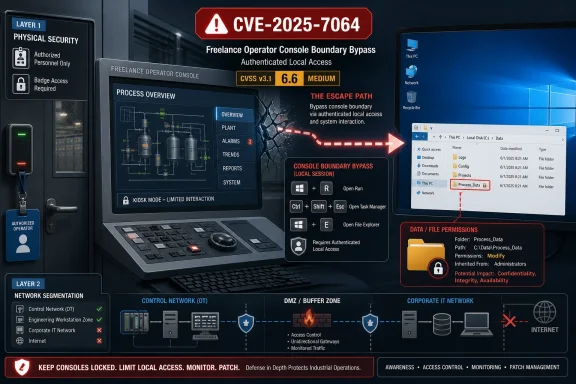 The Weak Point Is the Console, Not the Network Perimeter
The immediate facts are narrow. ABB Freelance Security Lock is an access-control component used with ABB’s Freelance distributed control system, and CVE-2025-7064 is rated CVSS 6.6, a medium-severity flaw with local attack requirements and low complexity. The affected range is broad: ABB lists systems up to Freelance 2013, Freelance 2013 SP1, Freelance 2016, Freelance 2016 SP1, Freelance 2019, Freelance 2019 SP1, Freelance 2019 SP1 FP1, and Freelance 2024 when installed with Security Lock.The exploit condition is oddly mundane. An attacker first needs to bypass Freelance Operations, the operator-facing environment that is supposed to block access to the underlying Windows operating system. ABB’s description points to undocumented or special key combinations available on modern keyboards, which may expose Windows functions depending on system configuration and user permissions.
That is the sort of sentence that should make industrial defenders sit up. It does not describe a packet storm from the public internet or a novel exploit chain from a nation-state lab. It describes the kind of physical or local-console interaction that many risk models quietly downgrade because the machine is assumed to be inside the plant, inside the control room, and therefore inside the circle of trust.
But control rooms are not magic circles. They are places where contractors, integrators, night-shift operators, maintenance staff, vendor technicians, auditors, and emergency responders may all interact with machines that are both specialized and ordinary. A human-machine interface can look like an appliance, but underneath it may still be a Windows workstation with keyboard shortcuts, accessibility features, shell behaviors, cached credentials, and file-system permissions.
Industrial Windows Has Always Been a Compromise
Windows won in industrial automation not because it was purpose-built for control rooms, but because it was familiar, supportable, and rich in application tooling. Engineering workstations, operator stations, historians, batch servers, and maintenance laptops all benefited from a common platform. Vendors could build complex graphical applications, reuse drivers and libraries, integrate with domain identity, and train staff without asking every plant to become a bespoke operating-system shop.The cost of that convenience is that Windows remains a general-purpose operating system even when dressed as an appliance. Lockdown layers can hide the desktop, suppress menus, constrain user actions, and steer operators into a vendor application. They do not erase the underlying platform. If the lockout model depends on intercepting every meaningful escape path, then every new keyboard feature, OS behavior, accessibility shortcut, and peripheral quirk becomes part of the security surface.
That appears to be the uncomfortable territory around this ABB advisory. Security Lock is intended to mediate access control for configuration and operation. ABB says the weakness can allow attacks on Freelance user management after the operator environment is bypassed, and the company’s own advisory notes that manipulation of Security Lock data files could affect access control across the Freelance system.
This is why a “local” vulnerability can matter in operational technology. In normal enterprise IT, local access often means the attacker has already won enough to make the issue less urgent. In industrial environments, local access to an operator station may be exactly the plausible scenario: a shared console, a maintenance window, a plant-floor workstation, or a vendor session where the attacker’s goal is not data theft but influence over process visibility and control.
Medium Severity Can Still Mean Operational Pain
The CVSS score lands at 6.6, which is easy to dismiss in a world trained to chase 9.8s and 10.0s. That would be a mistake. The vector says the vulnerability requires local access and low privileges, needs no user interaction, and can have high integrity impact with low confidentiality and availability impact. In the language of control systems, integrity is often the word that matters most.A system that stops responding is obvious. A system that leaks information is serious. But a system whose access-control data can be manipulated creates subtler failure modes: operators may lose access, unauthorized users may gain it, expected role boundaries may erode, or management functions may become exposed in ways the site did not intend.
ABB’s advisory language is careful, but its implications are direct. A successful attacker could cause the affected node to stop or become inaccessible, and could potentially take control of the system node. That does not mean every plant running Freelance is one keyboard shortcut away from catastrophe. It does mean Security Lock should not be treated as a hard wall if the surrounding Windows configuration and physical-access model are weak.
CISA also says it has no reports of known public exploitation specifically targeting the vulnerability and describes the issue as not remotely exploitable in its advisory text. ABB’s CSAF material, however, discusses the possibility of exploitation by an attacker with network access to an affected node. That apparent tension is a reminder that industrial advisories often compress different threat paths into different audiences’ language. The practical reading is that this is not an internet-reachable bug by itself, but remote access to a Windows node can collapse the distance between “remote” and “local” if interactive access is available.
ABB’s Fix Is Still Coming, So the Workaround Matters
The most important operational detail is that ABB says a fix for Freelance Security Lock is in preparation. Until that future update arrives, the recommended path for newer systems is to move away from Security Lock and use Freelance Extended User Management instead. ABB says Extended User Management is based on Windows user accounts and is available for Freelance 2019 or higher.That recommendation carries a quiet message. ABB is not merely telling customers to change a registry value or apply a small hotfix. It is steering supported customers toward a different access-management model, one that leans on Windows accounts rather than the vulnerable Security Lock mechanism. For administrators already managing identity through hardened Windows configurations, that may be a cleaner fit.
For older deployments, the picture is less comfortable. ABB says that for Freelance 2016 SP1 and older, no workaround is available. That is the moment where a medium-severity advisory becomes a lifecycle conversation. Industrial sites often keep control systems running for many years because downtime is expensive, validation is slow, and “if it works, don’t touch it” can be a rational operating principle. But unsupported or workaround-less systems accumulate architectural risk even when they are not facing a currently exploited bug.
This is one of the recurring asymmetries in operational technology security. Vendors can publish mitigations that assume a reasonably modern baseline, while asset owners may be running a plant reality shaped by capital cycles, spare-part availability, validation burdens, and scheduled outages. The gap between “use the newer management feature” and “we can safely migrate this production system” can be measured in quarters, not days.
The Keyboard Is Now Part of the Threat Model
The advisory’s most striking detail is the role of modern keyboard combinations. In consumer computing, shortcuts are convenience. In kiosk-style or operator-console environments, they are escape routes unless explicitly controlled. The more capable the endpoint, the more opportunities there are for the operating system to helpfully do something the control application never intended.This is not a new class of problem. Windows kiosk deployments, point-of-sale terminals, school testing systems, shared lab machines, and airport check-in screens have all wrestled with the same basic issue: hiding the desktop is not the same as hardening the session. A locked-down application must account for task switching, accessibility features, system dialogs, device insertion, browser invocation, shell escape, help links, print dialogs, crash handlers, and administrative tools.
Industrial systems add higher stakes and longer service lives. A workstation image hardened in 2016 may meet the assumptions of that period’s keyboards, operating-system policies, and site procedures. Ten years later, the same image may be attached to different peripherals, patched unevenly, managed by a different team, and connected through remote-support tooling that did not exist when the system was commissioned.
ABB’s mitigation advice reflects that reality. The company recommends disabling unnecessary accessibility features, using hardened OS configurations that suppress system-level shortcuts, and implementing BIOS or UEFI-level restrictions on keyboard input during runtime. None of those steps are glamorous. All of them recognize that the endpoint’s physical interface is not beneath the dignity of a serious security program.
CISA’s Boilerplate Is Boring Because It Is Right
CISA’s recommended practices for industrial control systems can sound repetitive: minimize network exposure, keep control systems off the internet, put them behind firewalls, isolate them from business networks, and use secure remote access methods when remote access is required. The temptation is to skim past that language as agency boilerplate. In this case, the boilerplate is exactly the point.A vulnerability like CVE-2025-7064 becomes far more dangerous when the affected node is reachable through weak remote access. If a remote-support tool, jump host, VPN, or domain credential gives an attacker interactive access to the operator station, the “local” nature of the bug stops being reassuring. The attack path becomes less about walking into a control room and more about reaching a Windows session that was never supposed to expose the OS beneath Freelance Operations.
That is why segmentation still matters even when a bug is not remotely exploitable in the classic sense. Network controls cannot fix a local authentication-bypass weakness in a console application. They can, however, decide who has a path to the machine, how interactive sessions are mediated, whether remote keyboard input is possible, and whether a compromised business account can become an OT incident.
The same is true of physical security. Plants often invest heavily in perimeter controls but treat consoles inside the facility as shared tools. If the control station is a shared endpoint, its lockout model has to survive shared-use reality. Badge access to a room is not the same as least privilege on a Windows node.
The Real Risk Is Configuration Drift
ABB’s wording repeatedly qualifies the impact with “depending on system configuration and user permissions.” That phrase is doing a lot of work. It means not every deployment is equally exposed, and it also means ABB cannot fully describe the risk without knowing how each customer has built, hardened, joined, patched, and operated the Windows environment.Configuration drift is the long tail of industrial cybersecurity. A system may have shipped with a recommended hardening profile, then gained exceptions over time for troubleshooting, vendor access, printer support, antivirus compatibility, domain migration, remote desktop convenience, or operator usability. Each exception may be justified in isolation. Together, they can reopen paths the original lockdown model assumed were closed.
The advisory’s file-permission angle is especially important. ABB’s FAQ-style material says the vulnerability is caused by non-admin users not being blocked from modifying Security Lock data files. That sounds like a permissions problem, but in a control-system context it is also a trust-boundary problem. If a low-privilege user can reach the OS and alter access-control data, then the system has confused application containment with operating-system authorization.
For Windows administrators, the lesson is familiar: access control belongs as low in the stack as possible. Application-level locks are useful, but file-system ACLs, group policy, endpoint hardening, credential hygiene, and privilege separation decide what happens when the application boundary fails. Industrial vendors can provide the architecture, but operators inherit the outcome.
Legacy Plants Will Feel This More Than New Installations
Freelance 2019 and higher customers at least have a vendor-recommended workaround path through Extended User Management. That does not make migration trivial, but it gives administrators a direction that aligns with modern identity practices. It also gives security teams a concrete project: inventory Security Lock use, map user roles, validate Windows account policies, test Extended User Management, and cut over during an approved maintenance window.Freelance 2016 SP1 and older customers have a harder conversation. With no workaround available, they are left with compensating controls: stricter physical access, more aggressive endpoint hardening, keyboard and peripheral restrictions, network isolation, remote-access review, monitoring, and procedural controls around operator stations. Those controls may be sufficient for some environments, but they do not remove the underlying flaw.
This is where industrial asset owners often face the uncomfortable arithmetic of deferred modernization. The system may be stable. Operators may know it well. Spare parts may be on the shelf. But when a vendor advisory says the only practical workaround exists in newer versions, the security debt becomes harder to ignore.
The right response is not panic replacement. Rushed industrial upgrades can create their own risks, especially where process uptime and safety dependencies are complex. The right response is to stop treating old control-system software as merely old software. It is infrastructure with known constraints, known exposure, and increasingly specific vendor caveats.
Windows Admins Have a Role in an OT Advisory
This advisory belongs on WindowsForum.com because it is not only an ABB story. It is a Windows administration story inside an industrial shell. The vulnerability depends on access to underlying OS functions, local permissions, user-management files, and endpoint hardening. Those are Windows problems as much as control-system problems.For IT teams supporting OT environments, the dividing line between “plant system” and “Windows endpoint” can be politically convenient but technically misleading. The operator station may be vendor-managed, but it still needs secure baseline configuration. It may be change-controlled by OT, but it still faces risks from local users, remote sessions, removable devices, and identity sprawl.
The best organizations bridge that gap deliberately. OT teams understand process impact, operational constraints, vendor support boundaries, and maintenance windows. IT teams understand Windows security baselines, account governance, endpoint detection, patch management, and remote access. CVE-2025-7064 sits precisely where those disciplines must meet.
There is also a cultural lesson here. A medium-severity local vulnerability may not trigger enterprise incident-response muscle memory. In OT, the relevant question is not simply whether the bug is remotely exploitable from the internet. It is whether the affected station is a trusted path into operations, whether shared users exist, whether a vendor tunnel can reach it, and whether the access-control model survives the first successful escape to Windows.
ABB’s Advisory Is a Reminder to Audit the Assumptions
The first operational step is inventory. Administrators need to know which Freelance versions are deployed, whether Freelance Security Lock is installed, and whether any systems are eligible for Extended User Management. This sounds basic, but many industrial sites still struggle with authoritative OT asset data, especially where systems have been upgraded piecemeal over many years.The second step is to validate the console boundary. If Freelance Operations is expected to prevent access to Windows, that assumption should be tested under controlled conditions with the exact keyboards, remote-access tools, Windows builds, policies, and user accounts used in production. A lab image is useful, but it is not the plant.
The third step is to examine permissions around Security Lock data files and related configuration paths. ABB’s description points to the risk of non-admin modification. Even if a full vendor fix is pending, administrators should understand whether local users have broader write access than intended and whether the current Windows configuration violates least-privilege assumptions.
The fourth step is to review remote access with brutal specificity. “VPN required” is not a security control by itself. The relevant questions are who can reach the node, whether sessions are interactive, whether MFA is enforced, whether vendor accounts are time-bound, whether jump hosts record sessions, and whether access can be disabled quickly during an incident.
The Practical Meaning of a Medium ABB Bug
CVE-2025-7064 is not a sky-is-falling advisory, but it is concrete enough to justify action. The strongest response is not to overstate it as a remote plant takeover bug or understate it as a harmless local quirk. It is to place it in the operational middle, where many real incidents begin: a trusted workstation, a weak boundary, an overprivileged user, and a configuration that aged out of its original assumptions.- Organizations running ABB Freelance with Security Lock should confirm whether their deployed versions fall into the affected range, including Freelance 2024 and older supported or legacy releases.
- Sites on Freelance 2019 or newer should evaluate ABB’s recommendation to use Freelance Extended User Management instead of Security Lock while awaiting a future fix.
- Sites on Freelance 2016 SP1 or older should treat the lack of a workaround as a reason to strengthen compensating controls and revisit upgrade planning.
- Administrators should test whether keyboard shortcuts, accessibility features, or remote interactive sessions can expose Windows functions from the operator environment.
- Security teams should review file permissions, local user privileges, remote-access paths, and physical access procedures for affected operator and engineering nodes.
- Risk owners should not rely on the CVSS “medium” label alone, because integrity impact on a control-system access model can have operational consequences beyond the score.
References
- Primary source: CISA
Published: 2026-06-23T12:00:00+00:00

ABB Freelance Security Lock | CISA
www.cisa.gov
