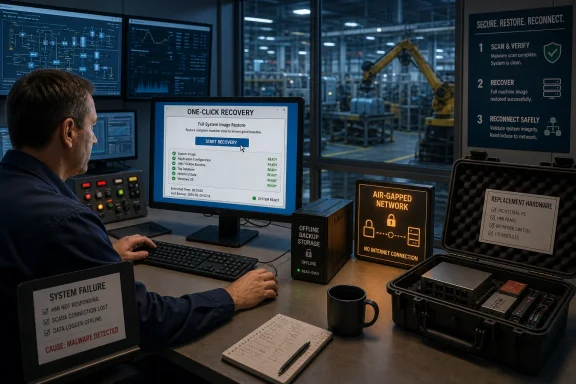
Acronis has published a 2026 buyer’s guide for operational-technology backup and recovery, placing its own Cyber Protect for OT platform ahead of Veeam, Rubrik and Commvault for industrial sites with legacy Windows systems, isolated networks and limited on-site IT support.
The guide is vendor-authored rather than an independent lab comparison, so its rankings should be read accordingly. Still, it usefully separates plant-floor recovery from mainstream enterprise backup: an HMI, SCADA server or engineering workstation may run Windows XP, Windows 7 or Server 2003 because its automation software remains tied to that build and cannot simply be upgraded.
According to Acronis, Cyber Protect for OT supports Windows XP SP1 and later Windows client and server versions, plus older Linux kernels, and can be deployed in air-gapped environments. It also highlights image-based bare-metal recovery, restore-to-dissimilar-hardware support, and a One-Click Recovery workflow intended for trained plant personnel rather than backup administrators.
Acronis positions Veeam Backup & Replication, Rubrik Security Cloud and Commvault Cloud as credible choices for IT-adjacent operational systems—such as modern historians, MES deployments and virtualized workloads—particularly when a corporate IT organization already operates one of those platforms.
Its central criticism is that those products are optimized for current operating systems, centralized administration and hybrid-cloud operations. That can create gaps in brownfield facilities with unsupported Windows versions, strictly segmented networks, obsolete workstation hardware and a need to restore systems locally without waiting for IT.
Those limitations will vary by deployment. Veeam, Rubrik and Commvault can be part of an OT resilience plan, but administrators should validate agent support, offline licensing, boot media, hardware-driver handling and restore permissions against the actual plant inventory rather than relying on general product compatibility lists.
Barracuda is similarly included as a corporate-side security and general backup reference point, not as a plant-floor OT recovery platform.
That distinction matters because industrial ransomware often causes disruption without directly manipulating PLC logic. Dragos reported in February that it tracked 119 ransomware groups affecting 3,300 industrial organizations in 2025, a 49% increase from the prior year. Recovering Windows-based operational systems quickly can therefore be as important as detecting suspicious traffic.
The guide is vendor-authored rather than an independent lab comparison, so its rankings should be read accordingly. Still, it usefully separates plant-floor recovery from mainstream enterprise backup: an HMI, SCADA server or engineering workstation may run Windows XP, Windows 7 or Server 2003 because its automation software remains tied to that build and cannot simply be upgraded.
According to Acronis, Cyber Protect for OT supports Windows XP SP1 and later Windows client and server versions, plus older Linux kernels, and can be deployed in air-gapped environments. It also highlights image-based bare-metal recovery, restore-to-dissimilar-hardware support, and a One-Click Recovery workflow intended for trained plant personnel rather than backup administrators.
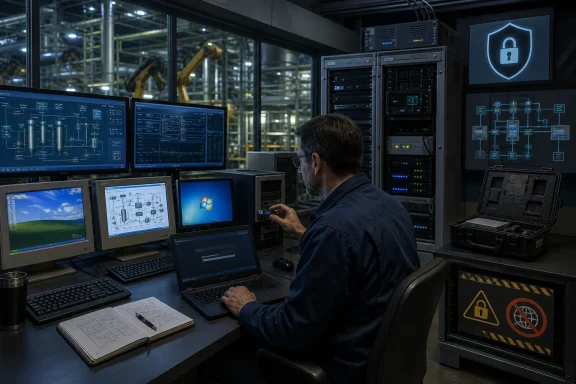 Enterprise backup is not automatically OT backup
Acronis positions Veeam Backup & Replication, Rubrik Security Cloud and Commvault Cloud as credible choices for IT-adjacent operational systems—such as modern historians, MES deployments and virtualized workloads—particularly when a corporate IT organization already operates one of those platforms.Its central criticism is that those products are optimized for current operating systems, centralized administration and hybrid-cloud operations. That can create gaps in brownfield facilities with unsupported Windows versions, strictly segmented networks, obsolete workstation hardware and a need to restore systems locally without waiting for IT.
Those limitations will vary by deployment. Veeam, Rubrik and Commvault can be part of an OT resilience plan, but administrators should validate agent support, offline licensing, boot media, hardware-driver handling and restore permissions against the actual plant inventory rather than relying on general product compatibility lists.
Security monitoring remains a separate layer
The guide also lists Claroty, Nozomi Networks and Armis, but correctly notes that they are not backup products. Those platforms focus on asset discovery, industrial network monitoring, vulnerability assessment and threat detection; they do not create or restore system images for Windows HMIs or SCADA servers.Barracuda is similarly included as a corporate-side security and general backup reference point, not as a plant-floor OT recovery platform.
That distinction matters because industrial ransomware often causes disruption without directly manipulating PLC logic. Dragos reported in February that it tracked 119 ransomware groups affecting 3,300 industrial organizations in 2025, a 49% increase from the prior year. Recovering Windows-based operational systems quickly can therefore be as important as detecting suspicious traffic.
What Windows admins should check
For organizations supporting Windows-based OT, the practical evaluation list is short:- Confirm whether every HMI, historian, engineering workstation and server is covered, including Windows XP and Windows 7 systems.
- Test a full bare-metal restore to replacement hardware, not merely file-level recovery.
- Verify that backup, management and recovery work with no internet connection.
- Define who can initiate recovery during an overnight outage and rehearse that process.
- Keep OEM configuration backups and change-control tools alongside system-image backups; they solve different problems.
References
- Primary source: Acronis
Published: 2026-07-13T15:03:42+00:00
Best OT Backup and Recovery Solutions (2026)
See how Acronis, Veeam, Rubrik and Commvault compare on legacy OS support, air-gap deployment and operator-led recovery for OT environments. www.acronis.com