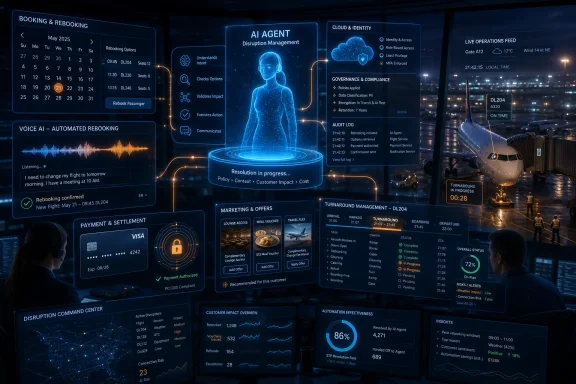
Amadeus and Microsoft released a new airline-focused agentic AI whitepaper on June 4, 2026, arguing that airlines can now deploy AI agents across rebooking, commerce, marketing, turnaround management, and customer experience rather than merely experiment with them. The claim is not that aviation has suddenly become easy to automate. It is that the industry’s most stubborn software problem—coordinating brittle systems, scarce capacity, messy data, and frustrated passengers in real time—is finally being reframed as an orchestration problem. For Microsoft, that makes aviation a showcase for Azure, Copilot, and governed enterprise agents; for airlines, it is a warning that the next competitive gap may open inside workflows passengers never see.
The travel industry has never lacked automation. Airlines have spent decades using optimization engines, fare rules, revenue management systems, global distribution systems, airport resource planning, and customer service scripts to keep an inherently chaotic business moving. What is new in the Amadeus-Microsoft argument is the proposition that AI agents can sit across those systems, interpret intent, make recommendations, and take limited action without forcing every process through a human queue.
That matters because airlines are unusually good at exposing the limits of software hype. A chatbot that writes a polite answer is one thing; a system that understands a fare differential, checks inventory, handles payment, respects airline policy, and updates a passenger itinerary during an operational disruption is another. In aviation, the cost of a hallucination is not just embarrassment. It can be a missed connection, a regulatory complaint, an angry loyalty customer, or a cascade of crew and aircraft problems.
The whitepaper therefore lands at an interesting moment for Microsoft’s broader AI push. The company has spent the past two years trying to move Copilot and Azure OpenAI from productivity demos into measurable business process automation. Aviation gives Microsoft a demanding test case: an industry with enormous data, high transaction volume, legacy systems, safety culture, tight margins, and customers who judge technology only by whether it gets them where they are going.
Amadeus, meanwhile, has a different incentive. It is not merely pitching an AI wrapper. It is presenting itself as a system-of-record and orchestration layer for travel, a position that becomes more valuable if airlines decide that agentic AI needs trusted plumbing more than dazzling user interfaces.
This is also where agentic AI becomes easier to understand. The agent is not being asked to “be intelligent” in the abstract. It is being asked to perform a bounded workflow: authenticate the traveler, interpret intent, search allowable options, explain consequences, and execute a transaction. That is exactly the type of repeatable, high-volume, rules-heavy process where enterprise AI has a better chance of moving from pilot to production.
The customer experience upside is obvious. A multilingual AI agent that can handle many calls at once would reduce wait times, especially during disruption spikes when human staffing cannot scale fast enough. It could also standardize explanations around fare differences, policy limits, and rebooking options, reducing the unevenness that travelers often experience across web, app, airport desk, and phone support.
But the operational question is not whether a demo can work. It is whether the system can survive the ugly edge cases: split PNRs, partially flown itineraries, interline bookings, loyalty upgrades, voucher payments, schedule changes, accessibility requirements, name mismatches, expired fare quotes, and passengers who are angry enough to interrupt every sentence. Airlines do not need an agent that succeeds in the median case. They need one that fails safely in the weird ones.
That is not just a user-interface shift. It is a commercial power shift. Airlines have spent years trying to move customers into direct channels, personalize offers, sell ancillaries, and reduce dependence on intermediaries. Agentic commerce could either strengthen that strategy, by letting airlines expose richer services through trusted agents, or weaken it, by making third-party assistants the primary layer of discovery and comparison.
Amadeus and Microsoft naturally frame this as an opportunity. Airlines can engage with AI assistants across websites, mobile apps, call centers, and external platforms. They can package offers dynamically and service the trip throughout its lifecycle. They can meet the traveler wherever the traveler chooses to ask.
The less comfortable interpretation is that airline retailing is about to become more machine-readable and less brand-controlled. If a traveler asks an assistant for the “best” itinerary, the assistant’s ranking logic becomes commercially important. Price, schedule, loyalty, baggage, seat selection, disruption history, refundability, and carbon claims may all become part of a negotiation between agents and airline systems. The airline that cannot expose clean, governed, real-time data may find itself invisible or poorly represented in the next discovery layer.
This is why the Microsoft angle matters for WindowsForum readers. Copilot is not simply a productivity sidebar in this scenario. It is one possible interface for commercial intent. If Microsoft can persuade industries like aviation to make their systems legible and executable through AI agents, Windows, Microsoft 365, Azure, Dynamics, and Copilot become parts of a broader transaction fabric rather than separate software products.
The difference is the stitching. Airlines do not market abstract products. They market perishable inventory tied to routes, seasons, aircraft utilization, fare classes, competitive pricing, loyalty segments, and operational constraints. A weak route is not merely a sales problem; it may reflect schedule timing, local demand, network connectivity, corporate travel patterns, or competitor capacity. An agent that can move from detection to recommendation to execution is valuable only if it understands those dependencies.
This is also where governance becomes more than a corporate checkbox. An AI-generated campaign can waste money, misprice demand, overpromise availability, or create brand problems in multiple languages at speed. The more autonomous the marketing workflow becomes, the more airlines need approval gates, policy constraints, audit trails, and clear accountability for what the agent did and why.
Microsoft’s enterprise AI messaging has increasingly centered on that exact theme: agents are useful only when wrapped in identity, permissions, monitoring, lifecycle management, and governance. Aviation is a useful proof point because it exposes the weakness of “just connect an LLM” thinking. A marketing agent that cannot distinguish between a revenue opportunity and an operational constraint is not an agent. It is a liability with a media budget.
The smarter airlines will probably start with narrow campaigns, constrained spend, and human approval before allowing more autonomy. That may sound less exciting than the “AI runs marketing” pitch, but it is how enterprise systems become real. The first win is not replacing a department. It is shortening the loop between signal, decision, action, and measurement.
The report says teams of AI agents could monitor those processes and recommend an integrated plan. Icelandair and Southwest Airlines are exploring AI-enabled decision support to improve operational planning. That phrase, “decision support,” is doing important work. Nobody sensible is proposing that an LLM should casually command airport operations. The plausible near-term role is a system that detects conflicts earlier, surfaces trade-offs, and helps human coordinators choose the least bad option.
This is a classic airline problem because the right answer changes by the minute. Holding a flight may protect connecting passengers but delay the aircraft’s next sector. Speeding boarding may be pointless if fueling is late. Swapping gates may solve one flight and strand another. Airline operations centers already use specialized systems, but agentic AI promises a more conversational and cross-functional layer over the mess.
The danger is that the word agent can obscure the difference between recommendation and control. A useful turnaround agent might say, “If fueling completes within eight minutes, boarding can finish at 14:32, preserving the slot; otherwise, gate reassignment reduces downstream delay by 11 minutes.” That is materially different from a black-box system making operational calls without human understanding.
For IT pros, this is where architecture becomes destiny. Turnaround AI needs reliable event streams, integration with airport and airline systems, role-based access, robust logging, and low-latency interfaces. It also needs a culture that treats AI as an operational instrument, not a novelty. The ramp is not a demo stage.
AI agents could improve that by replacing static rules with more adaptive decisioning. Instead of pushing the same ancillary bundle to a broad segment, an airline could tailor offers based on trip purpose, loyalty status, disruption risk, seat preferences, destination, previous behavior, and real-time context. The report frames this as journey orchestration: aligning individual needs with the airline’s strategic priorities.
That last phrase is where the tension lives. Personalization can mean helping a traveler get the right product at the right time. It can also mean extracting more revenue by exploiting asymmetries of information, patience, or urgency. An agent that “understands” a traveler stranded during a cancellation has enormous power to help. It also has enormous power to upsell.
Airlines will need to be careful, because travelers already suspect that pricing and offers are opaque. AI-powered personalization could make that suspicion worse if it feels arbitrary, manipulative, or impossible to challenge. The airlines that win trust will be those that use AI to simplify choices, explain trade-offs, preserve entitlements, and make service recovery faster—not merely those that produce the most finely segmented offer.
Microsoft and Amadeus both emphasize governance, and in this area governance must include customer-facing fairness. It is not enough for an airline to know internally why an offer was presented. The experience must feel coherent to the passenger. In travel, personalization that cannot be explained quickly becomes suspicion.
Airline data is fragmented by history. Reservation systems, departure control, loyalty databases, customer relationship management, revenue management, crew systems, maintenance platforms, airport systems, and third-party distribution channels were not designed as one elegant data estate. They were layered over decades of mergers, outsourcing, standards changes, and survival-driven modernization.
Agentic AI raises the cost of that fragmentation. A human employee can sometimes compensate for bad interfaces by checking three systems, calling a colleague, or using institutional memory. An AI agent needs structured access, consistent semantics, permission boundaries, and confidence signals. If the data is wrong, stale, or contradictory, the agent may act with impressive speed in the wrong direction.
This is the part of the AI story that vendors often underplay because it sounds like plumbing. Yet the winners in airline AI may be determined less by model selection than by data readiness. The airline with cleaner operational data, clearer policies, and better integration may extract more value from a modest model than a rival gets from the flashiest frontier system.
For sysadmins and enterprise architects, the lesson is familiar. The AI project is also an identity project, an API project, a data governance project, a logging project, and a change-management project. If those foundations are weak, the agent becomes another brittle integration with better marketing.
The obstacle is that agentic AI increases both capability and exposure. A conventional analytics dashboard can be wrong and still leave the decision to a human. An agent that recommends, initiates, or executes actions has a different risk profile. It touches money, customer records, operational decisions, and brand voice.
This is why Microsoft’s enterprise stack is central to the pitch. Azure identity, security, data services, monitoring, and Copilot extensibility are not side dishes; they are the mechanism by which Microsoft argues agents can be deployed responsibly. The more serious the workflow, the more the buyer cares about permissions, auditability, compliance, and rollback.
Airlines will need governance that is specific rather than ceremonial. Which actions can an agent take without approval? Which require a human? What confidence thresholds trigger escalation? How are errors detected? How are passenger complaints traced back to agent behavior? How are fare rules, policies, and regulatory constraints updated? Who owns the outcome when the agent follows a policy that was poorly written?
The answer cannot be “the AI did it.” In regulated, operationally sensitive industries, accountability remains human even when execution is automated. Agentic AI does not remove responsibility. It redistributes the places where responsibility must be designed into software.
That does not make Windows irrelevant. Quite the opposite: Windows endpoints, Microsoft 365 identities, Teams conversations, Power Platform workflows, Dynamics records, Azure data stores, and Copilot interfaces all become surfaces in a larger enterprise fabric. The user may experience that fabric as a chat, a voice call, a dashboard, or an automated workflow, but Microsoft’s goal is to keep the identity, governance, and execution plane inside its ecosystem.
Amadeus brings the aviation-specific depth Microsoft cannot manufacture on its own. Airline workflows are full of industry standards, fare logic, inventory constraints, distribution channels, and operational dependencies that general-purpose AI does not inherently understand. The partnership is therefore a marriage of cloud platform ambition and domain-system gravity.
There is also a defensive element. If airlines are going to expose their products and operations to AI assistants, Microsoft wants Copilot and Azure to be among the trusted rails. If airline employees are going to build and supervise agents, Microsoft wants those agents governed through its enterprise stack. If travelers begin asking assistants to plan and service trips, Microsoft wants a role in that transaction path.
The risk for Microsoft is overpromising the readiness of the agentic layer. Enterprises have heard many versions of “the next interface” before. The risk for airlines is moving too slowly and discovering that the customer relationship has shifted to platforms that are better at interpreting traveler intent.
The first question is where to start. Rebooking and customer service may offer visible wins because pain is obvious and volume is high. Marketing may offer faster experimentation because the operational safety risk is lower. Turnaround management may deliver enormous value but requires deeper integration and stronger human oversight. Personalized offers may generate revenue, but they invite scrutiny if customers perceive unfairness.
The second question is how to avoid agent sprawl. Once a company proves that one agent can help one workflow, every department will want its own. Without standards, identity controls, shared data models, and lifecycle management, airlines could recreate the same fragmentation that made legacy modernization so painful in the first place. The agentic future can become just another integration swamp.
The third question is workforce design. Airlines should not pretend that agentic AI has no labor implications. Call-center roles, marketing operations, revenue management support, disruption handling, and operations coordination may all change. The better framing is not replacement versus preservation, but task redesign: what should humans decide, what should agents prepare, and what should systems execute automatically?
This is where the next 18 months will separate serious adopters from AI tourists. Serious adopters will pick bounded workflows, prepare data, define governance, measure outcomes, and expand only when the system proves itself. AI tourists will run impressive demos, issue strategy decks, and quietly retreat when the first edge cases arrive.
 The Agentic AI Pitch Has Finally Found a Hard Industry
The travel industry has never lacked automation. Airlines have spent decades using optimization engines, fare rules, revenue management systems, global distribution systems, airport resource planning, and customer service scripts to keep an inherently chaotic business moving. What is new in the Amadeus-Microsoft argument is the proposition that AI agents can sit across those systems, interpret intent, make recommendations, and take limited action without forcing every process through a human queue.That matters because airlines are unusually good at exposing the limits of software hype. A chatbot that writes a polite answer is one thing; a system that understands a fare differential, checks inventory, handles payment, respects airline policy, and updates a passenger itinerary during an operational disruption is another. In aviation, the cost of a hallucination is not just embarrassment. It can be a missed connection, a regulatory complaint, an angry loyalty customer, or a cascade of crew and aircraft problems.
The whitepaper therefore lands at an interesting moment for Microsoft’s broader AI push. The company has spent the past two years trying to move Copilot and Azure OpenAI from productivity demos into measurable business process automation. Aviation gives Microsoft a demanding test case: an industry with enormous data, high transaction volume, legacy systems, safety culture, tight margins, and customers who judge technology only by whether it gets them where they are going.
Amadeus, meanwhile, has a different incentive. It is not merely pitching an AI wrapper. It is presenting itself as a system-of-record and orchestration layer for travel, a position that becomes more valuable if airlines decide that agentic AI needs trusted plumbing more than dazzling user interfaces.
Rebooking Is the Use Case That Makes the Promise Tangible
The most concrete example in the report is automated voice rebooking. Amadeus says trials show an airline AI agent can identify a booking, understand a spoken change request, propose new flight options, explain the fare difference, and initiate payment. In a travel industry still haunted by call-center meltdowns during weather events, strikes, IT outages, and peak-season disruptions, this is the kind of use case that sounds mundane only until you have spent two hours listening to hold music.This is also where agentic AI becomes easier to understand. The agent is not being asked to “be intelligent” in the abstract. It is being asked to perform a bounded workflow: authenticate the traveler, interpret intent, search allowable options, explain consequences, and execute a transaction. That is exactly the type of repeatable, high-volume, rules-heavy process where enterprise AI has a better chance of moving from pilot to production.
The customer experience upside is obvious. A multilingual AI agent that can handle many calls at once would reduce wait times, especially during disruption spikes when human staffing cannot scale fast enough. It could also standardize explanations around fare differences, policy limits, and rebooking options, reducing the unevenness that travelers often experience across web, app, airport desk, and phone support.
But the operational question is not whether a demo can work. It is whether the system can survive the ugly edge cases: split PNRs, partially flown itineraries, interline bookings, loyalty upgrades, voucher payments, schedule changes, accessibility requirements, name mismatches, expired fare quotes, and passengers who are angry enough to interrupt every sentence. Airlines do not need an agent that succeeds in the median case. They need one that fails safely in the weird ones.
Agentic Commerce Threatens the Airline’s Front Door
The whitepaper’s second big theme is agentic commerce, and this is where the strategic stakes rise. If AI assistants become the place where travelers ask for trips to be planned, priced, booked, changed, and serviced, airlines risk losing some control over the digital front door. Instead of starting on an airline website or mobile app, the traveler may start with Copilot, ChatGPT, Gemini, or another assistant and expect the booking to happen through conversation.That is not just a user-interface shift. It is a commercial power shift. Airlines have spent years trying to move customers into direct channels, personalize offers, sell ancillaries, and reduce dependence on intermediaries. Agentic commerce could either strengthen that strategy, by letting airlines expose richer services through trusted agents, or weaken it, by making third-party assistants the primary layer of discovery and comparison.
Amadeus and Microsoft naturally frame this as an opportunity. Airlines can engage with AI assistants across websites, mobile apps, call centers, and external platforms. They can package offers dynamically and service the trip throughout its lifecycle. They can meet the traveler wherever the traveler chooses to ask.
The less comfortable interpretation is that airline retailing is about to become more machine-readable and less brand-controlled. If a traveler asks an assistant for the “best” itinerary, the assistant’s ranking logic becomes commercially important. Price, schedule, loyalty, baggage, seat selection, disruption history, refundability, and carbon claims may all become part of a negotiation between agents and airline systems. The airline that cannot expose clean, governed, real-time data may find itself invisible or poorly represented in the next discovery layer.
This is why the Microsoft angle matters for WindowsForum readers. Copilot is not simply a productivity sidebar in this scenario. It is one possible interface for commercial intent. If Microsoft can persuade industries like aviation to make their systems legible and executable through AI agents, Windows, Microsoft 365, Azure, Dynamics, and Copilot become parts of a broader transaction fabric rather than separate software products.
Marketing Automation Moves From Dashboard to Decision
The report’s intelligent digital marketing use case sounds, at first, like the least dramatic of the five. An AI agent identifies underperforming routes, recommends a campaign strategy, generates digital ads, allocates spend across channels, executes the campaign, and reports results. In marketing technology, every verb in that sentence has already been automated somewhere.The difference is the stitching. Airlines do not market abstract products. They market perishable inventory tied to routes, seasons, aircraft utilization, fare classes, competitive pricing, loyalty segments, and operational constraints. A weak route is not merely a sales problem; it may reflect schedule timing, local demand, network connectivity, corporate travel patterns, or competitor capacity. An agent that can move from detection to recommendation to execution is valuable only if it understands those dependencies.
This is also where governance becomes more than a corporate checkbox. An AI-generated campaign can waste money, misprice demand, overpromise availability, or create brand problems in multiple languages at speed. The more autonomous the marketing workflow becomes, the more airlines need approval gates, policy constraints, audit trails, and clear accountability for what the agent did and why.
Microsoft’s enterprise AI messaging has increasingly centered on that exact theme: agents are useful only when wrapped in identity, permissions, monitoring, lifecycle management, and governance. Aviation is a useful proof point because it exposes the weakness of “just connect an LLM” thinking. A marketing agent that cannot distinguish between a revenue opportunity and an operational constraint is not an agent. It is a liability with a media budget.
The smarter airlines will probably start with narrow campaigns, constrained spend, and human approval before allowing more autonomy. That may sound less exciting than the “AI runs marketing” pitch, but it is how enterprise systems become real. The first win is not replacing a department. It is shortening the loop between signal, decision, action, and measurement.
Turnaround Management Is Where AI Meets the Ramp
Aircraft turnaround management is the most operationally interesting use case in the whitepaper because it moves AI away from the customer-service screen and into the choreography of the airport. A turnaround depends on maintenance checks, cleaning, catering, fueling, baggage, boarding, crew readiness, gate availability, air traffic constraints, and passenger behavior. Delay in one task can ruin the plan for all of them.The report says teams of AI agents could monitor those processes and recommend an integrated plan. Icelandair and Southwest Airlines are exploring AI-enabled decision support to improve operational planning. That phrase, “decision support,” is doing important work. Nobody sensible is proposing that an LLM should casually command airport operations. The plausible near-term role is a system that detects conflicts earlier, surfaces trade-offs, and helps human coordinators choose the least bad option.
This is a classic airline problem because the right answer changes by the minute. Holding a flight may protect connecting passengers but delay the aircraft’s next sector. Speeding boarding may be pointless if fueling is late. Swapping gates may solve one flight and strand another. Airline operations centers already use specialized systems, but agentic AI promises a more conversational and cross-functional layer over the mess.
The danger is that the word agent can obscure the difference between recommendation and control. A useful turnaround agent might say, “If fueling completes within eight minutes, boarding can finish at 14:32, preserving the slot; otherwise, gate reassignment reduces downstream delay by 11 minutes.” That is materially different from a black-box system making operational calls without human understanding.
For IT pros, this is where architecture becomes destiny. Turnaround AI needs reliable event streams, integration with airport and airline systems, role-based access, robust logging, and low-latency interfaces. It also needs a culture that treats AI as an operational instrument, not a novelty. The ramp is not a demo stage.
Personalization Is Easy to Sell and Hard to Trust
The fifth use case, personalized offers and customer experience, is the one every airline executive wants and every frequent flyer has learned to distrust. Airlines know a lot about travelers, yet the experience often remains strangely blunt: irrelevant upgrade offers, poorly timed baggage prompts, loyalty benefits hidden behind friction, and disruption messaging that feels disconnected from the passenger’s actual journey.AI agents could improve that by replacing static rules with more adaptive decisioning. Instead of pushing the same ancillary bundle to a broad segment, an airline could tailor offers based on trip purpose, loyalty status, disruption risk, seat preferences, destination, previous behavior, and real-time context. The report frames this as journey orchestration: aligning individual needs with the airline’s strategic priorities.
That last phrase is where the tension lives. Personalization can mean helping a traveler get the right product at the right time. It can also mean extracting more revenue by exploiting asymmetries of information, patience, or urgency. An agent that “understands” a traveler stranded during a cancellation has enormous power to help. It also has enormous power to upsell.
Airlines will need to be careful, because travelers already suspect that pricing and offers are opaque. AI-powered personalization could make that suspicion worse if it feels arbitrary, manipulative, or impossible to challenge. The airlines that win trust will be those that use AI to simplify choices, explain trade-offs, preserve entitlements, and make service recovery faster—not merely those that produce the most finely segmented offer.
Microsoft and Amadeus both emphasize governance, and in this area governance must include customer-facing fairness. It is not enough for an airline to know internally why an offer was presented. The experience must feel coherent to the passenger. In travel, personalization that cannot be explained quickly becomes suspicion.
Data Quality Is the Unfashionable Gatekeeper
The whitepaper’s least glamorous warning may be its most important: airlines need clean, available, well-structured data before agentic AI can deliver meaningful results. That sounds like the sort of sentence every enterprise technology report includes, but in aviation it is existential. An AI agent is only as useful as the systems it can trust.Airline data is fragmented by history. Reservation systems, departure control, loyalty databases, customer relationship management, revenue management, crew systems, maintenance platforms, airport systems, and third-party distribution channels were not designed as one elegant data estate. They were layered over decades of mergers, outsourcing, standards changes, and survival-driven modernization.
Agentic AI raises the cost of that fragmentation. A human employee can sometimes compensate for bad interfaces by checking three systems, calling a colleague, or using institutional memory. An AI agent needs structured access, consistent semantics, permission boundaries, and confidence signals. If the data is wrong, stale, or contradictory, the agent may act with impressive speed in the wrong direction.
This is the part of the AI story that vendors often underplay because it sounds like plumbing. Yet the winners in airline AI may be determined less by model selection than by data readiness. The airline with cleaner operational data, clearer policies, and better integration may extract more value from a modest model than a rival gets from the flashiest frontier system.
For sysadmins and enterprise architects, the lesson is familiar. The AI project is also an identity project, an API project, a data governance project, a logging project, and a change-management project. If those foundations are weak, the agent becomes another brittle integration with better marketing.
Governance Is the Difference Between Automation and Exposure
Julie Shainock, Microsoft’s global managing director for travel, transport and logistics, frames 2026 as a defining year for agentic AI in aviation, with airlines moving over the next 18 months from exploration to real-world deployment. That is a bold timeline, but it fits the broader enterprise mood. The pilot phase is no longer enough; boards want measurable productivity, revenue, and service improvements.The obstacle is that agentic AI increases both capability and exposure. A conventional analytics dashboard can be wrong and still leave the decision to a human. An agent that recommends, initiates, or executes actions has a different risk profile. It touches money, customer records, operational decisions, and brand voice.
This is why Microsoft’s enterprise stack is central to the pitch. Azure identity, security, data services, monitoring, and Copilot extensibility are not side dishes; they are the mechanism by which Microsoft argues agents can be deployed responsibly. The more serious the workflow, the more the buyer cares about permissions, auditability, compliance, and rollback.
Airlines will need governance that is specific rather than ceremonial. Which actions can an agent take without approval? Which require a human? What confidence thresholds trigger escalation? How are errors detected? How are passenger complaints traced back to agent behavior? How are fare rules, policies, and regulatory constraints updated? Who owns the outcome when the agent follows a policy that was poorly written?
The answer cannot be “the AI did it.” In regulated, operationally sensitive industries, accountability remains human even when execution is automated. Agentic AI does not remove responsibility. It redistributes the places where responsibility must be designed into software.
Microsoft’s Real Prize Is the Workflow Layer
For Microsoft, aviation is not just another vertical press release. It is an example of the company’s larger bet that AI agents will become the workflow layer of enterprise computing. If that bet is right, the operating system is no longer merely Windows, and productivity is no longer merely Office. The strategic layer is the governed agent that can move across applications, data, and business processes.That does not make Windows irrelevant. Quite the opposite: Windows endpoints, Microsoft 365 identities, Teams conversations, Power Platform workflows, Dynamics records, Azure data stores, and Copilot interfaces all become surfaces in a larger enterprise fabric. The user may experience that fabric as a chat, a voice call, a dashboard, or an automated workflow, but Microsoft’s goal is to keep the identity, governance, and execution plane inside its ecosystem.
Amadeus brings the aviation-specific depth Microsoft cannot manufacture on its own. Airline workflows are full of industry standards, fare logic, inventory constraints, distribution channels, and operational dependencies that general-purpose AI does not inherently understand. The partnership is therefore a marriage of cloud platform ambition and domain-system gravity.
There is also a defensive element. If airlines are going to expose their products and operations to AI assistants, Microsoft wants Copilot and Azure to be among the trusted rails. If airline employees are going to build and supervise agents, Microsoft wants those agents governed through its enterprise stack. If travelers begin asking assistants to plan and service trips, Microsoft wants a role in that transaction path.
The risk for Microsoft is overpromising the readiness of the agentic layer. Enterprises have heard many versions of “the next interface” before. The risk for airlines is moving too slowly and discovering that the customer relationship has shifted to platforms that are better at interpreting traveler intent.
The Airline CIO Is the Main Character Now
The Amadeus-Microsoft whitepaper is ostensibly about AI use cases, but its deeper audience is the airline CIO and technology leadership team. Agentic AI is not a feature that can be bought, switched on, and declared transformative. It requires decisions about architecture, vendor dependence, operating model, data rights, employee training, and customer trust.The first question is where to start. Rebooking and customer service may offer visible wins because pain is obvious and volume is high. Marketing may offer faster experimentation because the operational safety risk is lower. Turnaround management may deliver enormous value but requires deeper integration and stronger human oversight. Personalized offers may generate revenue, but they invite scrutiny if customers perceive unfairness.
The second question is how to avoid agent sprawl. Once a company proves that one agent can help one workflow, every department will want its own. Without standards, identity controls, shared data models, and lifecycle management, airlines could recreate the same fragmentation that made legacy modernization so painful in the first place. The agentic future can become just another integration swamp.
The third question is workforce design. Airlines should not pretend that agentic AI has no labor implications. Call-center roles, marketing operations, revenue management support, disruption handling, and operations coordination may all change. The better framing is not replacement versus preservation, but task redesign: what should humans decide, what should agents prepare, and what should systems execute automatically?
This is where the next 18 months will separate serious adopters from AI tourists. Serious adopters will pick bounded workflows, prepare data, define governance, measure outcomes, and expand only when the system proves itself. AI tourists will run impressive demos, issue strategy decks, and quietly retreat when the first edge cases arrive.
The 2026 Airline AI Race Will Be Won in the Boring Middle
The most useful reading of the Amadeus-Microsoft report is neither blind optimism nor reflexive skepticism. Agentic AI is mature enough for targeted airline deployment, but not magical enough to skip the hard parts. The airlines that benefit will treat agents as operational software, not as a branding exercise.- Airlines can begin with bounded workflows such as voice rebooking, where intent, policy, inventory, and payment can be constrained and audited.
- Agentic commerce could shift traveler discovery away from airline-controlled websites and apps toward assistants such as Copilot and ChatGPT.
- Turnaround management is likely to remain decision support before it becomes automation, because ramp operations require accountability and real-time human judgment.
- Personalization will create value only if passengers experience it as service rather than opaque extraction.
- Data readiness, identity, governance, monitoring, and escalation rules will matter more than model hype.
- Microsoft’s opportunity is to make Azure and Copilot the governed execution layer for industry-specific agents, while Amadeus supplies the travel-domain systems and connectivity.
References
- Primary source: Aviation Business News
Published: 2026-06-04T09:50:33.572820
Amadeus and Microsoft identify AI-ready opportunities for airlines in 'defining year' - Aviation Business News
The report pinpoints five areas for focus including: e-commerce, marketing, disruption and turnaround management, and customer experiencewww.aviationbusinessnews.com - Related coverage: uat.amadeus.com
- Official source: microsoft.com
Becoming a Frontier Firm: A guide for deploying AI agents based on our experience at Microsoft - Inside Track Blog
We share what we’ve learned from deploying agents to more than 300,000 employees and vendors at Microsoft and encouraging adoption across the organization.www.microsoft.com - Official source: info.microsoft.com
- Related coverage: amadeus-hospitality.com
Announces Demand360 Meetingbroker Be | Amadeus Hospitality
Amadeus integrates artificial intelligence into Demand360 and MeetingBroker. Discover how predictive AI enhances hotel business intelligence and sales.www.amadeus-hospitality.com
- Related coverage: business20channel.tv
How Airlines Are Deploying AI Across Operations in 2026, Led by Boeing - Business 2.0 News
Major airframe manufacturers and enterprise technology analysts are tracking a decisive shift in how commercial aviation deploys artificial intelligence — from predictive maintenance and autonomous air traffic management to fuel optimisation and crew scheduling. Here is what the data reveals...business20channel.tv
- Related coverage: agenticcommerceindex.com
Agentic Commerce Index
Tracking the emerging industry of agentic commerce - AI-driven commerce ecosystem agenticcommerceindex.com
- Related coverage: amadeus.com
Transforming operational efficiency in the travel industry with AI and Agentic flows
PDF documentamadeus.com
- Related coverage: corporate.amadeus.com
</rdf:Seq> </dc:creator> <xmp:CreateDate>2022-03-23T17:48:54+00:00</xmp:CreateDate> <xmp:CreatorTool>hp officejetpro</xmp:CreatorTool> <pdf:Producer/> </rdf:Description> </rdf:RDF> </x:xmpmeta> <?xpacket e
</rdf:Seq> </dc:creator> <xmp:CreateDate>2022-03-23T17:48:54+00:00</xmp:CreateDate> <xmp:CreatorTool>hp officejetpro</xmp:CreatorTool> <pdf:Producer/> </rdf:Description> </rdf:RDF> </x:xmpmeta> <?xpacket end="r"?> endstream endobj 9 0 obj...corporate.amadeus.com
Last edited: