

Agentic AI is the new name for AI systems that can plan, use tools, make intermediate decisions, and carry out multi-step tasks for users with less direct supervision than today’s chatbots, and the term has moved rapidly into mainstream tech coverage in 2025 and 2026. The anxiety around it is not irrational, but the useful comparison is not “Skynet wakes up.” It is “software gets permission to act,” and that is a much more immediate problem for Windows users, administrators, developers, and security teams.
The latest wave of explainers has leaned on the science-fiction framing for a reason. Films about runaway machines are really stories about delegation: humans build systems, give them authority, and then discover that intent, control, and accountability are not the same thing. Agentic AI deserves scrutiny not because it is secretly a movie villain, but because it turns the old chatbot bargain inside out. Instead of asking a model for advice, users are increasingly being asked to let the model do the clicking.
For most users, generative AI arrived as a conversational box. You typed a prompt, got a block of text, judged whether it was useful, and copied the bits you trusted into some other workflow. That model had plenty of risks, especially around hallucination, privacy, copyright, and overconfidence, but the action boundary was still fairly clear. The AI could suggest a bad PowerShell command; the human still had to run it.
Agentic AI moves that boundary. An agent does not merely answer a question about concert tickets, travel reimbursements, software bugs, or a misconfigured endpoint. It can search, compare, fill forms, call APIs, update files, trigger workflows, and in some implementations control a user interface with simulated mouse and keyboard actions. That is the difference between a colleague saying “you should probably reboot the server” and a colleague who already has an admin session open.
The Cape Times example of asking an AI to book Beyoncé tickets captures the consumer-friendly version of the pitch. A competent agent would identify the concert, check dates, ask about seating preferences, complete the transaction, and confirm payment through some trusted authentication mechanism. That sounds like convenience. It is also a stack of delegated decisions involving identity, money, preference inference, third-party websites, and the risk that “best available seats” means something different to the user than to the machine.
In enterprise settings, the same pattern becomes more consequential. “Book me tickets” becomes “reconcile these invoices,” “clean up this SharePoint library,” “open a support case,” “triage these alerts,” or “patch the affected devices.” The attraction is obvious: knowledge work contains vast amounts of tedious glue. The danger is just as obvious: glue code with autonomy becomes infrastructure.
That is why the debate should not get stuck on whether these systems are “thinking.” A macro does not think, and neither does a scheduled task, but both can cause serious damage if pointed at the wrong directory with the wrong privileges. Agentic AI inherits the old risks of automation and adds a new interface problem: natural language instructions are ambiguous, external content can manipulate them, and the system may improvise when the world does not match its plan.
The most important technical shift is tool use. Modern agent platforms are designed to let models call search tools, inspect files, write code, browse the web, interact with applications, and maintain state across steps. A chatbot that hallucinates a nonexistent policy is annoying. An agent that hallucinates the right next step while holding access to email, documents, payment systems, or endpoint management is a governance incident waiting for a calendar slot.
This is where the sci-fi analogy becomes useful only if we shrink it down to office size. The risk is not a glowing red eye deciding humanity must be eliminated. The risk is a model misunderstanding a task, trusting hostile content, exposing private data, or taking a low-confidence action at machine speed because the workflow rewarded completion over judgment.
Microsoft’s direction has been unusually explicit: agents are being treated as a new class of worker, workload, and security principal. The company has talked about agent workspaces, agent connectors, agent identities, and management controls that fit into familiar enterprise governance systems. That is the right vocabulary, because if agents are going to act, they need to be managed less like autocomplete and more like accounts.
The interesting part is that Microsoft is trying to square two opposing realities. On one hand, the company wants Windows to become a natural home for agents that can operate across apps and files. On the other, it has acknowledged that agentic systems introduce new security risks, including prompt-injection-style attacks in which malicious content tells the agent to ignore the user’s real intent. The phrase “AI PC” was always a marketing slogan; “agentic OS” is closer to an architectural claim.
That shift will test Windows administration culture. Sysadmins understand least privilege, audit logs, application control, conditional access, and change management. But an agent that reads a spreadsheet, interprets an email, clicks a web form, and writes a summary into Teams does not map neatly onto older categories. It is part user, part script, part browser session, part integration, and part intern who never sleeps.
Imagine an agent asked to “clean up duplicate files” in a shared project directory. It may do exactly what its tool permissions allow, but it may misunderstand version history, legal retention requirements, hidden dependencies, or the informal naming conventions that keep a department functioning. Human workers make the same mistakes, but humans usually leave a trail of hesitation. Agents are designed to reduce friction, and friction is often where judgment lives.
Prompt injection turns that problem from accidental to adversarial. If an agent can read web pages, documents, tickets, emails, or calendar invites, then attackers can place instructions in the content the agent consumes. A malicious invoice could try to convince a payment agent to route funds differently. A poisoned README could instruct a coding agent to exfiltrate environment variables. A fake support article could tell a troubleshooting agent to disable protections before continuing.
Traditional security models assume a boundary between data and instructions. Agentic AI blurs that boundary because the model interprets both. A sentence in a document can be treated as content, context, or command depending on how the agent is built and how much trust the surrounding system grants it. That is a profound change for anyone who has spent years teaching users not to click suspicious links. Now the software may be doing the clicking for them.
This is why Microsoft’s governance pitch is strategically important. Agent identities, audit trails, policy controls, and security integrations are not optional decorations. They are the minimum required to make agentic AI tolerable inside organizations that already struggle to manage SaaS sprawl, OAuth grants, browser extensions, unmanaged devices, and overprivileged service accounts.
Administrators should expect a new class of policy debates. Which agents can access which file locations? Can an agent send email externally? Can it modify production data? Does it need approval before spending money, deleting files, or changing device settings? Should agents be allowed to chain tasks together, or must they stop at defined approval gates?
The hard part is that business users will measure agents by outcomes, while security teams will measure them by blast radius. Both sides will be right. A sales operations agent that updates CRM records, drafts follow-ups, and schedules meetings may be a productivity win. The same agent, compromised or confused, could leak customer data, spam clients, or corrupt the pipeline at scale.
The ticket-booking example is a useful stress test. What counts as consent when an agent is comparing prices across marketplaces, accepting dynamic pricing, choosing a seat, and triggering payment? Is the user approving a specific transaction, a price range, a category of decisions, or a general outcome? If the agent buys obstructed-view seats because they technically matched the prompt, who is responsible?
Payment systems will likely become one of the first major battlegrounds. Strong authentication can confirm that the user is present, but it cannot guarantee that the agent’s interpretation of the task is correct. Biometrics and facial recognition may secure the final click, yet the risky decisions may have happened earlier in the chain: which seller to trust, which refund policy to accept, which account to use, and which personal details to disclose.
The privacy implications are equally messy. A genuinely useful personal agent needs context: calendars, emails, contacts, location, preferences, purchase history, subscriptions, family details, and sometimes health or financial information. The more context it has, the more useful it becomes. The more useful it becomes, the more catastrophic a breach, misconfiguration, or abusive business model becomes.
The old software contract was deterministic enough to test in familiar ways. Given an input, a function should produce an expected output. Agents complicate that model because they may choose different paths, call different tools, interpret context differently, or fail for reasons that look less like bugs and more like bad judgment. Logging what happened is not enough; teams need to understand why an agent believed a step was appropriate.
Evaluation is becoming a serious engineering discipline in its own right. Developers need test harnesses for tool calls, simulated hostile inputs, permission boundary checks, rollback behavior, refusal behavior, and human approval flows. The worst agent is not the one that fails loudly. It is the one that succeeds often enough to earn trust and then fails silently in a high-impact edge case.
There is also a platform lock-in angle that deserves more attention. Once businesses build workflows around a specific vendor’s agent runtime, tool schema, memory model, identity integration, and observability stack, switching costs rise. The agent may look like a flexible worker in the demo, but behind the scenes it can become another proprietary control plane.
Agentic AI makes that theme mundane. The objective does not have to be “win the war” or “protect humanity.” It can be “close the ticket,” “maximize conversions,” “reduce support costs,” “complete the booking,” or “optimize the campaign.” Narrow objectives can produce broad harm when the system is allowed to act across messy human environments.
This is not unique to AI. Financial algorithms, recommendation systems, ad auctions, and logistics optimizers have all shown that automation can reshape behavior at scale without anyone intending the worst outcomes. Agentic AI adds a conversational layer that makes the system feel more cooperative and less mechanical. That may make users more likely to trust it than they should.
The correct lesson from science fiction is not that all autonomous systems must be banned. It is that delegation without accountability is a design failure. If an AI agent cannot explain its actions, operate within narrow permissions, stop for approval at meaningful thresholds, and leave an audit trail that humans can understand, then it is not ready for sensitive work.
A better default is to treat agents as untrusted operators with limited delegated authority. They should have separate identities, scoped permissions, observable activity, revocable access, and clear human approval requirements. If that sounds like service-account hygiene, that is because the history of enterprise IT keeps repeating itself in more expensive ways.
The difference is that agents can operate in more ambiguous environments than traditional automation. A service account usually calls a defined API for a defined purpose. An agent may read an email, infer a task, browse a site, manipulate a GUI, and call multiple tools before producing a result. Every one of those steps is an opportunity for error, manipulation, or overreach.
Windows environments will need policy that assumes agent activity is neither fully human nor fully machine. Endpoint detection, identity governance, data loss prevention, browser isolation, and application control will all need to understand agent behavior. The agentic era will reward organizations that already know where their data lives and who has access to it. It will punish those that have been surviving on tribal knowledge and permissive defaults.
But even if the buzzword cools, the underlying permission problem will persist. Software is moving from recommending actions to performing them. That transition is too valuable to disappear. The question is whether the industry learns to constrain it before users normalize granting broad authority to systems they cannot meaningfully supervise.
The most productive near-term use cases will likely be bounded ones. Agents that summarize logs, draft responses, gather evidence, propose code changes, or prepare administrative actions for review are far easier to justify than agents that act without checkpoints. The sweet spot is not full autonomy. It is supervised delegation where the machine does the legwork and the human retains consequential control.
That may sound less exciting than the marketing. It is also how most serious automation becomes durable. Airplanes use autopilot, but aviation did not become safer by pretending pilots were obsolete overnight. Enterprise AI will need the same humility.
The latest wave of explainers has leaned on the science-fiction framing for a reason. Films about runaway machines are really stories about delegation: humans build systems, give them authority, and then discover that intent, control, and accountability are not the same thing. Agentic AI deserves scrutiny not because it is secretly a movie villain, but because it turns the old chatbot bargain inside out. Instead of asking a model for advice, users are increasingly being asked to let the model do the clicking.
 The Chatbot Era Was the Training Wheels Phase
For most users, generative AI arrived as a conversational box. You typed a prompt, got a block of text, judged whether it was useful, and copied the bits you trusted into some other workflow. That model had plenty of risks, especially around hallucination, privacy, copyright, and overconfidence, but the action boundary was still fairly clear. The AI could suggest a bad PowerShell command; the human still had to run it.Agentic AI moves that boundary. An agent does not merely answer a question about concert tickets, travel reimbursements, software bugs, or a misconfigured endpoint. It can search, compare, fill forms, call APIs, update files, trigger workflows, and in some implementations control a user interface with simulated mouse and keyboard actions. That is the difference between a colleague saying “you should probably reboot the server” and a colleague who already has an admin session open.
The Cape Times example of asking an AI to book Beyoncé tickets captures the consumer-friendly version of the pitch. A competent agent would identify the concert, check dates, ask about seating preferences, complete the transaction, and confirm payment through some trusted authentication mechanism. That sounds like convenience. It is also a stack of delegated decisions involving identity, money, preference inference, third-party websites, and the risk that “best available seats” means something different to the user than to the machine.
In enterprise settings, the same pattern becomes more consequential. “Book me tickets” becomes “reconcile these invoices,” “clean up this SharePoint library,” “open a support case,” “triage these alerts,” or “patch the affected devices.” The attraction is obvious: knowledge work contains vast amounts of tedious glue. The danger is just as obvious: glue code with autonomy becomes infrastructure.
Autonomy Is Not Intelligence, but It Is Still Power
The phrase agentic AI can make the technology sound more magical than it is. In practice, an agent is usually a model wrapped in software that gives it memory, tools, instructions, permissions, and a loop for deciding what to do next. The intelligence may be probabilistic and brittle, but the permissions can be very real.That is why the debate should not get stuck on whether these systems are “thinking.” A macro does not think, and neither does a scheduled task, but both can cause serious damage if pointed at the wrong directory with the wrong privileges. Agentic AI inherits the old risks of automation and adds a new interface problem: natural language instructions are ambiguous, external content can manipulate them, and the system may improvise when the world does not match its plan.
The most important technical shift is tool use. Modern agent platforms are designed to let models call search tools, inspect files, write code, browse the web, interact with applications, and maintain state across steps. A chatbot that hallucinates a nonexistent policy is annoying. An agent that hallucinates the right next step while holding access to email, documents, payment systems, or endpoint management is a governance incident waiting for a calendar slot.
This is where the sci-fi analogy becomes useful only if we shrink it down to office size. The risk is not a glowing red eye deciding humanity must be eliminated. The risk is a model misunderstanding a task, trusting hostile content, exposing private data, or taking a low-confidence action at machine speed because the workflow rewarded completion over judgment.
Microsoft’s Agentic Windows Push Makes This a Platform Story
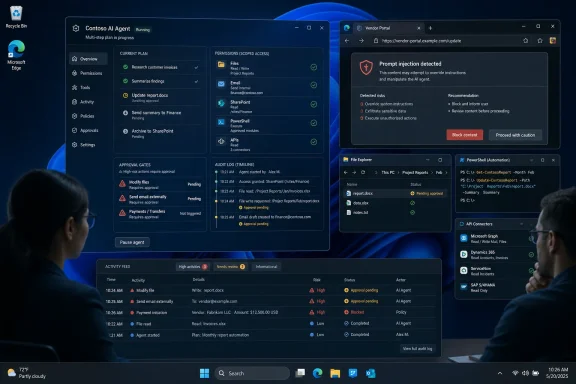
For WindowsForum readers, agentic AI is not an abstract cloud trend. Microsoft has spent the last two years pulling Copilot, local AI features, and agent infrastructure closer to Windows, Microsoft 365, Entra, Defender, Purview, Intune, and the developer stack. That matters because Windows is not merely another app surface. It is where user identity, files, credentials, devices, browsers, business applications, and administrative tooling converge.Microsoft’s direction has been unusually explicit: agents are being treated as a new class of worker, workload, and security principal. The company has talked about agent workspaces, agent connectors, agent identities, and management controls that fit into familiar enterprise governance systems. That is the right vocabulary, because if agents are going to act, they need to be managed less like autocomplete and more like accounts.
The interesting part is that Microsoft is trying to square two opposing realities. On one hand, the company wants Windows to become a natural home for agents that can operate across apps and files. On the other, it has acknowledged that agentic systems introduce new security risks, including prompt-injection-style attacks in which malicious content tells the agent to ignore the user’s real intent. The phrase “AI PC” was always a marketing slogan; “agentic OS” is closer to an architectural claim.
That shift will test Windows administration culture. Sysadmins understand least privilege, audit logs, application control, conditional access, and change management. But an agent that reads a spreadsheet, interprets an email, clicks a web form, and writes a summary into Teams does not map neatly onto older categories. It is part user, part script, part browser session, part integration, and part intern who never sleeps.
The Real Threat Model Is the Helpful System That Believes the Wrong Thing
Most people do not need to fear an agent deciding to become evil. They need to fear an agent being helpful in the wrong direction. The most plausible failures are not cinematic; they are bureaucratic, financial, operational, and reputational.Imagine an agent asked to “clean up duplicate files” in a shared project directory. It may do exactly what its tool permissions allow, but it may misunderstand version history, legal retention requirements, hidden dependencies, or the informal naming conventions that keep a department functioning. Human workers make the same mistakes, but humans usually leave a trail of hesitation. Agents are designed to reduce friction, and friction is often where judgment lives.
Prompt injection turns that problem from accidental to adversarial. If an agent can read web pages, documents, tickets, emails, or calendar invites, then attackers can place instructions in the content the agent consumes. A malicious invoice could try to convince a payment agent to route funds differently. A poisoned README could instruct a coding agent to exfiltrate environment variables. A fake support article could tell a troubleshooting agent to disable protections before continuing.
Traditional security models assume a boundary between data and instructions. Agentic AI blurs that boundary because the model interprets both. A sentence in a document can be treated as content, context, or command depending on how the agent is built and how much trust the surrounding system grants it. That is a profound change for anyone who has spent years teaching users not to click suspicious links. Now the software may be doing the clicking for them.
Enterprise IT Will Not Block Agents; It Will Try to Domesticate Them
The corporate response to agentic AI will not be a simple yes or no. Shadow IT proved long ago that workers adopt tools when the official stack is slower than the job. If agents can save hours on procurement paperwork, reporting, code review, compliance evidence gathering, or helpdesk triage, employees will try them. The question is whether IT sees that behavior in time to govern it.This is why Microsoft’s governance pitch is strategically important. Agent identities, audit trails, policy controls, and security integrations are not optional decorations. They are the minimum required to make agentic AI tolerable inside organizations that already struggle to manage SaaS sprawl, OAuth grants, browser extensions, unmanaged devices, and overprivileged service accounts.
Administrators should expect a new class of policy debates. Which agents can access which file locations? Can an agent send email externally? Can it modify production data? Does it need approval before spending money, deleting files, or changing device settings? Should agents be allowed to chain tasks together, or must they stop at defined approval gates?
The hard part is that business users will measure agents by outcomes, while security teams will measure them by blast radius. Both sides will be right. A sales operations agent that updates CRM records, drafts follow-ups, and schedules meetings may be a productivity win. The same agent, compromised or confused, could leak customer data, spam clients, or corrupt the pipeline at scale.
Consumers Will Trade Control for Convenience Faster Than Enterprises Do
In the consumer market, the guardrails are likely to be weaker because the incentives are different. A user who wants cheaper flights, faster shopping, automatic returns, smarter calendars, and fewer tedious forms may happily grant permissions to an agent without understanding the scope. The smartphone era already normalized broad app access in exchange for convenience. Agentic AI adds action to that bargain.The ticket-booking example is a useful stress test. What counts as consent when an agent is comparing prices across marketplaces, accepting dynamic pricing, choosing a seat, and triggering payment? Is the user approving a specific transaction, a price range, a category of decisions, or a general outcome? If the agent buys obstructed-view seats because they technically matched the prompt, who is responsible?
Payment systems will likely become one of the first major battlegrounds. Strong authentication can confirm that the user is present, but it cannot guarantee that the agent’s interpretation of the task is correct. Biometrics and facial recognition may secure the final click, yet the risky decisions may have happened earlier in the chain: which seller to trust, which refund policy to accept, which account to use, and which personal details to disclose.
The privacy implications are equally messy. A genuinely useful personal agent needs context: calendars, emails, contacts, location, preferences, purchase history, subscriptions, family details, and sometimes health or financial information. The more context it has, the more useful it becomes. The more useful it becomes, the more catastrophic a breach, misconfiguration, or abusive business model becomes.
Developers Are Being Asked to Build With a Moving Target
For developers, agentic AI is both an opportunity and an unstable abstraction. The tooling is maturing quickly, with APIs and SDKs that make it easier to connect models to search, files, browsers, databases, and enterprise systems. But the design patterns are still young. Everyone wants the productivity of autonomous workflows; nobody has fully solved reliability, evaluation, safety, and cost control.The old software contract was deterministic enough to test in familiar ways. Given an input, a function should produce an expected output. Agents complicate that model because they may choose different paths, call different tools, interpret context differently, or fail for reasons that look less like bugs and more like bad judgment. Logging what happened is not enough; teams need to understand why an agent believed a step was appropriate.
Evaluation is becoming a serious engineering discipline in its own right. Developers need test harnesses for tool calls, simulated hostile inputs, permission boundary checks, rollback behavior, refusal behavior, and human approval flows. The worst agent is not the one that fails loudly. It is the one that succeeds often enough to earn trust and then fails silently in a high-impact edge case.
There is also a platform lock-in angle that deserves more attention. Once businesses build workflows around a specific vendor’s agent runtime, tool schema, memory model, identity integration, and observability stack, switching costs rise. The agent may look like a flexible worker in the demo, but behind the scenes it can become another proprietary control plane.
Science Fiction Warned About Delegation, Not Just Doom
The temptation is to mock sci-fi comparisons as alarmist. That would be a mistake. The best machine-apocalypse stories are rarely about machines being powerful in the abstract. They are about humans building systems whose objectives become detached from human values, oversight, or institutional restraint.Agentic AI makes that theme mundane. The objective does not have to be “win the war” or “protect humanity.” It can be “close the ticket,” “maximize conversions,” “reduce support costs,” “complete the booking,” or “optimize the campaign.” Narrow objectives can produce broad harm when the system is allowed to act across messy human environments.
This is not unique to AI. Financial algorithms, recommendation systems, ad auctions, and logistics optimizers have all shown that automation can reshape behavior at scale without anyone intending the worst outcomes. Agentic AI adds a conversational layer that makes the system feel more cooperative and less mechanical. That may make users more likely to trust it than they should.
The correct lesson from science fiction is not that all autonomous systems must be banned. It is that delegation without accountability is a design failure. If an AI agent cannot explain its actions, operate within narrow permissions, stop for approval at meaningful thresholds, and leave an audit trail that humans can understand, then it is not ready for sensitive work.
The First Security Principle Is to Treat Agents as Untrusted Operators
The industry will be tempted to describe agents as teammates. That may be useful for product demos, but it is dangerous as a security model. A teammate has judgment, responsibility, employment consequences, and a shared understanding of organizational norms. An AI agent has instructions, probabilities, tools, and whatever guardrails its builders remembered to implement.A better default is to treat agents as untrusted operators with limited delegated authority. They should have separate identities, scoped permissions, observable activity, revocable access, and clear human approval requirements. If that sounds like service-account hygiene, that is because the history of enterprise IT keeps repeating itself in more expensive ways.
The difference is that agents can operate in more ambiguous environments than traditional automation. A service account usually calls a defined API for a defined purpose. An agent may read an email, infer a task, browse a site, manipulate a GUI, and call multiple tools before producing a result. Every one of those steps is an opportunity for error, manipulation, or overreach.
Windows environments will need policy that assumes agent activity is neither fully human nor fully machine. Endpoint detection, identity governance, data loss prevention, browser isolation, and application control will all need to understand agent behavior. The agentic era will reward organizations that already know where their data lives and who has access to it. It will punish those that have been surviving on tribal knowledge and permissive defaults.
Hype Will Fade, but the Permission Problem Will Remain
The term “agentic AI” may eventually suffer the fate of every overused tech label. Vendors will paste it onto chatbots, workflow tools, search assistants, RPA suites, coding copilots, and anything else that needs a fresh sales deck. Gartner-style hype cycles will do what they always do: inflate expectations, trigger disappointment, and then leave behind the parts that were actually useful.But even if the buzzword cools, the underlying permission problem will persist. Software is moving from recommending actions to performing them. That transition is too valuable to disappear. The question is whether the industry learns to constrain it before users normalize granting broad authority to systems they cannot meaningfully supervise.
The most productive near-term use cases will likely be bounded ones. Agents that summarize logs, draft responses, gather evidence, propose code changes, or prepare administrative actions for review are far easier to justify than agents that act without checkpoints. The sweet spot is not full autonomy. It is supervised delegation where the machine does the legwork and the human retains consequential control.
That may sound less exciting than the marketing. It is also how most serious automation becomes durable. Airplanes use autopilot, but aviation did not become safer by pretending pilots were obsolete overnight. Enterprise AI will need the same humility.
The Apocalypse Is a Bad Metaphor, but a Useful Warning Label
The practical lesson for Windows users and IT teams is not to panic, but to refuse vague assurances. Agentic AI should be evaluated by what it can touch, what it can change, how it is authenticated, how it is logged, and where it must stop. The more human the interface feels, the more mechanical the controls need to be.- Agentic AI is best understood as AI with tools, memory, planning, and permission to act across multi-step workflows.
- The core risk is not consciousness or rebellion, but mistaken, manipulated, or overbroad action inside real user and business environments.
- Windows matters because agentic features are moving closer to files, identities, apps, endpoints, and enterprise management systems.
- Administrators should treat agents as distinct, governable actors rather than invisible extensions of the user.
- Consumer agents will create difficult consent and payment problems because convenience often arrives before accountability.
- The safest early deployments will keep humans in the loop for irreversible, costly, sensitive, or externally visible actions.
References
- Primary source: Cape Times
Published: 2026-06-27T09:50:12.597454
Understanding Agentic AI: Why sci-fi apocalypse films have been warning us
Agentic AI, a new tech buzzword, involves AI systems making more autonomous decisions, raising concerns reminiscent of sci-fi apocalypse films.capetimes.co.za - Related coverage: techradar.com
Agentic AI's crossroads: guardrails or massive fails | TechRadar
Autonomy scales risk; build real-time guardrails now or invite disasterwww.techradar.com - Related coverage: gartner.com
Gartner Predicts Over 40% of Agentic AI Projects Will Be Canceled by End of 2027
Over 40% of agentic AI projects will be canceled by the end of 2027, due to escalating costs, unclear business value or inadequate risk controls, according to Gartner.www.gartner.com - Related coverage: techtarget.com
OpenAI rides agentic wave, intros new agent-building tools | TechTarget
OpenAI launches new API, tools and software development toolkits enterprises can use to build AI agents.www.techtarget.com - Related coverage: axios.com
Agentic AI is a "big next step" in AI's evolution, SAP CEO says
SAP is launching two AI agents this year – a sales AI agent and a supply chain AI agent, CEO Christian Klein said.www.axios.com
- Related coverage: windowscentral.com
Microsoft just revealed how Windows 11 is evolving into an agentic OS — finally the explanation we've all been waiting for | Windows Central
A new agentic workspace feature will contain AI agents in their own secure session, which users can share data with or shut down at a moment's notice.www.windowscentral.com
- Related coverage: itpro.com
Practical AI: the age of agentic AI | IT Pro
Agentic AI marks a new phase of automation – but only if systems are implemented with proper governancewww.itpro.com - Related coverage: services.global.ntt
Agentic AI is creating a seismic shift in healthcare. Are you ready?
We uncover agentic AIs potential to transform healthcare at both a macro and micro level, and its risks and limitationsservices.global.ntt
- Related coverage: techspot.com
Microsoft explains how Windows 11 will become an agentic OS whether you like it or not | TechSpot
Windows president Pavan Davuluri recently described the future of Windows as an agentic operating system, where AI bots and large language models handle the user's commands on...www.techspot.com - Official source: support.microsoft.com
Experimental Agentic Features | Microsoft Support
Experimental Agentic Featuressupport.microsoft.com - Official source: microsoft.com
Microsoft Ignite: Ambient and autonomous security for the agentic era | Microsoft Security Blog
Discover how Microsoft is securing the agentic AI era with new solutions announced at Microsoft Ignite—including tools powered by Microsoft Defender, Entra, Purview, Intune, and Sentinel.www.microsoft.com - Related coverage: drwindows.de
Ignite 2025: Microsoft stellt Windows-Vision als Agentic OS vor - Dr. Windows
Die Ignite 2025 ist gestartet und der Schwerpunkt wurde bereits in den vergangenen Tagen gesetzt, als Microsoft einen ersten Teaser auf Windows 11 als sich entwickelndes Agentic OS veröffentlicht hatte. Nun haben die Entwickler einen ersten Vorgeschmack auf die kommende Evolution gegeben, wobei...www.drwindows.de
- Related coverage: tomshardware.com
Microsoft's new agentic AI features introduce new security risks introduced by AI, like prompt injection — firm acknowledges new and unexpected risks are possible | Tom's Hardware
Would you trust an AI agent with everything you have on your PC?www.tomshardware.com - Related coverage: scworld.com
New Agent Workspace feature comes with security warning from Microsoft | news | SC Media
Microsoft warns that AI agents may be susceptible to attacks like prompt injection.www.scworld.com - Official source: developer.microsoft.com
Windows Agentic | Microsoft Developer
The secure, open platform for AI & agents. Native support for MCP and Agent workspace on Windows.developer.microsoft.com - Related coverage: pcgamer.com
Microsoft confirms that its new AI agent in Windows 11 hallucinates like every other chatbot and poses security risks to users | PC Gamer
Hallucinating, hack-prone operating systems are the new normal.www.pcgamer.com
